
Terms and brackets in expressions
Answer in short
Terms are the parts of an expression joined by + signs, after each subtraction is written as adding the inverse: 23 − 2 × 4 + 16 has the terms 23, −2 × 4 and 16. Terms can be added in any order. A minus sign before brackets flips every sign inside them when they are removed.
Stuck on a question? Take a photo and Lagnever AI explains it step by step. Try it for 7 days for ₹2. Get it on Google Play
What is a term?
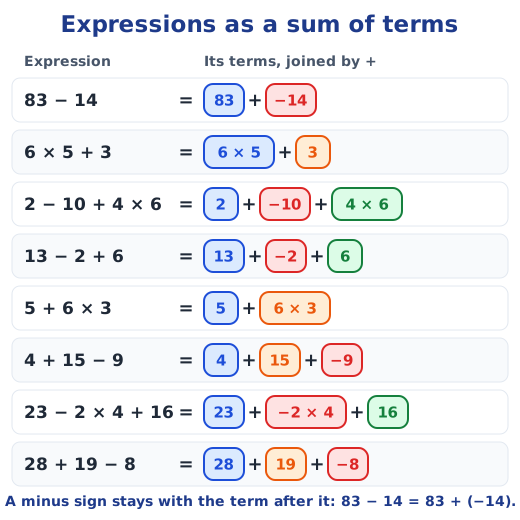
Terms are the parts of an expression that are joined by + signs. For 12 + 7, the two terms are 12 and 7. To find the terms of an expression with subtraction, first rewrite each subtraction as adding the inverse, the same number with the opposite sign. So 83 − 14 = 83 + (−14), with the terms 83 and −14, and −18 − 3 has the terms −18 and −3.
Multiplication and division stay inside a term. In 6 × 5 + 3 the terms are 6 × 5 and 3, and in 2 − 10 + 4 × 6 they are 2, −10 and 4 × 6. The minus sign always travels with the term after it.
Subtracting is adding the inverse
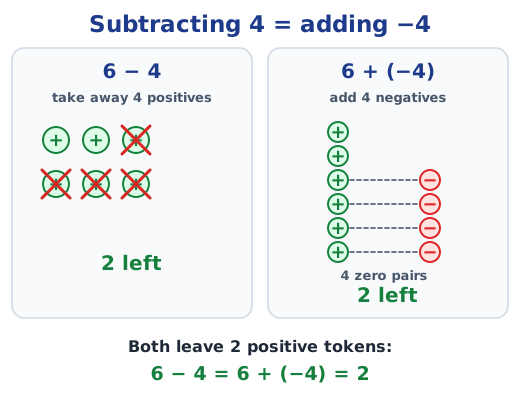
Why is 6 − 4 the same as 6 + (−4)? The token model of integers from Class 6 shows it. For 6 − 4, take 4 positive tokens away from 6, leaving 2. For 6 + (−4), put 4 negative tokens next to the 6 positive ones; each negative token cancels a positive one to make a zero pair, and again 2 positive tokens are left. Try other pairs, such as 18 − 10 and 18 + (−10): both are 8.
Swap and group the terms
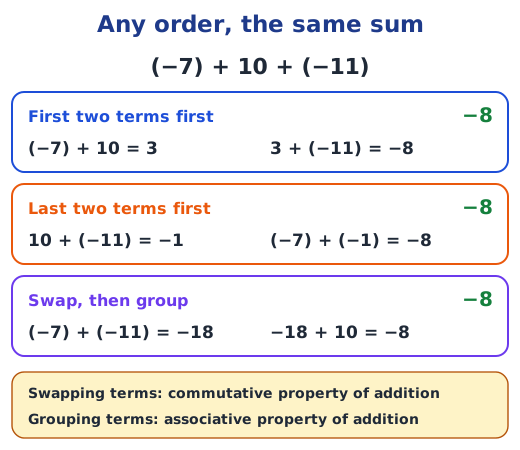
Madhu’s drone rises 6 m and then drops 4 m: 6 + (−4) = 2 m above the terrace. Swapping the terms, (−4) + 6, gives 2 as well. With three terms, (−7) + 10 + (−11), add the first two and then the third, or the last two and then the first, or the two negative terms first: every way gives −8. So when an expression has only additions, the terms may be added in any order. Swapping is called the commutative property of addition, and grouping is the associative property.
This saves work. Manasa took five minutes to add 1342, 774, 8611 and 1022 and got 11749, then saw she had missed 9055, the fourth number. She need not start again: 11749 + 9055 = 20804. Order does matter in some everyday tasks, though: Manasa can put on her hat and shoes in either order, but socks must go on before shoes.
Removing brackets
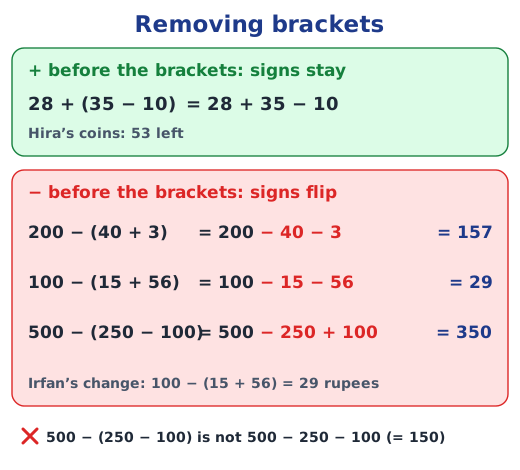
Sometimes it is easier to work without brackets. 200 − (40 + 3) means taking 43 away from 200, but you can take away 40 and then 3: 200 − 40 − 3 = 157. Irfan’s change works the same way: 100 − (15 + 56) = 100 − 15 − 56 = 29. In both, the + inside the brackets became −.
Now 500 − (250 − 100). If you take away 250, you have taken 100 more than needed, so add it back: 500 − 250 + 100 = 350. Here the − inside became +. So when a minus sign comes before the brackets, every term inside changes its sign. When a plus sign comes before them, nothing changes: Hira keeps 28 coins in one bag and 35 in another and gives away 10 from the second, so she has 28 + (35 − 10) = 28 + 35 − 10 = 53 coins. Thinking about what the expression means is better than learning the rule by heart.
Tinker the terms
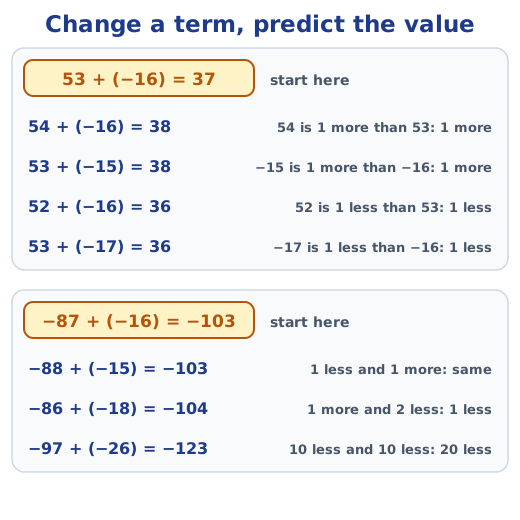
What happens to a value when one term changes? Start from 53 + (−16) = 37. In 54 + (−16) the first term is 1 more, so the value is 1 more, 38. In 53 + (−15) the second term is 1 more, because −15 is 1 more than −16, so the value is again 38. In the same way 52 + (−16) and 53 + (−17) are both 36. Changes can cancel too: −88 + (−15) has one term 1 less and the other 1 more than in −87 + (−16), so both are −103.
Jasoda’s shortcut
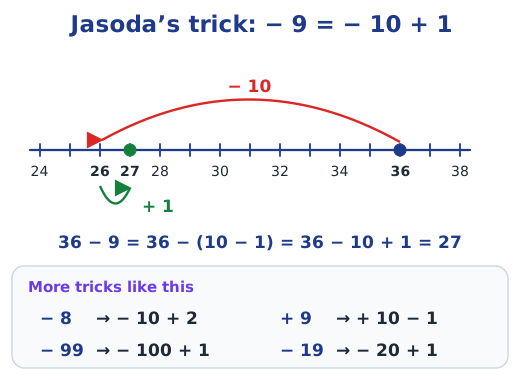
Whenever Jasoda has to subtract 9, she subtracts 10 and adds 1: 36 − 9 = 26 + 1 = 27. It always works, because 36 − 9 = 36 − (10 − 1) = 36 − 10 + 1. The same idea gives more shortcuts: subtract 8 by subtracting 10 and adding 2, and add 9 by adding 10 and subtracting 1.
Why it matters
Seeing an expression as a sum of terms lets you add in a convenient order, remove brackets without mistakes and predict how a change affects an answer. The order of working is explained in reading and evaluating expressions, and multiplying a sum in the distributive property. Worked answers to every textbook question are in the NCERT solutions for Chapter 2; see all of the Chapter 2 notes.
Practice
-
What are the terms of 39 − 2 × 6 + 11?
Show answer
Answer: (b) 39, −2 × 6 and 11
-
Which expression is equal to 14 − (12 − 10)?
Show answer
Answer: (c) 14 − 12 + 10
-
53 + (−16) = 37. What is 53 + (−17)?
Show answer
Answer: (d) 36
-
Remove the brackets and find the value: 14 − (−12 − 10).
Show answer
Answer: A minus sign comes before the brackets, so both signs inside flip: 14 − (−12 − 10) = 14 + 12 + 10 = 36.
-
Manasa added a long list of numbers and got 11749, then noticed she had missed 9055. Does she have to start again?
Show answer
Answer: No. Terms can be added in any order and grouped in any way, so she can simply add the missing number to her total: 11749 + 9055 = 20804.
Questions students ask
What is a term in an arithmetic expression?
A part of the expression joined to the others by a + sign. First rewrite each subtraction as adding the inverse: 4 + 15 − 9 = 4 + 15 + (−9), so its terms are 4, 15 and −9. A product such as 6 × 5 or a quotient such as 16 ÷ 2 has no + sign inside it, so it is a single term.
Why does a minus sign before brackets change the signs inside?
Because the whole bracket is being taken away. In 200 − (40 + 3) both 40 and 3 must be subtracted, so it equals 200 − 40 − 3. In 500 − (250 − 100), taking away all of 250 removes 100 too many, so 100 is added back: 500 − 250 + 100 = 350.
What are the commutative and associative properties of addition?
Names for two facts about adding. Commutative: swapping two terms keeps the sum, as in 6 + (−4) = (−4) + 6. Associative: grouping three terms either way keeps the sum, as in ((−7) + 10) + (−11) = (−7) + (10 + (−11)) = −8. Together they mean the terms may be added in any order.
Stuck on a question?
Take a photo and Lagnever AI explains it step by step. Try it for 7 days for ₹2.
Get it on Google Play Open in browser
For parents: after the trial, the plan renews monthly by UPI or card autopay. You can cancel anytime in the app.