
The distributive property: multiplying a sum
Answer in short
The distributive property says that a multiple of a sum or difference equals the sum or difference of the multiples: 2 × (43 + 24) = 2 × 43 + 2 × 24. It shows why brackets matter and gives quick products, such as 97 × 25 = 100 × 25 − 3 × 25 = 2425.
Stuck on a question? Take a photo and Lagnever AI explains it step by step. Try it for 7 days for ₹2. Get it on Google Play
Paying for two
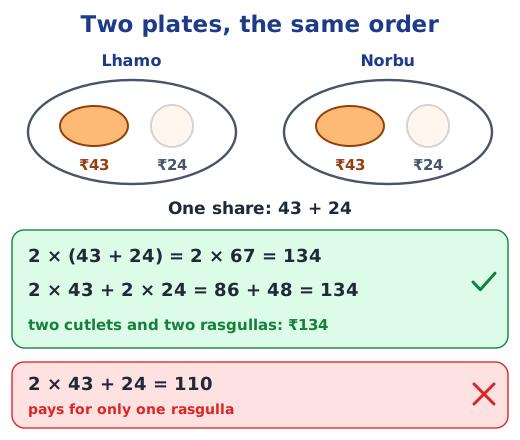
Lhamo and Norbu go to a hotel, and each orders a vegetable cutlet for ₹43 and a rasgulla for ₹24. Each share is 43 + 24. Could the total be 2 × 43 + 24? Written as terms, that is 2 × 43 plus 24, which pays for two cutlets but only one rasgulla. We want twice the whole share, and brackets say exactly that: 2 × (43 + 24) = 2 × 67 = 134 rupees.
Paying for two shares is the same as paying for two cutlets and two rasgullas, so 2 × (43 + 24) = 2 × 43 + 2 × 24 = 86 + 48 = 134. If their friend Sangmu joins with the same order, the bill becomes 3 × (43 + 24) = 201 rupees.
Rows of scouts and guides
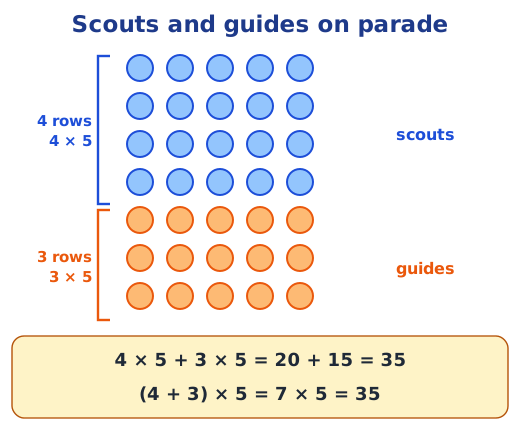
In a Republic Day parade, boy scouts march in 4 rows of 5 and girl guides in 3 rows of 5. Counting each group gives 4 × 5 + 3 × 5 = 20 + 15 = 35. Counting the rows first gives 4 + 3 = 7 rows of 5, so (4 + 3) × 5 = 35. Both counts must agree, so 4 × 5 + 3 × 5 = (4 + 3) × 5.
Brackets change the meaning here too: 5 × 4 + 3 is 23, but 5 × (4 + 3) is 35. And since swapping does not change a sum or a product, 5 × (4 + 3) = 5 × (3 + 4) = (3 + 4) × 5.
The rule in general
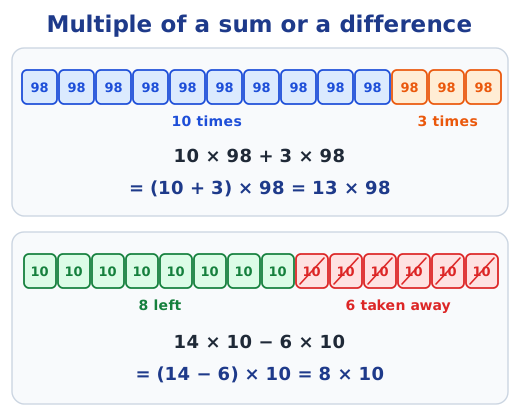
Think of 10 × 98 + 3 × 98 as ten 98s followed by three more 98s. That is thirteen 98s, so 10 × 98 + 3 × 98 = (10 + 3) × 98. Differences work the same way: fourteen 10s with six of them taken away leave eight 10s, so 14 × 10 − 6 × 10 = (14 − 6) × 10. In words, the multiple of a sum (or difference) is the sum (or difference) of the multiples. The chapter’s summary calls this the distributive property: multiplying a number by a bracket is the same as multiplying it by each term inside.
Extra: you can also picture 5 × (4 + 3) as a rectangle of 5 rows and 7 columns of dots. A line after the 4th column splits it into a 5 × 4 block and a 5 × 3 block, so the total is 20 + 15 = 35.
Quick products
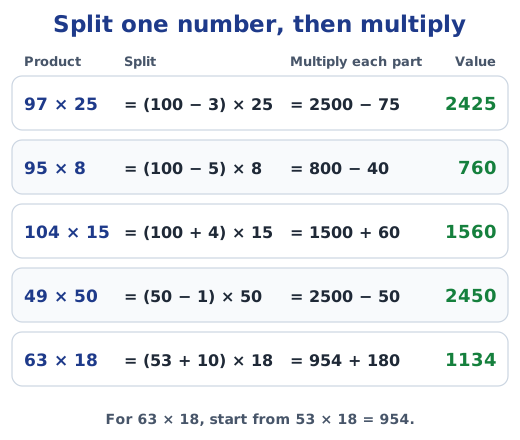
The property lets you change a product you know into one you need. Given 53 × 18 = 954, find 63 × 18: since 63 = 53 + 10, 63 × 18 = 53 × 18 + 10 × 18 = 954 + 180 = 1134. It also turns hard products into easy ones. Write 97 as 100 − 3: 97 × 25 = 100 × 25 − 3 × 25 = 2500 − 75 = 2425. Likewise 95 × 8 = 800 − 40 = 760, 104 × 15 = 1500 + 60 = 1560 and 49 × 50 = 2500 − 50 = 2450. This is often quicker than long multiplication, especially when one number is near a multiple of 10, 50, 100 or 1000, as in 98 × 7 or 103 × 9.
Adding numbers in a picture
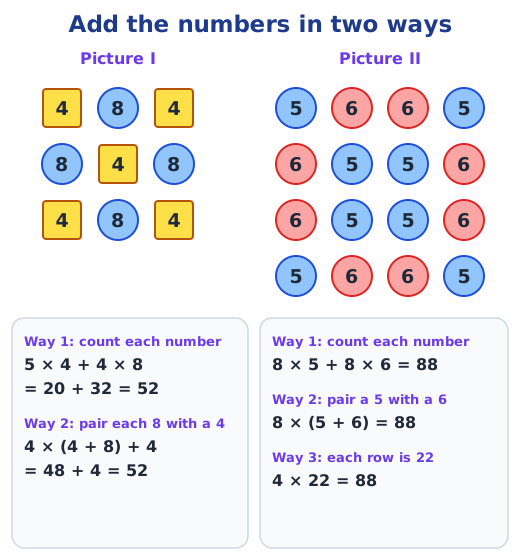
The property helps with sums too. A 3 by 3 grid has five 4s and four 8s: 5 × 4 + 4 × 8 = 52. Pairing each 8 with a 4 gives 4 × (4 + 8) + 4 = 52 as well. A 4 by 4 grid has eight 5s and eight 6s, so its sum is 8 × 5 + 8 × 6 = 8 × (5 + 6) = 88, and since every row adds to 22, it is also 4 × 22.
Why it matters
The distributive property is behind mental multiplication, quick bills and, later, algebra. It works together with the ideas in reading and evaluating expressions and terms and brackets. Worked answers to every textbook question are in the NCERT solutions for Chapter 2; see all of the Chapter 2 notes.
Practice
-
Which expression is equal to (9 + 2) × 4?
Show answer
Answer: (b) 9 × 4 + 2 × 4
-
What is 104 × 15? Use (100 + 4) × 15.
Show answer
Answer: (c) 1560
-
Given 53 × 18 = 954, what is 63 × 18?
Show answer
Answer: (b) 1134
-
Find 49 × 50 the quick way.
Show answer
Answer: 49 × 50 = (50 − 1) × 50 = 50 × 50 − 1 × 50 = 2500 − 50 = 2450.
-
Fill in the blank: 5 × (12 − 3) = 5 × 12 − 5 × ___.
Show answer
Answer: 3. The 5 multiplies both numbers in the brackets: 5 × 12 − 5 × 3 = 60 − 15 = 45, which matches 5 × 9 = 45.
Questions students ask
What is the distributive property in Class 7 Maths?
It is the rule that multiplying a sum or difference gives the same answer as multiplying each part and then adding or subtracting: 4 × 5 + 3 × 5 = (4 + 3) × 5 = 35. The chapter shows it with Lhamo and Norbu’s hotel bill and with rows of scouts and guides, and names it the distributive property in its summary.
Why is 5 × 4 + 3 not equal to 5 × (4 + 3)?
In 5 × 4 + 3, only the 4 is multiplied by 5, and then 3 is added: 20 + 3 = 23. In 5 × (4 + 3), the whole sum 7 is multiplied by 5, giving 35. The second expression equals 5 × 4 + 5 × 3, so it has 5 × 3 = 15 where the first has only 3.
How does the distributive property make multiplication quicker?
Split one number into a round number plus or minus a small one, multiply each part and combine. 97 × 25 = (100 − 3) × 25 = 2500 − 75 = 2425, and 104 × 15 = (100 + 4) × 15 = 1500 + 60 = 1560. It helps most when one number is near a round number such as 100.
Stuck on a question?
Take a photo and Lagnever AI explains it step by step. Try it for 7 days for ₹2.
Get it on Google Play Open in browser
For parents: after the trial, the plan renews monthly by UPI or card autopay. You can cancel anytime in the app.