
Reading and evaluating arithmetic expressions
Answer in short
To evaluate an expression, first work out anything inside brackets, then find the value of each term, a part joined by a + sign that may contain × or ÷, and finally add the terms. So 30 + 5 × 4 = 30 + 20 = 50. Expressions can often be compared by reasoning, without finding their values.
Stuck on a question? Take a photo and Lagnever AI explains it step by step. Try it for 7 days for ₹2. Get it on Google Play
Expressions and their values
Phrases such as 18 ÷ 3, 13 + 2, 12 × 5 and 20 − 4 are arithmetic expressions. Each one has a value, the number it works out to, and we join them with an equals sign: 13 + 2 = 15. Say 13 + 2 aloud as “13 plus 2”, or call it the sum of 13 and 2; 5 × 25 is “5 times 25”, which is the product of 5 and 25.
Many expressions share a value. Pick a favourite number, say 24, and write it many ways: 12 + 12, 30 − 6, 4 × 6, 48 ÷ 2. Expressions that describe real situations are just as useful: Mallika spends ₹25 on lunch each school day, so her lunches from Monday to Friday cost 5 × 25 rupees.
Comparing without calculating
We compare numbers with =, < and >, and expressions are compared by their values in the same way: 10 + 2 > 7 + 1, because 12 is more than 8. But there is often a quicker way than finding both values.
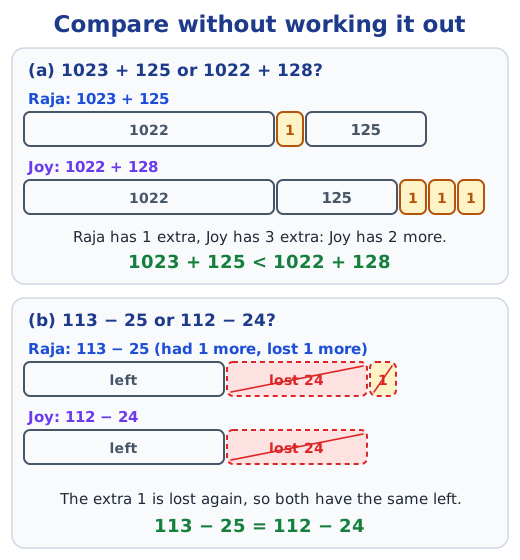
Compare 1023 + 125 with 1022 + 128. Think of Raja, who has 1023 marbles and gets 125 more, and Joy, who has 1022 and gets 128 more. Raja starts 1 ahead, but Joy gets 3 more today, so Joy ends 2 ahead: 1023 + 125 < 1022 + 128. Now try 113 − 25 and 112 − 24. Raja has 1 marble more, but he also loses 1 more, so they are left with the same number: 113 − 25 = 112 − 24.
One expression, two readings
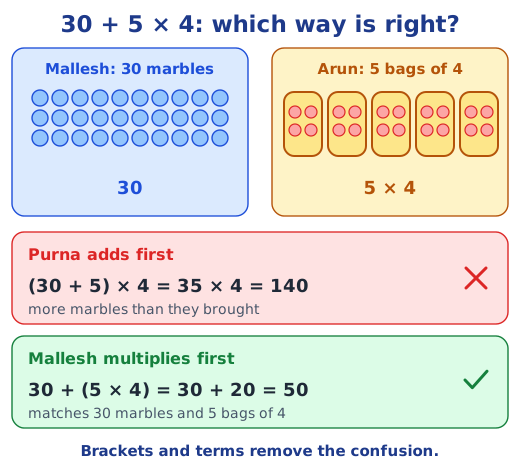
In the chapter’s example sentence about Shalini sitting next to a friend with toys, it is unclear who has the toys until a comma is added. Expressions can be unclear in the same way. Mallesh brought 30 marbles and Arun brought 5 bags with 4 marbles each, so Mallesh wrote 30 + 5 × 4. Purna, who did not know the story, added first: 30 + 5 = 35, then 35 × 4 = 140. Mallesh multiplied first: 5 × 4 = 20, then 30 + 20 = 50. Mallesh is right, but the expression alone does not say why. Mathematics uses two tools to fix this: brackets and terms.
Brackets come first
Whatever is inside brackets is worked out before anything else, so 30 + (5 × 4) = 30 + 20 = 50. Brackets matter in money problems too. Irfan buys biscuits for ₹15 and toor dal for ₹56 and pays with a ₹100 note. His change is 100 − (15 + 56) = 100 − 71 = 29 rupees. Without the brackets, 100 − 15 + 56 would give 141, more than he handed over, which makes no sense.
Terms decide the rest
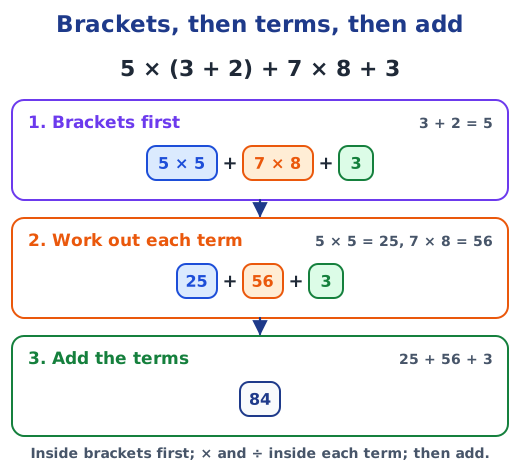
When brackets do not say what comes first, terms do. Terms are the parts of an expression joined by + signs; a subtraction is written as adding the inverse, so 30 − 4 becomes 30 + (−4). A product or a quotient is a single term. To evaluate any expression: work out the brackets, work out each term, then add the terms. For example, 5 × (3 + 2) + 7 × 8 + 3 has the terms 5 × (3 + 2), 7 × 8 and 3, worth 25, 56 and 3, so the value is 84.
Writing expressions for situations
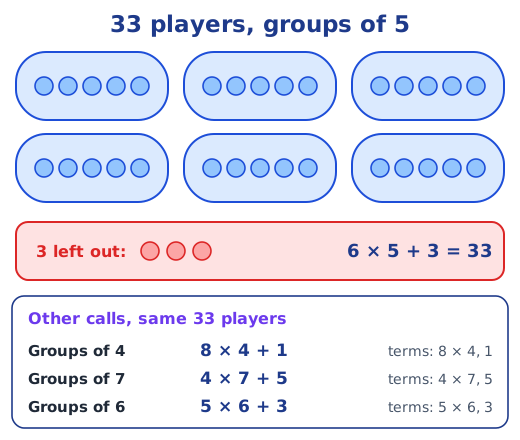
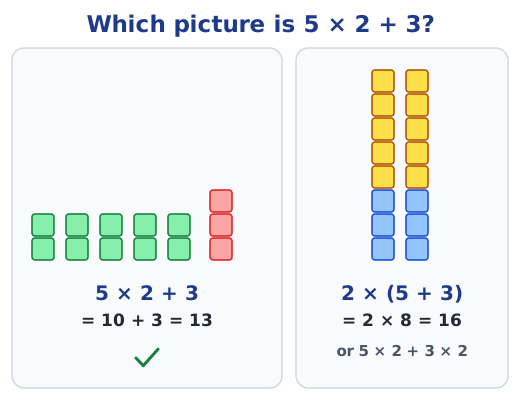
Four friends order dosas at ₹23 each and add a ₹5 tip: 4 × 23 + 5 = 92 + 5 = 97 rupees, with the terms 4 × 23 and 5. In a game, 33 players form groups of 5 when the teacher calls 5: six groups and 3 players out, so Ruby writes 6 × 5 + 3. Raghu packs 100 kg of rice into 2 kg packets and already has 4 packets, so he has 4 + 100 ÷ 2 packets. Pictures can be read the same way: five columns of 2 squares and one column of 3 make 5 × 2 + 3 = 13, but two columns of 5 + 3 squares make 2 × (5 + 3) = 16.
Why it matters
Reading an expression the same way as everyone else is what lets bills, recipes and spreadsheets give one right answer. Learn more about terms, swapping and removing brackets in terms and brackets, and about multiplying a sum in the distributive property. Worked answers to every textbook question are in the NCERT solutions for Chapter 2; see all of the Chapter 2 notes.
Practice
-
What is the value of 48 − 10 × 2 + 16 ÷ 2?
Show answer
Answer: (b) 36
-
Seven friends share dosas at ₹23 each and leave a ₹5 tip. Which expression gives the total?
Show answer
Answer: (b) 7 × 23 + 5
-
Which is greater: 245 + 289 or 246 + 285?
Show answer
Answer: (a) 245 + 289
-
A class of 33 players makes groups of 4 in the game. What expression describes it, and what are its terms?
Show answer
Answer: 8 groups of 4 use 32 players and 1 is left out, so the expression is 8 × 4 + 1. Its terms are 8 × 4 and 1, and its value is 33.
-
Without working out the values, compare 113 − 25 and 112 − 24.
Show answer
Answer: They are equal. 113 is 1 more than 112, and 25 is 1 more than 24, so the extra 1 is taken away again: 113 − 25 = 112 − 24.
Questions students ask
What is an arithmetic expression?
A mathematical phrase made of numbers and operation signs, such as 20 − 4, 13 + 2, 18 ÷ 3 or 12 × 5. Every expression has a value, the number it works out to, and an equals sign joins them: 13 + 2 = 15. Different expressions can have the same value: 10 + 2, 15 − 3, 3 × 4 and 24 ÷ 2 are all 12.
In what order should I work out an expression?
Work out anything inside brackets first. Then split the expression into terms, the parts joined by + signs once every subtraction is written as adding the inverse. Find the value of each term, which may involve × and ÷, and add the terms. For 5 × (3 + 2) + 7 × 8 + 3 this gives 25 + 56 + 3 = 84.
How can I compare two expressions without working them out?
Look at how their parts differ. In 1023 + 125 and 1022 + 128, the first starts 1 higher but adds 3 less, so it is 2 smaller. In 113 − 25 and 112 − 24, the first starts 1 higher and also takes away 1 more, so they are equal. Imagining marbles being gained or lost helps.
Stuck on a question?
Take a photo and Lagnever AI explains it step by step. Try it for 7 days for ₹2.
Get it on Google Play Open in browser
For parents: after the trial, the plan renews monthly by UPI or card autopay. You can cancel anytime in the app.