
NCERT Solutions Class 7 Maths Part 2 Chapter 4: Another Peek Beyond the Point
Answers to every question in Part 2 Chapter 4, Another Peek Beyond the Point, of Ganita Prakash Grade 7 (2026-27): the in-text questions, every Figure it Out, Try This and Math Talk question, and the three Hidato puzzles. The page numbers match the book (pages 67–96). Short notes: Part 2 Chapter 4 notes.
A quick recap of decimals (pages 67–69)
Jonali’s fractions as Pallabi’s decimals. 3/10 = 0.3, 4/100 = 0.04, 67/1000 = 0.067, 457/100 = 4.57, 71/100 = 0.71, 43/100 = 0.43 and 9/100 = 0.09.
Jonali’s spices in kilograms. 1 kg = 1000 g, so cinnamon 50 g = 50/1000 kg = 0.05 kg, cumin 100 g = 100/1000 kg = 0.1 kg, cardamom 25 g = 25/1000 kg = 0.025 kg and pepper 250 g = 250/1000 kg = 0.25 kg.
Write the fractions as sums and as decimals. 254/1000 = 2/10 + 5/100 + 4/1000 = 0.254. 4/1000 = 0.004. 847/10000 = 8/100 + 4/1000 + 7/10000 = 0.0847. 173/100 = 1 + 7/10 + 3/100 = 1.73. 23/1000 = 2/100 + 3/1000 = 0.023.
Math Talk: a rule to divide by 10, 100, 1000 and so on. Put a point after the number and move it left by as many places as the divisor has zeros, adding zeros in front if needed: 123/10 = 12.3, 24/100 = 0.24 and 678/1000 = 0.678.
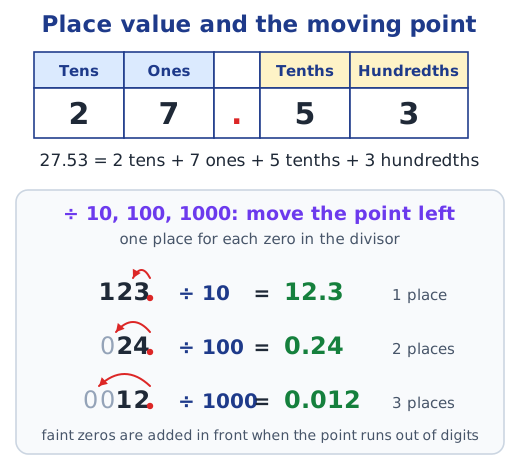
Decimal multiplication (pages 69–72)
What operation must Arshad use for 5 pens at ₹9.5? Multiplication: 9.5 × 5 = 9.5 + 9.5 + 9.5 + 9.5 + 9.5 = ₹47.5.
Can the product of two decimals be a natural number? Yes. For example, 2.5 × 0.4 = 1 and 1.25 × 0.8 = 1.
Can the product of a decimal and a natural number be a natural number? Yes. For example, 0.25 × 4 = 1 and 2.5 × 6 = 15.
Math Talk: compare the decimal places of the multiplier, the multiplicand and the product. In every example the places in the product equal the sum of the places in the two numbers: 9.5 × 5 = 47.5 (1 + 0 = 1), 12.5 × 7.5 = 93.75 (1 + 1 = 2), 1.64 × 6 = 9.84 (2 + 0 = 2) and 5.7 × 13.35 = 76.095 (1 + 2 = 3). The number of zeros in the denominator of the product fraction is that same sum.
Given 596 × 248 = 147808, write 5.96 × 24.8. 5.96 has 2 decimal places and 24.8 has 1, so the product has 3: 147.808.
Frame a rule to multiply two decimals. Multiply the numbers as counting numbers, ignoring the points, then place the point so that the product has as many decimal places as the two numbers have together.
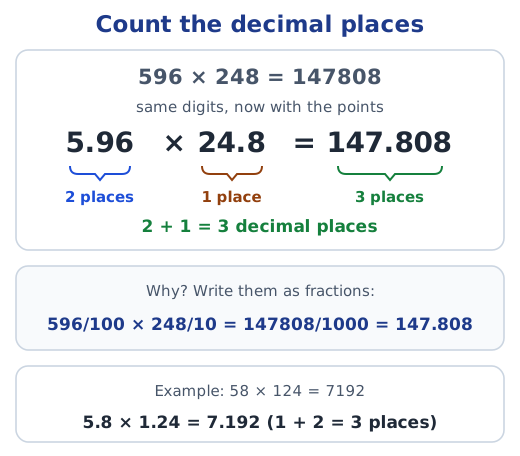
Example 5: verify 5.8 × 1.24 = 7.192 with fractions. 58/10 × 124/100 = 7192/1000 = 7.192.
When is the product greater than both numbers? When is it less than both? It is greater than both when both numbers are more than 1 (3.4 × 6.5 = 22.1). It is less than both when both numbers are between 0 and 1 (0.75 × 0.4 = 0.3). When one is between 0 and 1 and the other is more than 1, the product lies between them (0.75 × 5 = 3.75).
Figure it Out (pages 73–74)
1. Products in tenths and hundredths. (a) 6 × 4 tenths = 24 tenths = 2.4. (b) 7 × 0.3 = 7 × 3 tenths = 21 tenths = 2.1. (c) 9 × 5 hundredths = 45 hundredths = 0.45.
2. Find the products. (a) 27.34 × 6: 2734 × 6 = 16404, so 164.04. (b) 4.23 × 3.7: 423 × 37 = 15651, with 3 places, 15.651. (c) 0.432 × 0.23: 432 × 23 = 9936, with 5 places, 0.09936.
3. Cloth for 3 shirts at 1.65 m each. 1.65 × 3 = 4.95 m.
4. Meenu’s 4 notebooks at ₹15.50 and 3 erasers at ₹2.75. 4 × 15.50 = 62.00 and 3 × 2.75 = 8.25, so she spent ₹70.25.
5. Height of 36 coins, each 1.45 mm thick. 36 × 1.45 = 52.2 mm = 5.22 cm.
6. 2.250 kg of oranges at ₹56.50 per kg. 56.5 × 2.25 = ₹127.125, about ₹127.13. Yes, writing 56.50 as 56.5 and 2.250 as 2.25 gives the same product, because zeros at the end after the point do not change a number’s value: 56.50 = 5650/100 = 565/10 = 56.5.
7. Dwarakanath’s profit on 50 notebooks. Profit on one = 30 − 23.6 = ₹6.4, so on 50 it is 6.4 × 50 = ₹320.
8. Given 18 × 12 = 216. (a) 18 × 1.2 = 21.6. (b) 18 × 0.12 = 2.16. (c) 1.8 × 1.2 = 2.16. (d) 0.18 × 0.12 = 0.0216. (e) 0.018 × 0.012 = 0.000216. (f) 1.8 × 12 = 21.6. The product is less than 1 in (d) and (e).
9. Which products are less than 1, without multiplying? (b) 0.7 × 0.6 and (d) 0.07 × 0.06, because both numbers are between 0 and 1, so the product is smaller than each of them. In (a) and (c), one number is more than 1, and 7 × 0.6 = 0.7 × 6 = 4.2.
10. Multiply by 10, 100 and 1000. The point moves 1, 2 and 3 places right. 5.7: 57, 570, 5700. 23.02: 230.2, 2302, 23020. 0.92: 9.2, 92, 920. 0.306: 3.06, 30.6, 306. 24.67: 246.7, 2467, 24670.
Decimal division (pages 74–76)
Anuja’s ribbon. 3.9 ÷ 10 = 0.39 m and 3.9 ÷ 100 = 0.039 m. What is 0.039 m in centimetres and millimetres? 0.039 × 100 = 3.9 cm, and 0.039 × 1000 = 39 mm.
Complete the division table. Each step moves the point one more place left. 21.1: 2.11, 0.211, 0.0211, 0.00211. 0.13: 0.013, 0.0013, 0.00013, 0.000013. 2.146: 0.2146, 0.02146, 0.002146, 0.0002146. 0.0058: 0.00058, 0.000058, 0.0000058, 0.00000058.
How do we write 1/2 as a decimal? 1/2 = 5/10 = 0.5, so Neenu and Anu each get 14 + 0.5 = 14.5 m. Shared among four, 29/4 = 725/100 = 7.25 m each.
Can 10/3 be written with a denominator of 10, 100, 1000 and so on? No. None of these is a multiple of 3, so no equivalent fraction has such a denominator. That is why we need division by place value.
Division using place value (pages 77–82)
Fill in 1324 ÷ 4. 0 thousands + 3 hundreds + 3 tens + 1 one, so 1324 ÷ 4 = 331.
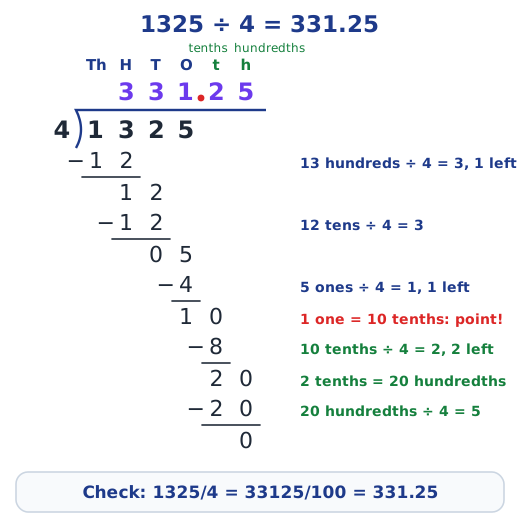
1325 ÷ 4. After 331 there is 1 one left; regroup it as 10 tenths and place the point. 10 tenths ÷ 4 = 2 tenths, 2 left; 20 hundredths ÷ 4 = 5 hundredths. So 1325 ÷ 4 = 331.25. Check with an equivalent fraction: (1325 × 25)/(4 × 25) = 33125/100 = 331.25.
Example 9: 237 ÷ 8 = 29.625. Example 10: 9.5 kg in 4 bags = 2.375 kg each. Example 11: 0.06 ÷ 5 = 0.012.
Figure it Out (page 83)
1. Make the denominator 10, 100 or 1000, then check by long division. (a) 18/5 = 36/10 = 3.6. Long division: 18 ÷ 5 = 3, with 3 left = 30 tenths, ÷ 5 = 6 tenths. (b) 415/4 = 10375/100 = 103.75. Long division: 415 ÷ 4 = 103, with 3 left; 30 tenths ÷ 4 = 7, with 2 left; 20 hundredths ÷ 4 = 5. (c) 1217/2 = 6085/10 = 608.5. Long division: 1217 ÷ 2 = 608, with 1 left = 10 tenths, ÷ 2 = 5. (d) 4827/8 = 603375/1000 = 603.375. Long division: 4827 ÷ 8 = 603, with 3 left; 30 tenths ÷ 8 = 3, with 6 left; 60 hundredths ÷ 8 = 7, with 4 left; 40 thousandths ÷ 8 = 5.
2. Choose the correct answer. (a) 1526/4 = (iii) 381.5. (b) 3567/8 = (iii) 445.875. (In the book, options (i) and (iv) of part (b) are both printed as 4458.75; neither is correct.)
3. Quotients. (a) 132 ÷ 4 = 33. (b) 13.2 ÷ 4 = 3.3. (c) 1.32 ÷ 4 = 0.33. (d) 0.132 ÷ 4 = 0.033.
4. Quotients. (a) 126 ÷ 8 = 15.75. (b) 12.6 ÷ 8 = 1.575. (c) 1.26 ÷ 8 = 0.1575. (d) 0.126 ÷ 8 = 0.01575. (e) 0.0126 ÷ 8 = 0.001575. Each time the dividend is divided by 10, so is the quotient.
Division with a decimal divisor (page 84)
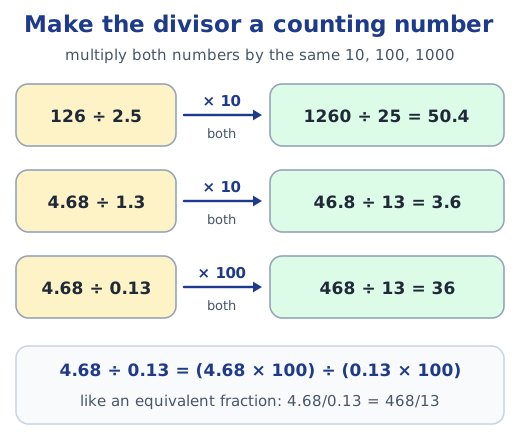
Example 12: Ravi’s average speed. 126 ÷ 2.5 = 1260 ÷ 25 = 50.4 km per hour.
Example 13: 4.68 ÷ 1.3 and 4.68 ÷ 0.13. 4.68 ÷ 1.3 = 46.8 ÷ 13 = 3.6, and 4.68 ÷ 0.13 = 468 ÷ 13 = 36.
What do you notice? Multiplying the divisor and the dividend by the same 10 or 100 turns the divisor into a counting number without changing the quotient. Then ordinary long division works.
Does this ever end? (pages 84–86)
10 ÷ 3 by long division: will the process end? No. Each step leaves a remainder of 1, which becomes 10 of the next smaller unit, and 10 ÷ 3 = 3 with 1 left again. So 10 ÷ 3 = 3.333… for ever.
Find 10 ÷ 9 and 100 ÷ 11. 10 ÷ 9 = 1.111… (the remainder is always 1). 100 ÷ 11 = 9.0909… (the remainders take turns: 1, 10, 1, 10).
1 ÷ 7: will this end? No. The remainders are 1, 3, 2, 6, 4, 5 and then 1 again, so 1 ÷ 7 = 0.142857 142857….
Why does it never end? In dividing by 7, every remainder is less than 7, and here it is never 0, so only 1, 2, 3, 4, 5 and 6 are possible. Within six steps a remainder must repeat, and from then on the same steps, and the same digits, repeat in a cycle.
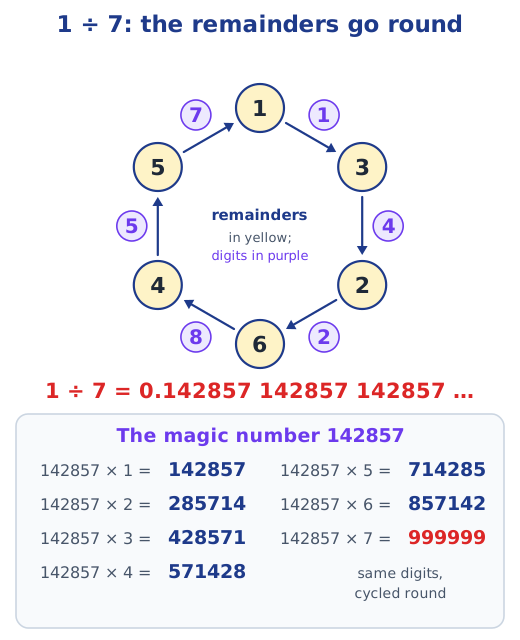
Multiply 142857 by 1 to 6. What do you notice? 142857, 285714, 428571, 571428, 714285, 857142: the same six digits in the same circular order, starting at a different place. Multiply by 7: 142857 × 7 = 999999.
Find another such number from 1 ÷ 17. 1 ÷ 17 = 0.0588235294117647 0588…, and the repeating block 0588235294117647 is another cyclic number: for example, 0588235294117647 × 2 = 1176470588235294, the same digits cycled.
Dividend, divisor and quotient (page 86)
Is the quotient always greater than the dividend when the divisor is a decimal? No. It depends on whether the divisor is more or less than 1: 128 ÷ 0.4 = 320 is bigger than 128, but 128 ÷ 2.5 = 51.2 is smaller.
Table of the relationship. Divisor more than 1: quotient less than the dividend (128 ÷ 4 = 32). Divisor equal to 1: quotient equal to the dividend (128 ÷ 1 = 128). Divisor between 0 and 1: quotient greater than the dividend (128 ÷ 0.4 = 320).
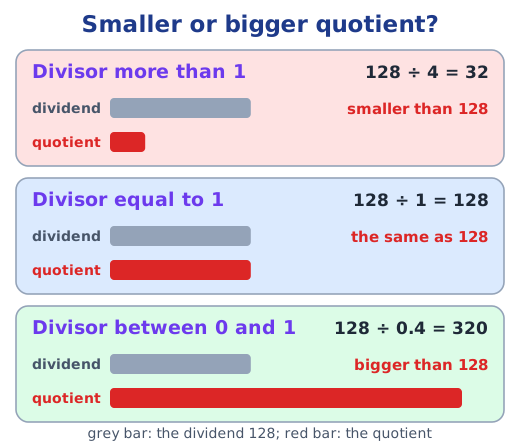
Figure it Out (pages 86–87)
1. Decimal form. (a) 2/5 = 4/10 = 0.4. (b) 13/4 = 325/100 = 3.25. (c) 4/50 = 8/100 = 0.08. (d) 5/8 = 625/1000 = 0.625.
2. Quotients. (a) 24.86 ÷ 1.2 = 248.6 ÷ 12 = 20.71666…, about 20.72; the 6 repeats for ever. (b) 5.728 ÷ 1.52 = 572.8 ÷ 152 = 3.7684…, about 3.77; this division does not end either.
3. Using 156 × 12 = 1872. (a) 15.6 × 1.2 = 18.72. (b) 187.2 ÷ 1.2 = 156. (c) 18.72 ÷ 15.6 = 1.2. (d) 0.156 × 0.12 = 0.01872.
4. Fill in. (a) 25 ÷ 1000 = 0.025. (b) 25 ÷ 0.1 = 250. (c) 25 ÷ 10 = 2.5. (d) 25 ÷ 10 = 25 × 0.1 (that is, 1/10). (e) 25 ÷ 0.10 = 25 × 10. (f) 25 ÷ 0.01 = 25 × 100.
5. Quotients. (a) 2.46 ÷ 1.5 = 24.6 ÷ 15 = 1.64. (b) 2.46 ÷ 0.15 = 246 ÷ 15 = 16.4. (c) 2.46 ÷ 0.015 = 2460 ÷ 15 = 164. Is 24.6 ÷ 1.5 the same as 2.46 ÷ 0.15? Yes, both are 16.4, because both equal 246 ÷ 15.
6. A 4 m block cut into 5 equal pieces. 4 ÷ 5 = 0.8 m each.
7. Side of a regular 12-sided polygon with perimeter 208.8 cm. 208.8 ÷ 12 = 17.4 cm.
8. 3 litres of juice shared among 8 friends. 3 ÷ 8 = 0.375 litre = 375 ml each.
9. 234.45 km on 12.6 litres. 234.45 ÷ 12.6 = 2344.5 ÷ 126 = 18.607…, about 18.61 km per litre. (This division does not end: 18.607142857142857…, with the digits 142857 repeating.)
10. 13.5 kg of flour shared among 15 students. 13.5 ÷ 15 = 0.9 kg, that is 900 g each.
Math Talk: halves and fifths. 1/(2 × 2 × 2 × 2 × 2) = 1/32 = 0.03125 and 1/(5 × 5 × 5 × 5 × 5) = 1/3125 = 0.00032. Pattern: with n twos or n fives in the denominator, the decimal has exactly n decimal places, the halves ending in 5 and the fifths in 2, 4, 8 or 6. This happens because 2 × 5 = 10: 1/32 = 3125/100000 and 1/3125 = 32/100000, so each one can be turned into a fraction over 1 followed by n zeros.
Look Before You Leap! (pages 88–93)
Which month has the extra day? February, which has 29 days in a leap year.
Days for 4 full trips around the Sun. 4 × 365.2422 = 1460.9688 days, against 4 × 365 + 1 = 1461 calendar days.
How many years are divisible by 4 in 100 years? 25. Days in 100 calendar years with a leap day every 4th year: 100 × 365 + 25 × 1 = 36,525 days. Other expressions: 75 × 365 + 25 × 366 = 36,525, or 100 × 365.25 = 36,525.
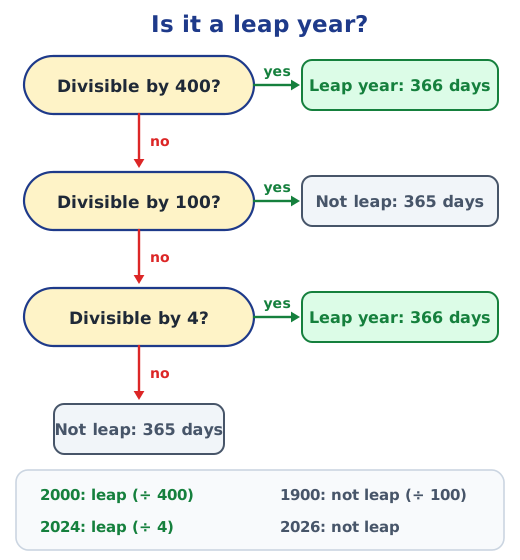
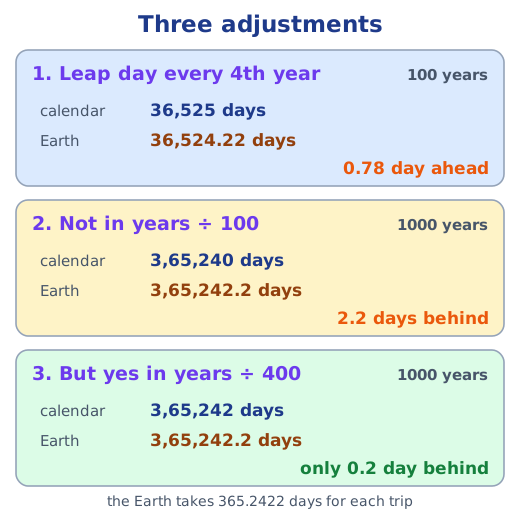
With no leap day in the 100th year: the expression for 100 years. 24 × 366 + 76 × 365 = 36,524 days. Is it close enough? What happens after 1000 years? The Earth needs 36,524.22 days in 100 years, so the calendar is 0.22 day short, which becomes 3,65,242.2 − 3,65,240 = 2.2 days after 1000 years.
With every 400th year a leap year. In 1000 years: 2 years divisible by 400, 8 divisible by 100 but not 400, 240 divisible by 4 but not 100, and 750 others, so (750 × 365) + (240 × 366) + (8 × 365) + (2 × 366) = 3,65,242 days, only 0.2 day short of 3,65,242.2.
Try This: 10,000 years. In 10,000 years there are 2500 − 100 + 25 = 2425 leap years, so the calendar has 10,000 × 365 + 2425 = 36,52,425 days. The Earth needs 10,000 × 365.2422 = 36,52,422 days. The difference is 3 days, with the calendar ahead. A fix: for example, make years divisible by 4000 ordinary years. That removes 2 leap days, leaving the calendar only about 1 day ahead in 10,000 years.
How did people find the length of the year? (The book prints 364.2422 here; the value used throughout the chapter is 365.2422.) (Extra) By watching the sky for many years: astronomers timed the Sun’s yearly cycle, for example from one equinox, when day and night are equal, to the next, and averaged their measurements over long periods to get such an exact value.
Investigate traditional Indian calendars. (Extra) Many traditional Indian calendars are lunisolar: their months follow the Moon, and an extra month, called adhik maas, is added about once every three years so that the months stay in step with the Sun and the seasons.
Figure it Out (pages 93–95)
1. Chikki or chips: which is cheaper? Compare the price per gram. Chikki: 70.5 ÷ 210 ≈ ₹0.336 per g, about ₹3.36 for 10 g. Chips: 33.25 ÷ 110 ≈ ₹0.302 per g, about ₹3.02 for 10 g. The potato chips are cheaper for the same weight.
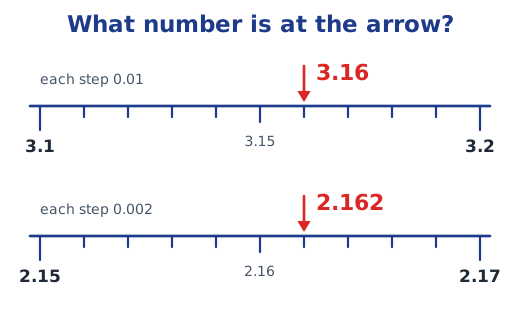
2. The decimal numbers at the arrows. The first line runs from 3.1 to 3.2 in steps of 0.01, and the arrow is at 3.16. The second runs from 2.15 to 2.17 in steps of 0.002, and the arrow is at 2.162.
3. Shyamala’s profit. Cost: 3 × ₹30 = ₹90. Sales: 35 × ₹5 = ₹175. Profit: 175 − 90 = ₹85.
4. Textbooks 2.5 cm thick on a 160 cm shelf. 160 ÷ 2.5 = 1600 ÷ 25 = 64 books fit. 64 × 2.5 = 160 cm exactly, so no space is left, and 80 − 64 = 16 books do not fit.
5. Fill in the blanks. 5.5 km = 5500 m. 35 cm = 0.35 m. 14.5 cm = 145 mm. 68 g = 0.068 kg. 9.02 m = 9020 mm. 125.5 ml = 0.1255 l.
6. Sridharacharya’s problem. 6 1/4 ÷ 2 1/2 = 6.25 ÷ 2.5 = 62.5 ÷ 25 = 2.5. 60 1/4 ÷ 3 1/2 = 60.25 ÷ 3.5 = 602.5 ÷ 35 = 17.2142857…, which never ends: after 17.2 the block 142857 repeats. As a fraction it is 17 3/14.
7. Fill the boxes in two ways. (a) 1.2 × 2, 0.6 × 4, 0.8 × 3 or 1.5 × 1.6 all make 2.4. (b) 2.9 × 5, 2.5 × 5.8, 1.45 × 10 or 0.5 × 29 all make 14.5.
8. Given 756 ÷ 36 = 21. (a) 75.6 ÷ 3.6 = 21. (b) 7.56 ÷ 0.36 = 21. (c) 756 ÷ 0.36 = 2100. (d) 75.6 ÷ 360 = 0.21. (e) 7560 ÷ 3.6 = 2100. (f) 7.56 ÷ 0.36 = 21 (the same as part (b) in the book).
9. The missing cells, each a ÷ b. b = 37: 1517 ÷ 37 = 41, then 4.1, 0.41, 0.041 and 410 for 151.7, 15.17, 1.517 and 15170. b = 3.7: 410, 41, 4.1, 0.41, 4100. b = 0.37: 4100, 410, 41, 4.1, 41000. b = 0.037: 41000, 4100, 410, 41, 410000. b = 370: 4.1, 0.41, 0.041, 0.0041, 41. Each move of the point in a or b moves the point of the quotient by one place.
10. The digits 2, 4, 5, 8 and 0 in □□.□ × □.□. (We do not start the two-digit number with 0.) (a) Maximum: 82.0 × 5.4 = 442.8 (54.0 × 8.2 gives the same). (b) Minimum: 45.8 × 0.2 = 9.16. (c) More than 150: for example, 85.4 × 2.0 = 170.8 or 28.0 × 5.4 = 151.2. (d) Nearest to 100: 20.5 × 4.8 = 98.4. (e) Nearest to 5: 45.8 × 0.2 = 9.16, the smallest product possible, so nothing comes closer to 5.
11. Increasing order. Multiplying 245.05 by a number less than 1 makes it smaller, and dividing by such a number makes it bigger. So: (f) 7.9682 < (c) 245.05 ÷ 7.9682 ≈ 30.75 < (a) 245.05 × 0.942368 ≈ 230.93 < (e) 245.05 < (d) 245.05 ÷ 0.942368 ≈ 260.04 < (b) 245.05 × 7.9682 ≈ 1952.61.
Hidato (pages 95–96)
In Hidato, consecutive numbers must sit in touching squares, sideways, up, down or diagonally, forming one path from the smallest to the largest number.
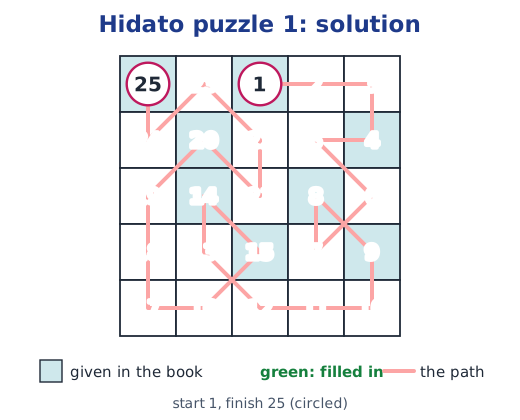
Puzzle 1 (5 × 5). The solution, row by row: 25 23 1 2 3 / 24 20 22 5 4 / 19 14 21 8 6 / 18 13 15 7 9 / 17 16 12 11 10.
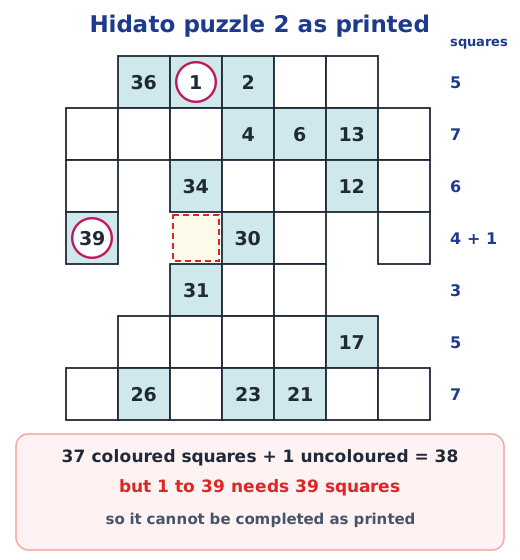
Puzzle 2 (ending at 39). As printed in the 2026-27 book, this puzzle cannot be completed. A path from 1 to 39 needs 39 squares, but the grid has only 37 coloured squares, plus one square below 34 that is outlined but printed without colour, 38 in all. Trying it shows the same problem: 14, 15 and 16 are forced into the squares between 13 and 17, and once the top rows are filled, every square touching 30 is taken, leaving no place for 29. It looks like a printing error; check with your teacher whether a corrected grid has been given.
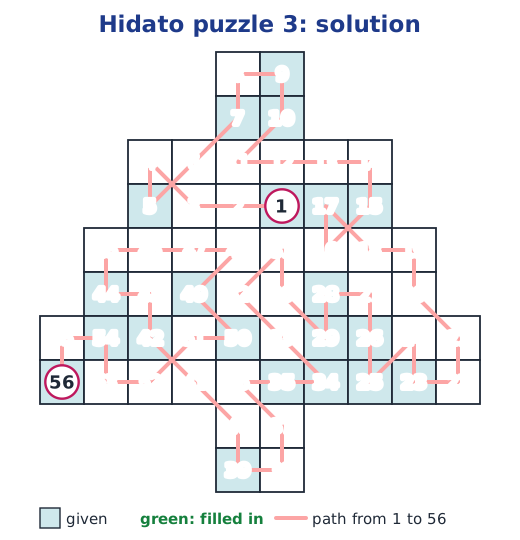
Puzzle 3 (56 squares). The solution, row by row from the top: 8 9 / 7 10 / 4 6 11 12 13 14 / 5 3 2 1 17 15 / 45 46 47 48 31 16 18 19 / 44 43 49 32 30 28 27 20 / 55 54 42 51 50 33 29 26 24 21 / 56 53 52 41 36 35 34 25 23 22 / 40 37 / 39 38.
Practice
-
What is 1.5 × 0.06?
Show answer
Answer: (b) 0.09 15 × 6 = 90, and 1 + 2 = 3 decimal places give 0.090 = 0.09.
-
What is 0.84 ÷ 4?
Show answer
Answer: (b) 0.21
-
Which is the same as 5 ÷ 0.25?
Show answer
Answer: (a) 500 ÷ 25 Multiply both numbers by 100: 5 ÷ 0.25 = 500 ÷ 25 = 20.
-
A bottle holds 1.25 litres. How much do 8 bottles hold?
Show answer
Answer: 125 × 8 = 1000, and 2 decimal places give 10.00. Eight bottles hold 10 litres.
-
Is 2028 a leap year? Is 2200?
Show answer
Answer: 2028 is divisible by 4 and is not a century year, so it is a leap year. 2200 is a century year and is not divisible by 400, so it is not a leap year.
Stuck on a question?
Take a photo and Lagnever AI explains it step by step. Try it for 7 days for ₹2.
Get it on Google Play Open in browser
For parents: after the trial, the plan renews monthly by UPI or card autopay. You can cancel anytime in the app.