
Class 7 Maths Part 2 Chapter 4: Another Peek Beyond the Point Notes
This chapter in five lines
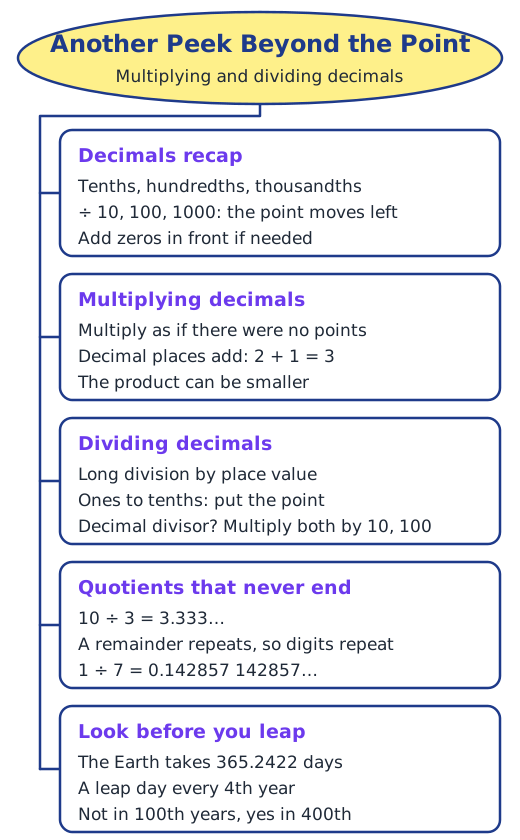
Another Peek Beyond the Point is about multiplying and dividing decimals. To multiply, multiply the numbers without their points and give the product as many decimal places as both numbers have together. To divide, use long division by place value, putting a point in the quotient when ones become tenths. Some quotients never end, and leap years put decimals to work.
What is this chapter about?
In Part 1 you met decimals and learnt to add and subtract them. This chapter takes the next step: multiplying and dividing decimals. Both turn out to be the methods you already use for counting numbers, stretched a little. You multiply as usual and place the point by counting, and you divide by place value, carrying on past the ones into tenths and hundredths. On the way you meet divisions that never finish, a curious number, 142857, and the decimal arithmetic hidden in leap years.
A quick recap of decimals
A decimal is the Indian place value system continued to the right of the ones, into tenths, hundredths, thousandths and so on. So 27.53 stands for 2 tens, 7 ones, 5 tenths and 3 hundredths, and a fraction such as 254/1000 is 2/10 + 5/100 + 4/1000 = 0.254. In kilograms, 50 g of cinnamon is 50/1000 kg = 0.05 kg.
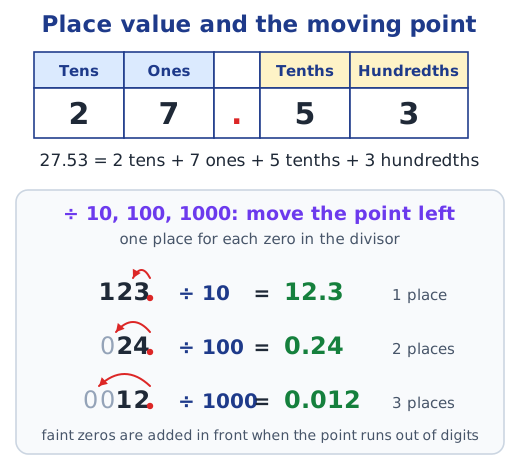
To divide by 10, 100 or 1000, move the point left by as many places as the divisor has zeros, adding zeros in front if the digits run out: 123 ÷ 10 = 12.3 and 12 ÷ 1000 = 0.012.
Multiplying decimals
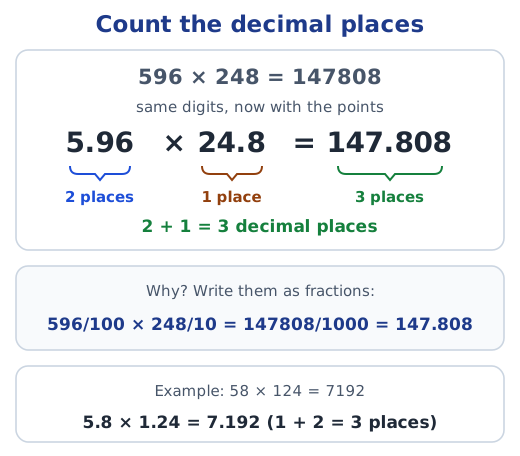
Multiplying a decimal by a counting number is repeated addition: 5 pens at ₹9.5 each cost 9.5 × 5 = ₹47.5. For two decimals, write each as a fraction over 10, 100 or 1000 and multiply: 12.5 × 7.5 = 125/10 × 75/10 = 9375/100 = 93.75. The numerators are the numbers without their points, and the denominator gets as many zeros as the two denominators had together. That gives the rule: multiply without the points, then give the product as many decimal places as the two numbers have together.
A product of decimals is not always bigger than the numbers. 2.25 × 8 = 18 is bigger than both, 0.25 × 8 = 2 lies between them, and 0.25 × 0.8 = 0.2 is smaller than both. When both numbers are between 0 and 1, the product is smaller than each of them. Read more in multiplying decimals.
Dividing decimals
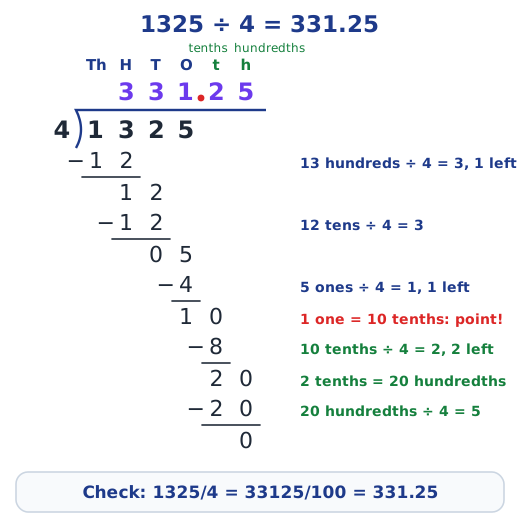
Division by place value works just as it does for counting numbers, but it need not stop at the ones. In 1325 ÷ 4, after 3 hundreds, 3 tens and 1 one, there is 1 one left. Regroup it as 10 tenths, put a decimal point in the quotient, and carry on: 2 tenths each with 2 tenths left, then 20 hundredths give 5 hundredths each. So 1325 ÷ 4 = 331.25.
A decimal dividend is handled the same way: 9.5 kg of sugar packed into 4 equal bags gives 2.375 kg a bag. If the divisor is a decimal, multiply both numbers by 10, 100 or 1000 so that it becomes a counting number: 126 km in 2.5 hours is 1260 ÷ 25 = 50.4 km per hour. Dividing by a number between 0 and 1 makes the quotient bigger than the dividend, as in 128 ÷ 0.4 = 320. See dividing decimals.
Quotients that never end
Try 10 ÷ 3. Every step leaves a remainder of 1, so the 3s never stop: 3.333…. In 1 ÷ 7 the remainders run 1, 3, 2, 6, 4, 5 and then 1 again, so the digits 142857 repeat for ever.
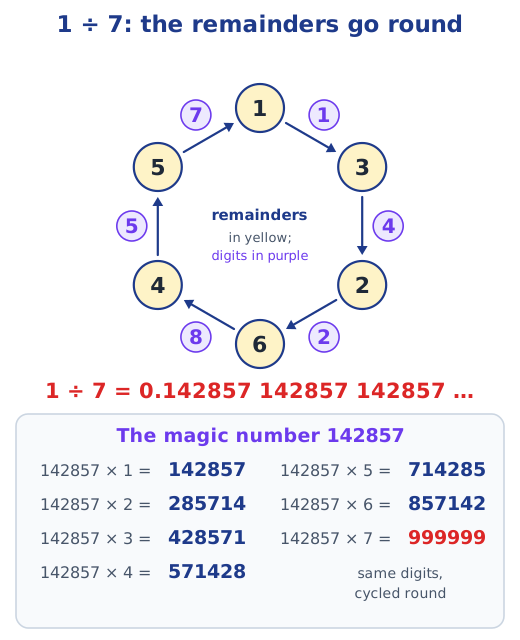
The number 142857 is special. Multiplying it by 2, 3, 4, 5 or 6 gives the same six digits in the same circular order, only starting at a different place, and 142857 × 7 = 999999. Numbers like this are called cyclic numbers, and 1 ÷ 17 gives another one. Whether there are infinitely many is still unknown; Emil Artin guessed in 1927 that there are, and nobody has proved it yet.
Look before you leap
The Earth takes 365.2422 days for one trip around the Sun, so each 365-day calendar year leaves 0.2422 of a day unfinished, which adds up to 24.22 days in 100 years. A leap day every 4th year overshoots a little, so century years are not leap years, unless they are divisible by 400. Decimal multiplication checks every step: with all three rules, 1000 calendar years have 3,65,242 days against the 3,65,242.2 days the Earth takes.
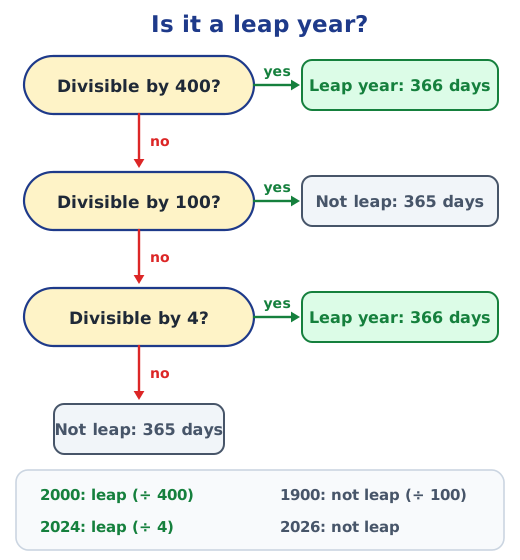
Read leap years and decimals. Answers to every question, including the Hidato puzzles, are in the NCERT solutions for Part 2 Chapter 4.
Key terms
| Term | Meaning |
|---|---|
| Decimal | A number that uses place values to the right of the ones: tenths, hundredths, thousandths and so on. 27.53 is 2 tens, 7 ones, 5 tenths and 3 hundredths. |
| Decimal places | How many digits come after the decimal point. 5.96 has 2 decimal places and 24.8 has 1. |
| Multiplier and multiplicand | The two numbers that are multiplied. In 5.8 × 1.24 = 7.192, they are 5.8 and 1.24, and 7.192 is the product. |
| Dividend, divisor and quotient | In 237 ÷ 8 = 29.625, 237 is the dividend (the number shared), 8 is the divisor and 29.625 is the quotient. |
| Division using place value | Dividing one place at a time, starting from the biggest place and passing what is left to the next smaller place. It is also called long division. |
| Regrouping | Changing what is left into the next smaller unit so it can be shared: 1 one = 10 tenths and 1 tenth = 10 hundredths. |
| Never-ending quotient | A quotient whose decimal digits go on for ever because a remainder keeps coming back, such as 10 ÷ 3 = 3.333… |
| Cyclic number | A number like 142857 whose products with 1 to 6 use the same digits in the same circular order: 142857 × 2 = 285714. |
| Leap year | A year of 366 days, the extra day being 29 February. Years divisible by 4 are leap years, except century years that are not divisible by 400. |
| Gregorian calendar | The calendar used in most of the world today, with 365 days in an ordinary year and the leap year rules above. |
Topics in this chapter
Practice
-
What is 0.6 × 0.3?
Show answer
Answer: (b) 0.18
-
Given 23 × 17 = 391, what is 2.3 × 1.7?
Show answer
Answer: (b) 3.91
-
What is 9.5 ÷ 4?
Show answer
Answer: (a) 2.375
-
Which division gives a quotient bigger than 50?
Show answer
Answer: (c) 50 ÷ 0.5 Dividing by a number between 0 and 1 makes the quotient bigger: 50 ÷ 0.5 = 100.
-
Which year was a leap year?
Show answer
Answer: (c) 2000 2000 is divisible by 400. 1900 and 1800 are century years not divisible by 400, and 2026 is not divisible by 4.
-
4.68 ÷ 0.13 is the same as:
Show answer
Answer: (a) 468 ÷ 13
Questions students ask
What are the main topics of Class 7 Maths Part 2 Chapter 4?
A recap of decimals and of dividing by 10, 100 and 1000; multiplying decimals and the decimal places rule; when a product is bigger or smaller; division by place value with decimal quotients, decimal dividends and decimal divisors; quotients that never end and the number 142857; and leap years, checked with decimals.
Is Another Peek Beyond the Point in the new Ganita Prakash Part 2 book?
Yes. It is Chapter 4 of Ganita Prakash, the Class 7 Maths textbook Part 2 (2026-27), on pages 67 to 96. It follows A Peek Beyond the Point in Part 1, which covers adding and subtracting decimals.
How do you multiply two decimals?
Multiply the numbers as if they had no points. Then add the counts of digits after the point in both numbers, and give the product that many digits after the point. For 5.8 × 1.24: 58 × 124 = 7192, and 1 + 2 = 3 places give 7.192.
Stuck on a question?
Take a photo and Lagnever AI explains it step by step. Try it for 7 days for ₹2.
Get it on Google Play Open in browser
For parents: after the trial, the plan renews monthly by UPI or card autopay. You can cancel anytime in the app.