
Dividing decimals
Answer in short
Divide decimals by long division, one place at a time. When the ones are used up, regroup what is left as tenths, then hundredths, and put a point in the quotient: 1325 ÷ 4 = 331.25. If the divisor is a decimal, multiply both numbers by 10, 100 or 1000: 4.68 ÷ 0.13 = 468 ÷ 13 = 36.
Stuck on a question? Take a photo and Lagnever AI explains it step by step. Try it for 7 days for ₹2. Get it on Google Play
Dividing by 10, 100 and 1000
Anuja cuts 3.9 m of ribbon into 10 equal pieces. As fractions, 3.9 ÷ 10 = 39/10 × 1/10 = 39/100, so each piece is 0.39 m. Cut into 100 pieces, each is 3.9 ÷ 100 = 0.039 m, which is 3.9 cm or 39 mm. Each time the point moves left as many places as the divisor has zeros, with zeros added in front if needed: 0.13 ÷ 100 = 0.0013.
Division as an equivalent fraction
Neenu shares 29 m of ribbon equally with Anu. Each gets 14 m, and the last 1 m is halved: 1/2 = 5/10 = 0.5, so each gets 14.5 m. Shared among four friends, each gets 29/4 m. Since 4 × 25 = 100, multiply the top and bottom by 25: 29/4 = 725/100 = 7.25 m. This trick needs a denominator that can be made into 10, 100 or 1000 (revise equivalent fractions from Class 6). It fails for 10/3, because no multiple of 3 is 10, 100 or 1000, so we need a method that always works.
Long division past the point
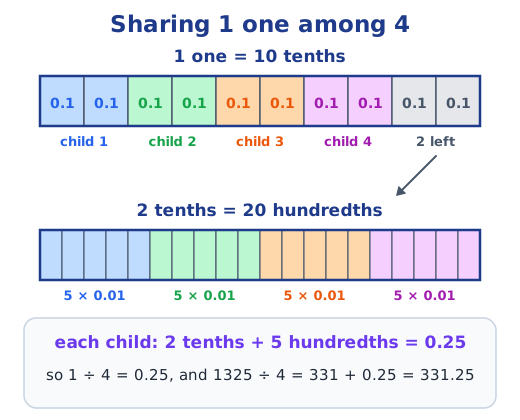
Long division shares one place at a time, starting from the biggest. In 1325 ÷ 4: 13 hundreds ÷ 4 = 3 hundreds, with 1 hundred left; that hundred becomes 10 tens, so 12 tens ÷ 4 = 3 tens; then 5 ones ÷ 4 = 1 one, with 1 one left. With counting numbers we would stop at remainder 1. Instead, regroup the 1 one as 10 tenths and put a decimal point in the quotient. Then 10 tenths ÷ 4 = 2 tenths, with 2 tenths left, and those 20 hundredths ÷ 4 = 5 hundredths. So 1325 ÷ 4 = 331.25.
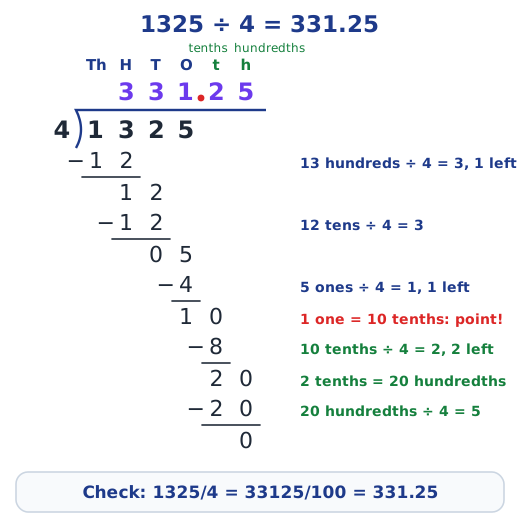
The same steps give 237 ÷ 8 = 29.625: 23 tens ÷ 8 = 2 tens, 77 ones ÷ 8 = 9 ones, and then 50 tenths ÷ 8 = 6, 20 hundredths ÷ 8 = 2 and 40 thousandths ÷ 8 = 5.
A decimal dividend
If the dividend already has a decimal part, divide in the same way and put the point in as you cross from ones to tenths. Packing 9.5 kg of sugar equally into 4 bags: 9 ones ÷ 4 = 2, with 1 left; 15 tenths ÷ 4 = 3, with 3 left; 30 hundredths ÷ 4 = 7, with 2 left; 20 thousandths ÷ 4 = 5. Each bag holds 2.375 kg. Small numbers work too: 0.06 ÷ 5 = 0.012.
A decimal divisor
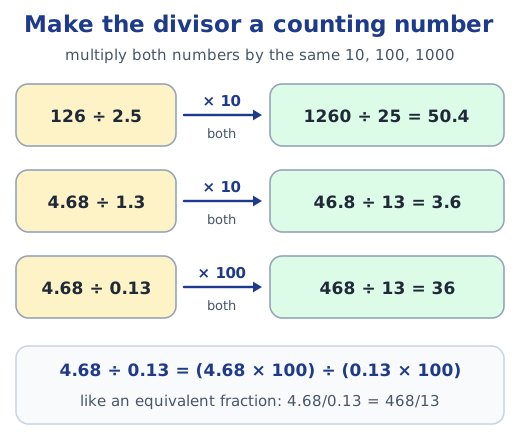
Ravi rides 126 km in 2.5 hours, so his average speed is 126 ÷ 2.5. Since 2.5 = 25/10, dividing by it is the same as multiplying by 10/25, so 126 ÷ 2.5 = 1260 ÷ 25 = 50.4 km per hour. In general, multiply the divisor and the dividend by the same 10, 100 or 1000 to make the divisor a counting number, then divide as usual: 4.68 ÷ 0.13 = 468 ÷ 13 = 36.
Smaller or bigger quotient?
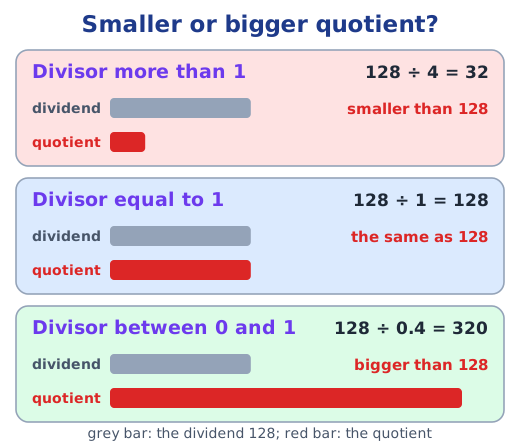
Dividing by a number more than 1 makes the quotient smaller than the dividend: 128 ÷ 4 = 32. Dividing by 1 changes nothing. But dividing by a number between 0 and 1 makes it bigger: 128 ÷ 0.4 = 320, because 0.4 fits into 128 more than 128 times.
Quotients that never end
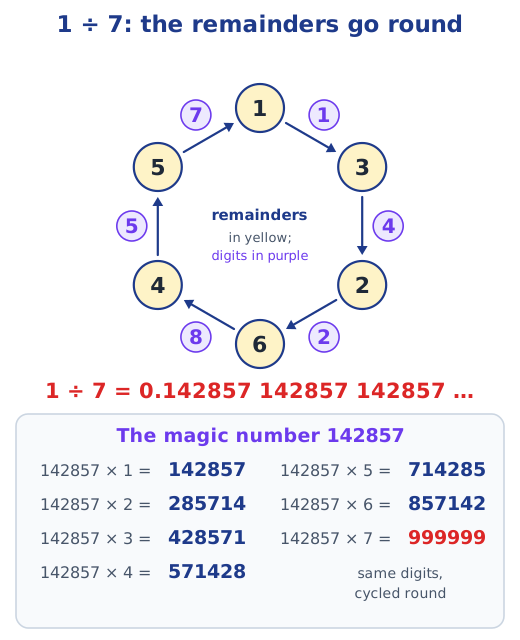
Some divisions never finish. In 10 ÷ 3 every step leaves a remainder of 1, so 10 ÷ 3 = 3.333… without end. In 1 ÷ 7 the remainders go 1, 3, 2, 6, 4, 5 and then 1 again, so the digits repeat in a cycle of six: 0.142857 142857….
Why it matters
Sharing, average speed and price per kilogram are all decimal divisions. Revise multiplying decimals, then see leap years and decimals. Answers to the textbook questions are in the NCERT solutions for Part 2 Chapter 4; see all of Part 2 Chapter 4 notes.
Practice
-
What is 7.2 ÷ 100?
Show answer
Answer: (c) 0.072
-
What is 3 ÷ 8?
Show answer
Answer: (a) 0.375
-
Which division has the same quotient as 6.3 ÷ 0.7?
Show answer
Answer: (a) 63 ÷ 7
-
Share 2.5 m of ribbon equally among 4 children.
Show answer
Answer: 2.5 ÷ 4: 2 ones cannot be shared among 4, so regroup them as 20 tenths; with 5 tenths that is 25 tenths. 25 tenths ÷ 4 = 6 tenths, 1 tenth left = 10 hundredths; 10 hundredths ÷ 4 = 2, with 2 left = 20 thousandths; 20 ÷ 4 = 5. Each gets 0.625 m.
-
Does 100 ÷ 11 end? What is it?
Show answer
Answer: No. After 9, the remainders go 1, 10, 1, 10 and so on, so the digits 0 and 9 take turns for ever: 100 ÷ 11 = 9.0909…
Questions students ask
How do you divide a decimal by a whole number?
Use long division as usual, starting from the biggest place. When you move from the ones to the tenths, put a decimal point in the quotient, then keep regrouping what is left into the next smaller place. For example, 9.5 ÷ 4 = 2.375.
How do you divide by a decimal?
Multiply the divisor by 10, 100 or 1000 to make it a counting number, and multiply the dividend by the same number. The quotient does not change. For example, 126 ÷ 2.5 = 1260 ÷ 25 = 50.4.
Why does 1 ÷ 7 never end?
Every remainder in the division is less than 7, and here it is never 0, so it can only be 1 to 6. Within six steps a remainder must come back, and after that the same steps repeat. The remainders go 1, 3, 2, 6, 4, 5, so the digits 142857 repeat for ever.
Stuck on a question?
Take a photo and Lagnever AI explains it step by step. Try it for 7 days for ₹2.
Get it on Google Play Open in browser
For parents: after the trial, the plan renews monthly by UPI or card autopay. You can cancel anytime in the app.