
Multiplying decimals
Answer in short
To multiply decimals, multiply the numbers as if they had no points, then give the product as many decimal places as both numbers have together. For 5.96 × 24.8, 596 × 248 = 147808, and 2 + 1 = 3 places give 147.808. It works because decimals are fractions over 10, 100 or 1000.
Stuck on a question? Take a photo and Lagnever AI explains it step by step. Try it for 7 days for ₹2. Get it on Google Play
Start with repeated addition
Arshad buys 5 pens at ₹9.5 each. The cost is 9.5 added five times: 9.5 × 5 = ₹47.5. Fractions give the same answer, since 9.5 = 95/10 and 95/10 × 5 = 475/10 = 47.5. In the same way, Ajay walks 827 m, or 0.827 km, each way to school, so he walks 0.827 × 2 = 1.654 km a day and 1.654 × 6 = 9.924 km in a six-day week.
Two decimals: use fractions
A car runs 12.5 km on one litre of petrol. On 7.5 litres it covers 12.5 × 7.5 km. Write both numbers as fractions and multiply tops and bottoms: 125/10 × 75/10 = (125 × 75)/(10 × 10) = 9375/100 = 93.75 km. Look at what happened. The numerators are just the numbers with their points removed, and the denominator is 100 because 10 × 10 = 100.
The decimal places rule
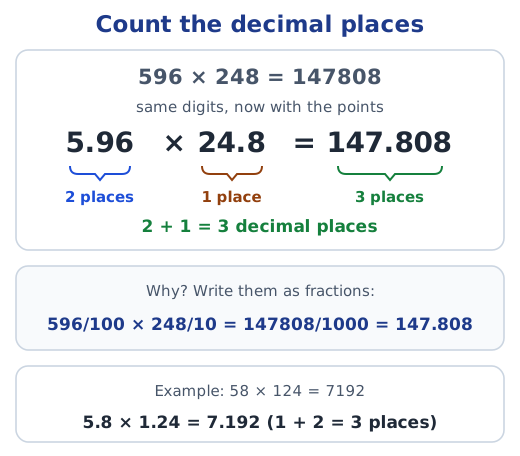
Every denominator is 10, 100, 1000 and so on, so the product of two denominators is 1 followed by as many zeros as both have together. That gives a three-step rule:
- Multiply the numbers as counting numbers, ignoring the points.
- Count the decimal places in both numbers and add the counts.
- Place the point so that the product has that many decimal places.
| Product | Decimal places |
|---|---|
| 9.5 × 5 = 47.5 | 1 + 0 = 1 |
| 12.5 × 7.5 = 93.75 | 1 + 1 = 2 |
| 1.64 × 6 = 9.84 | 2 + 0 = 2 |
| 5.7 × 13.35 = 76.095 | 1 + 2 = 3 |
So if you know 596 × 248 = 147808, you can write 5.96 × 24.8 = 147.808 at once. Count the places before dropping any zeros: 2.5 × 0.04 is 25 × 4 = 100 with three places, 0.100, which is 0.1. A zero at the end after the point changes nothing, so 56.50 × 2.250 gives the same product as 56.5 × 2.25, namely 127.125.
Why tenths × tenths = hundredths
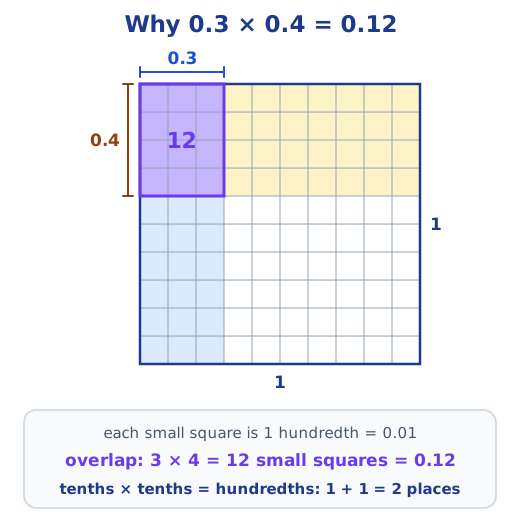
Picture a 1 by 1 square cut into 100 small squares, each one hundredth. A strip 0.3 wide and a strip 0.4 tall overlap in 3 × 4 = 12 small squares, so 0.3 × 0.4 = 0.12. A tenth of a tenth is a hundredth, which is why one place and one place make two. Areas work the same way with bigger numbers: a rectangle 5.7 cm by 13.3 cm has area 57 × 133 = 7581 hundredths of a sq cm, that is 75.81 sq cm.
Multiplying by 10, 100 and 1000
Multiplying by 10 makes every digit worth ten times as much, so the point moves one place to the right: 5.7 × 10 = 57, 5.7 × 100 = 570 and 5.7 × 1000 = 5700, with zeros added at the end when the digits run out. In the same way 0.306 × 100 = 30.6. Dividing by 10, 100 or 1000 moves the point to the left instead.
Bigger or smaller product?
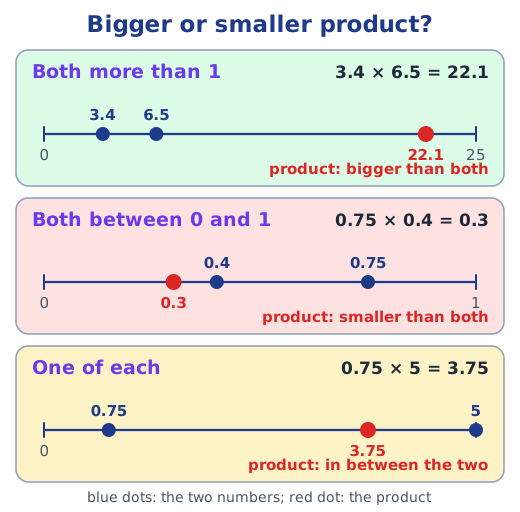
With counting numbers, a product is never smaller than either number. With decimals it can be:
- Both numbers more than 1: the product is bigger than both, as in 3.4 × 6.5 = 22.1.
- Both between 0 and 1: the product is smaller than both, as in 0.75 × 0.4 = 0.3.
- One of each: the product lies between the two, as in 0.75 × 5 = 3.75.
So you can tell that 0.7 × 0.6 is less than 1 without working it out, while 7 × 0.6 = 4.2 is not.
Why it matters
Prices, lengths, areas and speeds are all decimals, so multiplying them is everyday work. Next, learn dividing decimals, and see decimals checking the calendar in leap years and decimals. Answers to the textbook questions are in the NCERT solutions for Part 2 Chapter 4; see all of Part 2 Chapter 4 notes.
Practice
-
What is 0.4 × 0.07?
Show answer
Answer: (b) 0.028
-
Given 18 × 12 = 216, what is 1.8 × 0.12?
Show answer
Answer: (b) 0.216
-
Which product is less than 1?
Show answer
Answer: (b) 0.9 × 0.8
-
A pen costs ₹12.75. What do 6 pens cost?
Show answer
Answer: 12.75 × 6: first 1275 × 6 = 7650, then 2 decimal places give 76.50. Six pens cost ₹76.50.
-
Find the area of a rectangle 4.5 cm long and 2.4 cm wide.
Show answer
Answer: 45 × 24 = 1080, and 1 + 1 = 2 decimal places give 10.80. The area is 10.8 sq cm.
Questions students ask
How do you place the decimal point when multiplying decimals?
Count the digits after the point in each number and add the two counts. The product has that many digits after the point. For 2.5 × 0.04: 25 × 4 = 100, and 1 + 2 = 3 places give 0.100, which is 0.1.
Why do decimal places add when we multiply?
Each decimal is a fraction whose denominator is 10, 100 or 1000. Multiplying fractions multiplies the denominators, so their zeros add up: tenths × hundredths = thousandths. For example, 0.3 × 0.04 = 3/10 × 4/100 = 12/1000 = 0.012.
Can multiplying two decimals give a whole number?
Yes. 2.5 × 0.4 = 1 and 1.25 × 0.8 = 1. The digits after the point can multiply to end in zeros, and those zeros drop away. A decimal times a counting number can be whole too: 0.25 × 4 = 1.
Stuck on a question?
Take a photo and Lagnever AI explains it step by step. Try it for 7 days for ₹2.
Get it on Google Play Open in browser
For parents: after the trial, the plan renews monthly by UPI or card autopay. You can cancel anytime in the app.