
Leap years and decimals
Answer in short
The Earth takes 365.2422 days to go around the Sun, so a 365-day calendar falls 0.2422 day behind each year. A leap day every 4th year fixes most of this, but century years are not leap years unless they are divisible by 400. Then 1000 calendar years have 3,65,242 days, just 0.2 day short.
Stuck on a question? Take a photo and Lagnever AI explains it step by step. Try it for 7 days for ₹2. Get it on Google Play
365 days is not quite enough
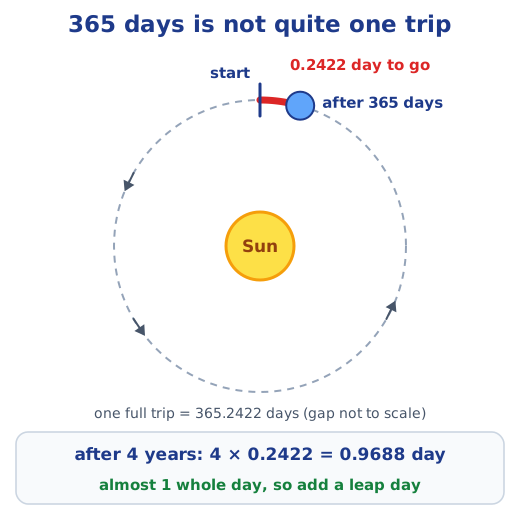
A calendar year has 365 days, but one trip of the Earth around the Sun takes 365.2422 days. So when a calendar year ends, the Earth still has 0.2422 of a day to travel, nearly 6 hours (0.2422 × 24 = 5.8128 hours). That looks tiny, but it grows: after 100 calendar years the shortfall is 0.2422 × 100 = 24.22 days. The seasons depend on where the Earth is on its path, so a calendar that keeps slipping would slowly carry summer into the months we call winter.
Adjustment 1: a leap day every 4th year
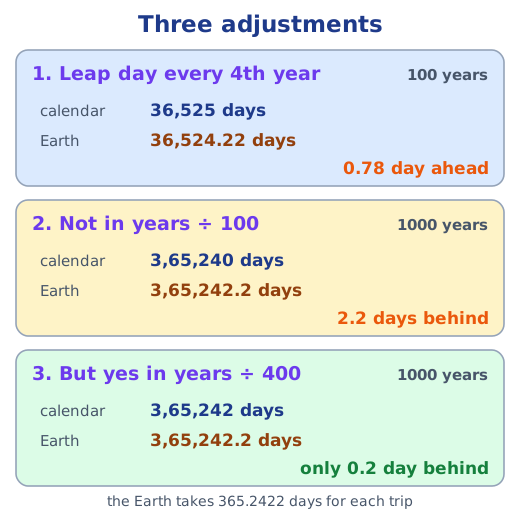
Give every year divisible by 4 one extra day, 29 February. Four calendar years then have 4 × 365 + 1 = 1461 days, while four trips take 4 × 365.2422 = 1460.9688 days, which is very close. Over 100 years, 25 years are divisible by 4, so the calendar has 100 × 365 + 25 = 36,525 days. But the Earth needs only 100 × 365.2422 = 36,524.22 days. The calendar is now 0.78 day ahead every century: we have overcorrected.
Adjustment 2: skip the century years
So years divisible by 100 get no extra day. In 100 years only 25 − 1 = 24 years are now leap years, giving 24 × 366 + 76 × 365 = 36,524 days, just 0.22 day short of 36,524.22. Small, but it grows again: in 1000 years the calendar has 36,524 × 10 = 3,65,240 days, while the Earth needs 1000 × 365.2422 = 3,65,242.2 days. Now the calendar is 2.2 days behind.
Adjustment 3: keep every 400th year
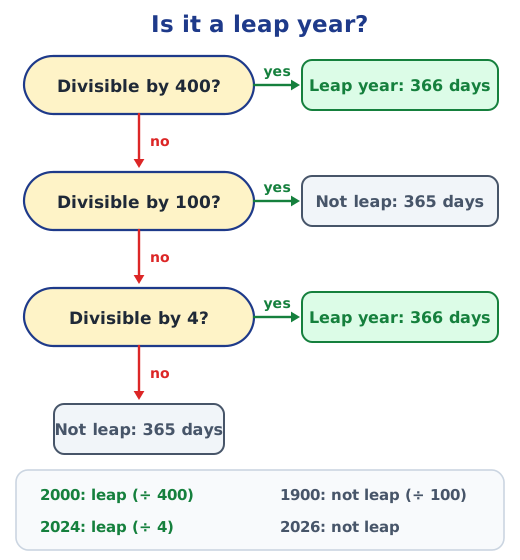
To win back about two days in a thousand years, every year divisible by 400 is a leap year after all. Count the years from 1 to 1000:
| Kind of year | How many |
|---|---|
| Divisible by 400 (leap) | 2 |
| Divisible by 100, not by 400 (ordinary) | 10 − 2 = 8 |
| Divisible by 4, not by 100 (leap) | 250 − 10 = 240 |
| All the rest (ordinary) | 1000 − 250 = 750 |
So 242 years have 366 days and 758 have 365: 242 × 366 + 758 × 365 = 3,65,242 days, only 0.2 day short of 3,65,242.2. The calendar makers stopped there, and these three rules make up the Gregorian calendar used in most of the world today.
What about 10,000 years?
In 10,000 years, 2500 years are divisible by 4, 100 by 100 and 25 by 400, so there are 2500 − 100 + 25 = 2425 leap years. The calendar has 10,000 × 365 + 2425 = 36,52,425 days, while the Earth needs 10,000 × 365.2422 = 36,52,422 days, so the calendar ends up about 3 days ahead. (In the 1000 years above it was slightly behind, because 1 to 1000 holds only 2 multiples of 400, fewer than the average of 2.5.) One possible fix is to make years divisible by 4000 ordinary years. That removes 2 leap days in 10,000 years and leaves the calendar about 1 day ahead.
Why it matters
A gap of 0.2422 of a day sounds too small to matter, yet decimal multiplication shows how it builds up over the centuries, and why the leap year rule needs three parts. (Extra) Many traditional Indian calendars follow both the Moon and the Sun, and they keep festivals in their seasons by adding an extra month, called adhik maas, about once every three years. Revise the arithmetic in multiplying decimals and dividing decimals. Answers to the textbook questions are in the NCERT solutions for Part 2 Chapter 4; see all of Part 2 Chapter 4 notes.
Practice
-
Which of these is a leap year?
Show answer
Answer: (b) 1996
-
How many leap years are there from 2001 to 2100?
Show answer
Answer: (b) 24 2004, 2008, …, 2096 make 24 leap years; 2100 is divisible by 100 but not by 400.
-
With 365-day years only, how many days behind is the calendar after 50 years?
Show answer
Answer: (a) 12.11
-
How many days are there in 400 calendar years under the final rule?
Show answer
Answer: Of the 400 years, 100 are divisible by 4. Four of these are century years, and one of those is divisible by 400. So there are 100 − 4 + 1 = 97 leap years, and 400 × 365 + 97 = 1,46,097 days.
-
After those 400 years, how far is the calendar from the Earth?
Show answer
Answer: The Earth needs 400 × 365.2422 = 1,46,096.88 days. The calendar has 1,46,097 days, so it is 0.12 day ahead.
Questions students ask
Why do we have leap years?
The Earth takes about 365.2422 days to go once around the Sun, not 365. Without leap days the calendar would slip by about a quarter of a day every year, 24.22 days in a century, and the seasons would slowly move through the months.
How do you know if a year is a leap year?
If the year is divisible by 400, it is a leap year. If not, but it is divisible by 100, it is not a leap year. If neither, it is a leap year when it is divisible by 4. So 2000 and 2024 are leap years, while 1900 and 2026 are not.
Which month gets the extra day in a leap year?
February. It has 29 days in a leap year instead of 28, so a leap year has 366 days.
Stuck on a question?
Take a photo and Lagnever AI explains it step by step. Try it for 7 days for ₹2.
Get it on Google Play Open in browser
For parents: after the trial, the plan renews monthly by UPI or card autopay. You can cancel anytime in the app.