
NCERT Solutions Class 7 Science Chapter 11: Light: Shadows and Reflections
Answers to every question in Chapter 11, Light: Shadows and Reflections, of Curiosity, the Class 7 Science textbook (Reprint 2026-27): the questions in the text, Activities 11.1–11.10 with sample observations, the Dive Deeper boxes, all 12 “Let Us Enhance Our Learning” questions and the exploratory projects. Page numbers follow the book (pages 153–168). Short notes: Chapter 11 notes.
Keshav’s questions (page 153)
Does the Moon produce its own light? No. The Moon is non-luminous: it shines only by reflecting the sunlight that falls on it, so moonlight is just reflected sunlight. The planets also shine by reflected sunlight.
Which objects give off their own light? Luminous objects such as the Sun and other stars, lightning, fire, glowing animals such as fireflies, and electric lamps.
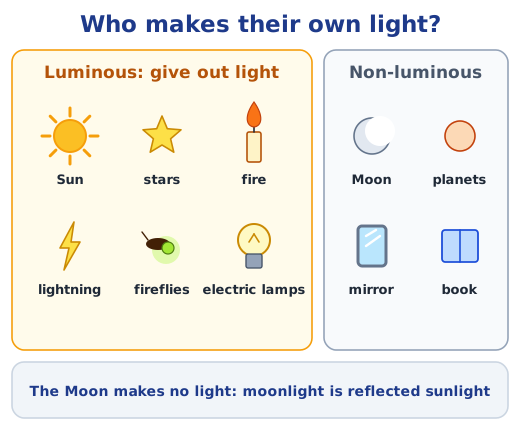
Does light travel in a straight line? (pages 155–156)
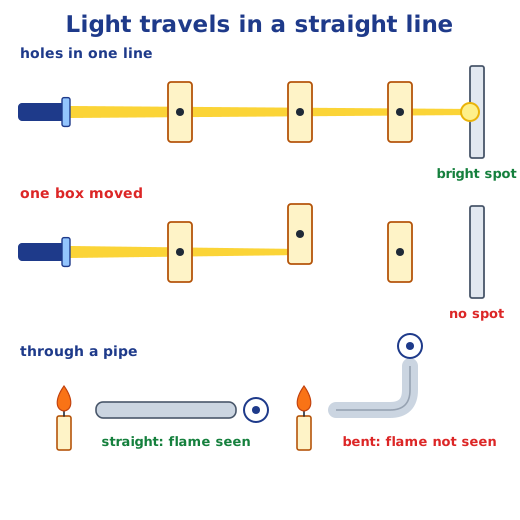
Activity 11.1: when one matchbox is moved a little, do you still get the spot on the screen? No. With the three holes in one straight line, the torch light passes through all of them and makes a bright spot. When one box moves, its hole is out of line, the light hits the cardboard instead, and the spot disappears. So light travels in a straight line.
Activity 11.2: can you still see the candle flame through the bent pipe? No. Through the straight pipe the flame is visible, but in the bent pipe there is no straight path from the flame to the eye. So light must be travelling in straight lines.
Dive Deeper: a laser beam in water with a drop of milk. The milk makes the beam visible, and it goes through the water along a straight path.
Transparent, translucent and opaque materials (pages 156–157)
Activity 11.3: sample observations for Table 11.1.
| Material | Light passes; type |
|---|---|
| Cardboard | not at all; opaque |
| Notebook paper | partially; translucent |
| Glass | almost fully; transparent |
| Tracing paper | partially; translucent |
| Thick cloth | not at all; opaque |
| Clear plastic sheet | almost fully; transparent |
Was your observation the same as your prediction? What can you conclude? Mostly yes, though thin paper often surprises people by letting some light through. Conclusion: light passes almost completely through transparent materials, partially through translucent materials and not at all through opaque materials.
Shadow formation (pages 157–159)
What did you see on the screen when an opaque object was placed in the path of light, and why? A dark patch, the shadow. Light travels in a straight line, so the opaque object blocks it, and the region behind the object, where light cannot reach, stays dark.
Do translucent and transparent objects make shadows? Translucent objects make lighter shadows, and some transparent objects make faint shadows. Opaque objects make the darkest shadows.
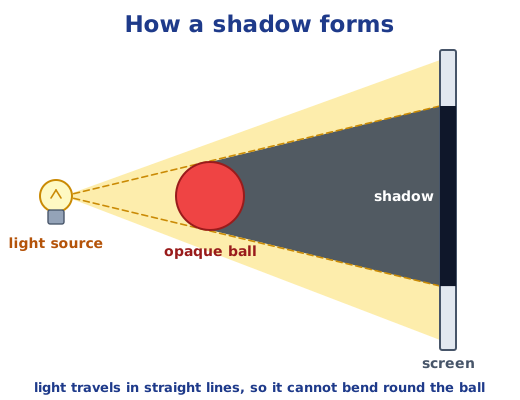
Activity 11.4: sample observations for Table 11.2.
| Action | Observation about the shadow |
|---|---|
| The screen is removed | No shadow on the screen; it falls on whatever is behind, such as a far wall |
| The object is removed | No shadow; only a bright patch of light |
| The torch is switched off | No shadow, because there is no light |
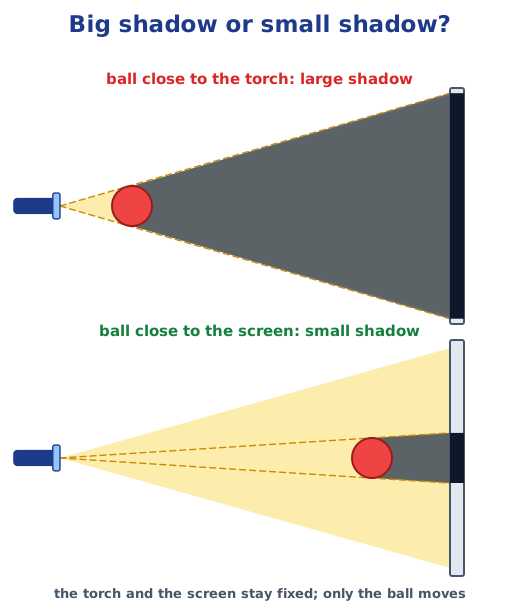
| The object moved closer to the screen | The shadow becomes smaller and sharper |
| The object moved closer to the torch | The shadow becomes larger and fuzzier |
| The object is tilted | The shape of the shadow changes |
| The colour of the object is changed | The shadow stays dark; its colour does not change |
What do we need to see a shadow? Does the shadow’s colour change with the object’s colour? Three things: a light source, an opaque object and a screen to catch the shadow. How big, what shape and how sharp the shadow is depends on where the object is relative to the light and the screen, but the shadow stays dark whatever the colour of the object.
Reflection of light (pages 159–160)
A shiny steel plate gave a shadow and also a bright spot on the opposite wall. Why? The plate is opaque, so it casts a shadow, but its shiny surface also reflects the light that falls on it, sending a bright spot to the opposite wall.
Activity 11.5: how can you send sunlight onto a wall that the Sun does not reach? Turn the mirror or shiny plate so that the light reflected from it falls on that wall. A bright spot appears, which shows the mirror has changed the direction of the light. Tilting the mirror moves the spot.
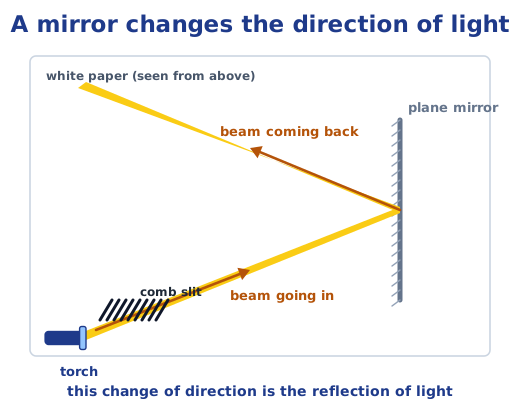
Activity 11.6: what happens when a mirror is placed in the path of the thin beam? The beam changes direction after striking the mirror. We call this turning of light by a mirror the reflection of light.
Is seeing your face in a mirror also due to reflection? Yes. Light from your face falls on the mirror and is reflected back into your eyes, so you see your image.
Images formed in a plane mirror (pages 161–162)
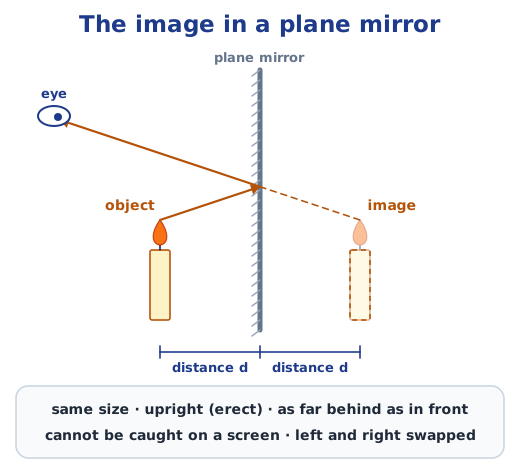
Activity 11.7. A pen seems to stand behind the mirror: that is its image. At every position the image is the same size as the pen and erect, with the tip on top. A screen placed behind or in front of the mirror never shows the image, so a plane mirror’s image can never be caught on a screen.
Activity 11.8: how is your distance from the mirror related to the distance of your image? They are equal: the image is as far behind the mirror as you are in front of it. Step closer and the image comes closer; step back and it moves away.
Raise your left arm; touch your right ear. The image raises the arm on its right side and touches its left ear. Left and right are swapped: this is lateral inversion.
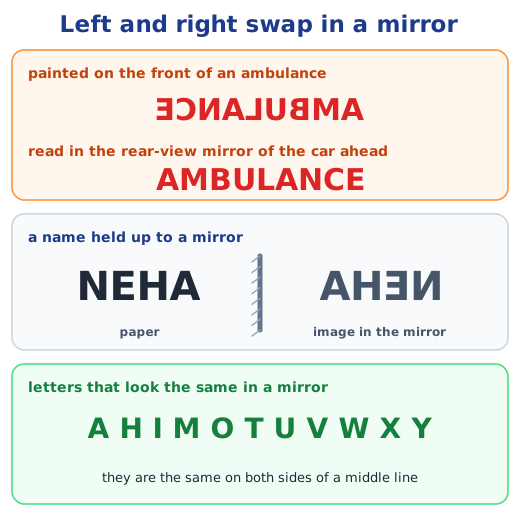
Why is AMBULANCE written reversed on ambulances? The word is painted laterally inverted, so when drivers ahead see it in their rear-view mirrors, the mirror inverts it again and it reads AMBULANCE, and they can make way quickly.
Can we see images only in mirrors? No. We see images in still water, polished steel and window glass, and a pinhole camera forms an image on a screen.
Pinhole camera (pages 162–164)
Activity 11.9: what do you see on the screen? An image of the candle flame, and it is upside down, or inverted, because the light from the top and the bottom of the flame travels in straight lines that cross at the hole.
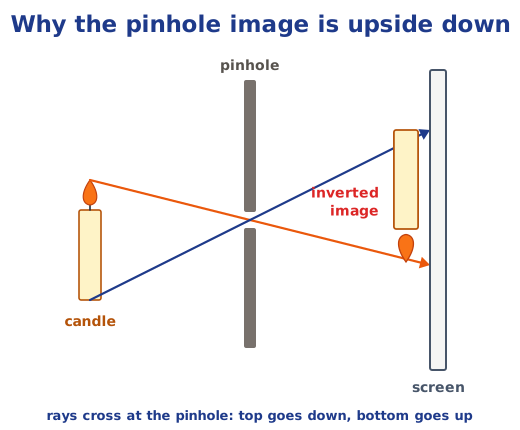
Activity 11.10: do the images show the colours of objects? Are they erect or upside down? The images show the colours of the objects, and they are upside down.
Making some useful items (pages 164–165)
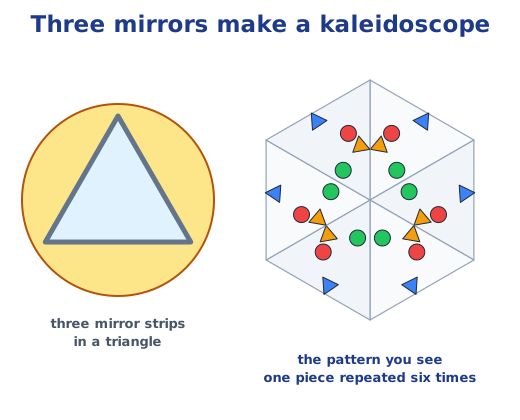
A periscope has two plane mirrors fixed in a Z-shaped box to let us see things that are not directly visible, as in submarines and tanks. A kaleidoscope uses three mirror strips in a triangle; reflections of reflections of coloured pieces make a new pattern each time it is turned.
Let Us Enhance Our Learning (pages 165–167)
1. Which are luminous? The Sun and the Pole Star, which are stars and give out their own light. Mars, the Moon and Venus shine by reflected sunlight, and a mirror only reflects light, so they are non-luminous.
2. Match the columns. Pinhole camera – forms an inverted image; Opaque object – blocks light completely; Transparent object – light passes almost completely through it; Shadow – the dark region formed behind the object.
3. Who can see the candle flame through the pipes? Rekha. Her pipe runs in one straight line to the flame. Sahil’s and Patrick’s pipes join at an angle and Qasima’s joins at a right angle, so no straight path reaches their eyes, and light travels only in straight lines.
4. Which image shows the boy’s shadow correctly? (d). A shadow falls on the side opposite the light source. In (d) the Sun is high on the right and the shadow stretches away to the left. In (a) the Sun is almost straight behind the boy, so the shadow should point straight towards us, not sideways; in (b) the shadow lies right under his feet, which would need the Sun overhead; and in (c) the Sun is on the right but the shadow points straight towards us.
5. Which shadow goes with which scenario? Scenario (i), with the ball close to the torch, gives the larger shadow, (b). Scenario (ii), with the ball close to the wall, gives the smaller shadow, (a).
6. Match the torch positions with the shadows. Torch close to the ball – the shadow would be larger; torch far away – the shadow would be smaller; ball removed – a bright spot would appear on the screen; two torches on the left of the ball – two shadows would appear on the screen.
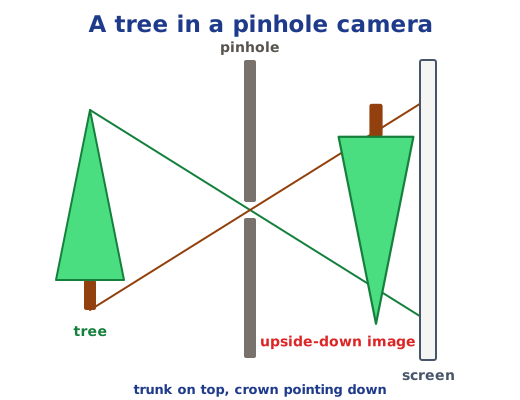
7. Sketch the image of the tree in a pinhole camera. The image is upside down: the trunk at the top and the pointed crown pointing downwards (and left and right are swapped too).
8. Your name in a plane mirror. The image shows the name reversed from left to right: the letters appear in the opposite order and each letter is flipped, so “NEHA” looks like a back-to-front word. The reason is lateral inversion: a plane mirror swaps left and right. The writing is not upside down, because a plane mirror’s image is erect.
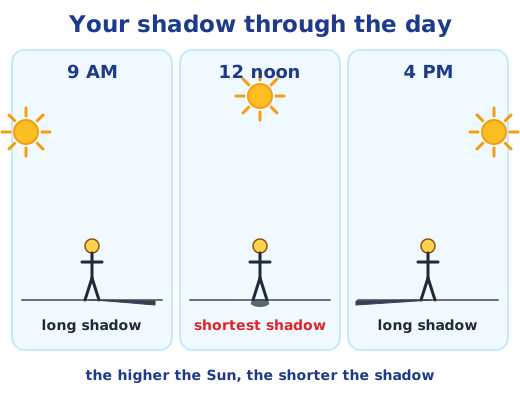
9. Your shadow at 9 AM, 12 PM and 4 PM. Sample observations for a 1.4 m tall student in north India in late October: about 2 m at 9 AM, about 1 m at 12 PM and about 3.5 m at 4 PM; your numbers will depend on the place and the season. (i) The shadow is shortest at 12 PM. (ii) At noon the Sun is highest in the sky, so its light falls steeply and the shadow is short; in the morning and late afternoon the Sun is low, its light comes in at a slant, and the shadow stretches out.
10. Statements A and B. (i) Both statements are true. A plane mirror’s image is laterally inverted, and T and O look the same in a mirror because each is the same on both sides of a vertical middle line, so swapping left and right changes nothing.
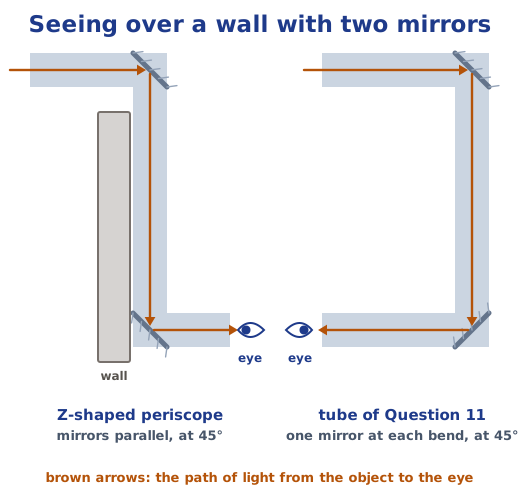
11. Can the bracket-shaped tube be used as a periscope? Where do the mirrors go? Yes. Fix one plane mirror at each bend of the tube, at 45°: at the top bend, sloping so that light coming in through the upper opening is sent down the tube, and at the bottom bend, sloping so that the light is sent out through the lower opening. Looking into the lower opening, you see what is in front of the upper opening. The mirrors only need to be big enough to cover the bend, so mirrors smaller than the tube’s width work.
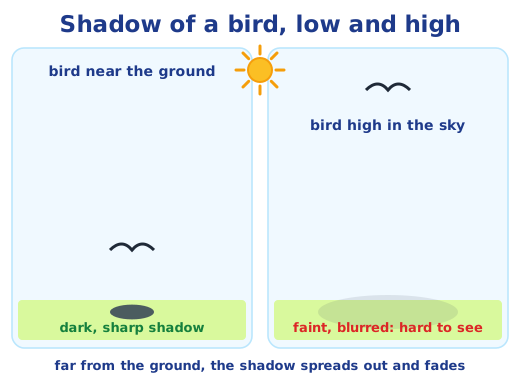
12. Why do we not see the shadow of a bird flying high, but do see it when the bird swoops low? The sharpness and darkness of a shadow depend on where the object is between the light and the screen. When the bird is close to the ground, its shadow is dark and sharp. When it is high in the sky, far from the ground, the shadow spreads out into a very faint, blurred patch that we cannot notice. (Extra) This happens because the Sun is a wide source of light, not a point, so light from different parts of the Sun reaches the ground from slightly different directions and fills in the shadow of a small, distant object.
Exploratory Projects (pages 167–168)
Fireflies where you live. Ask elders whether fireflies were common before. If they have become rare, the reasons the chapter gives are light pollution, the loss of forests and too much tourism; (Extra) pesticides and the drying of wet grassland also harm them. Turn what you learn into a short story, for example about a child who persuades the village to switch off extra lights at night.
A coloured transparent paper over the torch. The lit part of the screen takes the colour of the paper, but the shadow stays dark: no light reaches the shadow, whatever its colour. With papers of different colours, the bright area changes colour and the shadow does not.
Two mirrors at an angle or parallel. Two mirrors at an angle show several images, and the number grows as the angle gets smaller. Parallel mirrors facing each other show a long row of images, each fainter than the last. (Extra) For mirrors at an angle θ, the number of images is about 360°/θ − 1, for example 3 images at 90° and 5 at 60°.
Can a small piece of mirror show a whole large tree? Yes, if you stand back far enough and look at the right angle. The image is as far behind the mirror as the tree is in front, so it looks small enough to fit in the little mirror, just as a whole mountain fits in a pocket mirror.
Practice
-
Which of these lets only part of the light pass through it?
Show answer
Answer: (b) butter paper
-
The Moon is seen at night because it:
Show answer
Answer: (b) reflects sunlight
-
In a plane mirror, the image of your right hand appears as:
Show answer
Answer: (b) the image’s left hand
-
Why does a shadow form behind an opaque object?
Show answer
Answer: Light travels in straight lines and cannot pass through an opaque object or bend around it, so the region behind the object gets no light. That dark region is the shadow.
-
What two things show that the image in a plane mirror is not upside down but laterally inverted?
Show answer
Answer: The image keeps the top of an object at the top, so it is erect, but a raised left arm appears as the image’s right arm and writing appears reversed, so left and right are swapped.
Stuck on a question?
Take a photo and Lagnever AI explains it step by step. Try it for 7 days for ₹2.
Get it on Google Play Open in browser
For parents: after the trial, the plan renews monthly by UPI or card autopay. You can cancel anytime in the app.