
Class 7 Science Chapter 11: Light: Shadows and Reflections Notes
This chapter in five lines
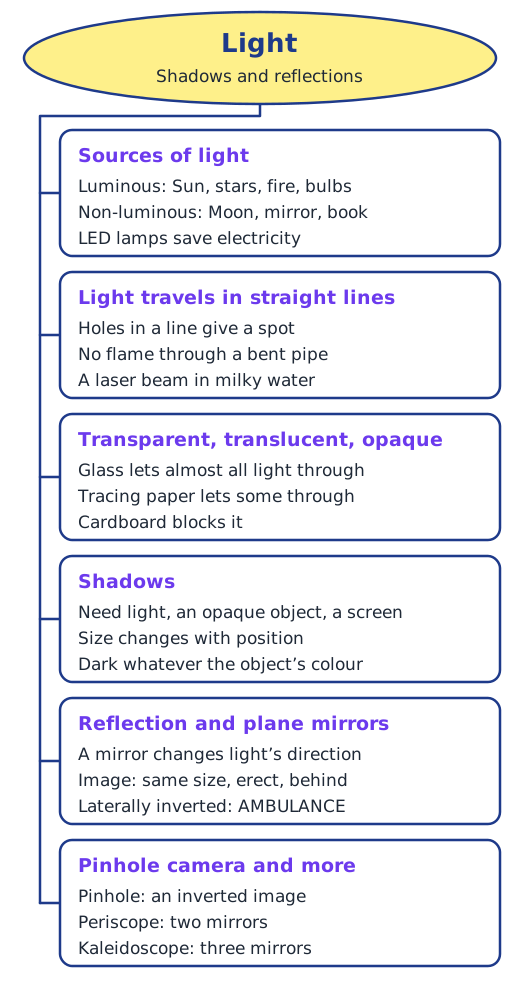
Light: Shadows and Reflections explains how light behaves. Luminous objects such as the Sun give out light; others, like the Moon, only reflect it. Light travels in straight lines, so an opaque object blocks it and casts a shadow. A plane mirror changes the direction of light and forms an upright, same-size, laterally inverted image, while a pinhole camera forms an inverted image.
What is this chapter about?
On a holiday in the Western Ghats, Keshav watches hundreds of fireflies flash in the dark. He learns that these insects talk to one another with light, and that they are disappearing because of light pollution, shrinking forests and too many tourists. On the bus home he looks at the moonlit hills and wonders: does the Moon make its own light? And why do the headlight beams look like straight lines? This chapter answers such questions: where light comes from, how it travels, and what happens when it meets objects and mirrors.
Sources of light
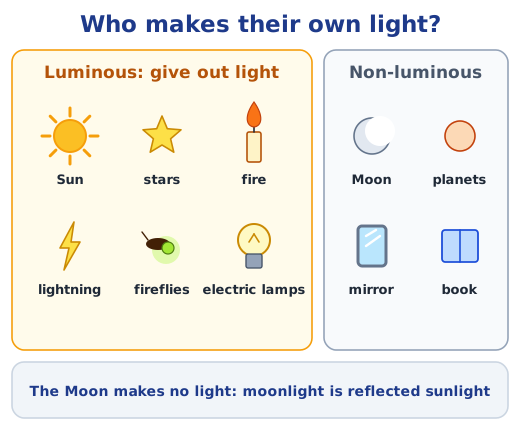
The Sun is our main source of natural light: it emits, or gives out, its own light. Stars, lightning, natural fire and some animals such as fireflies also emit light. People first made light with fire, then with lamps burning oil, wax or gas, and today mostly with electric lamps. Objects that emit their own light are luminous; objects that do not are non-luminous. The Moon is non-luminous: moonlight is sunlight reflected by the Moon. Modern LED lamps need far less electricity, shine brighter and work for longer, but at the end of their life they must be recycled, not thrown in the garbage.
Light travels in a straight line
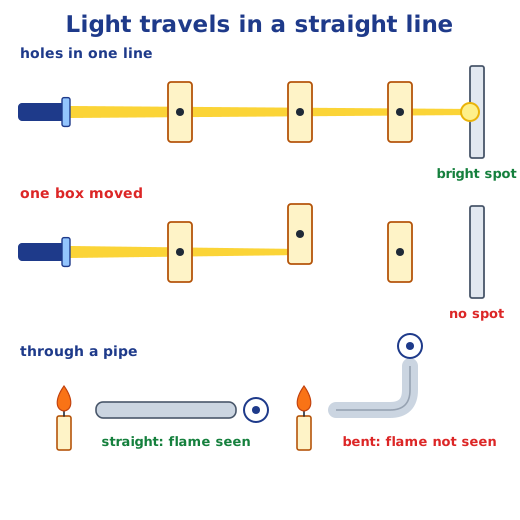
Shine a torch through holes in three matchboxes standing in a line, and a bright spot appears on a screen; move one box slightly and the spot disappears. A candle flame shows at the end of a straight pipe but never at the end of a bent one. A laser beam in water with a drop of milk shows a straight path too. All these show that light travels in a straight line.
Transparent, translucent and opaque
Light passes almost completely through transparent materials such as clear glass, partly through translucent ones such as tracing paper, and not at all through opaque ones such as cardboard. Read more in how shadows are formed.
Shadows
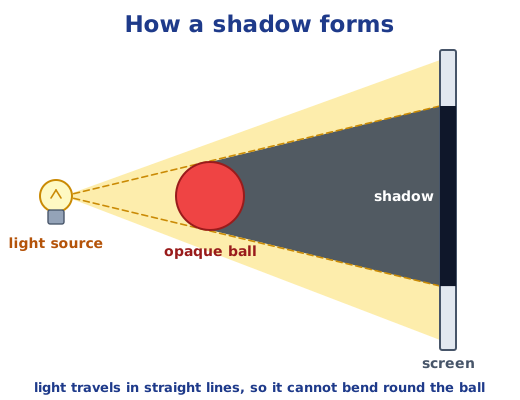
When an opaque object stands in the path of light, it blocks the light, and a dark patch, the shadow, forms on the surface behind it. To see a shadow we need a light source, an opaque object and a screen, such as a wall or the ground. The shadow’s shape, size and sharpness change with the positions of the object, the light and the screen, but its colour does not change with the object’s colour. Translucent objects give lighter shadows. India’s many forms of shadow puppetry, such as Tholu Bommalata in Andhra Pradesh and Ravana Chhaya in Odisha, use this idea.
Reflection and plane mirrors
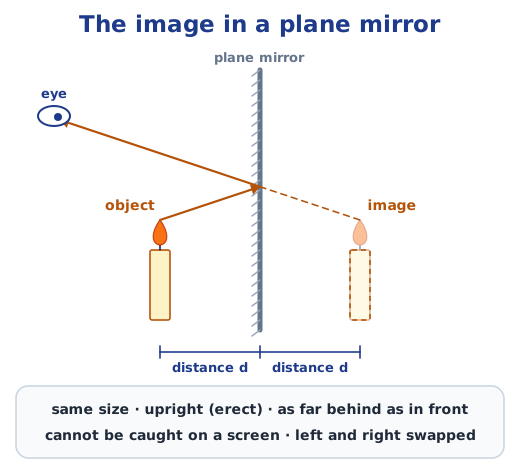
A shiny plate or a mirror can throw a spot of sunlight onto a shaded wall: it changes the direction of light. This is the reflection of light. A flat, or plane, mirror forms an image that is the same size as the object, erect (upright), as far behind the mirror as the object is in front, and cannot be caught on a screen. It is also laterally inverted: left and right swap, which is why AMBULANCE is painted reversed on ambulances. See reflection and plane mirrors.
Pinhole camera, periscope and kaleidoscope
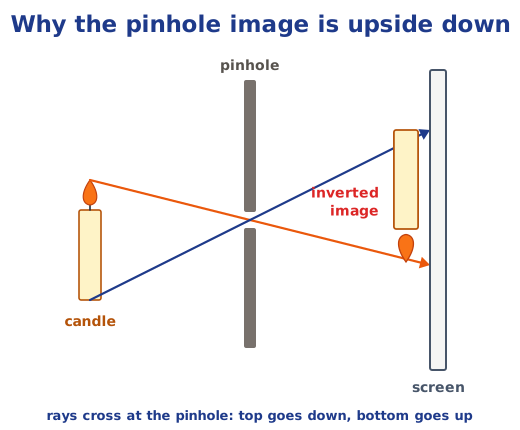
In a pinhole camera, light from an object passes through a tiny hole and forms an image on a screen. The image is inverted, upside down, because rays from the top and bottom of the object cross at the hole. Read the pinhole camera. Mirrors also make useful toys and tools: a periscope uses two plane mirrors to see over walls, and a kaleidoscope uses three to make endless patterns. Every answer is in the NCERT solutions for Chapter 11.
Key terms
| Term | Meaning |
|---|---|
| Luminous object | An object that gives out its own light, such as the Sun, stars, fire, lightning, fireflies and electric lamps. |
| Non-luminous object | An object that does not give out light of its own and is seen only by the light it reflects, such as the Moon, a book or a mirror. |
| Transparent | Letting almost all light pass through, so we can see clearly through it, like clear glass. |
| Translucent | Letting only part of the light pass through, so things behind look hazy, like tracing paper. |
| Opaque | Letting no light pass through, like cardboard, wood or thick cloth. |
| Shadow | The dark patch formed on a surface where an opaque object blocks the light from reaching it. |
| Reflection of light | The change in the direction of light when it falls on a shiny surface such as a mirror. |
| Plane mirror | A mirror with a flat surface, not a curved one. |
| Erect image | An image that is upright, the same way up as the object. A plane mirror forms an erect image. |
| Lateral inversion | The left-right swap in a mirror image: your left hand appears as the right hand of your image. |
| Pinhole camera | A device in which light from an object passes through a tiny hole and forms an inverted image on a screen. |
Topics in this chapter
Practice
-
Which of these is a luminous object?
Show answer
Answer: (c) Firefly
-
Tracing paper is:
Show answer
Answer: (b) translucent
-
To see a shadow we need a light source, an opaque object and:
Show answer
Answer: (b) a screen
-
A plane mirror forms an image that is:
Show answer
Answer: (b) erect and the same size
-
Why is AMBULANCE painted in reverse on the front of ambulances?
Show answer
Answer: (b) So it reads correctly in the rear-view mirrors of vehicles ahead
-
A pinhole camera forms an image that is:
Show answer
Answer: (b) inverted
Questions students ask
What are the main topics of Class 7 Science Chapter 11?
Luminous and non-luminous objects; how light travels in a straight line; transparent, translucent and opaque materials; how shadows form and change; reflection of light; images in a plane mirror and lateral inversion; the pinhole camera; and making a periscope and a kaleidoscope.
Is Light: Shadows and Reflections in the new Class 7 Science book?
Yes. It is Chapter 11 of Curiosity, the Class 7 Science textbook (Reprint 2026-27), on pages 153 to 168.
Does the Moon give out its own light?
No. The Moon is non-luminous: it shines only because it reflects the sunlight falling on it, so moonlight is really reflected sunlight.
Stuck on a question?
Take a photo and Lagnever AI explains it step by step. Try it for 7 days for ₹2.
Get it on Google Play Open in browser
For parents: after the trial, the plan renews monthly by UPI or card autopay. You can cancel anytime in the app.