
How shadows are formed
Answer in short
A shadow forms when an opaque object blocks light. Because light travels in straight lines, it cannot bend around the object, so a dark patch appears behind it on a screen such as a wall or the ground. To see a shadow you need a light source, an opaque object and a screen. Translucent objects give lighter shadows.
Stuck on a question? Take a photo and Lagnever AI explains it step by step. Try it for 7 days for ₹2. Get it on Google Play
Light travels in straight lines
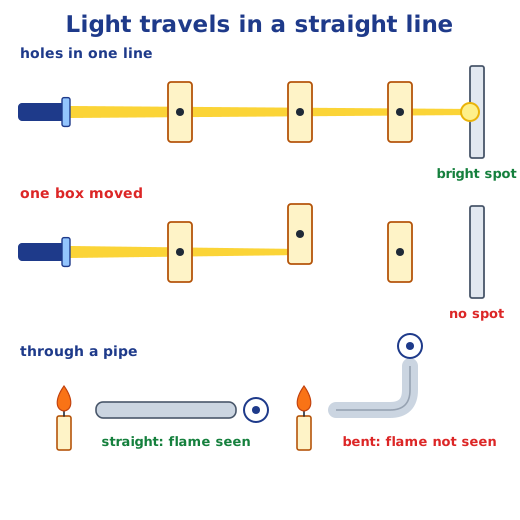
Shadows exist because of one simple fact: light travels in a straight line. You can test it with three matchboxes, each with a hole in its inner tray at exactly the same place. Stand them in a row so that the holes line up, shine a torch through them, and a bright spot appears on a cardboard screen. Nudge one box sideways or up and the spot vanishes, because the light cannot turn to find the next hole. In the same way, a candle flame shows at the end of a straight pipe but never at the end of a bent one. With a teacher’s help, a low-power laser beam shone through water with a drop of milk shows a straight path too. Never point a laser at anyone’s eyes.
Light through different materials
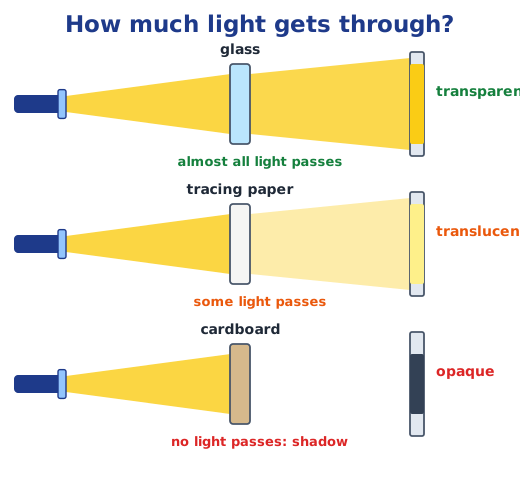
Now put different things in the path of a torch beam in a dark room. Clear glass lets almost all the light through: it is transparent. Tracing paper lets only some through, so the spot is dim: it is translucent. Cardboard, wood or thick cloth let none through: they are opaque.
How a shadow forms
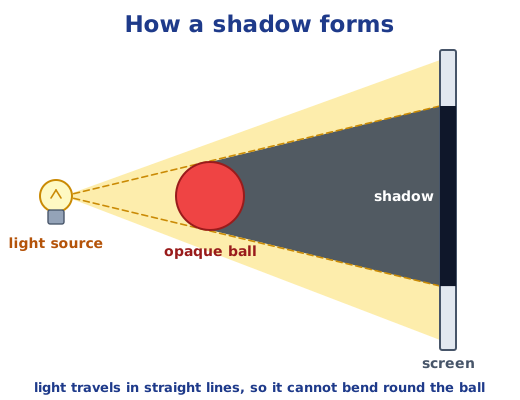
When an opaque object stands in the path of light, the light that strikes it is stopped. Since light cannot bend around the object, the region behind it receives no light, and a dark patch appears on whatever surface lies there. This dark patch is the shadow. So every shadow needs three things: something that gives light, an opaque object in the way, and a screen for the shadow to fall on. In daily life the walls, the floor and the ground act as screens. Opaque objects form dark shadows, translucent objects lighter ones, and even some transparent objects cast faint shadows.
What changes a shadow?
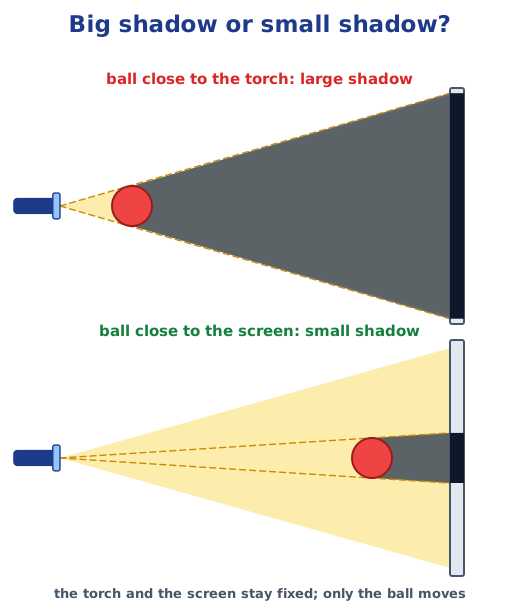
Try changing one thing at a time in the torch set-up. Remove the screen, the object or the light, and the shadow is gone. Move the object towards the torch and the shadow grows larger and fuzzier; move it towards the screen and the shadow shrinks and becomes sharper. Tilt the object and the shadow changes shape, so a shadow may or may not tell you what the object is. Paint the object a different colour, and the shadow stays just as dark.
Shadows around us
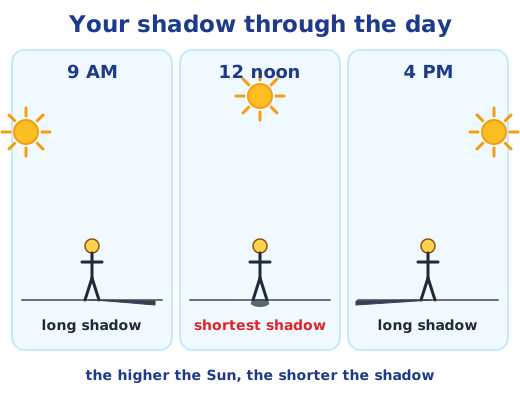
Your own shadow changes through the day. In the morning and evening, when the Sun is low, it is long; at noon, when the Sun is high, it is shortest. A bird flying close to the ground casts a dark, sharp shadow, but a bird high in the sky casts only a faint, blurred one that we hardly notice. Shadows can also be art: shadow puppetry, with flat cut-out figures moved between a lamp and a screen, is an old Indian tradition, from Togalu Gombeyaata in Karnataka to Tholpavakoothu in Kerala.
Why it matters
Knowing that light travels in straight lines explains shadows, sundials and even eclipses. Next, see how mirrors change the direction of light in reflection and plane mirrors, and how a tiny hole makes a picture in the pinhole camera. Answers to the textbook questions are in the NCERT solutions for Chapter 11; see all of Chapter 11 notes.
Practice
-
Which material gives the darkest shadow?
Show answer
Answer: (c) cardboard
-
When a ball is moved closer to the torch, its shadow on the wall becomes:
Show answer
Answer: (b) larger
-
At what time of day is your shadow shortest?
Show answer
Answer: (b) 12 noon
-
Why can you not see a candle flame through a bent pipe?
Show answer
Answer: Light travels only in straight lines. In a bent pipe there is no straight path from the flame to your eye, so the light hits the inside of the pipe and never reaches you.
-
Give two examples each of opaque, translucent and transparent materials.
Show answer
Answer: Opaque: cardboard and wood. Translucent: tracing paper and butter paper. Transparent: clear glass and clean water.
Questions students ask
What is needed to form a shadow?
Three things: a source of light, an opaque object that blocks the light, and a screen, such as a wall, the floor or the ground, on which the dark patch can fall.
Why is a shadow formed?
Light travels in straight lines. When an opaque object stands in its path, the light that hits the object is blocked and cannot bend around it, so the region behind the object gets no light. That dark region is the shadow.
Does the size of a shadow change?
Yes. Moving the object closer to the light makes its shadow larger; moving it closer to the screen makes the shadow smaller and sharper. Tilting the object changes the shadow’s shape.
Stuck on a question?
Take a photo and Lagnever AI explains it step by step. Try it for 7 days for ₹2.
Get it on Google Play Open in browser
For parents: after the trial, the plan renews monthly by UPI or card autopay. You can cancel anytime in the app.