
Pinhole camera
Answer in short
A pinhole camera is a box with a tiny hole on one side and a translucent screen on the other. Light from an object travels in straight lines through the hole onto the screen. Rays from the top of the object land at the bottom and rays from the bottom at the top, so the image is inverted.
Stuck on a question? Take a photo and Lagnever AI explains it step by step. Try it for 7 days for ₹2. Get it on Google Play
What is a pinhole camera?
Mirrors are not the only way to form an image. In a pinhole camera, light from an object passes through a tiny hole, the pinhole, and forms an image on a screen. It needs no lens and no electricity, only darkness around the screen and a bright object to look at. It works because light travels in straight lines.
A candle on a screen
Make a small hole in a piece of cardboard and stand it a short distance from a screen in a dim room. Place a lighted candle in front of the hole, under an adult’s supervision. A small image of the flame appears on the screen, and it holds a surprise: the flame points downwards. The image is inverted, that is, upside down.
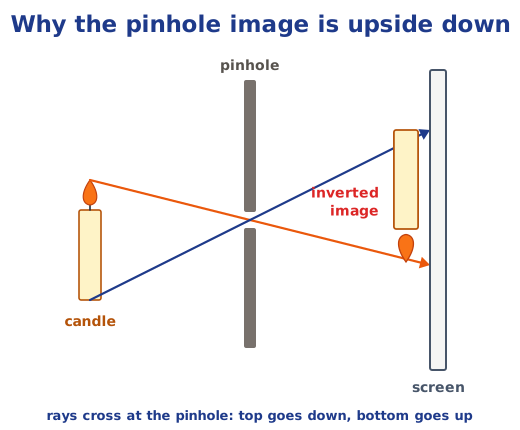
Why the image is upside down
Think of two rays. Light from the tip of the flame travels in a straight line downwards through the hole and lands low on the screen. Light from the foot of the candle travels upwards through the same hole and lands high. Every point of the object sends light through the hole along its own straight line, and all these lines cross at the pinhole. So the top of the object appears at the bottom of the image and the bottom at the top. The same crossing swaps left and right as well. (Extra) The farther the screen is from the hole, the larger and dimmer the image; the nearer, the smaller and brighter.
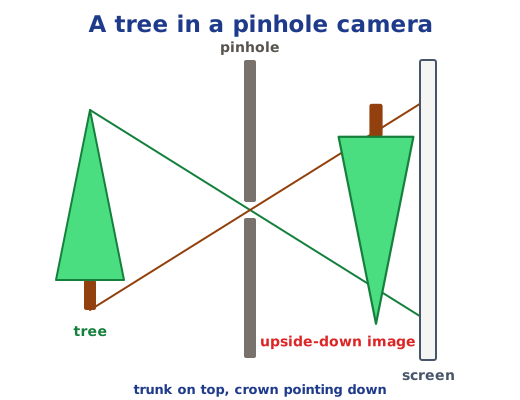
Build a sliding pinhole camera
You can make a pinhole camera to use outdoors:
- Take two cardboard boxes, one of which slides into the other with very little gap. Cut open one side of each.
- Make a small hole at the centre of the larger box’s face opposite its open side.
- In the matching face of the smaller box, cut a window about 5–6 cm square and cover it with tracing paper. This is the screen.
- Slide the smaller box into the larger one, with the tracing paper inside.
- Point the pinhole at a tree or a building in bright sunlight, drape a dark cloth over your head and the camera, and look through the open end. Slide the inner box back and forth until a clear image appears.
The images are in colour, and they are upside down.
Pinhole or mirror?
A pinhole camera and a plane mirror both form images, but different ones. The pinhole image falls on a screen and is upside down. The mirror image cannot be caught on a screen and stays upright, with only left and right swapped. You will learn more about both in higher grades. (Extra) The same effect happens in nature: gaps between leaves act like pinholes, so during a partial solar eclipse the patches of sunlight under a tree become little crescent images of the Sun.
Why it matters
The pinhole camera is the simplest camera of all, and it shows clearly that light travels in straight lines. Revise how shadows are formed and compare mirror images in reflection and plane mirrors. Answers to the textbook questions are in the NCERT solutions for Chapter 11; see all of Chapter 11 notes.
Practice
-
The image in a pinhole camera is:
Show answer
Answer: (b) inverted
-
In the sliding pinhole camera, the screen is made of:
Show answer
Answer: (b) tracing paper
-
The image in a pinhole camera is inverted because:
Show answer
Answer: (b) light travels in straight lines that cross at the hole
-
Do the images in a pinhole camera show colours?
Show answer
Answer: Yes. Light from each part of the object keeps its colour as it passes through the pinhole, so green leaves give a green image and a candle flame an orange one.
-
How is a pinhole camera image different from a plane mirror image?
Show answer
Answer: A pinhole camera forms an inverted (upside-down) image on a screen. A plane mirror forms an erect image that is only laterally inverted, and it cannot be caught on a screen.
Questions students ask
What is a pinhole camera?
A pinhole camera is a simple device in which light from an object passes through a tiny hole and forms an image on a screen, usually inside a box that keeps out other light.
How do you make a pinhole camera at home?
Take two cardboard boxes that slide into each other and cut one side off each. Make a small hole in the middle of the face opposite the open side of the larger box. Cut a 5–6 cm square window in the matching face of the smaller box and cover it with tracing paper. Slide the smaller box in, tracing paper inside, and look through the open end at a bright object.
Why is the image in a pinhole camera upside down?
Light travels in straight lines. Rays from the top of the object pass down through the hole and land at the bottom of the screen, and rays from the bottom pass up and land at the top. The rays cross at the pinhole, so the image is inverted.
Stuck on a question?
Take a photo and Lagnever AI explains it step by step. Try it for 7 days for ₹2.
Get it on Google Play Open in browser
For parents: after the trial, the plan renews monthly by UPI or card autopay. You can cancel anytime in the app.