
Reflection and plane mirrors
Answer in short
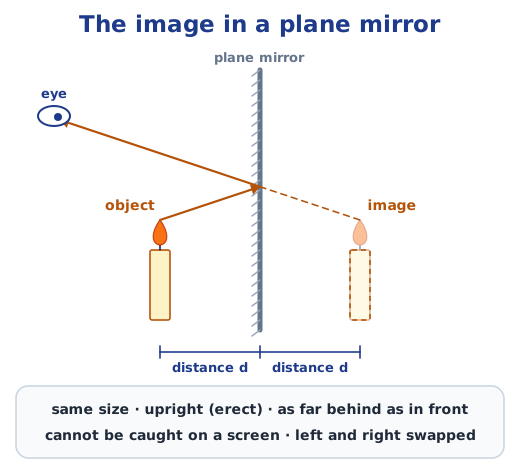
Reflection is the change in direction of light at a shiny surface such as a mirror. A plane mirror forms an image that is the same size as the object, erect, as far behind the mirror as the object is in front, and it cannot be caught on a screen. It is also laterally inverted: left and right swap.
Stuck on a question? Take a photo and Lagnever AI explains it step by step. Try it for 7 days for ₹2. Get it on Google Play
Mirrors change the direction of light
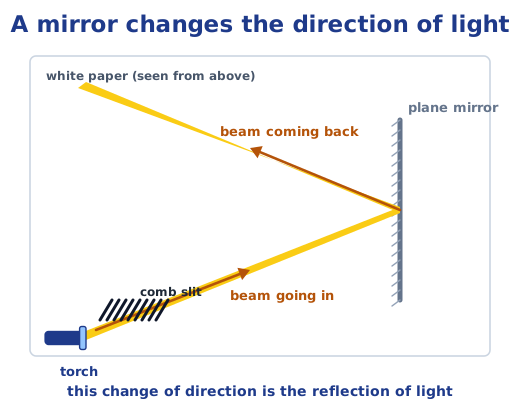
Hold a shiny steel plate or a flat mirror in sunlight and turn it: a patch of light jumps onto a wall that the Sun does not reach. Tilt the mirror and the patch moves. Light still travels in straight lines, but on meeting the shiny surface it sets off in a new direction. We call this turning of light by a mirror the reflection of light. A mirror with a flat surface, rather than a curved one, is a plane mirror.
A beam meets a mirror
To watch reflection closely, cover all the gaps of a comb with black paper except one, so that it makes a single thin slit. Lay a white sheet on a table, stand the comb upright on it and shine a torch through the slit: a thin beam of light runs across the paper. Now place a plane mirror in its path. The beam strikes the mirror and comes back along a new line. That is reflection at the mirror.
The image in a plane mirror
Put a pen in front of a plane mirror and a second pen seems to stand behind the glass. That apparent pen is the image; the real pen is the object. Move the pen around and you find that the image is always the same size as the pen, and always erect, the right way up. Try catching the image on a sheet of paper behind or in front of the mirror: it never appears there, because no light actually reaches the place behind the mirror. Next, stand at different distances from a mirror. Step closer and your image comes closer; step back and it moves away. The image is always as far behind the mirror as you are in front of it.
Left and right swap
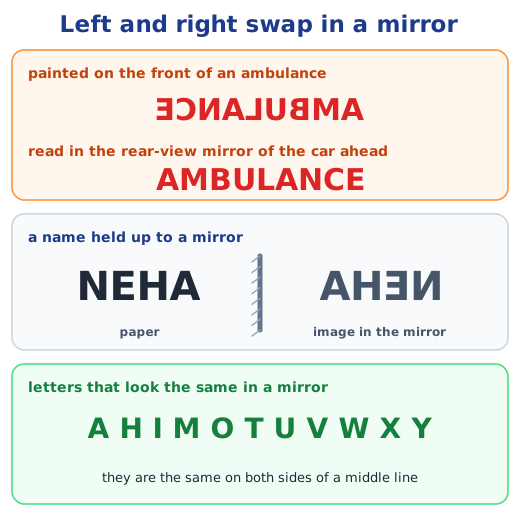
Raise your left arm in front of a mirror and the image raises the arm on its right side; touch your right ear and the image touches its left ear. This left-right swap is called lateral inversion. It is why AMBULANCE is painted reversed on the front of ambulances: in the rear-view mirror of the vehicle ahead, the word reads correctly. Hold a paper with your name up to a mirror and the letters appear reversed, though letters such as A, H, O and T, which are the same on both sides, look unchanged. Long before glass mirrors, people polished stone or metal to see themselves; in Kerala, the metal mirrors called Aranmula Kannadi are still made today.
Periscopes and kaleidoscopes
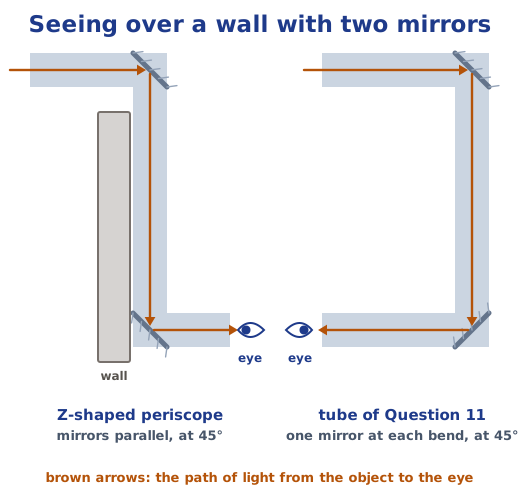
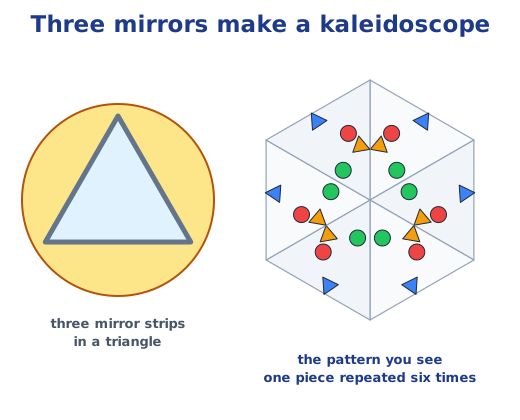
Two plane mirrors fixed at 45° in a Z-shaped tube make a periscope. Light from an object enters the top, reflects off the upper mirror down the tube and off the lower mirror into your eye, so you see objects you could not see directly. Submarines, tanks and soldiers in bunkers use periscopes, and you can use one to see over taller friends. Three mirror strips joined in a triangle make a kaleidoscope: pieces of coloured bangles at one end are reflected again and again, so a new symmetric pattern appears every time you turn the tube.
Why it matters
Mirrors are everywhere: in bathrooms, vehicles, shops and scientific instruments. Compare the mirror image with the upside-down picture in the pinhole camera, and revise how shadows are formed. Answers to the textbook questions are in the NCERT solutions for Chapter 11; see all of Chapter 11 notes.
Practice
-
Which is NOT true of the image in a plane mirror?
Show answer
Answer: (c) It can be caught on a screen
-
You stand 2 m in front of a plane mirror. How far are you from your image?
Show answer
Answer: (c) 4 m The image is 2 m behind the mirror, so it is 2 + 2 = 4 m from you.
-
Which letter looks the same in a plane mirror?
Show answer
Answer: (c) H
-
How does a periscope work?
Show answer
Answer: A periscope has two plane mirrors fixed at 45°, parallel to each other, in a Z-shaped tube. Light from an object enters the top opening, reflects down off the top mirror and then off the bottom mirror into the eye, so you can see over a wall or a crowd.
-
Why do you see changing patterns in a kaleidoscope?
Show answer
Answer: Its three mirror strips, joined in a triangle, reflect the coloured pieces again and again, making reflections of reflections. The pieces appear many times in a symmetric pattern, and turning the tube moves them into a new pattern.
Questions students ask
What is reflection of light?
Reflection is the change in the direction of light when it falls on a shiny surface such as a mirror or a polished steel plate. That is how a mirror can throw a spot of sunlight onto a wall in the shade.
What are the features of an image in a plane mirror?
It is the same size as the object, erect (upright), as far behind the mirror as the object is in front, laterally inverted (left and right swapped), and it cannot be obtained on a screen.
What is lateral inversion?
It is the left-right swap in a mirror image: when you raise your left arm, your image seems to raise its right arm. That is why AMBULANCE is painted reversed on ambulances, so that drivers ahead read it correctly in their rear-view mirrors.
Stuck on a question?
Take a photo and Lagnever AI explains it step by step. Try it for 7 days for ₹2.
Get it on Google Play Open in browser
For parents: after the trial, the plan renews monthly by UPI or card autopay. You can cancel anytime in the app.