
NCERT Solutions Class 7 Science Chapter 12: Earth, Moon, and the Sun
Answers to every question in Chapter 12, Earth, Moon, and the Sun, of Curiosity, the Class 7 Science textbook (Reprint 2026-27): the questions in the text, Activities 12.1–12.4 with sample observations, all 12 “Let Us Enhance Our Learning” questions and the three exploratory projects. Page numbers follow the book (pages 169–186). Short notes: Chapter 12 notes.
Rashmika’s question (page 169)
Does the Sun move in the sky, or does the Earth move? The Earth moves. It rotates on its axis from West to East, and from this turning Earth the Sun only seems to cross the sky from East to West. The shadows Rashmika saw change for the same reason. In the morning the Sun is low in the East, so shadows are long; around noon it is high, so shadows are short; in the evening it is low in the West, and shadows grow long again.
Rotation of the Earth (pages 170–175)
Activity 12.1: do the objects around you seem to move on a merry-go-round? Yes. When the merry-go-round turns anti-clockwise, the objects around seem to turn the opposite way, clockwise. A tree you watch is not in view all the time: it comes in from your left and goes out of view on your right.
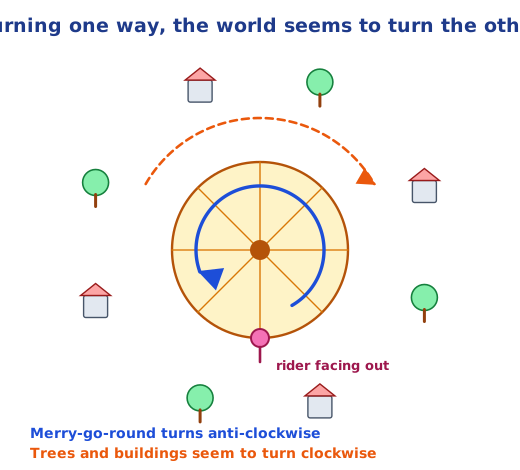
Is the Sun moving, or is the Earth turning? The Earth is turning. Just as the trees seem to move when we ride the merry-go-round, the Sun seems to move because we watch it from the rotating Earth.
Activity 12.2: in which direction must the globe turn for eastern India to get light first? From West to East, about its North–South axis. Turning that way, your marked location goes through a full cycle: sunrise as it moves into the light, day, sunset as it moves into darkness, and night.
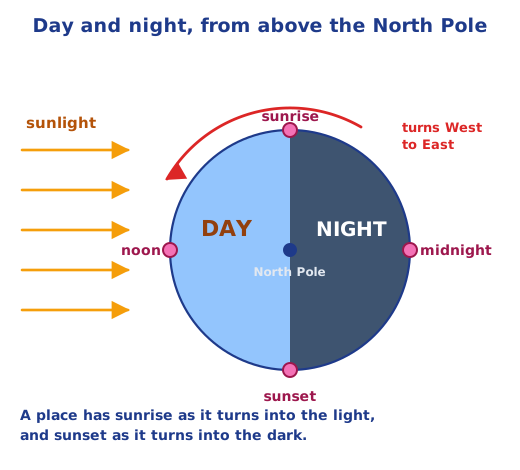
Standing on the Equator for one rotation, what would you see? Is it the same as the girl in Fig. 12.6? Yes, the same. Facing north, you would see the Sun rise on your right, in the East, in the morning; around noon it would be overhead; in the evening it would set on your left, in the West. Then night would fall and the stars would come out.
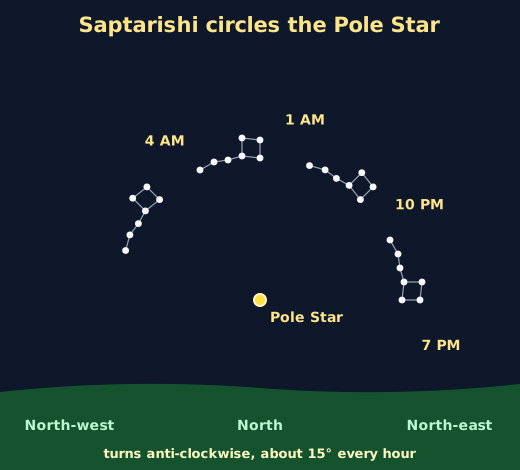
Shouldn’t the stars also seem to move, since the Earth rotates? Yes. The stars too seem to rise in the East and set in the West, as Activity 12.3 shows.
Activity 12.3: does the Big Dipper seem to move around the Pole Star? Yes. Sample observations from north India on an April night: at 8 pm the Big Dipper is low in the north-east; by 10 pm it has climbed higher and turned; by midnight it is high above the Pole Star. It moves anti-clockwise around the Pole Star by about 30° every 2 hours, while the Pole Star itself hardly moves, because the Earth’s axis points almost at it.
Revolution of the Earth (pages 175–179)
Why do different stars appear in the night sky over the year? Because the Earth revolves around the Sun. The night side of the Earth always faces away from the Sun, so as the Earth moves along its orbit, the night side looks out at a different part of space. The stars that rise at sunset therefore change from month to month, and the same ones return after a year.
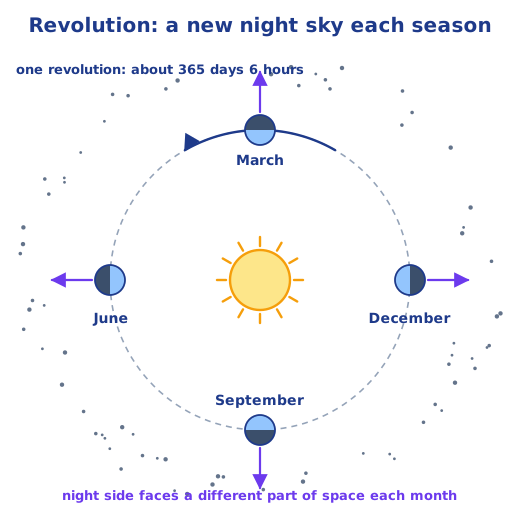
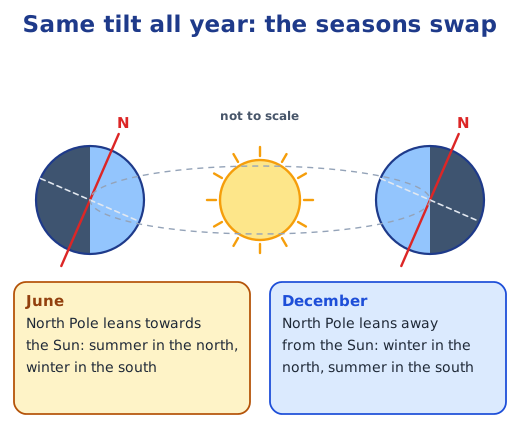
Is the cycle of seasons related to the Earth’s revolution? Why are summer days longer? Yes. As the Earth revolves with its tilted axis, each hemisphere in turn leans towards the Sun. The hemisphere leaning towards the Sun gets more concentrated sunlight and spends more than half of each rotation in the light, so its days are longer than 12 hours and it has summer.
Eclipses (pages 179–183)
Could Mercury or Venus block the Sun’s light? No. Though both are bigger than the Moon, they are much farther from us, so they look tiny next to the Sun. Venus passing in front of the Sun appears only as a small black dot, a Transit of Venus. Only the Moon can block the Sun completely.
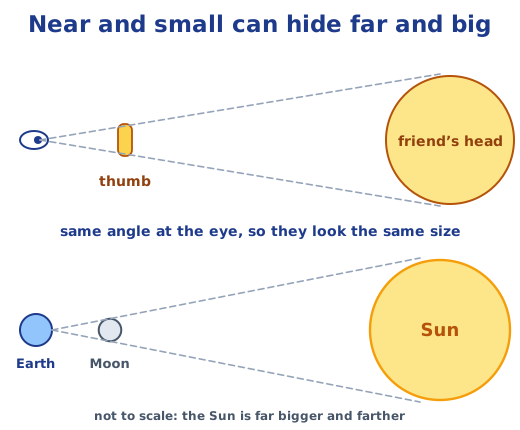
Activity 12.4: can your thumb cover your friend’s head 5 metres away? Yes. The thumb is much smaller than the head but much nearer the eye, so both look about the same size. The size something appears to have depends on both its real size and its distance.
Let Us Enhance Our Learning (pages 184–186)
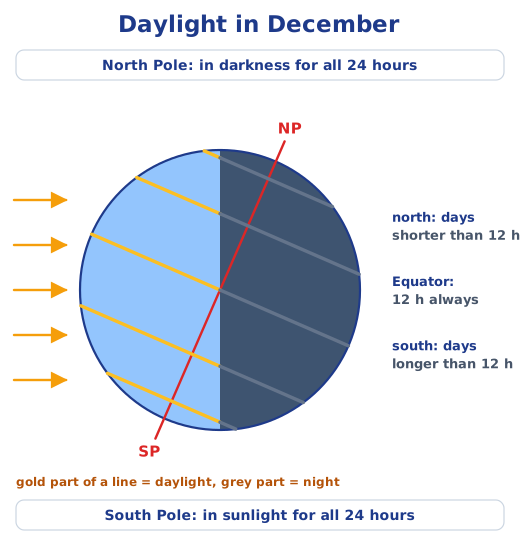
1. In Fig. 12.17, how many hours of sunlight do the North Pole and the South Pole receive in one rotation? In the figure the North Pole leans away from the sunlight and stays inside the dark half all the way round, so it gets 0 hours of sunlight. The South Pole leans into the lit half and stays there, so it gets 24 hours of sunlight. This is the Earth around December.
2. Fill in the blanks. (i) Stars rise in the East and set in the West. (ii) Day and night are caused by the Earth’s rotation. (iii) When the Moon fully covers the Sun from our view, it is called a total solar eclipse.
3. True or False.
- (i) False. A lunar eclipse happens when the Earth comes between the Sun and the Moon.
- (ii) False. The Earth rotates from West to East, so places in the east get sunlight first. Jharkhand is east of Gujarat, so sunrise is earlier in Jharkhand.
- (iii) True. Chennai is in the Northern Hemisphere, so its longest day comes at the summer solstice, around 21 June.
- (iv) False. Never watch a solar eclipse with the naked eye; it can damage the eyes.
- (v) True.
- (vi) False. Day and night are caused by the Earth’s rotation, not its revolution.
4. Padmashree saw Orion overhead at 8 pm yesterday. When will she see it overhead today? At almost the same time, about 8 pm. More exactly, about 4 minutes earlier, around 7:56 pm, because the Earth turns once with respect to the stars in about 23 hours 56 minutes, as Aryabhata worked out, and not in 24 hours.
5. Nandhini saw a group of stars rising at midnight on 21 June. When will she see them rising at midnight next year? On 21 June next year. After one full revolution, about 365 days, the Earth is back at the same point in its orbit, so the night sky at midnight looks the same again.
6. Why is it night in the USA when it is day in India? Because of the Earth’s rotation. India and the USA lie on nearly opposite sides of the Earth. When India faces the Sun and has day, the USA faces away from the Sun and has night. (Extra) The time difference is about 9½ to 12½ hours, depending on the part of the USA.
7. Who was being careless? Adithya (iii), who looked at the Sun directly. That can damage the eyes and even cause blindness. Goggles, a projected image and a planetarium event are all safe.
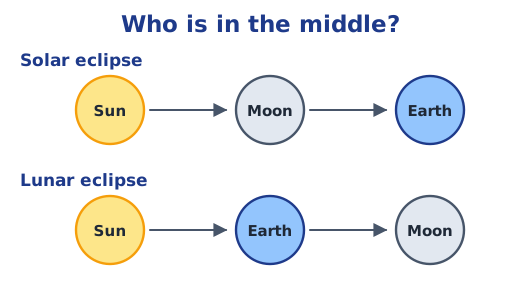
8. Fill in the circles in Fig. 12.18. Solar eclipse: Sun, Moon, Earth (the Moon in the middle). Lunar eclipse: Sun, Earth, Moon (the Earth in the middle).
9. The Moon is much smaller than the Sun. How can it block the Sun completely? How big something looks depends on its size and its distance. The Moon is much smaller than the Sun but also much closer to us, so in our sky both look about the same size, and the Moon can cover the whole Sun, like a thumb hiding a head. (Extra) The Sun is about 400 times wider than the Moon, and also about 400 times farther away.
10. Winter or summer clothes for matches in Australia in December? Summer clothes. Australia is in the Southern Hemisphere, where the seasons are the reverse of India’s: December is summer there.
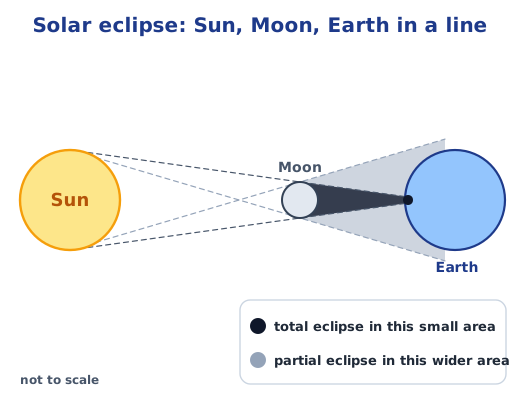
11. Why is a lunar eclipse seen from a large part of the Earth, but a total solar eclipse from only a small part? In a lunar eclipse the Earth’s shadow covers the Moon itself, so everyone on the night side of the Earth who can see the Moon sees it darken, about half the Earth at once. In a solar eclipse the Moon is small, so the darkest part of its shadow covers only a small area of the Earth, and only people there see a total eclipse; around them a wider area sees a partial one.
12. If the Earth’s axis were not tilted, what would happen to the seasons? There would be almost no seasons. Every place would have about 12 hours of day and 12 of night all year, and the strength of its sunlight would stay nearly the same, so each place would have much the same weather throughout the year. Places near the Equator would stay warm and places near the poles cold.
Exploratory projects (page 186)
1. A tilted globe around a lamp. Keep the globe’s tilt pointing the same way while you move it round the lamp. (i) Where the North Pole leans towards the lamp, more of the Northern Hemisphere is lit; where it leans away, more of the Southern Hemisphere is lit; at the two positions in between, both are lit equally. (ii) Turning the globe, the lit hemisphere has days longer than nights, the other has shorter days, and the Equator always has equal day and night. (iii) At the in-between positions, day and night are equal everywhere, like the equinoxes, and the pole leaning towards the lamp stays lit all the way round.
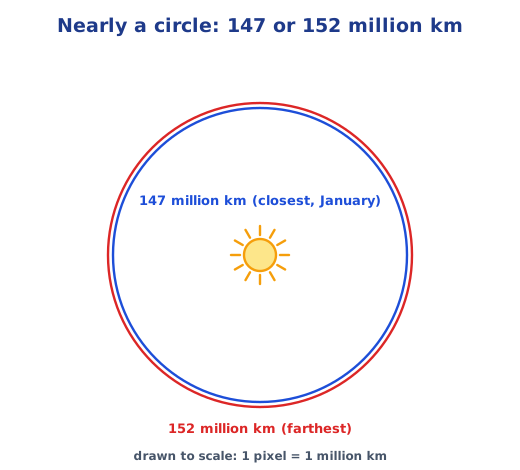
2. Two circles of 14.7 cm and 15.2 cm. With 1 cm for 10 million km, they show the closest and farthest distances of the Earth from the Sun, 147 million km and 152 million km. The circles almost overlap: the difference is only 5 million km, about 3%. The orbit is nearly a circle, and this small change cannot cause seasons; the Earth is in fact closest to the Sun in January.
3. More tilt, more extreme seasons? Uranus. Yes: with a bigger tilt, each hemisphere would lean further towards the Sun in summer and further away in winter, giving hotter summers, colder winters, and more places with 24-hour day or night. (Extra) Uranus is tilted by about 98°, so it spins almost on its side. Its year lasts about 84 Earth years, so each pole gets about 42 years of sunlight followed by 42 years of darkness. Use these facts for your article.
Practice
-
Which motion of the Earth causes the change of seasons, along with its tilt?
Show answer
Answer: (b) Revolution
-
On the equinoxes, how long is the daytime?
Show answer
Answer: (a) About 12 hours
-
During a lunar eclipse, which body is in the middle?
Show answer
Answer: (c) The Earth
-
A star rose at 9 pm tonight. At about what time will it rise tomorrow?
Show answer
Answer: About 4 minutes earlier, at about 8:56 pm, because the Earth turns once with respect to the stars in about 23 hours 56 minutes.
-
When it is noon in India, is it day or night on the opposite side of the Earth?
Show answer
Answer: Night. The side of the Earth facing the Sun has day and the opposite side faces away from it, so it has night, around midnight.
Stuck on a question?
Take a photo and Lagnever AI explains it step by step. Try it for 7 days for ₹2.
Get it on Google Play Open in browser
For parents: after the trial, the plan renews monthly by UPI or card autopay. You can cancel anytime in the app.