
Class 7 Science Chapter 12: Earth, Moon, and the Sun Notes
This chapter in five lines
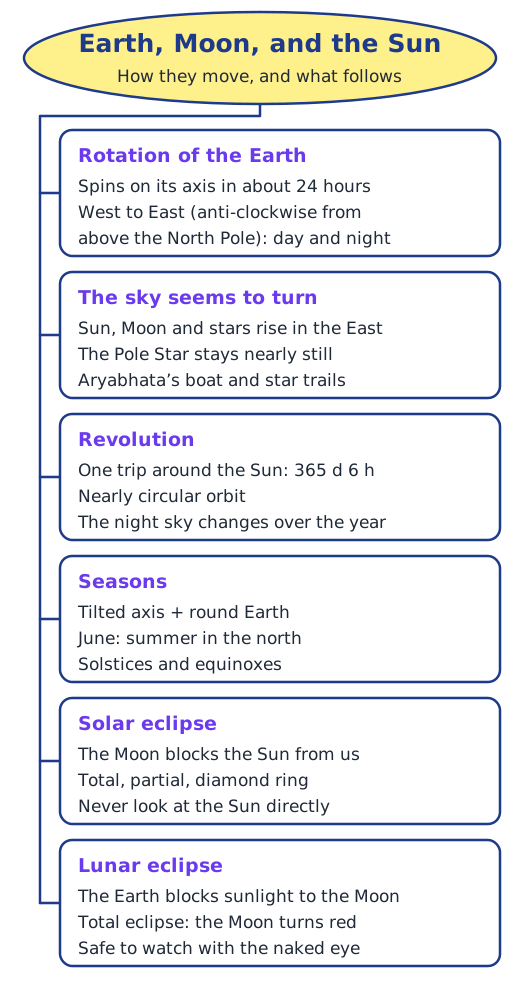
Earth, Moon, and the Sun explains how the Earth moves and what follows. The Earth rotates on its axis from West to East in about 24 hours, giving day and night and making the Sun and stars seem to move across the sky. It circles the Sun in about 365 days, and its tilted axis brings the seasons. The Moon and the Earth cause solar and lunar eclipses.
What is this chapter about?
In Kanniyakumari, Rashmika notices that coconut-tree shadows are long when she cycles to school and short when she rides home. Does the Sun move across the sky, or does the Earth move? This last chapter of the book answers her. It shows how the Earth spins and travels, and how those two motions explain day and night, the turning of the stars, the seasons and eclipses.
The Earth rotates
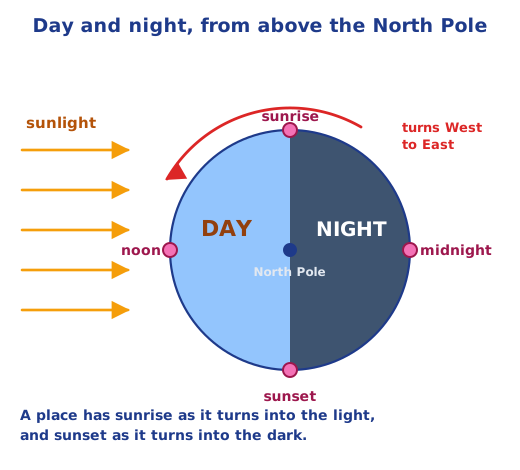
On a merry-go-round turning anti-clockwise, the world around you seems to turn clockwise. The Earth is the same. It rotates on its axis, a line through the North and South Poles, once in about 24 hours, turning anti-clockwise as seen from above the North Pole, that is, from West to East. The half facing the Sun has day and the other half has night, and each place has sunrise as it turns into the light. Because we turn West to East, the Sun, the Moon and the stars seem to rise in the East and set in the West. Read more in rotation and revolution of the Earth.
The sky seems to turn
At night the stars also move across the sky, all except the Pole Star (Dhruva Tara), which stays nearly still because the Earth’s axis points almost at it. Saptarishi, the Big Dipper, circles around it through the night. Long-exposure photographs show the stars drawing arcs called star trails. Aryabhata explained this around the 5th century CE: from a boat moving forward, things on the shore seem to move back, and in the same way the fixed stars seem to move west. A 22-metre Foucault pendulum in India’s new Parliament building shows the Earth’s rotation too.
The Earth revolves
While it spins, the Earth also revolves around the Sun in a nearly circular orbit, taking about 365 days and 6 hours. Its night side faces a different part of space as the months pass, so the stars that rise at sunset change through the year. The Bhil and Pawara communities of the Tapi valley used the appearance of certain stars to know that the monsoon was near.
Why seasons happen
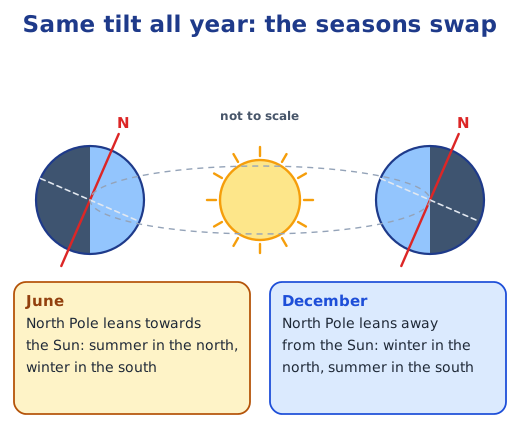
The Earth’s axis is tilted, and it keeps the same tilt all the way round its orbit. In June the Northern Hemisphere leans towards the Sun, so its sunlight is more concentrated and its days are longer than 12 hours: it is summer there, and winter in the Southern Hemisphere. In December the situation reverses. The longest northern day, around 21 June, is the summer solstice; day and night are equal at the equinoxes in March and September. Distance from the Sun is not the cause: the Earth comes nearest the Sun in January. See seasons on the Earth.
Eclipses
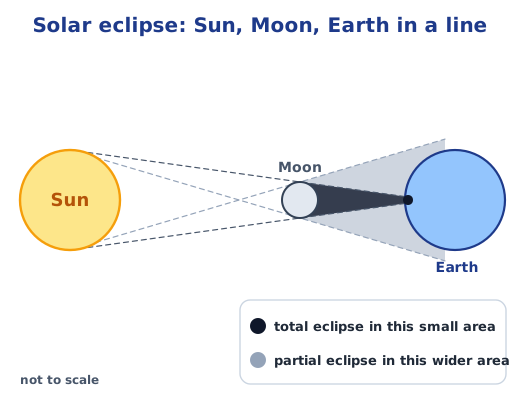
Mercury and Venus pass between us and the Sun but look far too small to hide it. The Moon, small but near, looks about as big as the Sun, so it can cover it. In a solar eclipse the Moon blocks the Sun’s light from a small area of the Earth, which sees a total eclipse, while a wider area sees a partial one. Never look at it directly. In a lunar eclipse the Earth’s shadow falls on the full Moon, which can turn dark red, and it is safe to watch. Read solar and lunar eclipses, and find answers to every question in the NCERT solutions for Chapter 12.
Key terms
| Term | Meaning |
|---|---|
| Rotation | Spinning on an axis, so that every part moves in a circle around an imaginary line through the object. The Earth rotates once in about 24 hours. |
| Axis of rotation | The imaginary line an object spins around. The Earth’s axis passes through the North Pole and the South Pole and is tilted with respect to its orbit. |
| Revolution | The motion of one object around another. The Earth revolves around the Sun once every 365 days and 6 hours or so. |
| Orbit | The path an object follows as it revolves around another. Seen from above, the Earth’s orbit around the Sun is nearly a circle. |
| Apparent motion | Motion that something only seems to have because we are moving. The Sun, Moon and stars seem to move from East to West because the Earth turns from West to East. |
| Pole Star (Dhruva Tara) | A star almost exactly in line with the Earth’s axis in the north, so it seems to stay still while the other stars circle around it. |
| Solstice | The day of the longest or shortest daytime in the year: in the Northern Hemisphere, the summer solstice is around 21 June and the winter solstice around 22 December. |
| Equinox | A day when daytime and night-time are 12 hours each everywhere, around 21 March (spring equinox) and 23 September (autumn equinox). |
| Solar eclipse | When the Moon comes between the Sun and the Earth and blocks the Sun’s light from part of the Earth. It is total where the Sun is fully hidden and partial where it is partly hidden. |
| Lunar eclipse | When the Earth comes between the Sun and the Moon and its shadow falls on the full Moon. In a total lunar eclipse the Moon looks dark red. |
Topics in this chapter
Practice
-
In which direction does the Earth rotate?
Show answer
Answer: (b) West to East
-
What causes day and night?
Show answer
Answer: (b) The Earth’s rotation
-
About how long does the Earth take to go once around the Sun?
Show answer
Answer: (c) 365 days and 6 hours
-
In a solar eclipse, which body is in the middle?
Show answer
Answer: (c) The Moon
-
Which of these is safe to watch with the naked eye?
Show answer
Answer: (c) A lunar eclipse
-
In December, which hemisphere has summer?
Show answer
Answer: (b) The Southern Hemisphere
Questions students ask
What are the main topics of Class 7 Science Chapter 12?
The rotation of the Earth and day and night; the apparent motion of the Sun, Moon and stars, with the Pole Star and the Big Dipper; the revolution of the Earth and the changing night sky; seasons, solstices and equinoxes; and solar and lunar eclipses, with how to watch them safely.
Is Earth, Moon, and the Sun in the new NCERT Curiosity book?
Yes. It is Chapter 12, the last chapter, of Curiosity, the Class 7 Science textbook (Reprint 2026-27), on pages 169 to 186. It builds on the chapter Beyond Earth in the Class 6 Curiosity book.
Why does the Sun seem to rise in the East?
Because the Earth turns from West to East. As our side of the Earth turns towards the Sun, the Sun comes into view on the eastern side, crosses the sky and goes out of view in the West. The Sun is not moving across our sky; we are turning.
Stuck on a question?
Take a photo and Lagnever AI explains it step by step. Try it for 7 days for ₹2.
Get it on Google Play Open in browser
For parents: after the trial, the plan renews monthly by UPI or card autopay. You can cancel anytime in the app.