
Rotation and revolution of the Earth
Answer in short
Rotation is the Earth spinning on its own axis, from West to East, once in about 24 hours; it causes day and night and makes the Sun, Moon and stars seem to move from East to West. Revolution is the Earth’s journey around the Sun along a nearly circular orbit, which takes about 365 days and 6 hours.
Stuck on a question? Take a photo and Lagnever AI explains it step by step. Try it for 7 days for ₹2. Get it on Google Play
Does the Sun move, or the Earth?
Every day the Sun rises in the East, crosses the sky and sets in the West. It is natural to think the Sun is travelling. But in Class 6 you learnt that the Earth moves. So which is it? A ride on a merry-go-round gives the answer.
Lessons from a merry-go-round
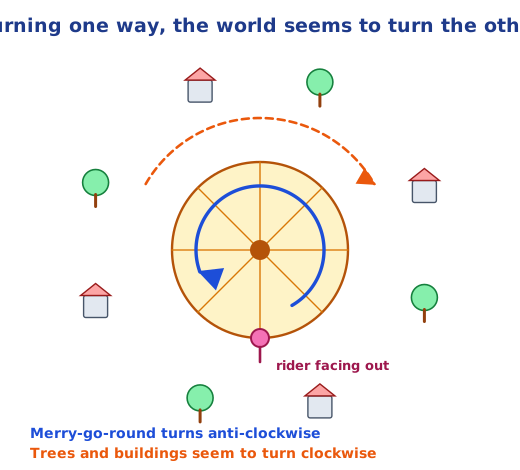
Sit on a merry-go-round facing outwards and let someone turn it slowly anti-clockwise. The trees and buildings around you seem to swing past the other way, clockwise. A tree you are watching appears from your left, passes in front of you and disappears on your right, though it never moved. The Sun behaves the same way. It seems to move from East to West because we watch it from an Earth that is turning.
The spinning Earth
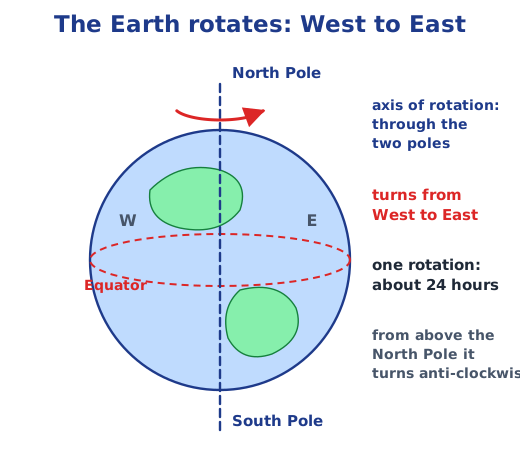
Like a top, a fan or a spinning ball, the Earth rotates on its own axis: every part moves in a circle around an imaginary line through it. The Earth’s axis passes through the geographic North Pole and South Pole, and one rotation takes about 24 hours. Seen from above the North Pole, the Earth turns anti-clockwise, that is, from West to East.
Day and night
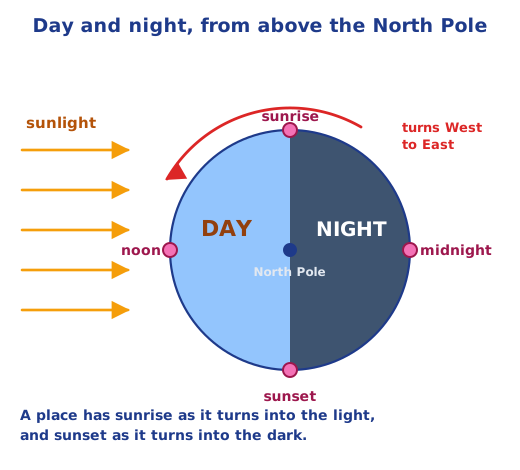
In a dark room, shine a torch on a globe from about 1.5 metres away. Only the half facing the torch is lit; the other half is dark. On the Earth, the lit half has day and the dark half has night. Turn the globe from West to East and watch a sticker marking your town: it moves into the light (sunrise), faces the torch (noon), moves into darkness (sunset), and comes round again. That is why eastern India sees the sunrise first. To someone on the Equator, the Sun appears in the East in the morning, is overhead around noon and sinks in the West in the evening, after which the stars come out.
The turning sky
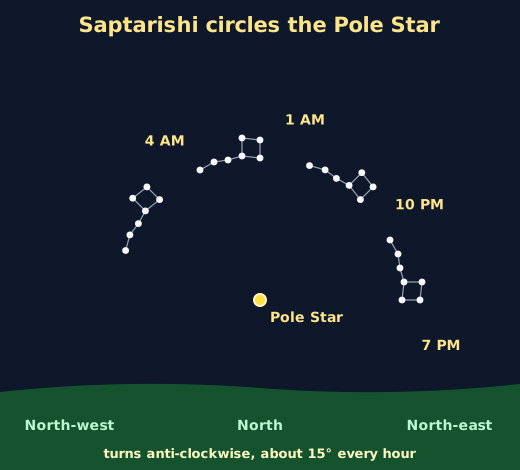
The stars too seem to rise in the East and set in the West. Watch the Big Dipper, Saptarishi, every two hours on one evening between March and May: it slowly circles round the Pole Star, Dhruva Tara. The Pole Star hardly moves, because the Earth’s axis points almost straight at it. Cameras left open for a long time record the stars as circular arcs, called star trails. The Moon, too, comes up in the East and goes down in the West, for the same reason.
Aryabhata, around the 5th century CE, explained this in his Aryabhatiya: someone in a boat moving ahead sees the still bank slide backwards, and in the same way the fixed stars seem to move west. His value for one rotation, about 23 hours 56 minutes 4.1 seconds, is remarkably close to today’s. In the 19th century Leon Foucault showed the rotation with a long pendulum, and a 22-metre Foucault pendulum now hangs in India’s new Parliament building.
Going round the Sun
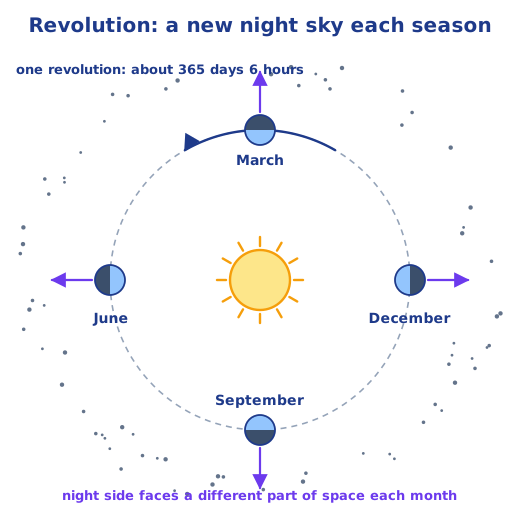
While it rotates, the Earth also revolves around the Sun. Its path, the orbit, is nearly a circle when seen from above, and one revolution takes about 365 days and 6 hours. As the Earth moves along its orbit, its night side looks out at a different part of space, so the stars that rise at sunset change from month to month. The Bhil and Pawara communities of the Tapi valley watched for certain stars to know that the monsoon was coming.
Why it matters
Rotation sets the rhythm of every day, and revolution the rhythm of the year. See how revolution and the tilted axis give us seasons in seasons on the Earth, and read about solar and lunar eclipses. Answers to the textbook questions are in the NCERT solutions for Chapter 12; see all of Chapter 12 notes.
Practice
-
Seen from above the North Pole, which way does the Earth rotate?
Show answer
Answer: (b) Anti-clockwise
-
Why does the Pole Star seem to stay in one place?
Show answer
Answer: (b) The Earth’s axis points almost at it
-
How long does the Earth take to revolve once around the Sun?
Show answer
Answer: (c) About 365 days and 6 hours
-
Why does the Sun rise earlier in Arunachal Pradesh than in Gujarat?
Show answer
Answer: The Earth rotates from West to East, so places in the east turn into the sunlight first. Arunachal Pradesh is far to the east of Gujarat, so its sunrise comes earlier.
-
Why do we see different stars in the evening sky in different months?
Show answer
Answer: As the Earth revolves around the Sun, its night side faces a different part of space each month. So the stars that rise at sunset slowly change through the year and come back after one full revolution.
Questions students ask
What is the difference between rotation and revolution?
Rotation is spinning around an axis that passes through the object itself: the Earth rotates once in about 24 hours, giving day and night. Revolution is moving around another object: the Earth revolves around the Sun once in about 365 days and 6 hours.
Why do the stars seem to move across the night sky?
Because the Earth turns from West to East. Like the Sun, the stars seem to rise in the East and set in the West. Only the Pole Star, which lies almost in line with the Earth’s axis, seems to stay still, and the other stars circle it.
How did Aryabhata explain the motion of the stars?
In his Aryabhatiya, written around the 5th century CE, he compared it to a man in a boat moving forward, who sees things on the bank moving backwards. In the same way the stars, which are fixed, seem to move west. He also gave the time for one rotation as about 23 hours 56 minutes 4.1 seconds, very close to today’s value.
Stuck on a question?
Take a photo and Lagnever AI explains it step by step. Try it for 7 days for ₹2.
Get it on Google Play Open in browser
For parents: after the trial, the plan renews monthly by UPI or card autopay. You can cancel anytime in the app.