
Seasons on the Earth
Answer in short
Seasons happen because the Earth’s axis is tilted and the Earth is round. In June the Northern Hemisphere leans towards the Sun, so its sunlight is more concentrated and its days are longer than 12 hours: it has summer. In December it leans away and has winter. The Southern Hemisphere has the opposite season at the same time.
Stuck on a question? Take a photo and Lagnever AI explains it step by step. Try it for 7 days for ₹2. Get it on Google Play
The tilted Earth
Every year we pass through a cycle of seasons, and summer days are longer than winter days. Both come from the way the Earth revolves. The Earth’s axis is not upright compared with its orbit but tilted, and the Earth keeps the same tilt, pointing the same way in space, all the way round the Sun. Together with the Earth’s round shape, this tilt gives us seasons.
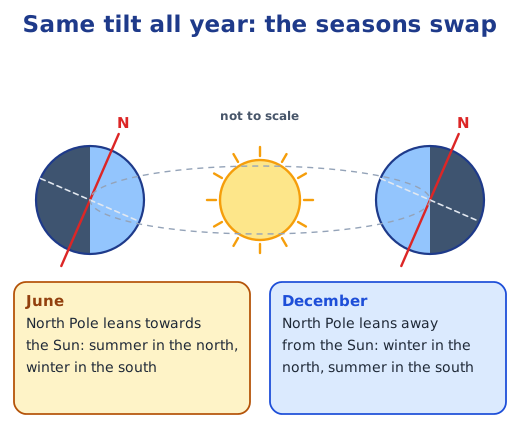
In June the Northern Hemisphere leans towards the Sun and the Southern Hemisphere leans away from it. In December the positions swap. That is why India, in the north, has summer in June, while Australia, in the south, has winter.
Concentrated sunlight
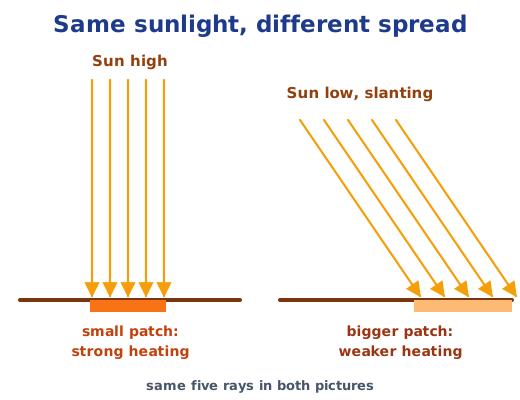
Shine a torch straight down on a table and then at a slant: the slanted beam spreads over a bigger patch and looks dimmer. Sunlight works the same way on the round Earth. In June the Northern Hemisphere faces the Sun more directly, so a given amount of sunlight falls on a smaller area there and heats it more. In the Southern Hemisphere the same sunlight spreads over a larger area and heats it less.
Longer days
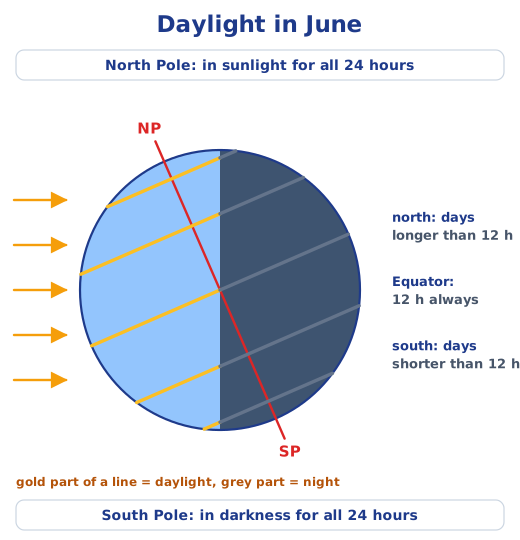
The tilt also changes the length of the day. In June, places in the Northern Hemisphere spend more than half of each 24-hour rotation in the lit half of the Earth, so they get more than 12 hours of sunlight. More intense sunlight for longer each day makes it summer. In December the north has shorter days and weaker sunlight, which means winter. In the Southern Hemisphere everything is reversed: winter in June and summer in December.
Solstices and equinoxes
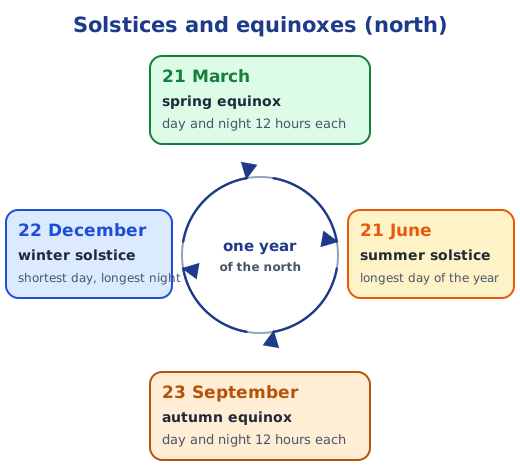
In the Northern Hemisphere the longest day comes around 21 June, the summer solstice. After it the days shorten until the shortest day and longest night, around 22 December, the winter solstice. At the spring and autumn equinoxes, about 21 March and 23 September, day and night each last 12 hours.
The poles and the Equator
At the North Pole the Sun rises around the March equinox and stays in the sky for six months, setting around the September equinox; then come six months of darkness. The South Pole has the opposite pattern. The Equator always has about 12 hours of daylight and 12 of night, and its sunlight hardly changes in strength, so the southern states of India, close to the Equator, feel the seasons only mildly. Nearness to the sea and local geography also shape the weather.
Two wrong reasons
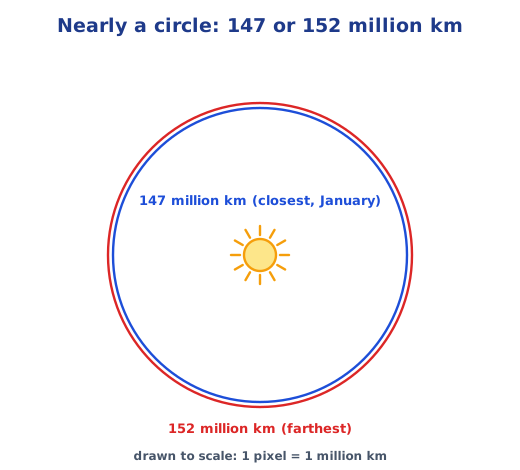
People often say that summer comes when the tilted hemisphere is closer to the Sun, or when the Earth’s slightly oval orbit brings it nearer. In both cases the change in distance is very small. In fact the Earth is nearest the Sun in early January, during the northern winter.
Why it matters
Seasons decide when farmers sow, when festivals fall and what clothes we pack. Read how the Earth spins and travels in rotation and revolution of the Earth, and about solar and lunar eclipses. Answers to the textbook questions are in the NCERT solutions for Chapter 12; see all of Chapter 12 notes.
Practice
-
In December, what season is it in Australia?
Show answer
Answer: (b) Summer
-
In the Northern Hemisphere, the longest day of the year is around:
Show answer
Answer: (b) 21 June
-
How long is the daytime on the Equator?
Show answer
Answer: (a) About 12 hours all year
-
Why are the seasons milder in Kerala than in Punjab?
Show answer
Answer: Kerala lies close to the Equator, where days stay close to 12 hours and the strength of sunlight changes little through the year. Punjab is farther north, so its summer days are much longer and its winter days much shorter, and the sunlight changes more. (Seas and local geography also affect the weather.)
-
What would happen to the seasons if the Earth’s axis were not tilted?
Show answer
Answer: There would be almost no seasons. Every place would get about 12 hours of day and 12 of night all year, and the strength of its sunlight would stay nearly the same, so each place would have much the same weather all year round.
Questions students ask
Why do seasons occur?
Because the Earth’s axis is tilted and the Earth is round. As the Earth goes round the Sun, keeping its tilt, each hemisphere in turn leans towards the Sun. The hemisphere leaning towards the Sun gets more concentrated sunlight for more than 12 hours a day and has summer; the other has winter.
What are solstices and equinoxes?
In the Northern Hemisphere the longest day comes around 21 June, the summer solstice, and the shortest day around 22 December, the winter solstice. The spring and autumn equinoxes, about 21 March and 23 September, have 12 hours of day and 12 of night.
Why are days longer in summer?
In summer your hemisphere leans towards the Sun, so as the Earth turns, places there spend more than half of each rotation in the lit half of the Earth. In June, for example, the North Pole is in sunlight for all 24 hours and northern places get more than 12 hours of daylight.
Stuck on a question?
Take a photo and Lagnever AI explains it step by step. Try it for 7 days for ₹2.
Get it on Google Play Open in browser
For parents: after the trial, the plan renews monthly by UPI or card autopay. You can cancel anytime in the app.