
Solar and lunar eclipses
Answer in short
A solar eclipse happens when the Moon comes between the Sun and the Earth and blocks sunlight from reaching part of the Earth. A lunar eclipse happens when the Earth comes between the Sun and the Moon and its shadow falls on the full Moon. Never look at a solar eclipse directly, but a lunar eclipse is safe to watch.
Stuck on a question? Take a photo and Lagnever AI explains it step by step. Try it for 7 days for ₹2. Get it on Google Play
Can anything block the Sun?
Day and night, the seasons and life itself depend on sunlight. Could something come in its way? Mercury and Venus, the two planets between the Earth and the Sun, look far too small. When Venus crosses in front of the Sun, it appears only as a tiny black dot moving across the bright face, a rare event called a Transit of Venus. The Moon, though, which goes round the Earth as the Earth goes round the Sun, can block the Sun completely.
A thumb can hide a head
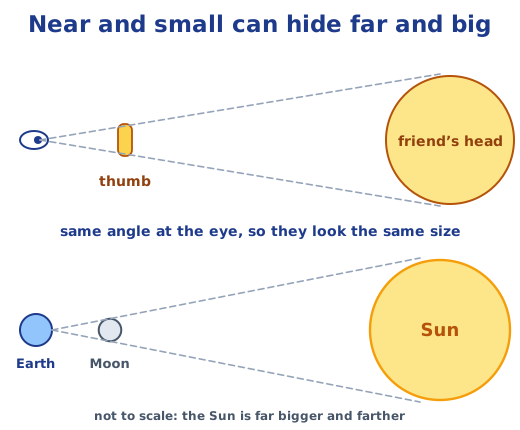
Ask a friend to stand about 5 metres away. Close one eye and hold your thumb up at arm’s length: it can cover your friend’s whole head. How big something looks, its apparent size, depends on its real size and on its distance. The Moon is far smaller than the Sun, but it is also far closer, so in our sky the two look about the same size. That is why the Moon can hide the Sun.
The solar eclipse
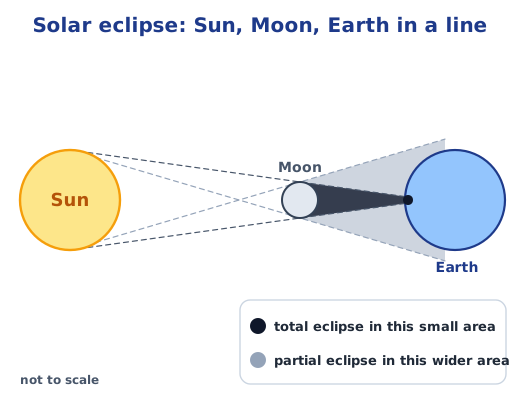
Sometimes the Moon comes between the Sun and the Earth and stops sunlight from reaching us: a solar eclipse. The Moon’s shadow falls on only a small area of the Earth. People there see the whole Sun hidden, a total solar eclipse, and for a few minutes day turns dark. People in the wider area around it see the Sun only partly covered, a partial solar eclipse. Because the Earth rotates and the Moon moves in its orbit, the shadow sweeps across the Earth, so totality lasts only minutes at any place. As the Moon starts to move off, a bright point of the Sun peeps out at one edge, the diamond ring, and daylight returns.
Watching safely
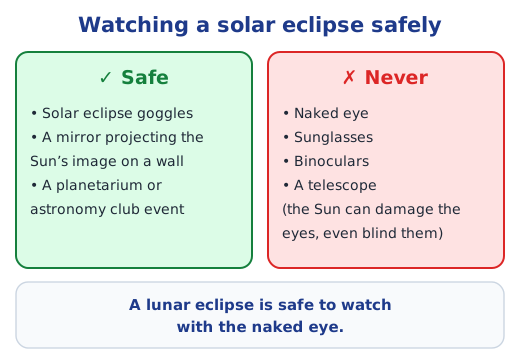
Even during an eclipse the Sun is strong enough to harm the eyes and even blind a person. Never look at it directly, and never through sunglasses, binoculars or a telescope. Planetaria and astronomy clubs hold public viewing events with special eye protection and explanations. A teacher can also project the Sun’s image on a wall with a small mirror stuck to a hollow ball half filled with sand, resting on a tape ring so it can be turned to follow the Sun. Take care not to reflect the beam into anyone’s eyes.
The lunar eclipse
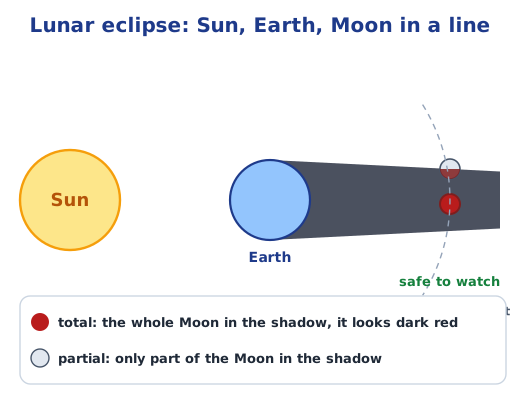
As the Moon goes round the Earth, sometimes the Earth comes between the Sun and the Moon and its shadow falls on the full Moon: a lunar eclipse. When the whole Moon is inside the Earth’s shadow, it is a total lunar eclipse, and the Moon turns dark red until it moves out again. When only part of it is in the shadow, it is a partial lunar eclipse. Unlike the Sun, an eclipsed Moon can be watched safely with the naked eye.
Eclipses, then and now
Eclipses are called grahan in Sanskrit and many Indian languages. Long ago, when their cause was not understood, people feared them, and many places had beliefs about not eating, cooking or going out during an eclipse. Yet ancient Indian astronomers could also calculate when eclipses would happen; the Surya Siddhanta, written in Sanskrit verse, is the most famous of their texts. Today scientists travel across the world to study eclipses. M. K. Vainu Bappu, called the father of modern Indian astronomy, did so too, and the Kodaikanal Solar Observatory, founded in 1899, has recorded the Sun for over a hundred years. The Stellarium computer app shows the eclipses coming up where you live.
Why it matters
Knowing why eclipses happen replaces fear with wonder, and knowing how to watch them protects your eyes. See how the Earth’s motions shape days and years in rotation and revolution of the Earth and seasons on the Earth. Answers to the textbook questions are in the NCERT solutions for Chapter 12; see all of Chapter 12 notes.
Practice
-
In what order are the three bodies during a solar eclipse?
Show answer
Answer: (b) Sun, Moon, Earth
-
During a total lunar eclipse the Moon looks:
Show answer
Answer: (b) dark red
-
Which is a safe way to watch a solar eclipse?
Show answer
Answer: (c) With solar eclipse goggles
-
Why can’t Venus cause a solar eclipse, though it is bigger than the Moon?
Show answer
Answer: Venus is much farther from the Earth than the Moon, so its apparent size is tiny. When it passes in front of the Sun, it looks only like a small black dot crossing the Sun, an event called a Transit of Venus.
-
Why does a total solar eclipse last only a few minutes at one place?
Show answer
Answer: The Moon’s shadow on the Earth is small, and it keeps moving across the Earth’s surface because the Moon moves in its orbit and the Earth rotates. So any one place stays in the dark shadow for only a few minutes.
Questions students ask
How can the small Moon hide the big Sun?
How big something looks depends on its real size and its distance. The Moon is far smaller than the Sun but also far closer, so in our sky both look about the same size. Just as a thumb held near the eye can hide a person’s head 5 metres away, the Moon can cover the whole Sun.
How should you watch a solar eclipse?
Never look at the Sun directly, not even with sunglasses, binoculars or a telescope, because it can damage the eyes and cause blindness. Use proper solar eclipse goggles, watch an image of the Sun projected on a wall with a small mirror, or, ideally, join an eclipse viewing event held by a planetarium or astronomy club.
What is the diamond ring in a solar eclipse?
Just as the Moon starts to move away after a total solar eclipse, a tiny bit of the Sun shines out at one edge. With the faint glow around the dark Moon, it looks like a ring with a bright diamond, and daylight starts to return.
Stuck on a question?
Take a photo and Lagnever AI explains it step by step. Try it for 7 days for ₹2.
Get it on Google Play Open in browser
For parents: after the trial, the plan renews monthly by UPI or card autopay. You can cancel anytime in the app.