
NCERT Solutions Class 7 Science Chapter 2: Exploring Substances: Acidic, Basic, and Neutral
Answers to every question in Chapter 2, Exploring Substances: Acidic, Basic, and Neutral, of Curiosity Grade 7 (Reprint 2026-27): Activities 2.1 to 2.7 with their tables, the questions in the text and boxes, all twelve questions of Let Us Enhance Our Learning, Dive Deeper and the projects. Page numbers follow the book (pages 7–22). Table entries are the results you should expect; record your own observations in class. Short notes: Chapter 2 notes.
Activity 2.1: litmus (pages 8–10)
Table 2.1, expected results.
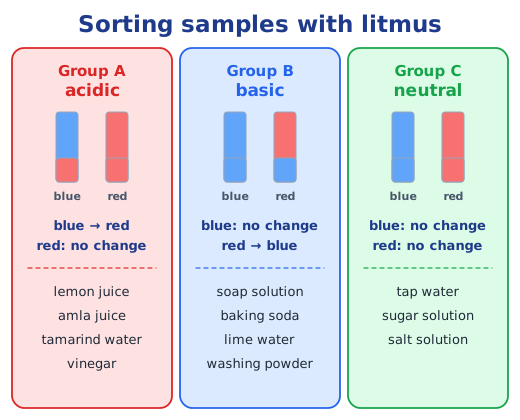
- Vinegar, lemon juice, tamarind water and amla juice: blue litmus turns red; red litmus does not change.
- Baking soda solution, soap solution, washing powder solution and lime water: blue litmus does not change; red litmus turns blue.
- Tap water, sugar solution and salt solution: neither paper changes.
Table 2.2. Group A (blue litmus turns red): vinegar, lemon juice, tamarind water, amla juice. Group B (red litmus turns blue): baking soda solution, soap solution, washing powder solution, lime water. Group C (no change): tap water, sugar solution, salt solution.
Do you find lichens on trees nearby? Look on old tree trunks and rocks for grey-green, crusty or leafy patches. They grow where the air is clean and rain is plentiful, so finding them is a good sign.
The nature of the Group C substances. They are neutral: neither acidic nor basic.
Activity 2.2: sour and bitter (page 11)
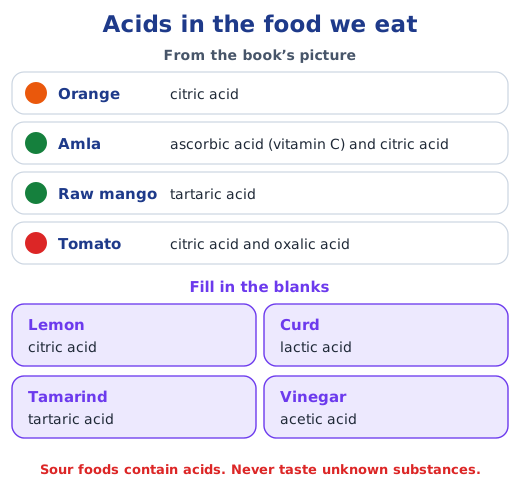
Are all the Group A substances edible, and how do they taste? Vinegar, lemon juice, tamarind water and amla juice are all eaten, and all taste sour, because they contain acids.
The most common acids in some substances. Lemon: citric acid. Curd: lactic acid. Tamarind: tartaric acid. Vinegar: acetic acid.
What do you feel when you rub baking soda solution between your fingers? It feels soapy or slippery, as basic substances generally do.
If there is no litmus, can other natural substances act as indicators? Yes: extracts of red rose, red hibiscus, beetroot, purple cabbage and jamun, and turmeric, all change colour with acids or bases.
Activities 2.3 and 2.4: red rose extract (pages 12–13)
Table 2.3, expected results. Vinegar, lemon juice, tamarind water and amla juice turn the extract red: acidic. Baking soda solution, soap solution, washing powder solution and lime water turn it green: basic. Tap water, sugar solution and salt solution leave it unchanged: neutral.
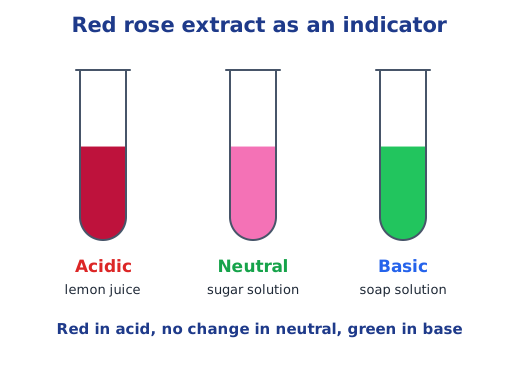
Comparing with Table 2.2. Yes, the samples that turn the extract red are the Group A samples, those that turn it green are the Group B samples, and those that do not change it are the Group C samples. So red rose extract sorts substances just as litmus does.
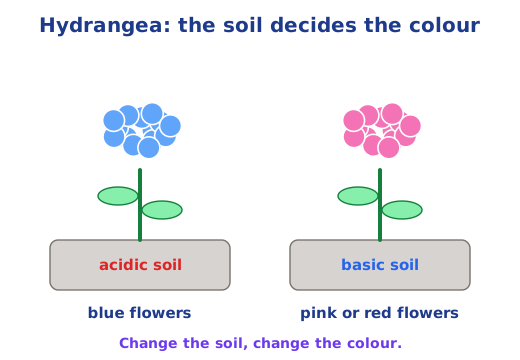
Hydrangeas: can gardeners change the flower colour? Yes. Making the soil more acidic gives blue flowers, and making it more basic gives pink or red ones.
Activity 2.5: turmeric paper (pages 14–15)
Table 2.4, expected results. Baking soda solution, soap solution, washing powder solution and lime water turn the turmeric paper red. Lemon juice, amla juice, tamarind water, vinegar, tap water, sugar solution and salt solution leave it yellow.
Do all samples change its colour? No; only the basic samples do.
The samples that do not change it are the acidic samples of Group A and the neutral samples of Group C together.
Can turmeric paper be used to test for acidic substances? No. Acids and neutral substances both leave it yellow, so it can detect only bases.
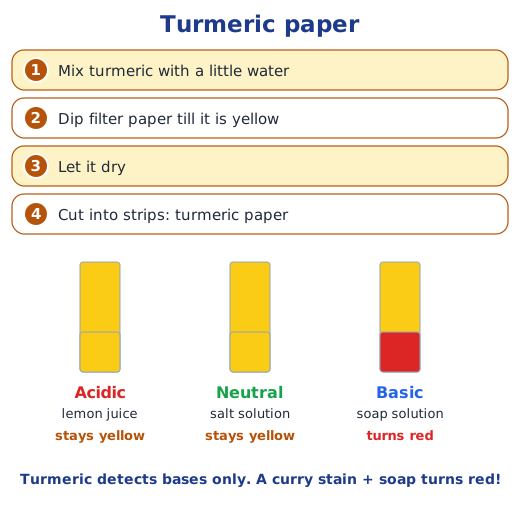
Ashwin’s Guru Purnima card: which solution could write the message? Any basic solution: baking soda solution, soap solution, washing powder solution or lime water. Where it touches the dried turmeric paper, the paper turns red, so the message appears in red.
Activity 2.6: a smell indicator (page 16)
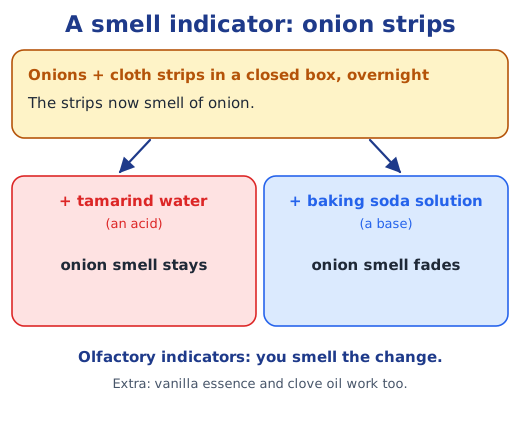
Do any substances change smell with acids or bases? Yes; they are called olfactory indicators.
Observations. Before the drops, both strips smell of onion. After the drops, the strip with tamarind water, an acid, still smells of onion, but on the strip with baking soda solution, a base, the onion smell fades. Other acids, such as vinegar and lemon juice, leave the smell; other bases, such as soap solution and lime water, make it fade.
Activity 2.7: neutralisation (pages 17–18)
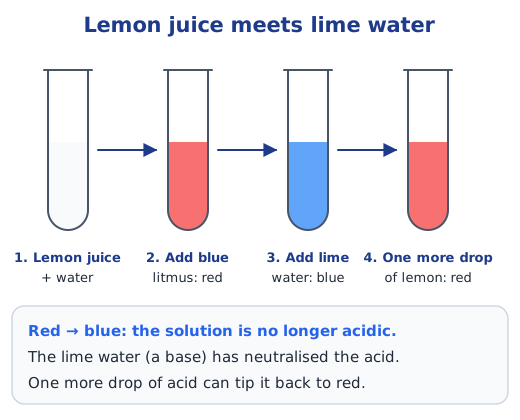
Observations. Lemon juice in water looks almost colourless. A drop of blue litmus solution turns it red, so it is acidic. As lime water is added drop by drop with swirling, it stays red for a while, then changes to blue: the solution is no longer acidic.
Why does one more drop of lemon juice change the colour? After neutralisation the solution is only just basic, so one drop of acid is enough to make it acidic again, and the litmus turns back to red.
Neutralisation in daily life (pages 18–19)
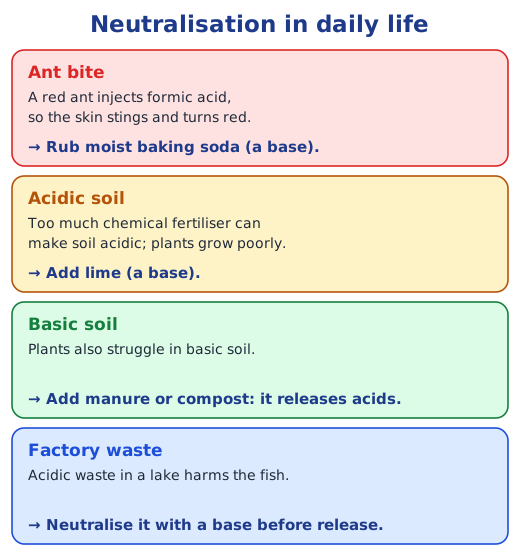
Situation 1: why did moist baking soda ease Keerthi’s ant bite? The ant injected formic acid, an acid; baking soda is a base, so it neutralised the acid. Remedies in your region: answers vary. Common ones are a paste of baking soda and washing the bite with soap and water, soap being basic; some families apply ice to ease the swelling.
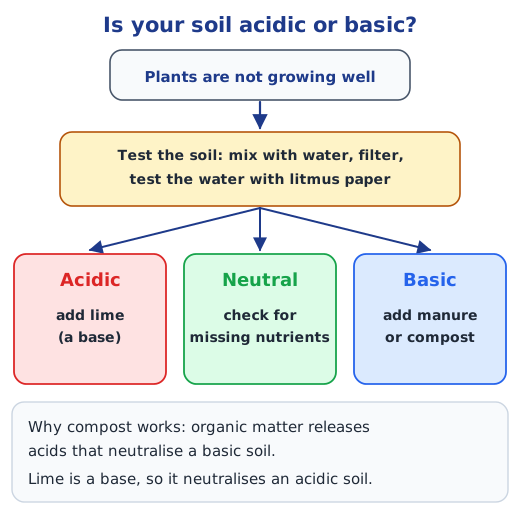
Situation 2: what remedy for the farmer? The soil had become acidic from too much chemical fertiliser, so the remedy is to add lime, a base. (If soil is basic, manure or compost is added; if it is neutral, the soil may lack nutrients.)
Situation 3: why are the fish dying, and what can be done? Factory waste released into the lake may be harming them. If the waste is acidic, it should be neutralised with a basic substance before release.
Let us wrap up (page 19)
Why did the welcome words appear? The words were probably written on the sheets with a basic solution, such as soap solution, and allowed to dry. The spray was turmeric solution: it turned the paper yellow, and where it met the base, it turned red, so the words appeared. So yes, turmeric spray and soap writing is one possibility.
Let Us Enhance Our Learning (pages 20–21)
1. (iii) Vinegar. The solution is basic; only an acid, added in excess, can neutralise it and turn the litmus back to red. Lime water and baking soda are bases, and common salt solution is neutral.
2. (iv) Basic, basic, and basic. Red litmus turning blue, turmeric turning red and red rose extract turning green all show a base.
3. Fig. 2.13: the tip turns green, so the solution is basic. Fig. 2.14: the strip does not change, so it is neutral. Fig. 2.15: the tip turns deep red, so it is acidic.
4. The liquid is acidic. Blue litmus turned red, which happens only with acids. Red litmus did not change, so it is not basic, and turmeric did not change, which fits, since turmeric reacts only with bases.
5. An olfactory indicator, such as cloth strips kept with chopped onions. Blindfolded, Manya cannot see colour changes, but she can smell: the onion smell stays in an acidic solution and fades in a basic one. (Extra: vanilla essence and clove oil also lose their smell in a base.)
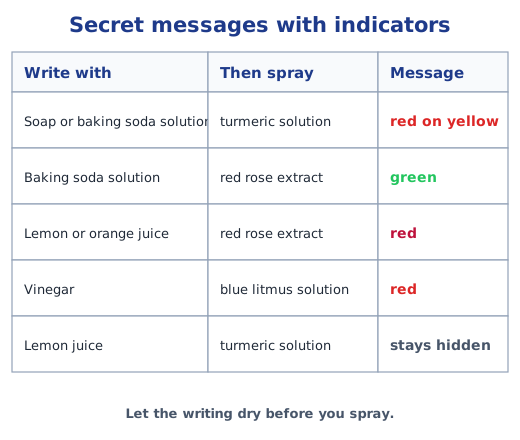
6. Write with one liquid, let it dry, then spray an indicator:
- Soap or baking soda solution, sprayed with turmeric solution: red writing on yellow.
- Baking soda solution, sprayed with red rose extract: green writing.
- Lemon or orange juice, sprayed with red rose extract: red writing.
- Vinegar, brushed with blue litmus solution: red writing.
- Lemon juice, sprayed with turmeric solution: the writing stays hidden, since turmeric does not change with acids.
7. Grape juice is acidic, so the extract turned red. Baking soda is a base: it first neutralises the acid, and when enough is added to make the mixture basic, the colour changes to green. (Extra: you may also see bubbles, as baking soda reacts with the acid.)
8. Orange juice is acidic, so use an indicator that changes with acids: spray red rose extract (the words turn red) or brush on blue litmus solution (they turn red). Turmeric would not work, because it does not change with acids.
9. Natural indicators are made from coloured parts of plants. Example, red rose extract: collect fallen red rose petals, wash and crush them, cover them with hot water (with an adult), wait 5 to 10 minutes and filter; the coloured liquid is the indicator. Turmeric paper is another example: dip filter paper in turmeric paste, dry it and cut it into strips.
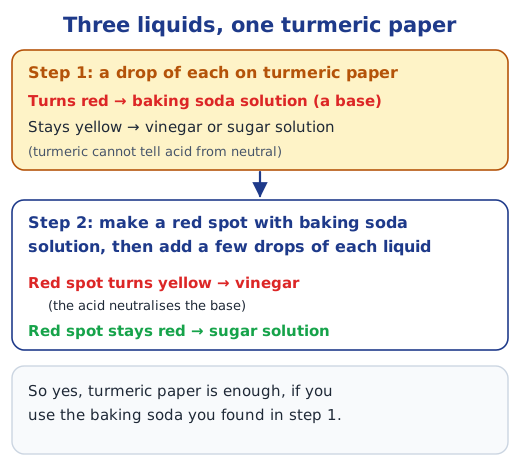
10. Yes. Put a drop of each on turmeric paper: the one that turns it red is the baking soda solution. Vinegar and sugar solution both leave it yellow, so turmeric alone cannot separate them. Now make a red spot with the baking soda solution and add a few drops of each of the other two: the one that turns the red spot yellow again is vinegar, an acid that neutralises the base; the one that leaves it red is sugar solution, which is neutral.
11. Liquid X is basic, since red rose extract turns green in bases. Amla juice is acidic, so adding it first neutralises the base, and with excess amla juice the mixture becomes acidic and the extract turns red.
12. The soil can be acidic or basic in nature. To test it, mix soil with water, let it settle or filter it, and test the water with litmus paper (red rose extract also works). Acidic soil can be treated with lime; basic soil can be treated with organic matter such as manure or compost.
Dive Deeper (page 22)
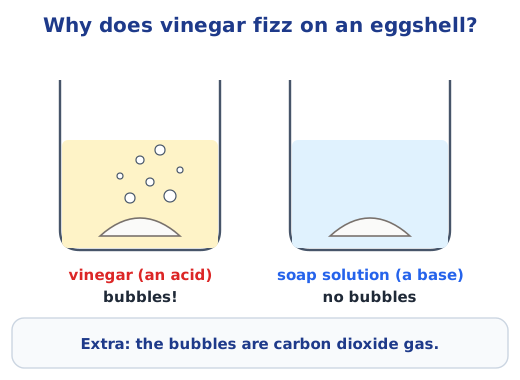
Why did vinegar make bubbles on the eggshell or marble, but soap solution did not? Vinegar is acidic, and eggshell and marble react with acids, giving off a gas that forms the bubbles. Soap solution is basic, so there is no such reaction. Extra: eggshell and marble are made of calcium carbonate, and the gas is carbon dioxide.
Disciplinary Exploratory Projects (page 22)
- Rangoli with indicators: make a rangoli with turmeric powder and sprinkle soap water to draw red patterns, or paint with red rose extract and touch it with lemon juice (red) and baking soda solution (green).
- Water from different sources: test rainwater, tap water and river or well water with litmus or red rose extract and compare. Most tap water is close to neutral; samples from other sources may differ. Discuss why.
- Your local soil: mix soil with water, let it settle, and test the water with litmus or red rose extract to find whether it is acidic, basic or neutral.
Practice
-
Which of these turns turmeric paper red?
Show answer
Answer: (b) Lime water
-
A drop of a liquid turns red rose extract red. The liquid is:
Show answer
Answer: (a) acidic
-
Which substance is used to treat soil that is too acidic?
Show answer
Answer: (b) Lime
-
A student adds lime water drop by drop to vinegar mixed with a little red rose extract. Describe the colour changes.
Show answer
Answer: At first the mixture is red, because vinegar is acidic. As lime water, a base, is added, it neutralises the acid; once enough has been added and the mixture turns basic, the colour changes to green.
-
Name two acidic, two basic and two neutral substances from your kitchen.
Show answer
Answer: Acidic: lemon juice and vinegar (also tamarind water, curd). Basic: baking soda solution and soap solution. Neutral: sugar solution and salt solution (also plain tap water).
Stuck on a question?
Take a photo and Lagnever AI explains it step by step. Try it for 7 days for ₹2.
Get it on Google Play Open in browser
For parents: after the trial, the plan renews monthly by UPI or card autopay. You can cancel anytime in the app.