
Class 7 Science Chapter 2: Exploring Substances: Acidic, Basic, and Neutral Notes
This chapter in five lines
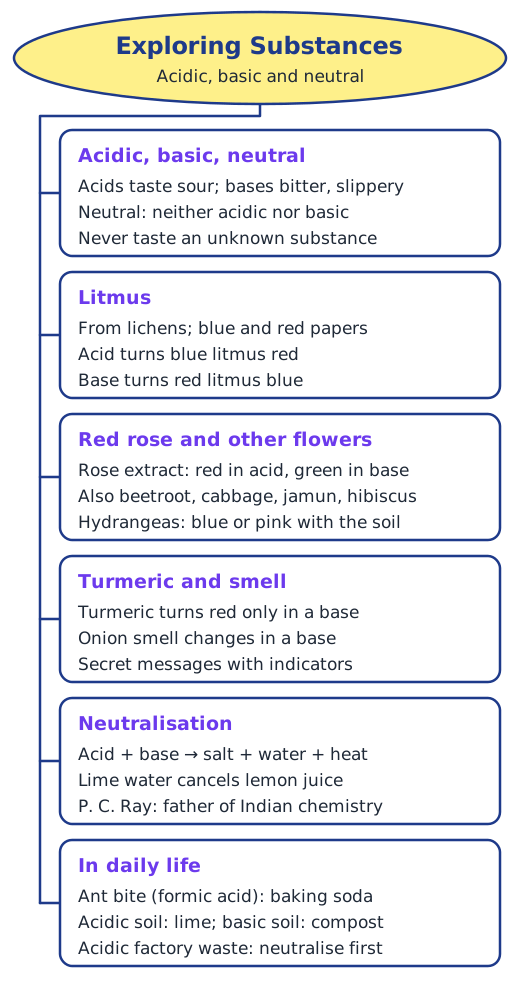
Exploring Substances: Acidic, Basic, and Neutral shows how to sort the substances around us by their nature. Acidic substances taste sour and turn blue litmus red; basic substances taste bitter, feel slippery and turn red litmus blue; neutral ones change neither paper. Natural indicators such as red rose extract and turmeric show the same, and when an acid meets a base they cancel each other, making salt and water and giving out heat.
What is this chapter about?
The chapter opens at a school science fair on National Science Day, 28 February. Visitors are handed blank white sheets, and the moment a volunteer sprays them, a message welcoming them to the wonderful world of science appears. How? The answer lies in a simple idea: many substances are acidic, basic or neutral, and some substances, called indicators, change colour to show which.
Testing with litmus
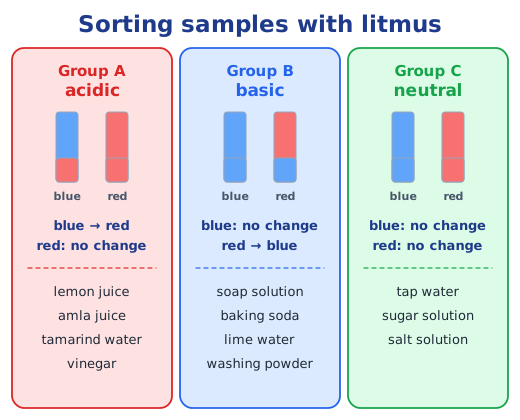
Litmus is a natural dye obtained from lichens, and it comes as blue and red papers. Put a drop of each sample on both. Vinegar, lemon juice, tamarind water and amla juice turn blue litmus red: they are acidic. Baking soda solution, soap solution, washing powder solution and lime water turn red litmus blue: they are basic. Tap water, sugar solution and salt solution leave both papers unchanged: they are neutral. Because litmus takes different colours in acids and bases, it is an acid-base indicator.
Sour and bitter
The acidic samples that we can eat all taste sour, because they contain acids: citric acid in oranges, ascorbic acid (vitamin C) and citric acid in amla, tartaric acid in raw mango and tamarind, and citric and oxalic acids in tomatoes. Bases usually taste bitter and feel slippery, like baking soda solution between the fingers. But bitter does not always mean basic: karela is bitter, yet it is not a base. And never taste an unknown substance. Read more in acids, bases and indicators.
Indicators from nature
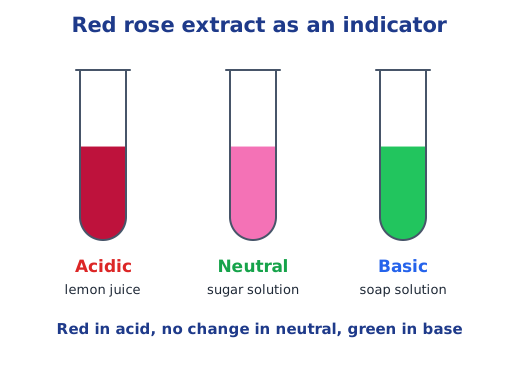
Litmus is not the only indicator. Red rose extract, made by soaking crushed petals in hot water and filtering, turns red in acids and green in bases. Turmeric paper turns red in bases but stays yellow in acids and neutral substances, so it can detect bases but cannot tell an acid from a neutral substance. That is why a yellow curry stain turns red when soap is rubbed on it. Beetroot, purple cabbage, jamun and red hibiscus also make indicators, and hydrangea plants even grow blue flowers in acidic soil and pink or red ones in basic soil. Some indicators work by smell: strips kept with chopped onions lose their onion smell in a base. See natural indicators.
Neutralisation
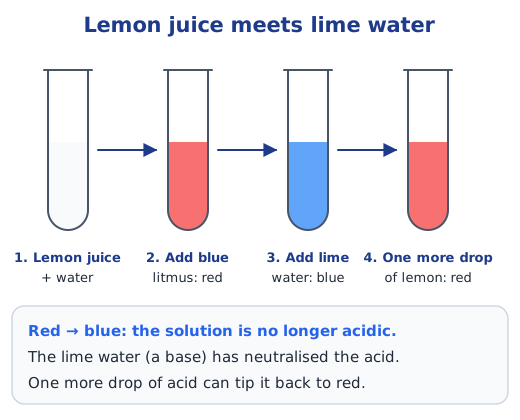
In Activity 2.7, a drop of lemon juice in water turns red with blue litmus solution. When lime water is added drop by drop, the colour changes from red to blue: the solution is no longer acidic, because the base has cancelled the acid. This is neutralisation. When an acid and a base react in the right amounts, the result is neither acidic nor basic, and salt, water and heat are produced:
Acid + Base → Salt + Water + Heat
Neutralisation in daily life
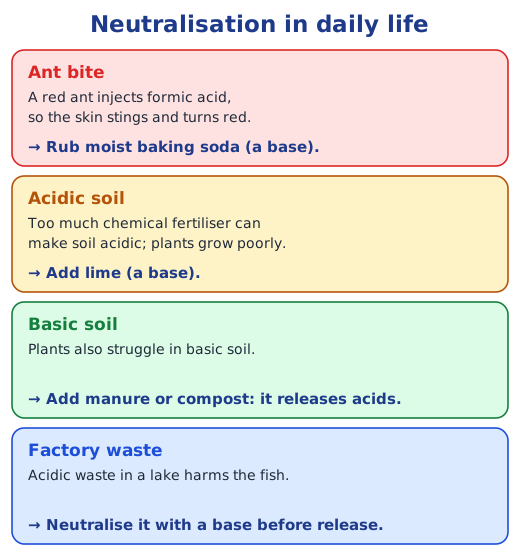
The same reaction solves everyday problems. A red ant bite injects formic acid, so rubbing moist baking soda, a base, eases the sting. Too much chemical fertiliser can make soil acidic; farmers add lime, a base. Basic soil is treated with manure or compost, whose organic matter releases acids. And acidic waste from factories should be neutralised with a base before it reaches a lake, to protect the fish. Read neutralisation in daily life.
The mystery solved, and a great chemist
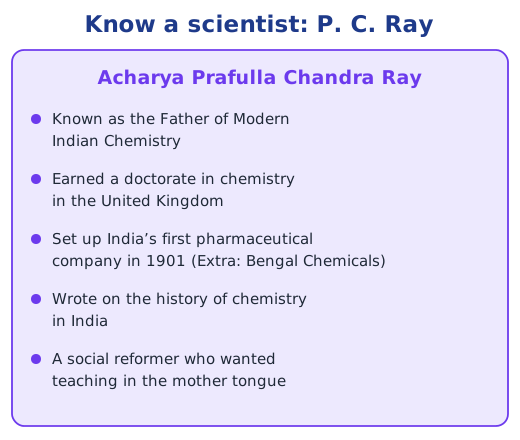
The welcome message at the fair could have been written in soap solution, which is basic, and then sprayed with turmeric solution: the paper turns yellow and the hidden letters turn red. The chapter also introduces Acharya Prafulla Chandra Ray, the Father of Modern Indian Chemistry, who set up India’s first pharmaceutical company in 1901 and wrote about chemistry in ancient India.
Answers to every activity question and all twelve exercise questions, with the Dive Deeper puzzle, are in the NCERT solutions for Chapter 2.
Key terms
| Term | Meaning |
|---|---|
| Acidic substance | A substance that contains an acid. It tastes sour and turns blue litmus red. Vinegar, lemon juice, tamarind water and amla juice are acidic. |
| Basic substance | A substance that contains a base. It usually tastes bitter, feels soapy or slippery, and turns red litmus blue. Soap solution, baking soda solution and lime water are basic. |
| Neutral substance | A substance that is neither acidic nor basic, so litmus does not change colour. Tap water, sugar solution and salt solution are neutral. |
| Acid-base indicator | A substance that shows one colour in an acidic solution and another in a basic solution, so it tells us the nature of a substance. |
| Litmus | A natural indicator obtained from lichens, used as a solution or as blue and red litmus paper. Acids turn blue litmus red; bases turn red litmus blue. |
| Natural indicator | An indicator made from a plant: red rose extract (red in acid, green in base), turmeric (red in base), and extracts of beetroot, purple cabbage, jamun and red hibiscus. |
| Olfactory indicator | A substance whose smell changes in an acidic or a basic medium, such as cloth strips kept with chopped onions. |
| Neutralisation | The reaction between an acid and a base. With enough of each, the result is neither acidic nor basic: acid + base → salt + water + heat. |
| Lime water | A solution of calcium hydroxide, made by mixing lime (chuna, calcium oxide) in water and filtering it. It is basic. |
| Lichen | A partnership of a fungus and an alga that grows on rocks and trees where there is plenty of rain and clean air. Litmus is obtained from lichens. |
Topics in this chapter
Practice
-
A substance turns blue litmus paper red. It is:
Show answer
Answer: (b) acidic
-
Which of these is basic?
Show answer
Answer: (c) Baking soda solution
-
Red rose extract turns green in:
Show answer
Answer: (b) a basic solution
-
Turmeric paper turns red when a drop of which sample is put on it?
Show answer
Answer: (c) Soap solution
-
Which acid does a red ant inject when it bites?
Show answer
Answer: (b) Formic acid
-
What forms when an acid neutralises a base?
Show answer
Answer: (a) Salt and water, with heat given out
Questions students ask
What are the main topics of Class 7 Science Chapter 2?
Testing substances with blue and red litmus; acidic, basic and neutral substances; the acids in common foods; natural indicators such as red rose extract and turmeric paper; olfactory indicators; neutralisation, with Activity 2.7 on lemon juice and lime water; and neutralisation in daily life, from ant bites to soil and factory waste. It also introduces the chemist P. C. Ray.
Is this chapter in the new Curiosity book?
Yes. Exploring Substances: Acidic, Basic, and Neutral is Chapter 2 of Curiosity, the Class 7 Science textbook (Reprint 2026-27), on pages 7 to 22, after the introductory chapter The Ever-Evolving World of Science.
How can you test whether a substance is acidic, basic or neutral at home?
Use an indicator. Red rose extract turns red in acids and green in bases; turmeric paper turns red in bases; and litmus paper, if you have it, turns blue to red in acids and red to blue in bases. If nothing changes, the substance is neutral. Never taste a substance to find out.
Stuck on a question?
Take a photo and Lagnever AI explains it step by step. Try it for 7 days for ₹2.
Get it on Google Play Open in browser
For parents: after the trial, the plan renews monthly by UPI or card autopay. You can cancel anytime in the app.