
Natural indicators you can make at home
Answer in short
Many plants make good acid-base indicators. Red rose extract, made by soaking crushed petals in hot water and filtering, turns red in acids and green in bases. Turmeric paper turns red in bases but stays yellow in acids and neutral substances. Beetroot, purple cabbage, jamun and red hibiscus work too, and onion-soaked strips change smell in a base.
Stuck on a question? Take a photo and Lagnever AI explains it step by step. Try it for 7 days for ₹2. Get it on Google Play
Plants that change colour
Litmus comes from lichens, but many other plants also hold colourful substances that change with acids and bases. With a few simple steps you can turn flowers, vegetables and spices into natural indicators at home.
Red rose extract
To make it, collect fallen red rose petals rather than plucking flowers. Wash a fistful, crush them with a mortar and pestle and put them in a glass tumbler. With an adult, pour in hot water till the petals are covered, put on a lid and wait 5 to 10 minutes till the water is coloured. Filter it; the coloured liquid is your indicator.
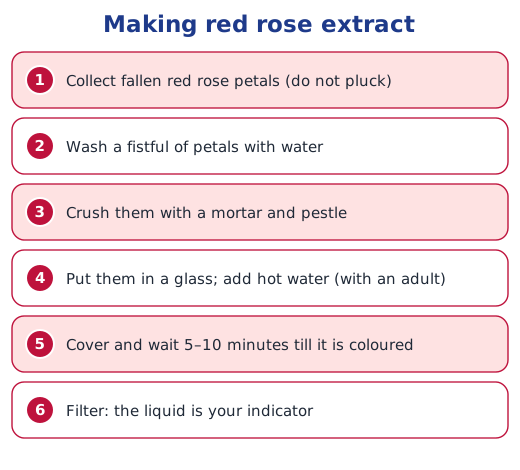
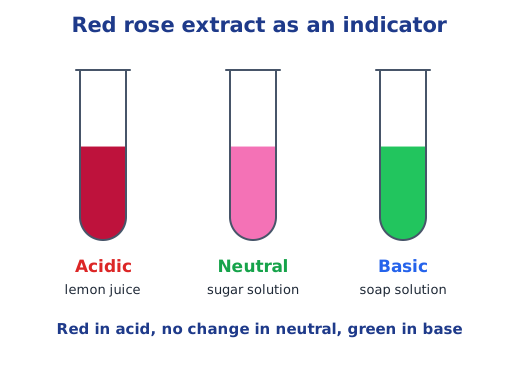
Put 10 to 20 drops of the extract in two small bottles. Add lemon juice to one and soap solution to the other. The lemon juice turns it red and the soap solution turns it green. Testing the other samples gives the same three groups as litmus: red for acids, green for bases and no change for neutral substances.
Turmeric paper
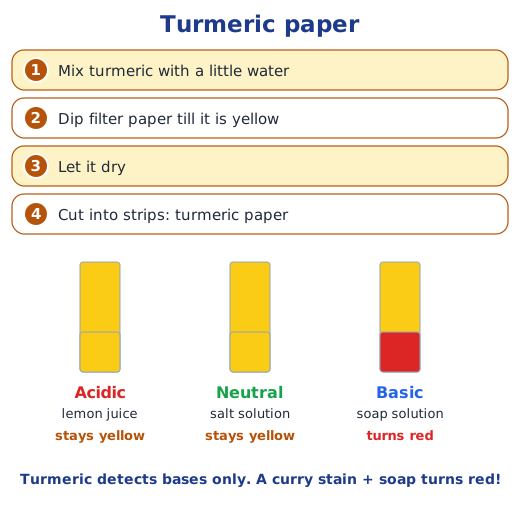
Mix a spoonful of turmeric (haldi) with a little water, dip filter paper in the paste till it turns yellow, let it dry and cut it into strips. A drop of soap or baking soda solution turns the strip red, but lemon juice, vinegar, sugar solution and salt solution leave it yellow. So turmeric can spot bases but cannot tell an acid from a neutral substance. That is why a curry stain on a white shirt turns red when soap is applied.
More plant indicators
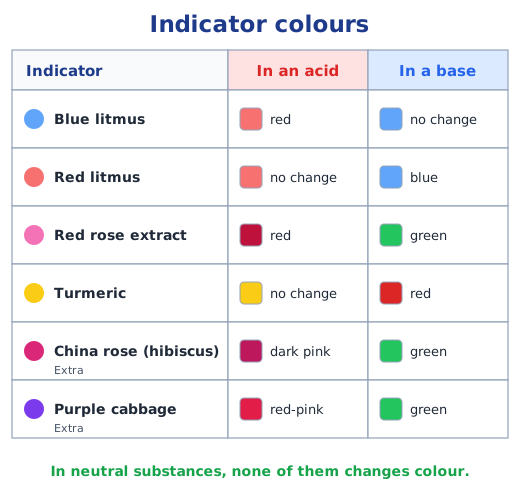
You can make extracts in the same way from beetroot, purple cabbage, jamun and red hibiscus (gudhal). Plants show their own response too: hydrangea bushes bloom blue in acidic soil and pink or red in basic soil. When you test a sample, try two or three of your indicators: if they agree, you can trust the result. Keep the extracts in a cool place and make fresh ones every few days, since plant colours fade with time.
Indicators you can smell
Some substances change their smell instead of their colour; they are called olfactory indicators. Keep strips of clean cloth with finely chopped onions in a closed box overnight. A drop of tamarind water, an acid, leaves the onion smell on a strip, but a drop of baking soda solution, a base, makes it fade. Such indicators help someone who cannot see colours.
Secret messages
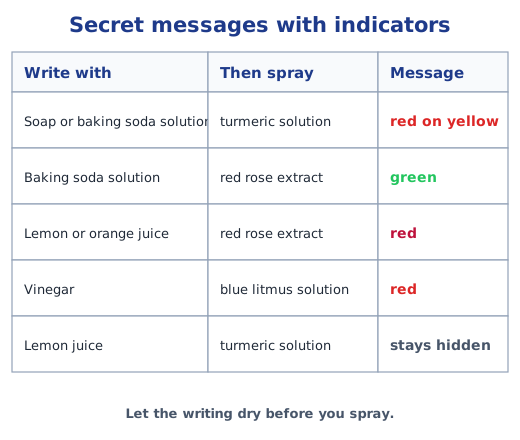
Indicators make a fun trick. Write a message with soap solution, let it dry, then spray turmeric solution: the paper turns yellow and the words appear in red. This is probably how the welcome sheets at the chapter’s science fair worked. Ashwin used the same idea for a Guru Purnima card for his teacher, written in Odia on turmeric paper.
Why it matters
Natural indicators let anyone test substances at home with flowers and spices. Learn the litmus test in acids, bases and indicators, see how acids and bases cancel in neutralisation in daily life, and find every textbook answer in the NCERT solutions for Chapter 2; see all of the Chapter 2 notes.
Practice
-
Red rose extract turns red when you add:
Show answer
Answer: (b) lemon juice
-
Turmeric paper cannot tell apart:
Show answer
Answer: (b) an acid and a neutral substance
-
What is an olfactory indicator?
Show answer
Answer: (b) One that changes smell
-
Ashwin wrote a message on turmeric paper for his teacher. Which liquid could he have written with, and what colour would the words be?
Show answer
Answer: A basic solution such as baking soda solution, soap solution, washing powder solution or lime water. Where the base touches the yellow turmeric paper, it turns red, so the words show up in red.
-
List the steps to prepare turmeric paper.
Show answer
Answer: Mix a spoonful of turmeric (or ground fresh turmeric) with a little water to make a paste, dip a piece of filter paper in it till it turns yellow, let it dry, and cut it into thin strips.
Questions students ask
How do you make a natural indicator from flowers?
Collect fallen petals of a coloured flower such as a red rose, wash a fistful, crush them with a mortar and pestle, and put them in a glass. With an adult, pour in hot water to cover them, put a lid on and wait 5 to 10 minutes till the water is coloured. Filter it; the coloured liquid is your indicator.
Which vegetables and flowers can be used as indicators?
Besides the red rose, the chapter suggests beetroot, purple cabbage, turmeric, jamun (Indian blackberry) and red hibiscus (gudhal). Make an extract the same way and test it with an acid such as lemon juice and a base such as soap solution.
Why do hydrangea flowers change colour?
Hydrangeas, which grow in cool hill areas of the Himalayas and the Northeast, produce blue flowers in acidic soil and pink or red flowers in basic soil. So a gardener can change the flower colour by making the soil more acidic or more basic.
Stuck on a question?
Take a photo and Lagnever AI explains it step by step. Try it for 7 days for ₹2.
Get it on Google Play Open in browser
For parents: after the trial, the plan renews monthly by UPI or card autopay. You can cancel anytime in the app.