
Acids, bases and indicators
Answer in short
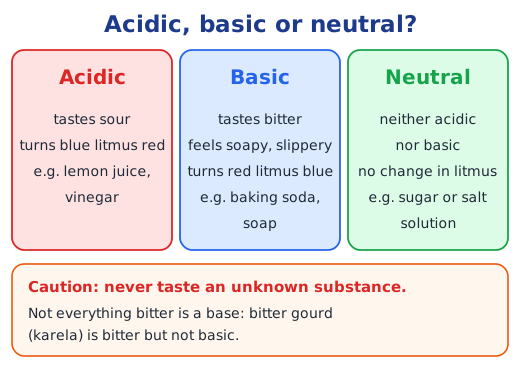
Acidic substances taste sour and turn blue litmus red; basic substances taste bitter, feel slippery and turn red litmus blue; neutral substances change neither. An indicator, such as litmus from lichens, shows different colours in acids and bases, so it tells us the nature of a substance without tasting it.
Stuck on a question? Take a photo and Lagnever AI explains it step by step. Try it for 7 days for ₹2. Get it on Google Play
Three kinds of substances
Look around the kitchen: lemon juice, soap, sugar, vinegar, baking soda. Chemists sort substances like these into three groups by their nature. Acidic substances contain acids, basic substances contain bases, and neutral substances are neither. We cannot see the difference, and tasting is unsafe, so we use an indicator: something that changes colour to tell us.
The litmus test
Litmus, a natural dye obtained from lichens, is sold as a solution and as blue and red paper strips. To test a sample, cut small pieces of both papers, lay them on a clean, dry white tile and put a drop of the sample on each with a dropper.
- If blue litmus turns red, the sample is acidic: vinegar, lemon juice, tamarind water and amla juice.
- If red litmus turns blue, the sample is basic: baking soda solution, soap solution, washing powder solution and lime water.
- If neither paper changes, the sample is neutral: tap water, sugar solution and salt solution.
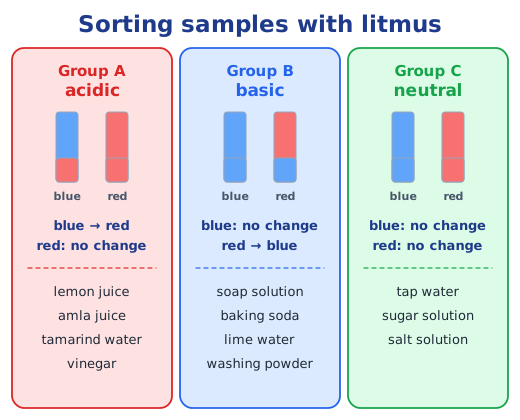
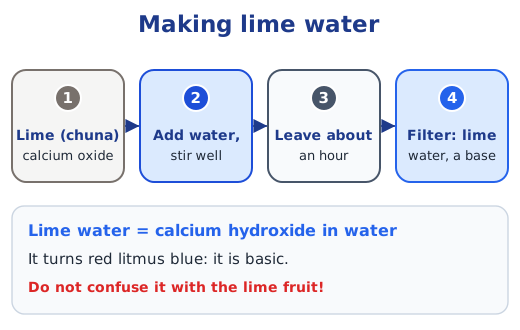
Litmus takes one colour in acids and another in bases, which makes it an acid-base indicator. Lime water, one of the samples, is easy to make: mix lime (chuna, calcium oxide) in water, leave it for about an hour and filter it. It is a solution of calcium hydroxide, and it has nothing to do with the lime fruit.
Where litmus comes from
Lichens look like crusty or leafy patches on rocks and tree bark. Each one is a partnership of two living things, a fungus and an alga. They need plenty of rain and clean air, so finding them on trees nearby is a sign of a healthy environment.
Sour acids, bitter bases
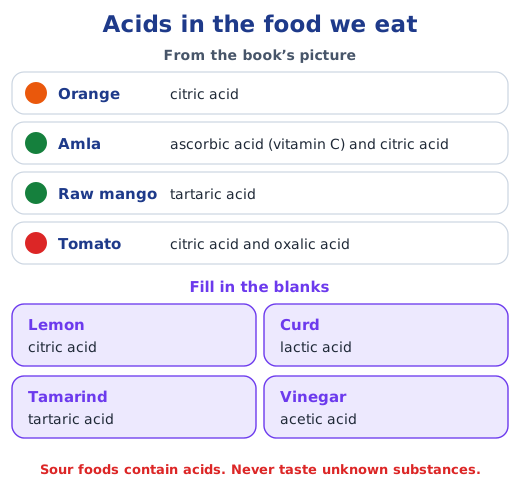
All the edible samples in the acidic group taste sour, so a sour taste is a clue that a food contains an acid. Oranges and lemons contain citric acid; amla contains ascorbic acid (vitamin C) and citric acid; raw mango and tamarind contain tartaric acid; tomatoes contain citric and oxalic acids; curd contains lactic acid; and vinegar contains acetic acid.
Bases, on the other hand, generally taste bitter and feel soapy or slippery: rub baking soda solution between your fingers and you will feel it. But the clue works only one way. Bitter gourd (karela) is bitter without being a base. So never taste anything to test it, and never taste an unknown substance at all.
Other indicators
If there is no litmus at home, plants can help. Red rose extract turns red in acids and green in bases, and turmeric turns red in bases. These and other homemade indicators are explained in natural indicators. Laboratories also use synthetic indicators, which you will meet in higher classes.
Why it matters
Knowing whether something is acidic or basic helps us choose a cleaner, treat an ant bite or fix the soil in a garden. See how acids and bases cancel each other in neutralisation in daily life. Answers to every textbook question are in the NCERT solutions for Chapter 2; see all of the Chapter 2 notes.
Practice
-
Which sample turns red litmus blue?
Show answer
Answer: (b) Lime water
-
Litmus is obtained from:
Show answer
Answer: (b) lichens
-
Which acid is found in curd?
Show answer
Answer: (c) Lactic acid
-
A sample changes neither blue nor red litmus. What is its nature?
Show answer
Answer: It is neutral: neither acidic nor basic. Tap water, sugar solution and salt solution behave this way.
-
How does baking soda solution feel between your fingers, and what does that suggest?
Show answer
Answer: It feels soapy or slippery. Basic substances generally feel slippery, which fits with baking soda turning red litmus blue.
Questions students ask
What is an acid-base indicator?
A substance that takes one colour in an acidic solution and another in a basic solution. Litmus is the most familiar example: acids turn blue litmus red and bases turn red litmus blue. Some indicators are natural, like red rose extract and turmeric; others, called synthetic indicators, are made in laboratories.
Why do we need both blue and red litmus paper?
Each paper shows only one kind of change. Blue litmus turns red only with acids, and red litmus turns blue only with bases. A neutral substance changes neither, so you need both papers to sort a sample into acidic, basic or neutral.
What are lichens?
Lichens are formed when a fungus and an alga live together. They grow on rocks and tree bark in places with plenty of rain and clean air. Litmus, the most common indicator, is obtained from them.
Stuck on a question?
Take a photo and Lagnever AI explains it step by step. Try it for 7 days for ₹2.
Get it on Google Play Open in browser
For parents: after the trial, the plan renews monthly by UPI or card autopay. You can cancel anytime in the app.