
NCERT Solutions Class 7 Science Chapter 3: Electricity: Circuits and their Components
Answers to every question in Chapter 3, Electricity: Circuits and their Components, of Curiosity, the Class 7 Science textbook (Reprint 2026-27): the opening questions, Activities 3.1 to 3.11 with Tables 3.1 and 3.3, the Dive Deeper boxes, all eleven questions of Let Us Enhance Our Learning and the Exploratory Projects. Page numbers follow the book (pages 23–40). Answers to activities give the results to expect; record your own observations. Short notes: Chapter 3 notes.
Uses of electricity (pages 23–24)
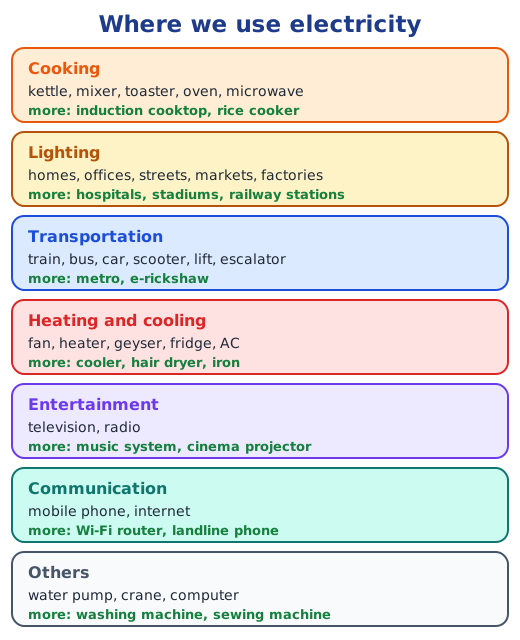
Add more uses to Nihal’s lists. Cooking: induction cooktop, rice cooker, sandwich maker. Lighting: hospitals, stadiums, railway stations, traffic signals. Transportation: metro trains, electric rickshaws and electric cars. Heating and cooling: cooler, hair dryer, electric iron. Entertainment: music system, cinema projector, video games. Communication: Wi-Fi router, landline phone, laptop. Others: washing machine, sewing machine, vacuum cleaner.
Other ways of grouping the uses. By place (home, school, hospital, farm, factory); by what electricity is turned into (light, heat, cooling, motion, sound); by the source (wall socket or battery); or by how much power the device needs (small devices such as remotes, large ones such as air conditioners).
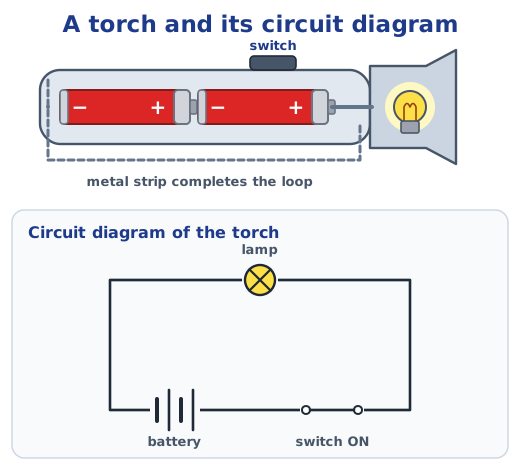
Activity 3.1: A torchlight (page 24)
Does the lamp glow, and what is inside? In one position of the switch the lamp glows and in the other it does not. Inside you find at least two electric cells.
Why does the torch lamp glow in one position of its switch? In that position the switch closes a gap, completing the circuit from the cells through the lamp and back, so current flows. In the other position the gap stops the current.
Activity 3.2: An electric cell (page 25)
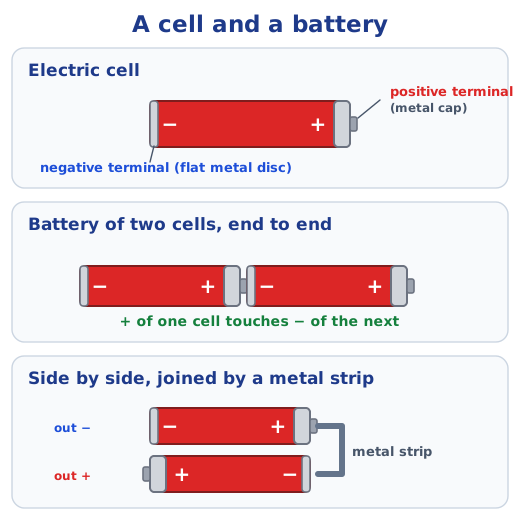
The cell is marked + at the end with a small protruding metal cap, its positive terminal, and − at the end with a flat metal disc, its negative terminal.
Activity 3.3: Cells in a torch (page 25)
Are the cells placed in any particular order? Yes. The lamp glows only when each cell’s + end touches the − end of the next. With one cell reversed, the lamp does not glow. Cells joined this way form a battery.
Activity 3.4: An incandescent lamp (page 26)
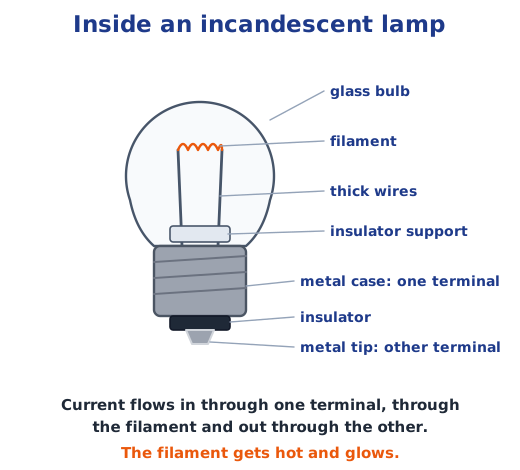
What do you see, and which part glows? A thin wire fixed in the middle of the glass bulb, the filament, glows. How is the filament fixed? It is held between two thicker wires. One of the thicker wires is joined to the metal case of the base, and the other to the small metal tip in the middle of the base. These are the lamp’s two terminals, and they do not touch each other.
Activity 3.5: An LED (page 27)
There is no filament inside an LED, and one of its two wires is longer than the other. The longer wire is the positive terminal and the shorter wire the negative.
Activity 3.6: Making a lamp glow (pages 27–30)
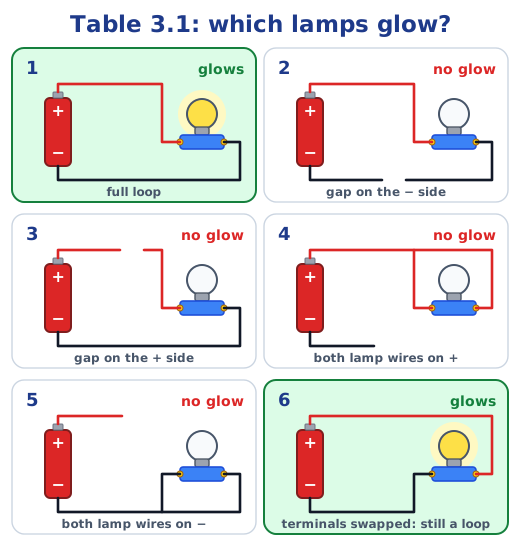
Table 3.1, predictions and observations. Predictions will vary; the observations are:
- 1: the lamp glows; each lamp terminal is joined to a different terminal of the cell.
- 2: does not glow; there is a gap in the wire on the negative side.
- 3: does not glow; there is a gap in the wire on the positive side.
- 4: does not glow; both lamp wires go to the positive terminal and the negative terminal is left loose.
- 5: does not glow; both lamp wires go to the negative terminal and the positive terminal is left loose.
- 6: the lamp glows; the wires cross, but each lamp terminal still reaches a different cell terminal.
Can you find the reason for the difference? The lamp glows only when there is a complete path from one terminal of the cell, through the lamp, to the other terminal. In 2 and 3 the path is broken; in 4 and 5 the current has no way through the lamp from + to −.
Activity 3.7: Making an LED glow (pages 30–31)
Which is the positive terminal of the battery in the holder? The holder terminal joined to the positive terminal (metal cap) of one cell is positive; and the holder end touching the other cell’s − end is negative.
Does the LED glow? With the battery’s positive wire on the LED’s longer wire, yes. With the wires interchanged, no, because current passes through an LED in one direction only.
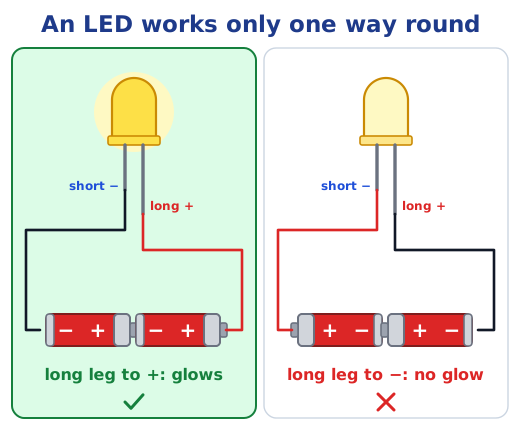
Dive Deeper: cells side by side. A thick wire or metal strip in the compartment links the + end of one cell with the − end of the next, and + and − marks inside show how to place each cell.
Activities 3.8 and 3.9: A switch (page 32)
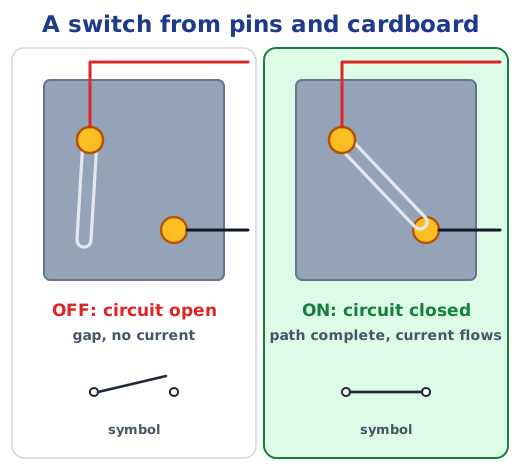
How does a switch turn the torch on or off? With the home-made switch in the OFF position (Fig. 3.12a), the lamp does not glow; there is a gap, so the circuit is open. When the safety pin is turned to touch the second drawing pin (Fig. 3.12b), the gap closes, the circuit is closed, current flows and the lamp glows.
Activity 3.10: Circuit diagrams (pages 33–34)
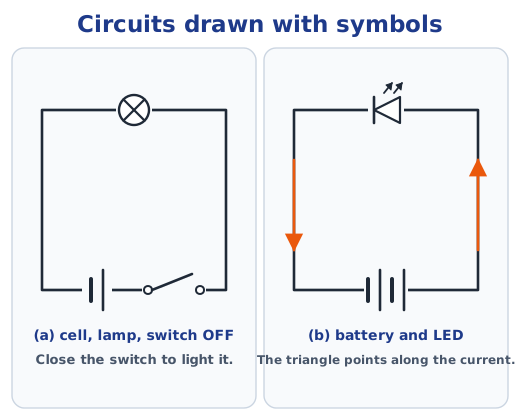
Can we represent circuits more simply? Yes, with symbols. For Fig. 3.12a: a cell, a lamp and a switch in the OFF position in one loop. For Fig. 3.10c: a battery of two cells and an LED, with the LED’s triangle pointing the same way as the current, which leaves the long line of the battery. These match Fig. 3.14a and 3.14b.
Electrical conductors and insulators (page 34)
Why metal wires, and why the plastic or rubber covering? Metals let current flow easily, so they make good wires. Plastic and rubber do not let current pass, so a covering of them keeps the current in the wire and protects us from shocks.
Activity 3.11: Conductors and insulators (pages 35–36)
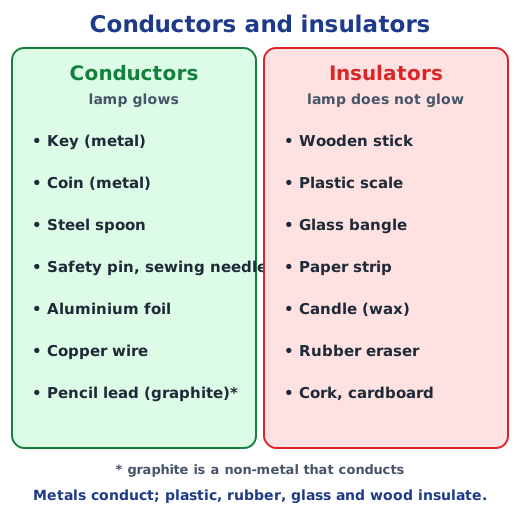
Table 3.3, completed. Lamp glows (Yes/No) and conclusion:
- Stick (wood): No, insulator.
- Scale (plastic): No, insulator.
- Bangle (glass): No, insulator.
- Paper strip (paper): No, insulator.
- Candle (wax): No, insulator.
- Key (metal): Yes, conductor.
- Eraser (rubber): No, insulator.
- Your own rows, for example coin (metal): Yes, conductor; aluminium foil (metal): Yes, conductor; cork: No, insulator.
Did the lamp glow for all materials? No, only for the metal objects. Extra: pencil lead (graphite) also conducts, though with one cell the lamp may glow only dimly.
Let Us Enhance Our Learning (pages 37–39)
1. Choose the incorrect statement. (i) A switch is the source of electric current in a circuit. The cell or battery is the source; a switch only completes or breaks the circuit.
2. Which material between A and B will not let the lamp glow? Any insulator, such as a plastic scale, a rubber eraser, a wooden stick, a glass bangle, a paper strip or a candle. With a metal object, such as a key or a coin, the lamp glows.
3. In Fig. 3.17, if one filament breaks, will the other lamp glow? No. Both lamps and the battery are in one loop, so the broken filament leaves a gap in the only path. No current flows, and the other lamp goes out too.
4. The insulation was not removed from the wire ends. Will the lamp glow? No. The plastic covering is an insulator, so the metal of the wires does not touch the terminals, the path is not complete and no current flows.
5. Draw a circuit diagram for a simple torch. A battery of two cells, a switch and a lamp, all in one loop.
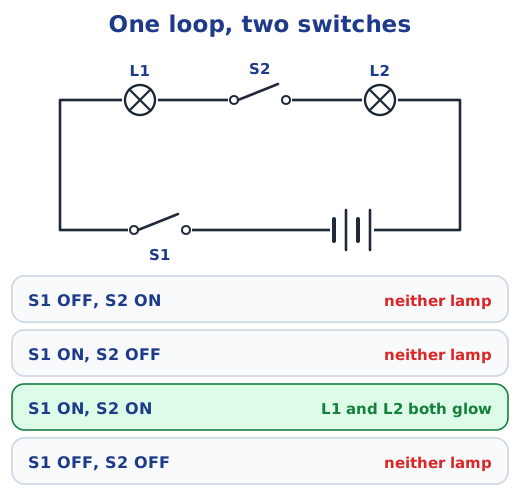
6. In Fig. 3.18 (L1, S2, L2, the battery and S1 are all in one loop):
- (i) S2 ON, S1 OFF: no lamp glows.
- (ii) S2 OFF, S1 ON: no lamp glows.
- (iii) S1 and S2 both ON: both L1 and L2 glow.
- (iv) S1 and S2 both OFF: no lamp glows.
There is only one path, so an open switch anywhere stops the current through both lamps.
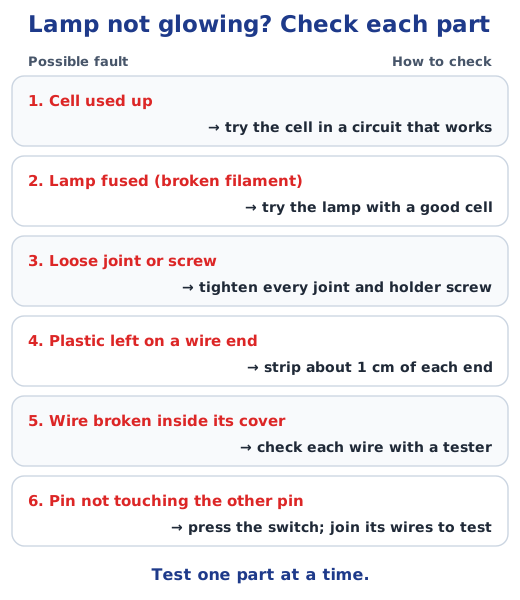
7. Why might Vidyut’s lamp not glow, and how to find out? Possible reasons: the cell is used up; the lamp has fused (broken filament) or is loose in its holder; a joint or holder screw is loose; the plastic covering was not stripped from a wire end; a wire is broken inside its covering; the safety pin does not properly touch the second drawing pin; or the cell does not touch the holder’s contacts. To find out, test one part at a time: try the cell with a lamp that works, try the lamp with a good cell, tighten every joint, check each wire with a conduction tester, and touch the switch wires together to see whether the switch is the problem.
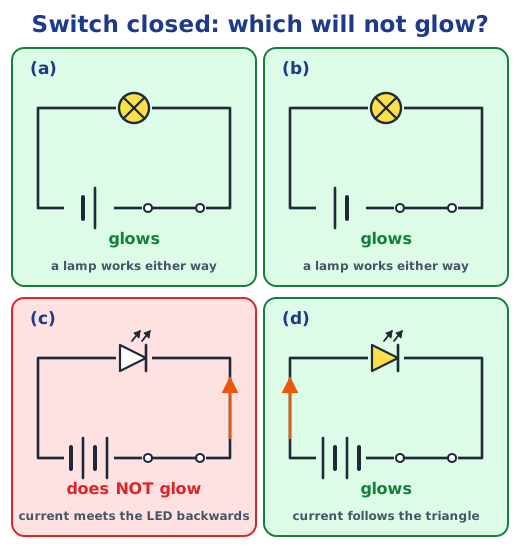
8. In which circuits of Fig. 3.20 will the lamp or LED not glow? Only (c). In (a) and (b) the lamps glow, since an incandescent lamp works whichever way the cell faces. In (c) the long line of the battery, its positive terminal, is on the right, so current reaches the LED against the direction of its triangle and cannot pass. In (d) the positive terminal is on the left, the current flows the way the triangle points, and the LED glows.
9. The + and − marks cannot be read. How can you find the terminals? For a cell, the end with the small protruding metal cap is positive and the flat end is negative. You can also use an LED: join it to the battery; if it glows, the terminal joined to the LED’s longer wire is positive. If it does not glow, swap the wires: now it should glow, and the longer wire shows the positive terminal.
10. Which of the cells A to F are working?
- (i) Items: a torch lamp in a lamp holder (one you know works), a cell holder for one cell, and two or three connecting wires with their ends stripped.
- (ii) Procedure: make a circuit of the cell holder, the lamp and the wires. Put cell A in the holder; if the lamp glows, cell A works, and if it does not, it is used up. Take it out and repeat with B, C, D, E and F, using the same lamp and wires each time. First check the lamp with a cell you know is good, so that a dark lamp means a dead cell and not a fused lamp.
- (iii) Carry it out and record each result, for example: A glows (working), B does not glow (not working), and so on.
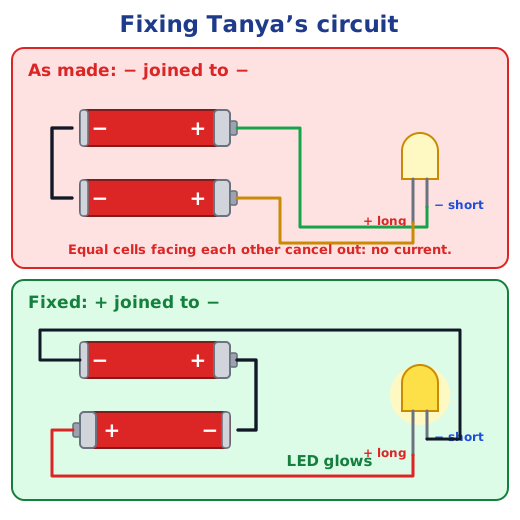
11. Will Tanya’s LED glow? No. Both cells face the same way and the black wire joins their negative terminals, so the cells push against each other and cancel out; no current flows. To correct it, turn one cell round and connect the + end of one cell to the − end of the other. Then connect the remaining positive terminal to the longer wire of the LED and the remaining negative terminal to the shorter wire.
Exploratory Projects (pages 39–40)
A two-day power cut: what could you not do? A sample list: no fans, coolers or air conditioners; no lights after dark, except torches and candles; no television or internet once the Wi-Fi router stops; phones go flat; in many homes no tap water, since the pump cannot run; no refrigerator, so food spoils; no washing machine, mixer, electric iron or geyser; no lifts in tall buildings; and online classes and work stop.
A solar panel and a toy fan. Join the two wires of the solar panel to the two terminals of the toy fan’s motor and place the panel in sunlight; the fan turns. Extra: if it turns the wrong way, swap the two wires.
Cells at an electrical shop (a sample report). AA cells for torches, remotes, clocks and toys; smaller AAA cells for remotes and wireless mice; large C and D cells for big torches and radios; 9 V rectangular batteries for smoke alarms and some toys; button cells for watches, calculators and hearing aids; rechargeable batteries for phones, laptops and power banks; and large lead-acid batteries for inverters and vehicles.
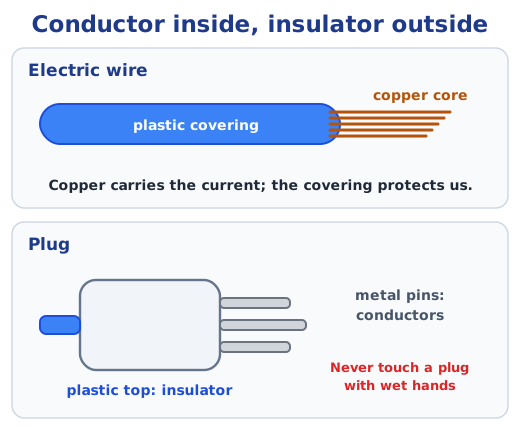
Objects at home in three groups (a sample). Insulators only: wooden spoon, plastic bucket, rubber slippers, glass tumbler, paper. Conductors only: steel spoon, iron nail, aluminium foil, keys, steel plate. Made of both: an electric iron (metal base, plastic handle), a screwdriver (steel tip, plastic handle), a pressure cooker (steel body, plastic handle), electric wires (copper inside, plastic outside) and plugs (metal pins, plastic top).
Practice
-
Which statement is incorrect?
Show answer
Answer: (b) A switch is the source of current
-
In which circuit of Fig. 3.20 will the LED not glow?
Show answer
Answer: (c) (c)
-
Which object completes the circuit of a conduction tester?
Show answer
Answer: (c) Key
-
Two cells are joined negative to negative and then to an LED. Will it glow?
Show answer
Answer: No. The cells push against each other and cancel out, so no current flows. Connect the + end of one cell to the − end of the other, then connect the remaining positive terminal to the LED’s longer wire.
-
How can you tell which of six cells still work?
Show answer
Answer: Put each cell in turn into a simple circuit with a torch lamp that you know works. If the lamp glows, the cell works; if it stays dark, the cell is used up.
Stuck on a question?
Take a photo and Lagnever AI explains it step by step. Try it for 7 days for ₹2.
Get it on Google Play Open in browser
For parents: after the trial, the plan renews monthly by UPI or card autopay. You can cancel anytime in the app.