
Class 7 Science Chapter 3: Electricity: Circuits and their Components Notes
This chapter in five lines
Electricity: Circuits and their Components explains how a torch works. An electric cell has a positive and a negative terminal, and cells joined positive to negative make a battery. A lamp or LED glows only when it is part of a complete path, an electrical circuit, which a switch opens or closes. Circuits are drawn with symbols, and they need conductors such as copper, covered by insulators such as plastic.
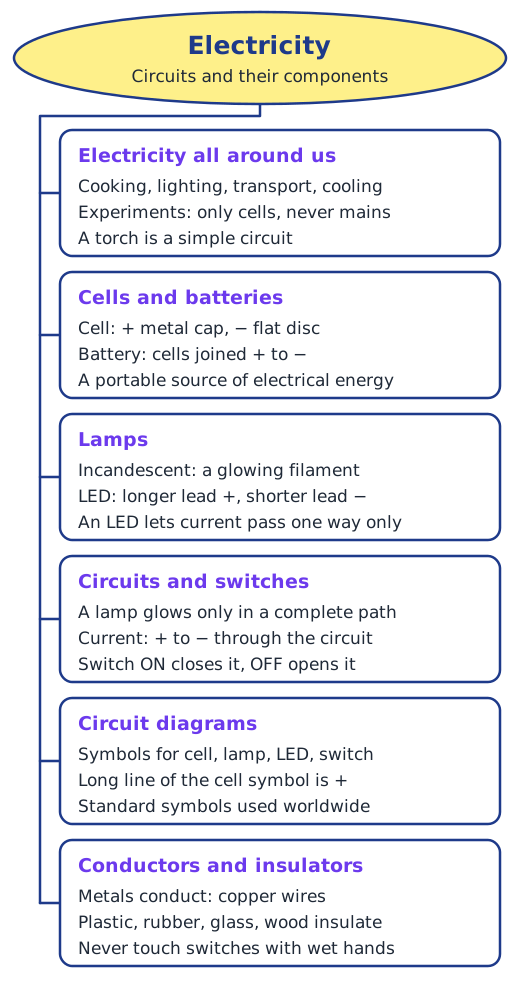
What is this chapter about?
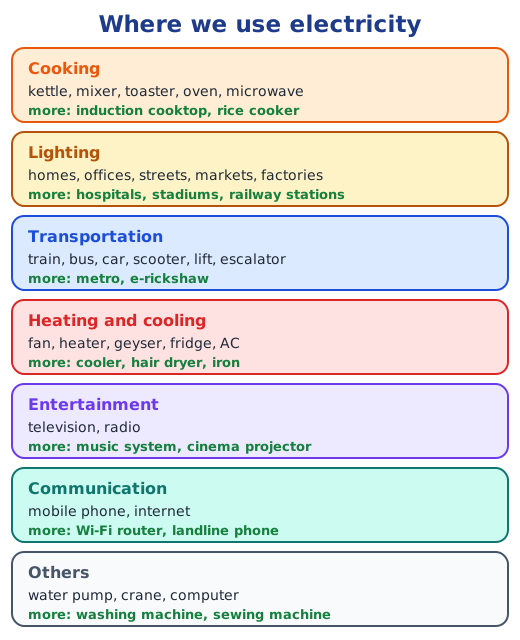
Before a school trip to the hydroelectric power house at the Bhakra Nangal Dam, Nihal and his classmates list the uses of electricity, and the list keeps growing: cooking, lighting, transport, heating and cooling, entertainment, communication and more. Electricity reaches homes through wires from power stations, but that supply is dangerous. So the chapter learns about electricity with a safe, portable source, the electric cell, starting with a common device: the torch.
Cells and batteries
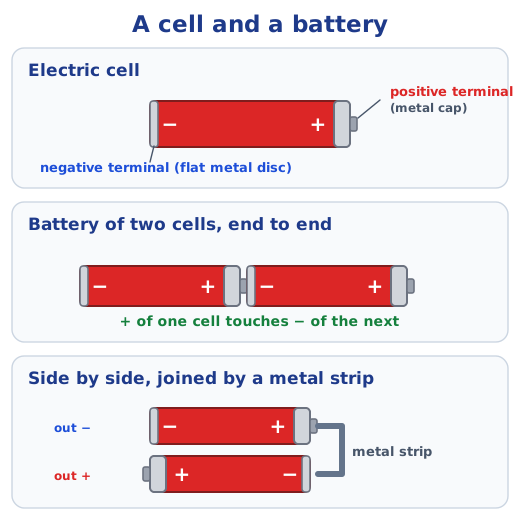
A torch contains two or more electric cells. Each cell has two terminals: the small metal cap is the positive (+) terminal and the flat metal disc is the negative (−) terminal. In the torch, the cells sit in a particular order, with the positive terminal of one cell touching the negative terminal of the next. Cells joined like this make a battery, which supplies energy for longer and/or more energy. The single cell in a mobile phone is also called a battery. Read more in cells, batteries and lamps.
Lamps: incandescent and LED
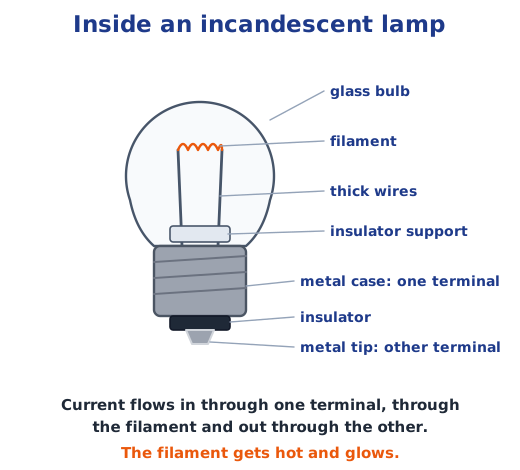
Older torches use an incandescent lamp. Inside its glass bulb a thin wire, the filament, is held by two thicker wires; one connects to the metal case of the base and the other to the metal tip, and these are the lamp’s two terminals. Current heats the filament until it glows. Most torches today use an LED, a light emitting diode, which has no filament. An LED’s longer wire is its positive terminal and its shorter wire its negative, and current can pass through it in one direction only.
Making a lamp glow: the electrical circuit
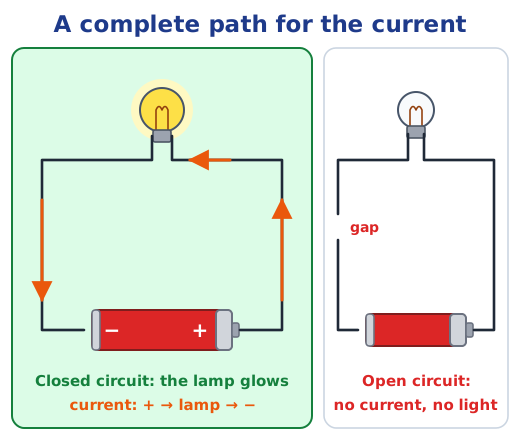
Joining a cell and a lamp in six different ways shows that the lamp lights up only if its two terminals are joined to the two different terminals of the cell. This forms an electrical circuit, a complete path for electric current. The current is taken to flow from the positive terminal of the cell, through the circuit, to its negative terminal. An incandescent lamp glows whichever way round it is joined, but an LED glows only when its longer wire goes to the positive side. A lamp with a broken filament is said to have fused: the break stops the current. Read electric circuits and circuit diagrams.
Switches
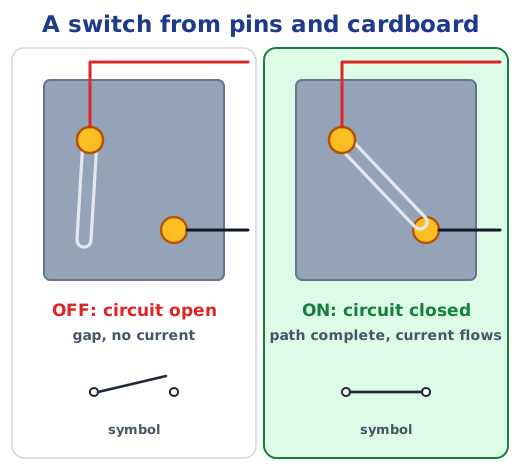
A simple switch can be made from two drawing pins, a safety pin and a piece of cardboard. Once the safety pin rests on both drawing pins, the gap is bridged: the switch is ON and the circuit is closed, so current flows and the lamp glows. When it does not, the gap stops the current: the switch is OFF and the circuit is open. A switch works at any point in the loop, and the switches at home work the same way.
Circuit diagrams
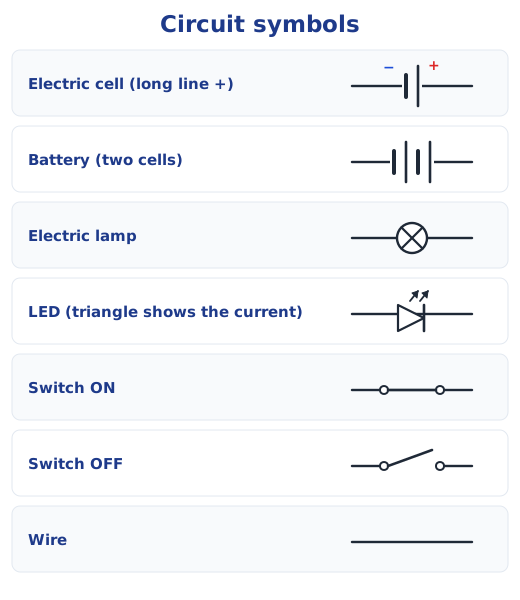
Drawing real cells and wires every time is slow, so we use symbols: two lines of unequal length for a cell (the long line is positive), a circle with a cross for a lamp, a triangle with a bar and two arrows for an LED, and simple marks for a switch and a wire. A drawing of a circuit with these symbols is a circuit diagram. Bodies such as the International Electrotechnical Commission set standard symbols, so that people everywhere read diagrams the same way.
Conductors and insulators
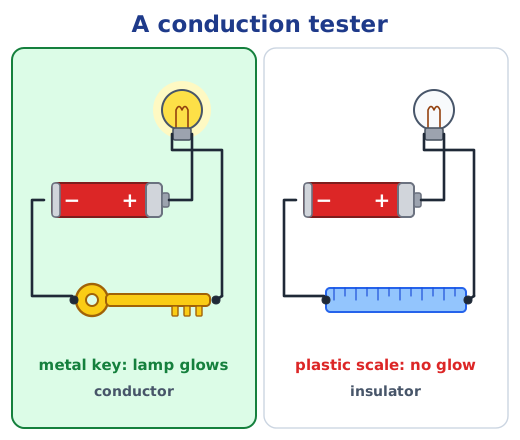
A tester made from a cell and a lamp with two open wire ends shows which materials let current through. Keys, coins, pins and aluminium foil make the lamp glow: they are conductors, and all of them are metals. Wood, plastic, glass, paper, wax and rubber do not: they are insulators. Silver, copper and gold conduct better than other metals, and wires are made of copper because it is cheaper and plentiful. Plastic, rubber and ceramics, which are insulators, wrap wires and form plug tops and switch covers, keeping us safe. Our body is a conductor, so do not handle switches or plugs with wet hands, use electrical devices in wet places or handle damaged wires. Cells give direct current (DC) for small devices, while the wall socket supplies alternating current (AC) from power plants for larger appliances. Read conductors and insulators.
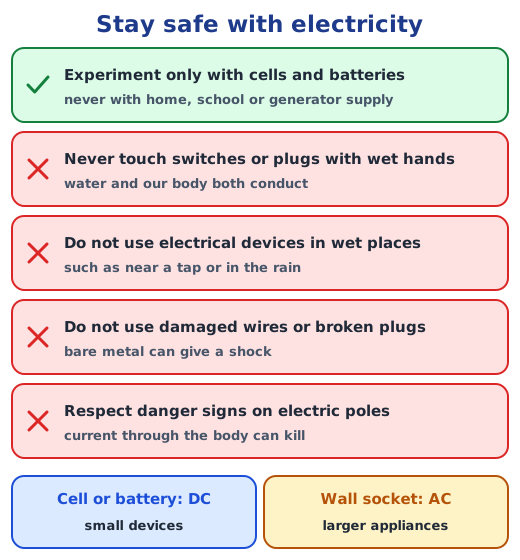
Answers to every activity, Tables 3.1 and 3.3, the questions in Let Us Enhance Our Learning and the projects are in the NCERT solutions for Chapter 3.
Key terms
| Term | Meaning |
|---|---|
| Electric cell | A portable source of electrical energy with two terminals: the positive (+) metal cap and the negative (−) flat metal disc. |
| Battery | Two or more cells joined so that each cell’s + end meets the − end of the next. |
| Filament | The thin wire inside an incandescent lamp that gets hot and glows when current passes through it. |
| LED (light emitting diode) | A lamp with no filament. Its longer wire is the positive terminal and its shorter wire the negative, and current passes through it in one direction only. |
| Electrical circuit | A complete path through which electric current flows, from the positive terminal of the cell, through the components, back to its negative terminal. |
| Switch | A simple device that completes (ON, closed circuit) or breaks (OFF, open circuit) a circuit. It can be placed anywhere in the circuit. |
| Circuit diagram | A drawing of an electrical circuit using standard symbols for its components. |
| Conductor | A material through which electric current flows easily, such as metals like copper and aluminium. |
| Insulator | A material through which current cannot pass, such as plastic, rubber, glass, wood and ceramics. Insulators are also called poor conductors. |
Topics in this chapter
Practice
-
Which part of an electric cell is its positive terminal?
Show answer
Answer: (b) The metal cap
-
How are cells joined to make a battery?
Show answer
Answer: (c) Positive of one to negative of the next
-
Which wire of an LED is its positive terminal?
Show answer
Answer: (b) The longer wire
-
When a switch is OFF, the circuit is:
Show answer
Answer: (b) Open
-
Which of these is an insulator?
Show answer
Answer: (c) Rubber eraser
-
In the symbol for a cell, the long line stands for:
Show answer
Answer: (b) The positive terminal
Questions students ask
What are the main topics of Class 7 Science Chapter 3?
The uses of electricity and how to stay safe; the torch as a simple circuit; electric cells, batteries, incandescent lamps and LEDs; making a lamp glow in a complete circuit; switches; circuit diagrams with standard symbols; and conductors and insulators, with a short note on DC and AC.
Is Electricity: Circuits and their Components in the new Curiosity book?
Yes. It is Chapter 3 of Curiosity, the Class 7 Science textbook (Reprint 2026-27), on pages 23 to 40. It starts with Nihal’s class listing the uses of electricity before a trip to the Bhakra Nangal Dam.
Why does a lamp glow only in a complete circuit?
Current must flow out of one terminal of the cell, through the lamp and back into the other terminal. If there is a gap anywhere, or both lamp wires go to the same terminal, there is no complete path, no current flows, and the filament does not heat up and glow.
Why are electric wires made of copper and covered with plastic?
Copper is a metal, so current flows through it easily, and it costs less and is more plentiful than silver or gold, which conduct even better. The plastic or rubber covering is an insulator: it stops current from passing into our bodies and protects us from electric shocks.
Stuck on a question?
Take a photo and Lagnever AI explains it step by step. Try it for 7 days for ₹2.
Get it on Google Play Open in browser
For parents: after the trial, the plan renews monthly by UPI or card autopay. You can cancel anytime in the app.