
Cells, batteries and lamps: how a torch works
Answer in short
A torch is a circuit. Its cells, each with a positive metal cap and a negative flat disc, are joined positive to negative to make a battery. A switch completes the path, and current lights the lamp: an incandescent lamp, whose filament glows when hot, or an LED, which has no filament and lets current pass one way only.
Stuck on a question? Take a photo and Lagnever AI explains it step by step. Try it for 7 days for ₹2. Get it on Google Play
A torch to explore
Slide a torch switch one way and the lamp glows; slide it back and the light goes out. Open the torch and you will usually find two or more electric cells inside. A torch is one of the simplest electrical devices, and taking it apart shows the parts of every circuit: a source of energy, a lamp, a switch and connections between them.
The electric cell
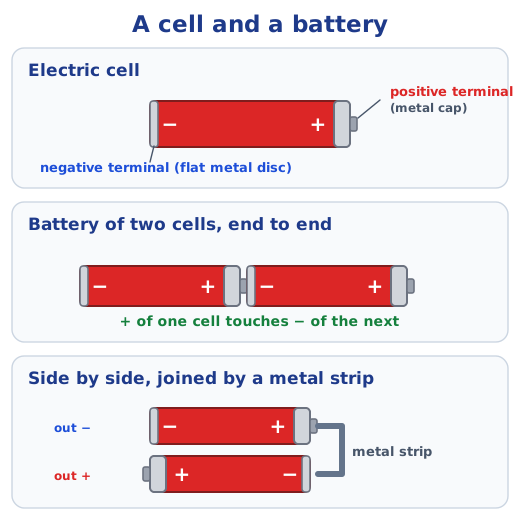
Look closely at a cell. One end has a small protruding metal cap and is marked plus (+): this is the positive terminal. The other end is a flat metal disc marked minus (−): this is the negative terminal. Every cell has these two terminals. A cell is a source of electrical energy you can carry around, which is why it powers torches, clocks, remotes and toys, and why it is the only safe source for your experiments.
From cells to a battery
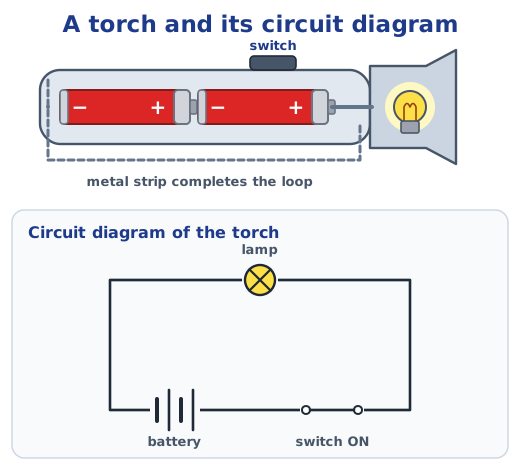
Take the two cells out of a torch and put them back in different orders, or turn one round, then try the switch. The lamp glows only when the cells sit in one particular order: the positive terminal of one cell touches the negative terminal of the next. Two or more cells joined like this form a battery. More cells keep the circuit running longer, or give it more energy, or both. In devices where cells lie side by side, a thick wire or metal strip links the + end of each cell with the − end of the next, and + and − marks inside show which way each cell goes.
The incandescent lamp
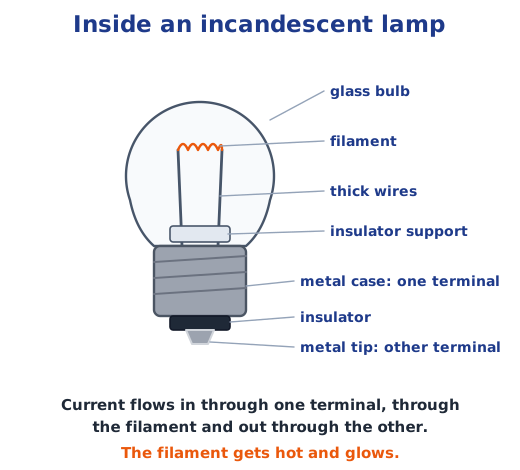
Many older torches use an incandescent lamp. With your teacher’s help, look inside its glass bulb: a thin wire, the filament, is held between two thicker wires. One thicker wire is joined to the metal case of the base and the other to the small metal tip in the middle of the base. These are the lamp’s two terminals, and they are fixed so that they never touch each other. When current flows, the filament gets hot and glows.
The LED
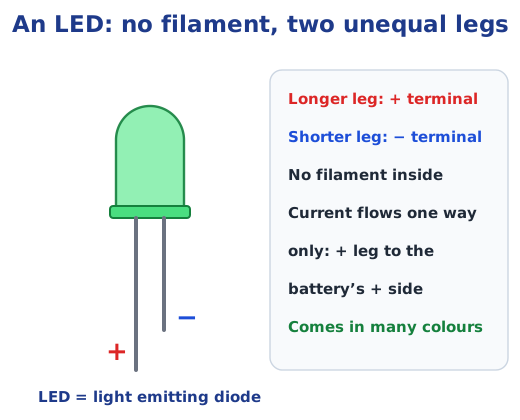
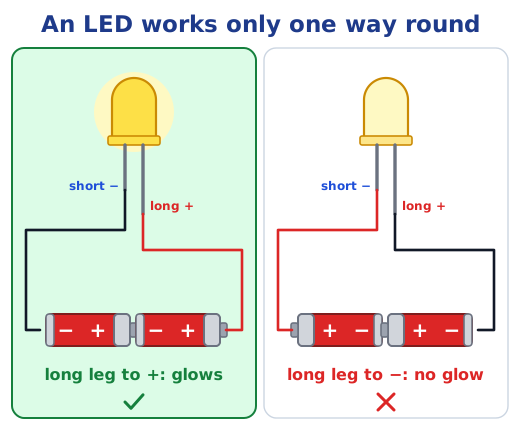
Most torches today use a light emitting diode (LED), often fixed in place so it cannot be taken out. An LED has no filament. Its two wires are of different lengths: the longer one is the positive terminal and the shorter one the negative. Current passes through an LED in one direction only, so it glows only when its longer wire goes to the battery’s + side and its shorter wire to the − side. A torch may use one LED or several, sometimes of different shapes.
Putting the torch together
In a torch, the battery, the switch and the lamp are joined by metal parts into one loop. Sliding the switch ON closes the loop, current flows from the positive terminal of the battery through the lamp and back to the negative terminal, and the lamp glows. Its circuit diagram is simply a battery, a switch and a lamp in a single loop.
Why it matters
Cells now come in many shapes: cylindrical ones for torches, clocks, remotes and toys, button cells for watches and hearing aids, and rechargeable batteries for phones, laptops and electric vehicles. How these parts work together is explained in electric circuits and circuit diagrams, and which materials carry the current in conductors and insulators. Answers to every activity and question are in the NCERT solutions for Chapter 3; see all of the Chapter 3 notes.
Practice
-
Which part of a cell is its negative terminal?
Show answer
Answer: (b) The flat metal disc
-
Inside an incandescent lamp, which part glows?
Show answer
Answer: (c) The filament
-
Which statement about an LED is true?
Show answer
Answer: (c) Current passes through it one way only
-
How can you find the + and − terminals of a battery whose marks have worn off?
Show answer
Answer: Look at the ends: the end with the small protruding metal cap is positive and the flat end is negative. Or join an LED to it: if it glows, the battery terminal joined to the LED’s longer wire is positive; if not, swap the wires and try again.
-
What does a battery of more cells give?
Show answer
Answer: Joining cells positive to negative lets the circuit run longer, or gives it more energy, or both, which is why many torches and devices use two or more cells.
Questions students ask
What is the difference between a cell and a battery?
A cell is a single portable source of electrical energy with a positive and a negative terminal. A battery is two or more cells joined so that the positive terminal of one meets the negative terminal of the next. In everyday speech a single cell, such as the one in a mobile phone, is also called a battery.
How is an incandescent lamp different from an LED?
An incandescent lamp has a thin filament held by two thicker wires joined to its two terminals, the metal case and the metal tip; current heats the filament until it glows, whichever way round it is connected. An LED has no filament, its longer wire is positive, and it glows only when connected the right way round.
How does a torch work?
Its cells are placed positive to negative to form a battery. Sliding the switch ON completes a circuit from the battery, through the lamp and back. Current then flows and the lamp, an incandescent bulb or an LED, gives light. Sliding it OFF opens a gap, so the current stops and the light goes out.
Stuck on a question?
Take a photo and Lagnever AI explains it step by step. Try it for 7 days for ₹2.
Get it on Google Play Open in browser
For parents: after the trial, the plan renews monthly by UPI or card autopay. You can cancel anytime in the app.