
Electric circuits and circuit diagrams
Answer in short
An electrical circuit is a complete path for electric current, from the positive terminal of a cell, through wires and a lamp, back to its negative terminal. A lamp glows only when the path is complete. A switch closes the circuit when ON and opens it when OFF. A circuit diagram draws the circuit with standard symbols for each component.
Stuck on a question? Take a photo and Lagnever AI explains it step by step. Try it for 7 days for ₹2. Get it on Google Play
Six ways to join a cell and a lamp
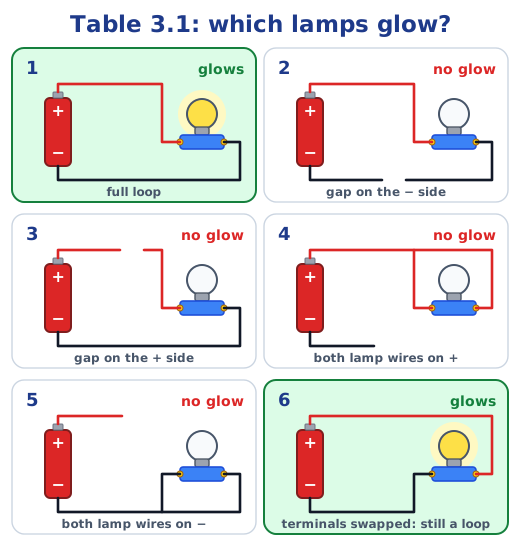
Take a cell, a torch lamp in a holder and some wires with about 1 cm of plastic removed from each end. Joining them in six different ways, first predicting and then testing, shows a clear pattern: the lamp glows in only two of the arrangements. In those, one terminal of the lamp is joined to the positive terminal of the cell and the other terminal to the negative. Where a wire is left loose, or both lamp wires go to the same terminal of the cell, the lamp stays dark.
A complete path
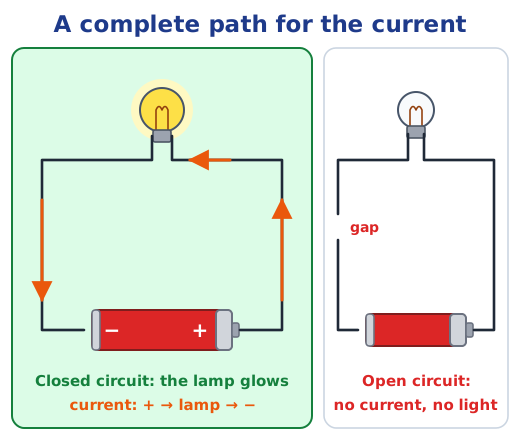
When the cell, the wires and the lamp make one unbroken loop, they form an electrical circuit. Electric current flows around it, and its direction is taken to be from the positive terminal of the cell, through the wires and the lamp, to the negative terminal. In an incandescent lamp the current passes through the filament and makes it glow, and it does not matter which lamp terminal goes to which cell terminal. If the filament breaks, the lamp has fused: the break is a gap in the path, so no current flows.
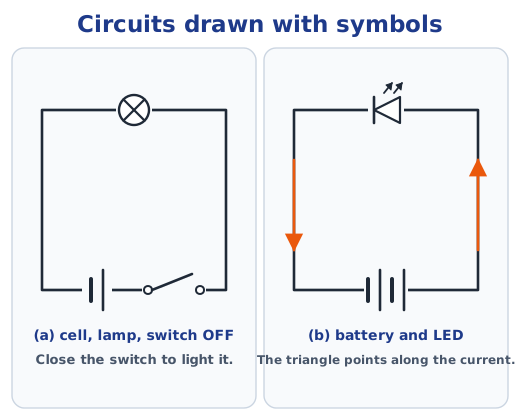
An LED is different, because current can pass through it in one direction only. It glows when its longer wire goes to the battery’s + terminal and its shorter wire to the − terminal; swap them and it stays dark.
Switches open and close a circuit
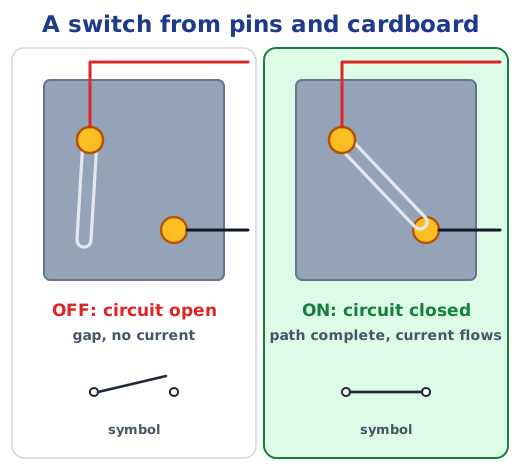
A switch completes or breaks a circuit. You can make one with two drawing pins, a safety pin and a small piece of cardboard: the safety pin turns about one drawing pin, and its other end can be swung to touch the second pin. When it touches, the gap closes, current flows from the positive to the negative terminal, and the lamp glows; this is the ON position and the circuit is closed. When it does not touch, the gap stops the current; this is the OFF position and the circuit is open. A switch works wherever it sits in the loop, and the switches on your walls do the same job inside a plastic cover.
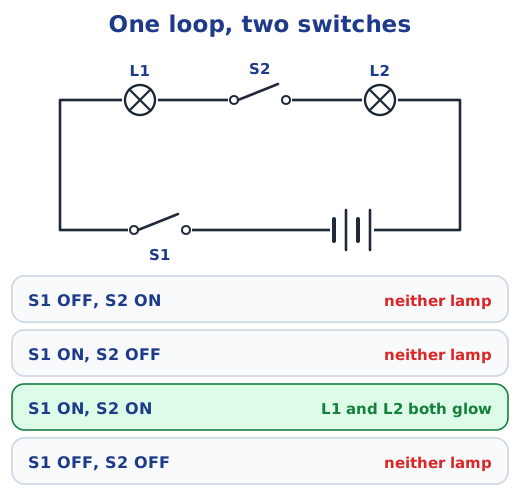
Because a single loop has only one path, a gap anywhere stops the current everywhere. Two lamps and two switches in one loop light up only when both switches are ON, and if one lamp fuses, the other goes out too.
Circuit diagrams and symbols
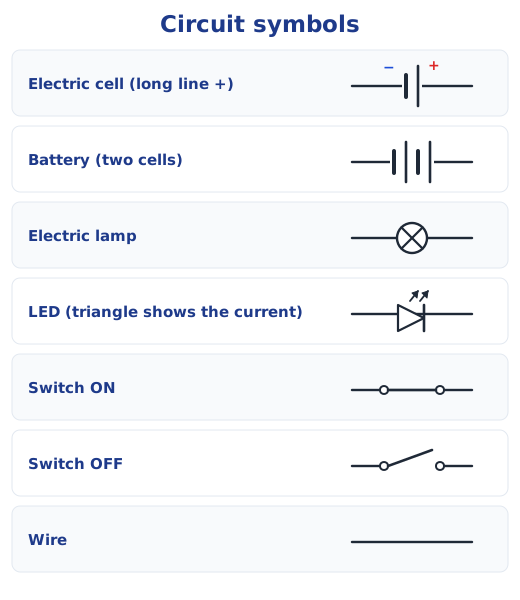
Instead of drawing real parts, we use symbols. A cell is a long line and a short line: the long line is positive and the short line negative. A battery is two or more cell symbols together. A lamp is a circle with a cross. An LED is a triangle with a bar, whose triangle points the way current can flow, plus two arrows for the light it gives out. A switch is drawn closed for ON and with a tilted, open line for OFF. A drawing of a circuit with symbols is its circuit diagram, and standard symbols, set by bodies such as the IEC, ANSI and IEEE, help people from different countries understand one another.
Why it matters
Every electrical device, from a torch to a television, depends on complete circuits and switches. What a circuit is made of is explained in cells, batteries and lamps, and which materials let current through in conductors and insulators. Answers to every activity and question are in the NCERT solutions for Chapter 3; see all of the Chapter 3 notes.
Practice
-
When does a lamp glow in a circuit?
Show answer
Answer: (b) When the path through it is complete
-
Two lamps and a battery are in one loop. One lamp fuses. What happens to the other?
Show answer
Answer: (b) It stops glowing
-
What does a circle with a cross stand for in a circuit diagram?
Show answer
Answer: (c) An electric lamp
-
Why does a torch lamp glow in only one position of its switch?
Show answer
Answer: In the ON position the switch joins the gap, so the circuit through the cells and the lamp is complete and current flows. In the OFF position it leaves a gap, the circuit is open and no current flows.
-
In a loop with two lamps L1 and L2, a battery and two switches S1 and S2, when do the lamps glow?
Show answer
Answer: Only when both S1 and S2 are ON. There is just one path, so a gap at either switch stops the current everywhere and neither lamp glows.
Questions students ask
What is an electrical circuit?
A complete path through which electric current flows. In the simplest circuit, one terminal of a lamp is joined by a wire to one terminal of a cell and the other lamp terminal to the other cell terminal. Current flows from the positive terminal, through the lamp, to the negative terminal, and the lamp glows.
What is the difference between an open and a closed circuit?
In a closed circuit the path is complete, so current flows and the lamp glows; a switch in the ON position closes the circuit. In an open circuit there is a gap somewhere, such as a switch in the OFF position or a loose wire, so no current flows.
Why do we draw circuit diagrams?
Symbols make circuits quicker to draw and easier to understand than pictures of real cells, lamps and wires. Organisations such as the International Electrotechnical Commission set standard symbols, so a circuit diagram drawn in one country can be read anywhere.
Stuck on a question?
Take a photo and Lagnever AI explains it step by step. Try it for 7 days for ₹2.
Get it on Google Play Open in browser
For parents: after the trial, the plan renews monthly by UPI or card autopay. You can cancel anytime in the app.