
Conductors and insulators of electricity
Answer in short
Conductors are materials through which electric current flows easily, such as metals like copper, aluminium and iron. Insulators are materials through which current cannot pass, such as plastic, rubber, glass, wood and ceramics. Wires are made of copper, a conductor, and covered with plastic or rubber, insulators, so that current flows where we want and we stay safe.
Stuck on a question? Take a photo and Lagnever AI explains it step by step. Try it for 7 days for ₹2. Get it on Google Play
Why metal wires?
Circuits use metal wires, and the wires are covered with plastic or rubber. Why not wires of some other material, and why the covering? A simple tester answers both questions.
A conduction tester
Join a cell and a torch lamp with wires, leaving two wire ends open. Touch the open ends together for a moment: if the lamp glows, the tester works. Now touch the two ends to the two ends of different objects, one at a time, making sure the wires do not touch each other. If the lamp glows, current has passed through the object and completed the circuit; if not, the object has blocked it.
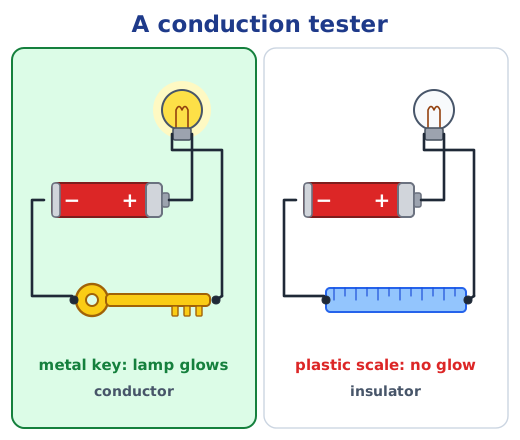
What the tester shows
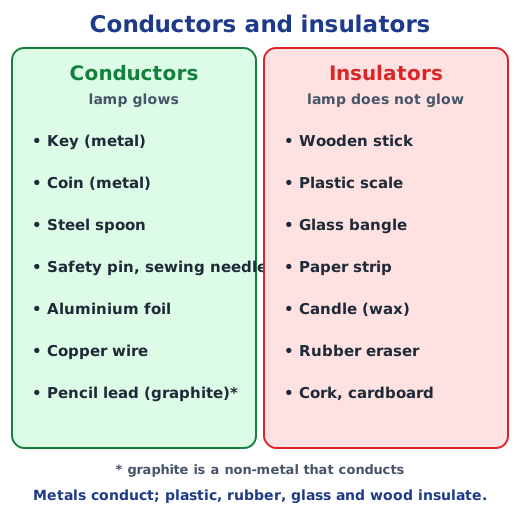
The lamp glows for some materials only. A key, a coin, a steel spoon, a pin, a sewing needle and aluminium foil make it glow: these are conductors, materials through which current flows easily. A wooden stick, a plastic scale, a glass bangle, a paper strip, a candle, a rubber eraser, cork and cardboard do not: these are insulators, or poor conductors, through which current cannot pass. All the conductors in the list are metals, which is why wires are made of metal. Extra: pencil lead is graphite, which is not a metal, yet it also conducts, though with one cell the lamp may glow only dimly.
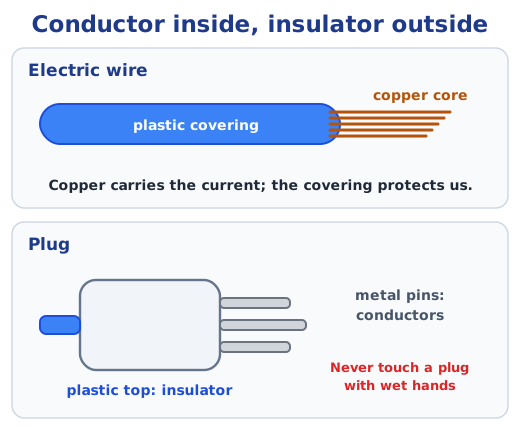
Copper inside, plastic outside
Silver, copper and gold conduct electricity better than other metals, but silver and gold are costly. Copper is cheaper and plentiful, so most electrical wires are made of it, in different types for different uses. Around the copper is a covering of plastic or rubber, an insulator. Conductors and insulators work as a team: wires, switch contacts, plug pins and sockets are made of conductors so that current can flow, while plastic, rubber and ceramics cover wires, plug tops and switches so that it cannot reach us.
Safety first
Our body is also a conductor. Current passing through it can cause severe injury or even death. So do not handle switches or plugs when your hands are wet, keep electrical devices away from wet places, and never use anything whose covering is damaged or whose plug is broken. Danger signs on electric poles warn of this risk. For experiments, use only cells and batteries, such as those in torches, clocks, radios and remotes; never use the supply at home or school, or even a portable generator.
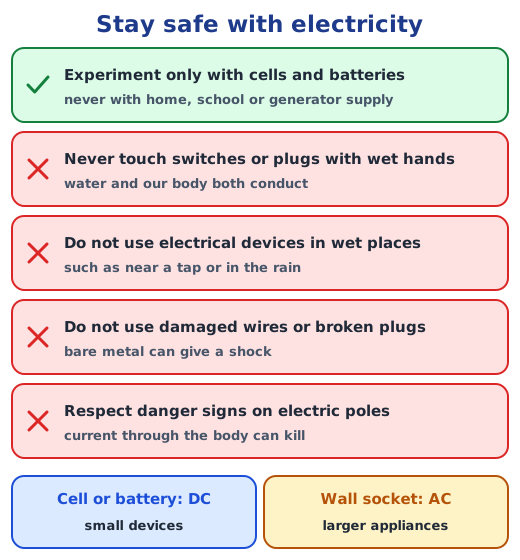
DC and AC
The electricity from a cell is different from the electricity at a wall socket. Cells and batteries give direct current (DC), which usually powers small devices. Power plants send alternating current (AC) to wall sockets, and it can run larger appliances.
Why it matters
Choosing the right material keeps current flowing where we want it and away from people. How the current flows around a loop is explained in electric circuits and circuit diagrams, and the parts of a torch in cells, batteries and lamps. Answers to every activity and question are in the NCERT solutions for Chapter 3; see all of the Chapter 3 notes.
Practice
-
Which material will make the lamp of a conduction tester glow?
Show answer
Answer: (c) A steel key
-
Why are electrical wires mostly made of copper?
Show answer
Answer: (b) It conducts well and is cheaper and plentiful
-
Which of these is a poor conductor of electricity?
Show answer
Answer: (d) Plastic
-
A student forgets to strip the plastic from the wire ends. Will the lamp glow?
Show answer
Answer: No. The plastic is an insulator, so the metal of the wire never touches the terminals and the path is not complete. Current cannot flow until about 1 cm of covering is removed from each end.
-
Name a household object that has both conductors and insulators.
Show answer
Answer: An electric iron: its base is metal, a conductor, and its handle is plastic, an insulator. A screwdriver with a plastic handle and a steel tip is another example.
Questions students ask
What is the difference between conductors and insulators?
Conductors let electric current pass easily, so a lamp in a tester glows when they complete the circuit; metals such as copper, aluminium and iron are conductors. Insulators do not let current pass, so the lamp stays dark; plastic, rubber, glass, wood, paper, wax and ceramics are insulators, also called poor conductors.
Why do electric wires have a plastic or rubber covering?
Plastic and rubber are insulators. The covering keeps the current inside the copper, stops it passing into anyone who touches the wire, and protects people from electric shocks. Plug tops and switch covers are made of insulators for the same reason, while their inside parts that carry current are conductors.
Why should we not touch switches with wet hands?
Our body is a conductor of electricity, and water helps current reach the skin. Current passing through the body can cause severe injury or even death, so switches and plugs must be handled with dry hands, devices kept away from wet places, and damaged wires or broken plugs never used.
Stuck on a question?
Take a photo and Lagnever AI explains it step by step. Try it for 7 days for ₹2.
Get it on Google Play Open in browser
For parents: after the trial, the plan renews monthly by UPI or card autopay. You can cancel anytime in the app.