
NCERT Solutions Class 7 Science Chapter 8: Measurement of Time and Motion
Answers to every question in Chapter 8, Measurement of Time and Motion, of Curiosity (Reprint 2026-27): the in-text questions and activities, all 11 “Let Us Enhance Our Learning” questions with full working, and the exploratory projects. The page numbers match the book (pages 105–120). Activities have sample readings; yours may differ a little. Short notes: Chapter 8 notes.
Measuring time before clocks (pages 105–107)
How was time measured when there were no clocks and watches? People used events that repeat in nature, such as sunrise and sunset, the phases of the Moon and the seasons, to make days and calendars. For shorter times they used sundials (a moving shadow), water clocks (water flowing out of, or into, a vessel), hourglasses (sand) and candle clocks (marked candles).
Activity 8.1: Your water clock is ready. Can you guess how to use it? Pour the water from the bottom half back into the top half. As it drips down, watch the level in the bottom half: each time it reaches one of your marks, one more minute has passed.
The simple pendulum (pages 109–110)
Is a pendulum similar to the eraser hung on a thread from Class 6? Yes. Both swing to and fro about a mean position, which is oscillatory motion, and both repeat their path after a fixed interval of time.
Activity 8.2: Is your pendulum oscillating? Is its time period almost the same every time? Yes. Sample readings for a 100 cm pendulum:
| Trial | Time for 10 oscillations → time period |
|---|---|
| 1 | 20.1 s → 2.01 s |
| 2 | 19.9 s → 1.99 s |
| 3 | 20.0 s → 2.00 s |
The time period is almost the same every time, so a pendulum of a given length takes the same time for each oscillation.
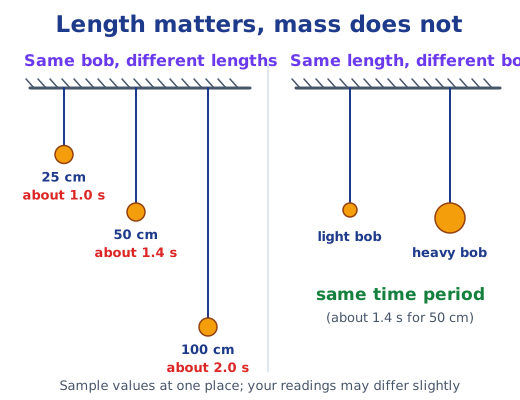
Think like a scientist: what would you investigate if you were Galileo? Questions to ask: do all pendulums have the same time period? Does the time period depend on the length, the mass of the bob, or how far the bob is pulled? Test one change at a time. With the same bob and different lengths, the time period changes: a longer pendulum swings more slowly (sample: about 1.0 s for 25 cm, 1.4 s for 50 cm, 2.0 s for 100 cm). With the same length and bobs of different mass, the time period does not change. So the time period depends on the length, not on the mass of the bob.
Units of time (pages 111–112)
Activity 8.3: What is the smallest interval of time you can measure with the wall clock? One second, the time for the seconds hand to move from one mark to the next.
For races of the same distance, time tells us who is faster. How can we tell when the races are of different distances? Compare speeds, that is, the distance each runner covers in unit time (total distance ÷ total time). The one with the higher speed is faster.
Speed (pages 113–116)
Activity 8.4: Find the speeds of trains between your station and the next one. Take the distance between the two stations from the timetable, find the time from departure to arrival, and divide. Sample (made-up numbers, to show the method):
| Train | Distance, time and speed |
|---|---|
| Passenger | 24 km in 30 min (0.5 h): 24 ÷ 0.5 = 48 km/h |
| Express | 60 km in 1 h: 60 km/h |
| Superfast | 105 km in 1 h 30 min (1.5 h): 105 ÷ 1.5 = 70 km/h |
Which is the fastest train? The one that covers the most distance in unit time, that is, the one with the highest speed: here, the superfast train.
Some marathon runners kept the same speed while others sped up or slowed down. How were their motions different? Runners keeping the same speed along the straight road were in uniform linear motion, covering equal distances in equal times. Runners who sped up or slowed down were in non-uniform linear motion.
Uniform and non-uniform motion (page 117)
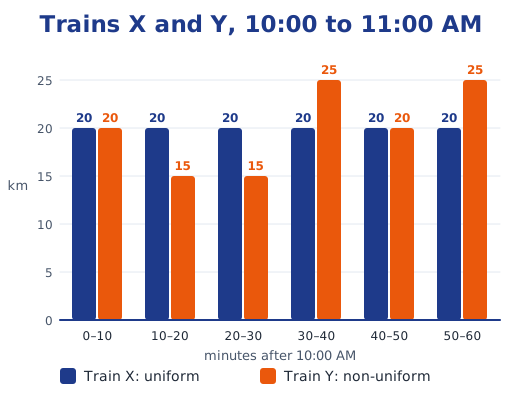
Which train in Table 8.3 is in uniform linear motion? Train X covers 20 km in every 10 minutes, equal distances in equal intervals, so it is in uniform linear motion. Train Y covers 20, 15, 15, 25, 20 and 25 km, so it is in non-uniform linear motion.
Let Us Enhance Our Learning (pages 118–119)
1. Calculate the speed of a car that travels 150 metres in 10 seconds. Express your answer in km/h. Speed = 150 m ÷ 10 s = 15 m/s. In km/h: 15 m/s = 15 × (1/1000 km) ÷ (1/3600 h) = 15 × 3600 ÷ 1000 = 54 km/h.
2. A runner completes 400 metres in 50 seconds. Another completes it in 45 seconds. Who has a greater speed and by how much? First runner: 400 m ÷ 50 s = 8 m/s. Second runner: 400 m ÷ 45 s = 8.89 m/s (about). The second runner is faster, by 8.89 − 8 = 0.89 m/s (exactly 8/9 m/s).
3. A train travels at 25 m/s and covers 360 km. How much time does it take? 360 km = 360,000 m. Time = distance ÷ speed = 360,000 m ÷ 25 m/s = 14,400 s = 14,400 ÷ 3600 h = 4 h.
4. A train travels 180 km in 3 h. Find (i) its speed in km/h, (ii) in m/s, (iii) the distance in 4 h at the same speed. (i) Speed = 180 km ÷ 3 h = 60 km/h. (ii) 60 km/h = 60 × 1000 m ÷ 3600 s = 16.67 m/s (about). (iii) Distance = 60 km/h × 4 h = 240 km.
5. A galloping horse can reach about 18 m/s. How does this compare with a train moving at 72 km/h? 72 km/h = 72 × 1000 m ÷ 3600 s = 20 m/s. The train (20 m/s) is faster than the horse (18 m/s) by 2 m/s. In km/h, the horse’s speed is 18 × 3.6 = 64.8 km/h, which is 7.2 km/h less than the train’s.
6. Distinguish between uniform and non-uniform motion using a car on a straight highway with no traffic and a car in city traffic. On a straight, empty highway a car can keep the same speed, say 80 km/h, covering equal distances in equal times: that is close to uniform linear motion. In city traffic a car keeps speeding up, slowing down and stopping at signals and crossings, covering unequal distances in equal times: that is non-uniform motion.
7. If the object is in uniform motion, fill in the gaps in the table. It covers 8 m in the first 10 s, so its speed is 8 m ÷ 10 s = 0.8 m/s, and it covers 8 m in every 10 s.
| Time (s) | Distance (m) |
|---|---|
| 0 | 0 |
| 10 | 8 |
| 20 | 16 |
| 30 | 24 |
| 40 | 32 |
| 50 | 40 |
| 60 | 48 |
| 70 | 56 |
8. A car covers 60 km in the first hour, 70 km in the second and 50 km in the third. Is the motion uniform? Find the average speed. The motion is not uniform, because the car covers different distances in equal intervals of one hour. Average speed = total distance ÷ total time = (60 + 70 + 50) km ÷ 3 h = 180 km ÷ 3 h = 60 km/h.
9. Which type of motion is more common in daily life: uniform or non-uniform? Give three examples. Non-uniform motion is far more common. Examples: a school bus that starts, speeds up, slows at turns and stops at bus stops; walking to school, slowing at crossings and speeding up when late; a bicycle going faster downhill and slower uphill. A ball rolling on the ground and slowing down, and a lift starting and stopping, are other examples.
10. Is the speed of the object uniform or non-uniform? Find the average speed. In each 10 s the object covers 6, 4, 6, 5, 8, 6, 7, 3, 10 and 5 m: unequal distances in equal intervals, so its speed is non-uniform. Average speed = 60 m ÷ 100 s = 0.6 m/s.
11. A vehicle covers 2 km along a straight line. The first 500 m at 10 m/s and the next 500 m at 5 m/s. At what speed must it cover the rest to finish in 200 s? What is the average speed? Time for the first 500 m = 500 m ÷ 10 m/s = 50 s. Time for the next 500 m = 500 m ÷ 5 m/s = 100 s. Time used = 150 s, so 200 − 150 = 50 s are left for the remaining 2000 − 1000 = 1000 m. Required speed = 1000 m ÷ 50 s = 20 m/s. Average speed for the journey = 2000 m ÷ 200 s = 10 m/s.
Exploratory Projects (pages 119–120)
1. Make a floating-bowl water clock that sinks in about 24 minutes. Use a small, light metal or plastic bowl, make a tiny hole in the middle of its bottom, float it in a bucket of water, and time how long it takes to sink. If it sinks too fast, use a bigger bowl or start again with a smaller hole; if too slow, make the hole slightly bigger. Keep notes of each bowl and hole size until one sinks in close to 24 minutes, one ghatika.
2. Measure pulse rates and use your pulse to measure time. Find the pulse on the inside of the wrist with two fingers and count the beats for 1 minute (or for 15 s and multiply by 4). Record each friend’s pulse at rest and after running on the spot. A story idea: like Galileo in the church, a girl times a swinging lamp, a dripping tap or a song with her pulse when her watch stops.
3. Why do readings of the time period differ slightly in Activity 8.2, and how can you reduce this? Reasons: a small delay in starting or stopping the watch, miscounting the oscillations, pushing the bob while releasing it, swings that are too wide or not in one plane, a breeze, or a support that is not rigid. To reduce them: time 20 or more oscillations, release the bob gently from the same small angle, use a firm support, start and stop the watch as the bob passes the same point, let the same person time every trial, and take the average of several readings.
4. Measure the time period of playground swings. The time period of a swing stays almost the same whether a lighter or a heavier child sits on it, but a swing with longer chains has a longer time period. So yes, a swing is a pendulum: the seat and child act as the bob and the chains as the thread.
5. Compare the speeds of Olympic winners in the 100 m, 200 m and 400 m races. (Extra: official winning times from the Paris 2024 Olympics.)
| Event, Paris 2024 | Winning time → speed |
|---|---|
| Men’s 100 m | 9.79 s → 100 ÷ 9.79 = 10.21 m/s (about 36.8 km/h) |
| Men’s 200 m | 19.46 s → 10.28 m/s (about 37.0 km/h) |
| Men’s 400 m | 43.40 s → 9.22 m/s (about 33.2 km/h) |
| Women’s 100 m | 10.72 s → 9.33 m/s (about 33.6 km/h) |
| Women’s 200 m | 21.83 s → 9.16 m/s (about 33.0 km/h) |
| Women’s 400 m | 48.17 s → 8.30 m/s (about 29.9 km/h) |
At Tokyo 2020, the men’s 100 m was won in 9.80 s (10.20 m/s), the men’s 200 m in 19.62 s (10.19 m/s) and the women’s 100 m in 10.61 s (9.43 m/s). The 400 m is the slowest of the three in both Games, because no one can sprint flat out for so long. In Paris the men’s 200 m winner was even faster on average than the 100 m winner, since the slow start takes up a smaller part of a longer race; among the women, the 100 m was the fastest.
Practice
-
A pendulum completes 10 oscillations in 15 s. Its time period is:
Show answer
Answer: (b) 1.5 s Time period = 15 s ÷ 10 = 1.5 s.
-
A scooter moves at 36 km/h. Its speed in m/s is:
Show answer
Answer: (b) 10 m/s 36 × 1000 m ÷ 3600 s = 10 m/s.
-
Which is written correctly?
Show answer
Answer: (c) 20 s
-
A cyclist rides 6 km in 30 min. Find the speed in km/h and in m/s.
Show answer
Answer: 30 min = 0.5 h, so speed = 6 km ÷ 0.5 h = 12 km/h. In m/s: 6000 m ÷ 1800 s = 3.33 m/s (about).
-
An object covers 3 m, 3 m, 3 m and 3 m in four seconds, one after another, along a straight line. What kind of motion is this, and what is its speed?
Show answer
Answer: Uniform linear motion, because it covers equal distances in equal intervals of time. Speed = 12 m ÷ 4 s = 3 m/s.
Stuck on a question?
Take a photo and Lagnever AI explains it step by step. Try it for 7 days for ₹2.
Get it on Google Play Open in browser
For parents: after the trial, the plan renews monthly by UPI or card autopay. You can cancel anytime in the app.