
Class 7 Science Chapter 8: Measurement of Time and Motion Notes
This chapter in five lines
Measurement of Time and Motion shows how people have measured time, from sundials, water clocks and hourglasses to pendulum, quartz and atomic clocks, each using something that repeats. A simple pendulum of a given length has a constant time period at a place. The SI unit of time is the second. Speed is the total distance divided by the total time, in m/s or km/h. Motion along a straight line at constant speed is uniform; if the speed changes, it is non-uniform.
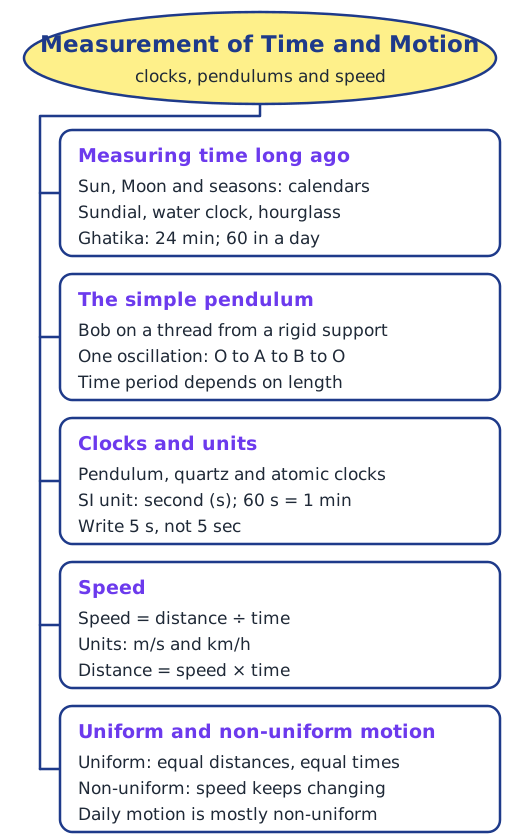
What is this chapter about?
Prerna, a fast sprinter, notices that Olympic timing can pick a winner even when two runners seem to finish together, while her school uses a stopwatch, her mother a wristwatch, her sister a phone and her uncle a Braille watch and a talking watch. That makes her wonder how people measured time before clocks. The chapter follows that question from sundials to atomic clocks, explores the simple pendulum, and then uses time to measure motion: who is faster, what speed is, and how uniform motion differs from non-uniform motion.
Measuring time long ago
People noticed that many events in nature repeat at fixed intervals: sunrise and sunset, the phases of the Moon, the seasons. They used these cycles to make calendars, with a day set by the Sun. To measure shorter times within a day, they built sundials, water clocks, hourglasses and candle clocks.
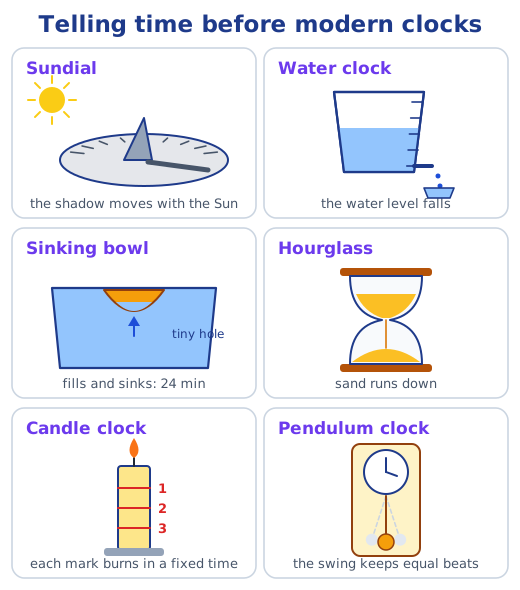
India has a long history of timekeeping. The Arthashastra mentions shadow clocks and water flowing out of a vessel; Varahamihira, around 530 CE, gave a rule for finding time from the shadow of a vertical stick; and Aryabhata described the sinking-bowl water clock, the ghatika-yantra. Its bowl took 24 minutes to fill and sink, a unit called a ghatika, so a day had 60 ghatis, and each sinking was announced with drums, conch shells or a gong. The Samrat Yantra at Jantar Mantar in Jaipur, built about 300 years ago, is the world’s largest stone sundial: 27 m tall, its shadow moves about 1 mm every second.
From pendulum clocks to atomic clocks
From the fourteenth century, mechanical clocks were driven by weights, gears and springs. In 1656 Christiaan Huygens invented the pendulum clock, inspired by Galileo’s discovery that a swinging lamp took the same time for each swing. Every clock, old or new, counts some process that repeats regularly. Modern clocks count the tiny, very fast vibrations of a quartz crystal or of certain atoms. Huygens’ early clocks could gain or lose 10 seconds a day, but atomic clocks lose only about one second in millions of years. More in how is time measured.
The simple pendulum
A simple pendulum is a small metal ball, the bob, hung from a rigid support by a long thread. At rest it hangs at its mean position. Pulled aside and released, it swings in periodic motion. One oscillation is a trip from O to the extreme position A, across to the other extreme position B, and back to O. The time for one oscillation is the time period.
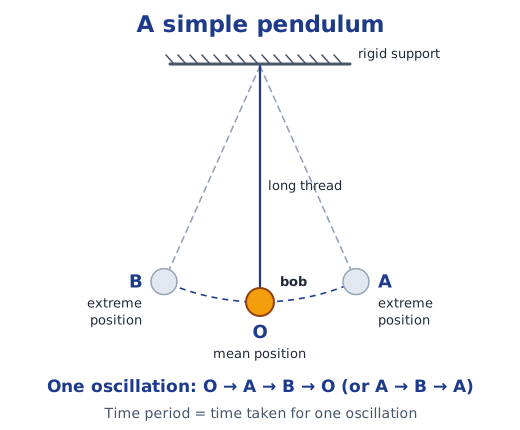
To measure it, time 10 oscillations of a pendulum about 100 cm long and divide by 10; repeating the measurement gives almost the same answer each time. A longer pendulum has a longer time period, but changing the mass of the bob makes no difference. All pendulums of the same length have the same time period at a given place, which is why pendulums can keep time. Read simple pendulum and time period.
Units of time
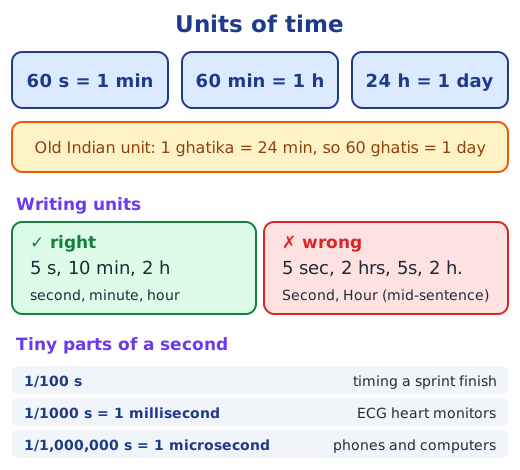
The SI unit of time is the second, with the symbol s. Larger units are the minute (min) and the hour (h): 60 s = 1 min and 60 min = 1 h. Unit names and symbols are written in lowercase and singular, with a space after the number and no full stop after the symbol: 5 s, not 5 sec. A wall clock with a seconds hand can measure intervals as short as 1 second, but race timing measures hundredths or thousandths of a second, heart monitors measure milliseconds, and computers work in microseconds.
Slow or fast? Speed
In a race over the same distance, the runner who covers more distance in the same time is faster. To compare different distances, we use speed: the distance covered in unit time.
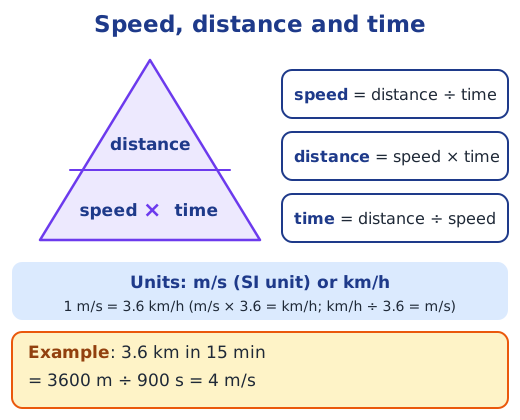
Speed = total distance covered ÷ total time taken. The SI unit is metre per second (m/s); kilometre per hour (km/h) is also common. Swati cycles 3.6 km to school in 15 min: 3600 m ÷ 900 s = 4 m/s. Turning the formula round, distance = speed × time (a bus at 50 km/h for 2 h goes 100 km) and time = distance ÷ speed (360 km at 90 km/h takes 4 h). Because things speed up and slow down on the way, this is really the average speed. A vehicle’s speedometer shows its speed at that moment, and its odometer shows the total distance travelled. See speed and uniform motion.
Uniform and non-uniform motion
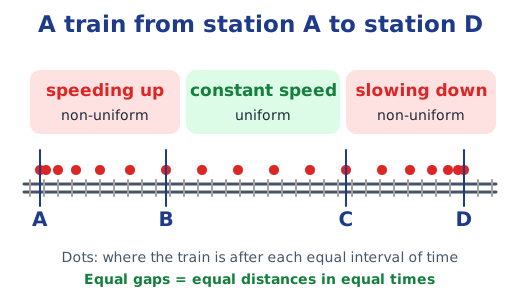
Motion along a straight line is linear motion. A train leaving station A speeds up, runs at a constant speed from B to C, then slows down and stops at D. Between B and C its motion is uniform linear motion: it covers equal distances in equal intervals of time. From A to B and from C to D its motion is non-uniform, because its speed keeps changing. In the book’s table, train X covers 20 km in every 10 minutes (uniform), while train Y covers different distances (non-uniform). Truly uniform motion is an idealisation, which is why we use average speed. Answers to all the questions are in the NCERT solutions for Chapter 8.
Key terms
| Term | Meaning |
|---|---|
| Periodic motion | Motion that repeats its path after a fixed interval of time, like the swing of a pendulum. |
| Sundial | A device that shows the time of day by the position of a shadow cast by the Sun. |
| Ghatika-yantra | An ancient Indian water clock: a bowl with a tiny hole floats on water, fills and sinks in a fixed time, 24 minutes, called one ghatika. |
| Simple pendulum | A small heavy ball, the bob, hung from a rigid support by a long thread. |
| Mean position | The position in which a pendulum hangs at rest, straight down from the support. |
| Oscillation | One complete to-and-fro swing, such as from the mean position O to A, then to B, and back to O. |
| Time period | The time a pendulum takes to complete one oscillation. For a given length it is constant at a place. |
| Second (s) | The SI unit of time. 60 s make 1 minute (min) and 60 min make 1 hour (h). |
| Speed | The distance an object covers in unit time: total distance divided by total time. |
| Average speed | Total distance divided by total time, even if the object went faster and slower on the way. This book calls it simply speed. |
| Speedometer | An instrument in a vehicle that shows its speed at that moment, usually in km/h. |
| Odometer | An instrument in a vehicle that shows the total distance it has travelled, in kilometres. |
| Uniform linear motion | Motion along a straight line at constant speed; equal distances are covered in equal intervals of time. |
| Non-uniform linear motion | Motion along a straight line in which the speed keeps changing, so unequal distances are covered in equal times. |
Topics in this chapter
Practice
-
Which device measures time from the position of a shadow?
Show answer
Answer: (b) Sundial
-
The time period of a pendulum is the time it takes to:
Show answer
Answer: (b) complete one oscillation
-
Which change will alter the time period of a simple pendulum?
Show answer
Answer: (b) A longer thread The time period depends on the length of the pendulum, not on the mass of the bob.
-
The SI unit of speed is:
Show answer
Answer: (b) m/s
-
A bus travels 120 km in 2 h. Its speed is:
Show answer
Answer: (b) 60 km/h Speed = 120 km ÷ 2 h = 60 km/h.
-
An object moves along a straight line covering 5 m every second. Its motion is:
Show answer
Answer: (b) uniform
Questions students ask
What are the main topics of Class 7 Science Chapter 8?
How time was measured before clocks; timekeeping in ancient India; the simple pendulum and its time period; pendulum, quartz and atomic clocks; the SI unit of time; speed and how to calculate it; and uniform and non-uniform linear motion.
Is Measurement of Time and Motion in the new Curiosity book?
Yes. It is Chapter 8 of Curiosity, the Class 7 Science textbook (Reprint 2026-27), on pages 105 to 120.
What is the time period of a simple pendulum?
The time it takes to complete one oscillation, for example from the mean position O to A, to B and back to O. To measure it, time 10 oscillations and divide by 10. For a given length it stays the same at a place.
Stuck on a question?
Take a photo and Lagnever AI explains it step by step. Try it for 7 days for ₹2.
Get it on Google Play Open in browser
For parents: after the trial, the plan renews monthly by UPI or card autopay. You can cancel anytime in the app.