
How is time measured?
Answer in short
Time is measured by counting something that repeats at equal intervals. Long ago people used the Sun, the Moon and the seasons, then sundials, water clocks, hourglasses and candle clocks. Pendulum clocks came in the 17th century, and today quartz and atomic clocks keep time very precisely. The SI unit of time is the second (s).
Stuck on a question? Take a photo and Lagnever AI explains it step by step. Try it for 7 days for ₹2. Get it on Google Play
Nature’s clocks
Long ago, people noticed that many events in nature repeat after fixed intervals: the Sun rises and sets, the Moon goes through its phases, and the seasons return. They used these cycles to keep track of time. The day, set by the rising and setting of the Sun, and the calendar came first. Then people looked for ways to tell the time within a day.
Sundials, water clocks, hourglasses and candles
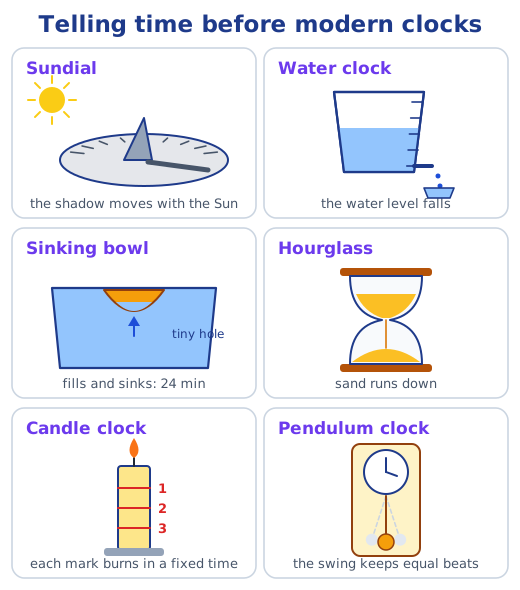
- Sundial: the shadow of an object, cast by the Sun, changes position through the day, and its place on a scale gives the time.
- Water clock: in one type, water flows out of a vessel with time marks on it. In the other, a bowl with a fine hole in its bottom floats on water, slowly fills, and sinks after a fixed time; it is then lifted and floated again.
- Hourglass: sand flows from one bulb to the other in a fixed time.
- Candle clock: a candle marked with lines; each part burns in a fixed time.
Timekeeping in ancient India
In ancient India, time was measured with both shadows and water clocks. The Arthashastra of Kautilya, composed and revised between the 2nd century BCE and the 3rd century CE, mentions shadow-based timekeeping and the outflow water clock. Around 530 CE, Varahamihira gave an accurate rule for time from the shadow of a vertical stick. Outflow clocks were not very accurate, because water flows out more slowly as the level drops. That led to the sinking-bowl clock, the ghatika-yantra, first described by Aryabhata. Its bowl took 24 minutes to fill and sink, a unit called a ghatika or ghati, so a 24-hour day had 60 ghatis. It was used in monasteries, palaces and town squares, where each sinking was announced with drums, conch shells or a gong, until pendulum clocks replaced it in the late nineteenth century.
The Samrat Yantra at Jantar Mantar in Jaipur, built about 300 years ago, is the world’s largest stone sundial. It is 27 m tall, its shadow moves about 1 mm every second, and its scale marks intervals as short as 2 seconds. Like every sundial, it shows local solar time, which needs a correction to give Indian Standard Time.
Make a water clock
Cut a used plastic bottle into two halves, make a small hole in the cap with a drawing pin, and fit the top half upside down on the bottom half. Fill the top with coloured water and mark the level in the bottom half every minute using a watch. To use the clock, pour the water back into the top: each time the level reaches a mark, one more minute has passed.
Pendulum, quartz and atomic clocks
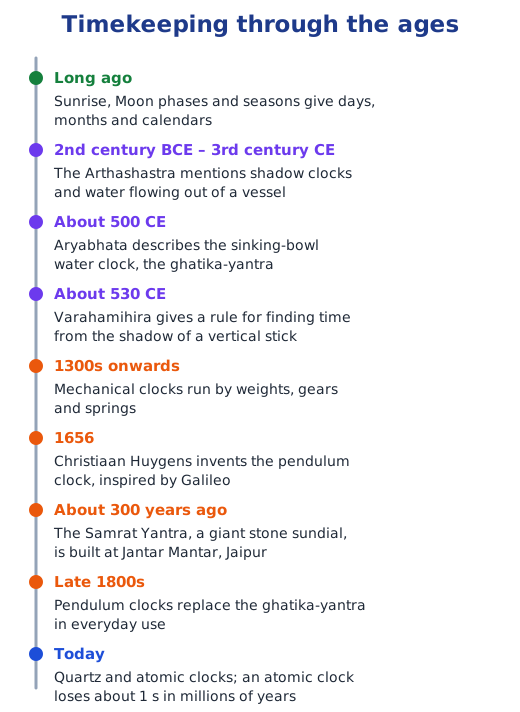
As people began to travel long distances, accurate time became very important. From the fourteenth century, mechanical clocks were driven by weights, gears and springs, and in 1656 Christiaan Huygens invented the pendulum clock, based on the steady swing of a pendulum (see simple pendulum and time period). Modern clocks use the same idea with tiny, very fast vibrations: of a quartz crystal in quartz clocks, or of certain atoms in atomic clocks. Huygens’ early clocks could gain or lose 10 seconds a day; atomic clocks lose only about one second in millions of years.
The second and other units
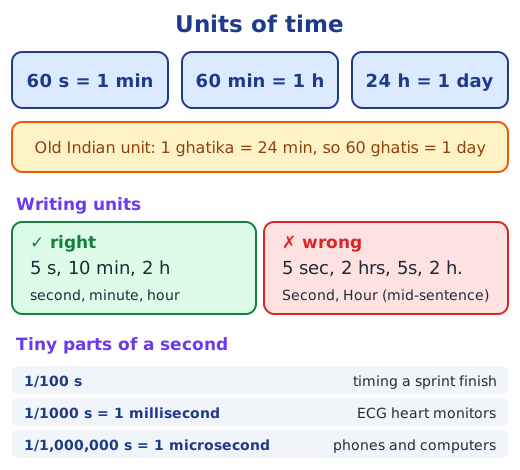
The SI unit of time is the second (s). Larger units are the minute (min) and the hour (h): 60 s = 1 min and 60 min = 1 h. Unit names and symbols are written in lowercase (except at the start of a sentence) and in the singular, with a space between the number and the symbol and no full stop after it. So write 5 s and 2 h, never 5 sec or 2 hrs. The smallest interval a wall clock with a seconds hand can measure is 1 second.
Many tasks need tinier intervals. Race timing records hundredths or even thousandths of a second (milliseconds), ECG heart monitors measure changes of milliseconds, and phones and computers process signals in microseconds, millionths of a second.
Why it matters
Accurate time runs our daily lives, from school bells and train timetables to sports, medicine and space exploration. Time is also what lets us measure motion: read speed and uniform motion. Answers to the textbook questions are in the NCERT solutions for Chapter 8; see all of Chapter 8 notes.
Practice
-
In a sinking-bowl water clock, time is measured by:
Show answer
Answer: (b) a bowl with a hole filling and sinking
-
How long did one ghatika last?
Show answer
Answer: (b) 24 minutes
-
Which is the correct way to write a time?
Show answer
Answer: (c) 10 s
-
Why did outflow water clocks become less accurate as they emptied?
Show answer
Answer: As the water level dropped, the water flowed out more slowly, so equal falls in level did not take equal times. This led to the sinking-bowl clock.
-
What do all clocks, old and modern, have in common?
Show answer
Answer: Each one counts a process that repeats at equal intervals of time: the Sun’s daily motion, a filling bowl, a swinging pendulum, or the vibrations of a quartz crystal or of atoms.
Questions students ask
How was time measured when there were no clocks?
By events that repeat in nature, such as sunrise and sunset, the phases of the Moon and the seasons, and with devices such as sundials, water clocks, hourglasses and candle clocks.
What is the Samrat Yantra?
The world’s largest stone sundial, built about 300 years ago at Jantar Mantar in Jaipur, a UNESCO World Heritage site. It is 27 m tall, and its shadow moves about 1 mm every second over a scale marked for intervals as short as 2 seconds.
What is the SI unit of time?
The second, written s. Larger units are the minute (min) and the hour (h): 60 s make 1 min and 60 min make 1 h.
Stuck on a question?
Take a photo and Lagnever AI explains it step by step. Try it for 7 days for ₹2.
Get it on Google Play Open in browser
For parents: after the trial, the plan renews monthly by UPI or card autopay. You can cancel anytime in the app.