
Simple pendulum and time period
Answer in short
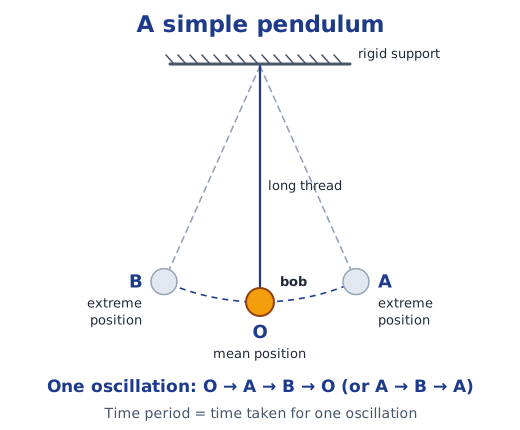
A simple pendulum is a heavy bob hung from a rigid support by a long thread. Pulled aside and released, it swings to and fro. One oscillation is a trip such as O to A to B and back to O; the time it takes is the time period. For a given length, this stays constant at a place.
Stuck on a question? Take a photo and Lagnever AI explains it step by step. Try it for 7 days for ₹2. Get it on Google Play
Parts of a simple pendulum
A simple pendulum is a small metal ball, called the bob, hung from a rigid support by a long thread. When the bob hangs still, straight down, it is at its mean position (O). Move the bob slightly to one side and let it go: it swings to and fro. This motion is periodic, because the bob repeats its path after a fixed interval of time. It is the same kind of oscillatory motion as an eraser swinging on a thread, which you may have seen in Class 6.
One oscillation and the time period
The farthest points of the swing are the extreme positions, A and B. The bob completes one oscillation when it starts at O, moves to A, turns back, swings to B, turns again and returns to O. Going from A to B and back to A is also one oscillation. The time taken for one oscillation is the time period of the pendulum.
Measure it yourself
Tie a heavy ball or stone to a string about 150 cm long and fix the string to a rigid support so that about 100 cm hangs between the support and the bob. Wait for the bob to rest, then move it slightly to one side and release it gently, without a push and with the string taut. Time 10 oscillations with a watch, repeat 3 or 4 times, and divide each time by 10.
| Trial | Time for 10 oscillations → time period (sample) |
|---|---|
| 1 | 20.1 s → 2.01 s |
| 2 | 19.9 s → 1.99 s |
| 3 | 20.0 s → 2.00 s |
The time period comes out almost the same every time. Your readings may differ a little from these sample values, but they should agree closely with one another.
What changes the time period?
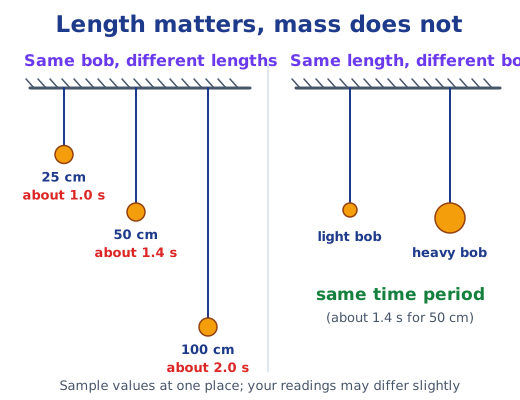
Think like a scientist and test one change at a time. Keep the same bob and use threads of two or three different lengths: the longer the pendulum, the longer its time period. Then keep the length fixed and change the bob for a lighter or heavier one: the time period stays the same. So the time period of a simple pendulum depends on its length but not on the mass of the bob, and all pendulums of the same length have the same time period at a given place. (Extra: the sample values in the picture, about 1.0 s for 25 cm, 1.4 s for 50 cm and 2.0 s for 100 cm, show that making a pendulum four times as long doubles its time period.)
Galileo and Huygens
It is said that Galileo Galilei (1564–1642), sitting in a church, noticed a hanging lamp swinging back and forth. Using his own pulse as a timer, he found that each swing took the same time. After experimenting with different pendulums, he concluded that a pendulum of a given length always takes the same time for one oscillation. Inspired by this, Christiaan Huygens (1629–1695) invented the pendulum clock in 1656 and patented it in 1657.
Why it matters
Because the time period of a pendulum of fixed length stays constant, its swings can count equal intervals of time, the basic idea behind every clock. You can see the same physics on a playground swing, whose time period also depends on its length. Read how pendulums fit into the history of clocks in how is time measured. Answers to the textbook questions are in the NCERT solutions for Chapter 8; see all of Chapter 8 notes.
Practice
-
Where does a pendulum come to rest?
Show answer
Answer: (c) At the mean position
-
A pendulum takes 20 s for 10 oscillations. Its time period is:
Show answer
Answer: (b) 2 s
-
Which change makes the time period of a pendulum longer?
Show answer
Answer: (b) Using a longer thread
-
Why do we time 10 oscillations instead of just one?
Show answer
Answer: One oscillation is very quick, so a small delay in starting or stopping the watch makes a big error. Timing 10 oscillations and dividing by 10 spreads that error and gives a more accurate time period.
-
Is a playground swing a pendulum? Give a reason.
Show answer
Answer: Yes. The seat with the child acts like the bob and the chains like the thread hung from a rigid support; it swings to and fro about a mean position with a time period that depends on its length.
Questions students ask
What is a simple pendulum?
A small metal ball, called the bob, hung from a rigid support by a long thread. When moved to one side and released, it swings to and fro about its mean position in periodic motion.
What is the time period of a pendulum?
The time it takes to complete one oscillation, for example from the mean position O to A, to B and back to O. It is found by timing 10 oscillations and dividing by 10.
Does the time period of a pendulum depend on the mass of the bob?
No. It depends on the length of the pendulum. Pendulums of the same length have the same time period at a given place, whether the bob is light or heavy.
Stuck on a question?
Take a photo and Lagnever AI explains it step by step. Try it for 7 days for ₹2.
Get it on Google Play Open in browser
For parents: after the trial, the plan renews monthly by UPI or card autopay. You can cancel anytime in the app.