
Speed and uniform motion
Answer in short
Speed is the distance an object covers in unit time: total distance divided by total time. Its SI unit is m/s, and km/h is also used. If an object moves along a straight line at a constant speed, covering equal distances in equal times, its motion is uniform; if its speed keeps changing, its motion is non-uniform.
Stuck on a question? Take a photo and Lagnever AI explains it step by step. Try it for 7 days for ₹2. Get it on Google Play
Who is faster?
In a 100 metre race, all the runners start together, but soon some are ahead of the others. The runner who is ahead at any instant has covered more distance in the same time, so that runner is faster. For races over the same distance, the one who takes the least time is fastest. To compare objects moving over different distances in different times, we need a single measure: speed.
Speed
Speed is the distance an object covers in unit time, such as one second, one minute or one hour.
Speed = total distance covered ÷ total time taken
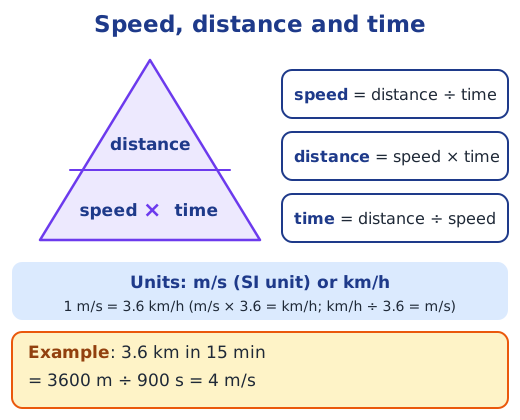
Since speed is distance divided by time, its SI unit is metre per second (m/s). When distance is in kilometres and time in hours, the unit is kilometre per hour (km/h). To change units, write 1 km as 1000 m and 1 h as 3600 s, so 1 m/s = 3.6 km/h.
Worked examples
- Speed: Swati’s school is 3.6 km away and she cycles there in 15 min. Speed = 3.6 km ÷ 15 min = 3600 m ÷ 900 s = 4 m/s.
- Distance: Raghav’s bus moves at 50 km/h for 2 h. Distance = speed × time = 50 km/h × 2 h = 100 km.
- Time: a train at 90 km/h must cover 360 km. Time = distance ÷ speed = 360 km ÷ 90 km/h = 4 h.
You can find the speed of real trains the same way: take the distance between two stations from a railway timetable and divide by the time between departure and arrival.
Average speed and the speedometer
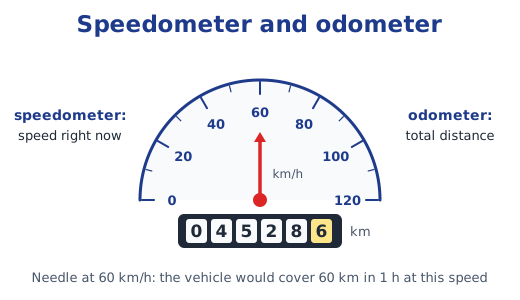
A bus or train rarely keeps the same speed for a whole journey: it speeds up, slows down and stops. So total distance ÷ total time gives its average speed; the Class 7 book calls this simply “speed”. Vehicles have a speedometer, which shows the speed at that moment in km/h, and an odometer, which shows the total distance travelled in kilometres.
Uniform and non-uniform motion
Motion along a straight line is linear motion. Picture a train on a straight track between stations A and D. It starts slowly, speeds up until B, runs at a constant speed from B to C, then slows down and stops at D.
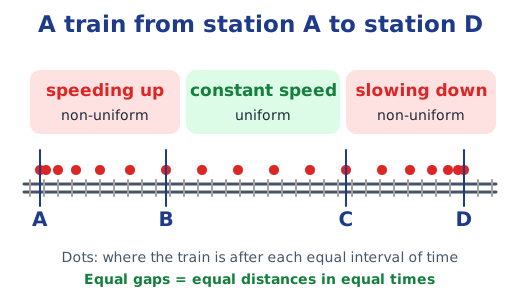
- Uniform linear motion: moving along a straight line at a constant speed, covering equal distances in equal intervals of time (B to C).
- Non-uniform linear motion: moving along a straight line with a changing speed, covering unequal distances in equal intervals (A to B and C to D).
Trains X and Y
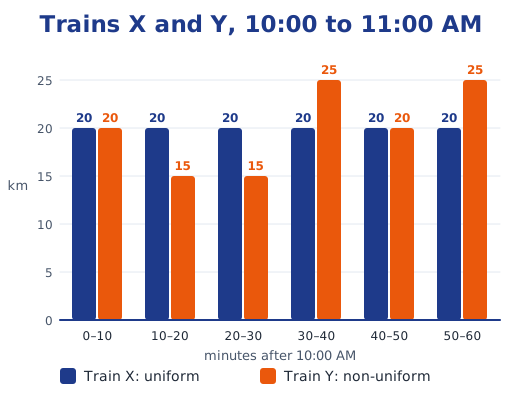
Between 10:00 and 11:00 AM, train X covers 20 km in every 10 minutes, so it is in uniform linear motion. Train Y covers 20, 15, 15, 25, 20 and 25 km, so its motion is non-uniform, even though both trains cover 120 km in the hour and have the same average speed, 120 km/h. Perfectly uniform motion over long distances is rare in everyday life; it is an idealisation, which is why we work with average speeds.
Why it matters
Speed helps us plan journeys, compare runners and trains, and stay safe on roads with speed limits. To see how we measure the time in these formulas, read how is time measured. Answers to the textbook questions are in the NCERT solutions for Chapter 8; see all of Chapter 8 notes.
Practice
-
A car covers 100 m in 5 s. Its speed is:
Show answer
Answer: (b) 20 m/s
-
A train moves at 80 km/h for 3 h. How far does it go?
Show answer
Answer: (a) 240 km
-
Which shows uniform linear motion?
Show answer
Answer: (c) An object covering 10 m in every second along a straight path
-
Convert 54 km/h into m/s.
Show answer
Answer: 54 km/h = 54 × 1000 m ÷ 3600 s = 15 m/s.
-
How long will a cyclist moving at 5 m/s take to cover 1.5 km?
Show answer
Answer: 1.5 km = 1500 m. Time = distance ÷ speed = 1500 m ÷ 5 m/s = 300 s, which is 5 min.
Questions students ask
What is speed?
Speed is the distance an object covers in unit time, such as one second or one hour. It is calculated as the total distance covered divided by the total time taken.
What is the difference between uniform and non-uniform motion?
In uniform linear motion an object moves along a straight line at a constant speed and covers equal distances in equal intervals of time. In non-uniform linear motion its speed keeps changing, so it covers unequal distances in equal intervals.
What is average speed?
The total distance divided by the total time, even if the object went faster at some times and slower at others. In the Class 7 book, ‘speed’ means this average speed.
Stuck on a question?
Take a photo and Lagnever AI explains it step by step. Try it for 7 days for ₹2.
Get it on Google Play Open in browser
For parents: after the trial, the plan renews monthly by UPI or card autopay. You can cancel anytime in the app.