
NCERT Solutions Class 7 Social Science Part 2 Chapter 5: India, a Home to Many
Answers to every question in Part 2 Chapter 5, India, a Home to Many, of Exploring Society: India and Beyond Grade 7 (2026-27): the Big Questions, every Think About It and Let’s Explore box, and all four questions and activities. Page numbers follow the book (pages 125–142). Short notes: Part 2 Chapter 5 notes.
The Big Questions (page 125)
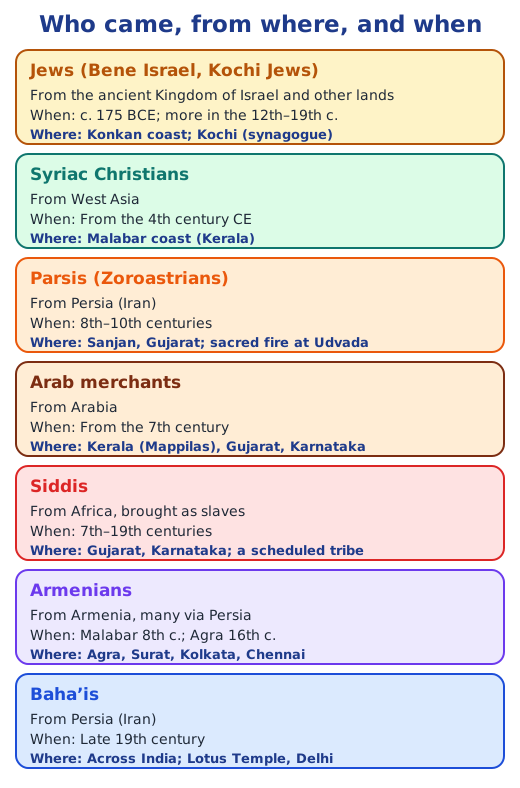
1. What has made India a home for people from different parts of the world? Several things together. A culture of acceptance taught people to see strangers as family and guests as God (vasudhaiva kutumbakam, atithi devo bhava). Rulers welcomed newcomers, gave them land and let them worship as they wished: the Raja of Kochi, Raja Jadi Rana of Sanjan, Akbar. India’s trade in spices and cloth drew merchants such as the Arabs and the Armenians, and its long coastline made it reachable by sea from West Asia and Africa. And a society that already held many languages and faiths had room for one more.
2. Why did oppressed or persecuted people from other countries seek refuge in India? Because they could not live or worship safely at home. Jews faced persecution in several countries; Syriac Christians were called heretics in the Roman Empire and suspected of helping Rome in Persia; after Persia’s 7th-century conquest, Zoroastrians faced forced conversion, the jizya tax and the loss of their fire temples; Baha’is were branded heretics in Iran; Tibetans fled after China took over Tibet. India had a name as a safe haven where they could practise their faith without fear.
3. What is it about the nature of Indian society that enables people to assimilate here? Indian society was already diverse, with many languages, faiths and schools of thought, so difference was normal rather than threatening. Its values of compassion and respect for guests meant newcomers were welcomed rather than forced to change. Communities could keep their own places of worship, from synagogues to fire temples, while taking up local dress, languages and customs. Like the sugar in the Parsi legend, they dissolved into society without losing themselves.
Think About It (page 126)
A stranger knocks at midnight in heavy rain: arguments for and against letting him in. For: he may truly be stranded and in danger in the storm; helping someone in need is right, and our tradition treats a guest as God; one night’s shelter costs the family little. Against: the family knows nothing about him, and his story may not be true; the safety of the family, especially at night, comes first; others, such as the police, a mechanic or a hotel, may be better placed to help. A middle path is also possible: offer shelter in a safe part of the house, ask questions, or call for help while keeping him dry.
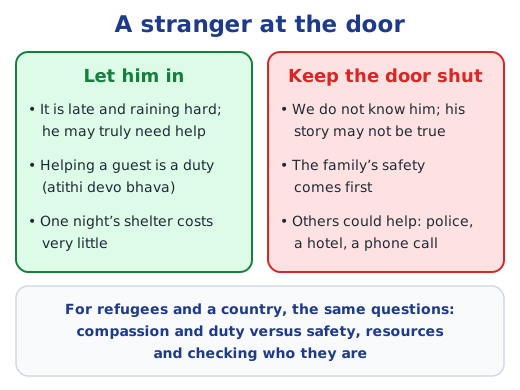
When refugees seek shelter in India, do similar arguments apply? Yes, on a much larger scale. For: refugees are fleeing real danger, compassion and India’s tradition say they should be helped, and many refugees, like the Parsis and Tibetans, have enriched India. Cautions: a country must check who is entering, think about security, and plan for the cost of housing, feeding and educating large numbers. Countries usually balance the two by giving shelter with care and planning, as India did with the Tibetan settlements.
The story of Indian Jews (pages 126–129)
Let’s Explore (page 128): is the place shown in both pictures the same? Yes. The painting on the plaque (Fig. 5.2) shows the same hall as the photograph (Fig. 5.3): the gilded railing round the raised reading platform, the decorated ark with its curtain where the Torah is kept, the hanging glass lamps and the blue and white tiled floor. Both show the synagogue at Kochi.
Why did the Maharaja of Travancore give such an expensive gift for the Torah? The plaque records that he presented a gold crown for the Torah in 1805. Such a gift showed respect for the Jewish community and its faith, and friendship towards people who had lived in the region for centuries. It told them that they belonged and that their religion was honoured like any other, in the tradition of welcoming guests. (Extra) Kochi’s Jews were also important traders, so goodwill with them helped the region’s trade.
Let’s Explore (page 129): what clues does Fig. 5.4 give about the Jewish community’s integration? The women wear saris in a local style, with Indian jewellery; the men and boys wear the caps and long coats then common in Bombay; the children sit cross-legged in front. Nothing in their dress sets them apart from their neighbours. By the late 19th century this Jewish family looked like any other family of the region, while keeping its own faith. (Extra) The Bene Israel spoke Marathi, the local language.
The Syriac Christian community (pages 129–130)
Let’s Explore (page 130): what clues do the wedding pictures give about integration? The bride wears a gold silk sari with gold jewellery and flowers in her hair, like a Kerala bride. The groom ties a small pendant on a thread round her neck, much like the thali tied at Hindu weddings, and a red and gold sari is placed over her head during the service. The wedding is a Christian ceremony in a church, led by priests, but its dress and rituals belong to Kerala. (Extra) Syrian Christians call the pendant the minnu and the wedding sari the manthrakodi.
The Parsis (pages 130–132)
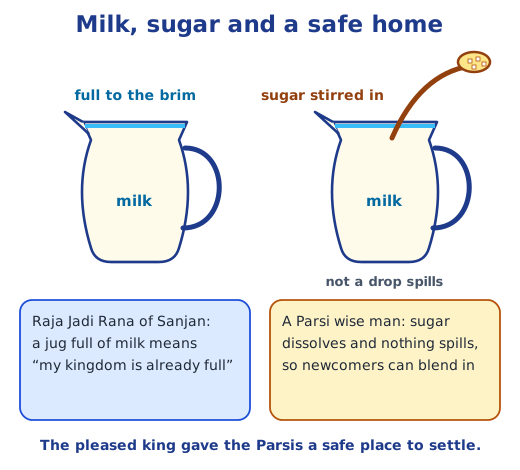
Think About It (page 131): what did dissolving the sugar in the milk without spilling it mean? That the Parsis would mix into the kingdom the way sugar mixes into milk. They would take up little room, would not disturb anyone or make the kingdom overflow, and would make life sweeter through their work and goodwill. The Raja understood, and over the centuries the Parsis did enrich many fields of Indian life.
Let’s Explore (page 132): what is familiar in the painting, and what does it show about Parsi integration? The women wear saris with the end drawn over the head, they wear bangles and other jewellery, one fixes the bride’s ornaments while another holds a tray with flowers, and the room has arched niches. These are familiar sights at Indian weddings. The painting shows that the Parsis, while keeping the Zoroastrian faith, took up Indian dress and customs and became part of Indian culture. (Extra) Most Parsis speak Gujarati as their mother tongue.
Arab merchants and the Siddis (pages 133–134)
Let’s Explore (page 134): what clues do the pictures give about African and Indian cultural integration? Which features are distinctly Indian? The African side shows in the dancers’ feathered headdresses, face paint, bead necklaces and fringed skirts, and in the African-style drumming the book describes. The Indian side shows in the Siddi woman’s nose ring and the cloth drawn over her head, the young girl’s earrings, Hirabai Lobi’s tie-dyed odhni and bangles, and the dancing woman’s full skirt and blouse, like a ghagra-choli. Distinctly Indian features: the nose ring, bangles, saris and odhnis worn over the head, an Indian name like Hirabai, and an Indian honour, the Padma Shri. The text adds that Siddis speak regional languages and follow Hinduism, Islam or Christianity.
The whole world is family (page 140)
Let’s Explore: communities in your neighbourhood whose ancestors came to India centuries ago. The answer depends on where you live. Some examples: Parsis in Mumbai and Gujarat; Jews in Mumbai, Thane and Kochi; Syrian Christians and Mappilas in Kerala; Siddis in Gujarat and Karnataka; Armenians in Kolkata; Tibetans in Dharamshala and Bylakuppe. In the class discussion, think about what they left behind, what was hard at first (a new language, food and customs), how their neighbours treated them, what they kept and what they gave to India.
Let’s Explore: similar values in a story or local tradition; a class manuscript. Examples to start with: (Extra) the story of King Shibi, who offered his own flesh to a hawk to save a dove that had come to him for shelter; the custom of offering water and food to any visitor; the langar of gurdwaras, where anyone of any faith is served a meal. Ask elders for stories from your family or region, write each one in a page or two, add drawings, and bind the pages into a class book.
Questions and activities (page 142)
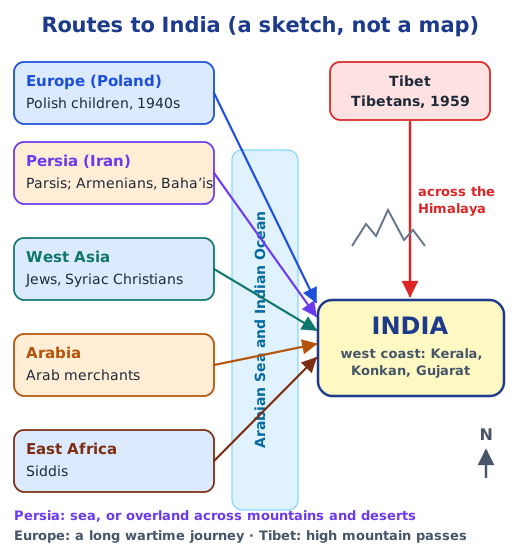
1. Trace the routes on a world map. What physical geographies did they have to negotiate? On an outline map, draw arrows from each homeland to the part of India where the community settled. The sketch below shows the directions:
- Jews and Syriac Christians from West Asia, Parsis from Persia, Arab merchants from Arabia and Siddis from East Africa came by sea, across the Arabian Sea and the Indian Ocean, facing storms and shipwrecks, as the Bene Israel did.
- Armenians and Baha’is from Persia (Iran) could come by sea or overland, across mountains, dry plateaus and deserts.
- Tibetans crossed the Himalaya, with high snowy passes and bitter cold.
- The Polish children made long wartime journeys from Europe across Asia.
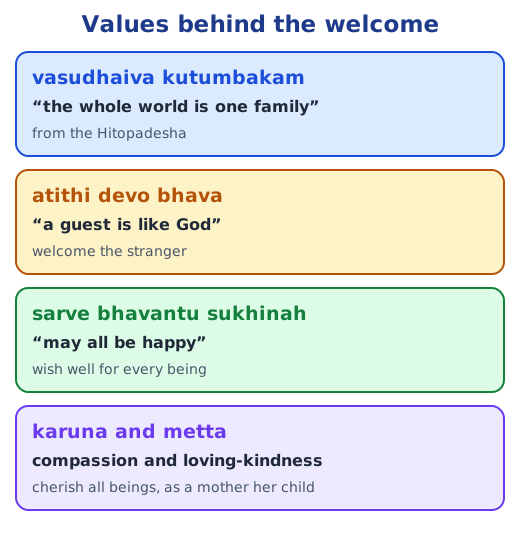
2. What are the key values intrinsic to Indian culture that enable it to welcome people of different backgrounds? Vasudhaiva kutumbakam, seeing the whole world as one family; atithi devo bhava, treating a guest as God; sarve bhavantu sukhinah, wishing happiness for all; compassion (karuna) and loving-kindness, as in the Karaniya Metta Sutta; ahimsa, non-violence; respect for many faiths and schools of thought living side by side; and the idea of the unity of humankind.
3. Parsis who excelled, and people from other communities who made India home. The Parsis named are Homi Bhabha, the physicist who led India’s nuclear programme; Sam Manekshaw, India’s first Field Marshal, who led the army in 1971; Ratan Tata, the industrialist; Fali Nariman and Nani Palkhivala, leading lawyers; and Cornelia Sorabji, India’s first woman lawyer. Starting points from other communities: Nissim Ezekiel, the poet, from the Bene Israel; Lieutenant General J. F. R. Jacob, a hero of the 1971 war, and Ruby Myers, the silent-film star, from Baghdadi Jewish families; Verghese Kurien, who led the White Revolution in milk, from a Syrian Christian family; and Hirabai Lobi of the Siddis. Find out more about each in your library.
4. Class project on the communities. Divide the class into groups, one community each. Each group finds out where its community came from, when, why, where it settled, what it kept and what it added to India, using the textbook, the library, the internet and, if possible, a talk with a member of that community. Present the findings in an interesting form: a short play of the milk and sugar legend, a poster of the routes and dates, a song about the Good Maharaja, or a painting of a festival.
Practice
-
Which community, some scholars say, reached India around 175 BCE?
Show answer
Answer: (b) The Bene Israel Jews
-
The Lotus Temple in New Delhi belongs to which community?
Show answer
Answer: (c) The Baha’is
-
In Kerala, Arab merchants became part of which community?
Show answer
Answer: (a) The Mappila Muslim community
-
Give two signs that the Parsis kept their own faith in India.
Show answer
Answer: Their ancient sacred fire still burns at Udvada, close to where they first landed, and they worship in fire temples, such as the 18th-century one at Udvada. India today has the largest Zoroastrian population in the world.
-
Why does the book call the Siddis’ story a different kind of story?
Show answer
Answer: Unlike the other communities, the Siddis did not choose to come. They were enslaved in Africa and brought to India as slaves by Arab, Portuguese and British traders. Even so, they built a culture that blends African and Indian traditions.
Stuck on a question?
Take a photo and Lagnever AI explains it step by step. Try it for 7 days for ₹2.
Get it on Google Play Open in browser
For parents: after the trial, the plan renews monthly by UPI or card autopay. You can cancel anytime in the app.