
Class 7 Social Science Part 2 Chapter 5: India, a Home to Many Notes
This chapter in five lines
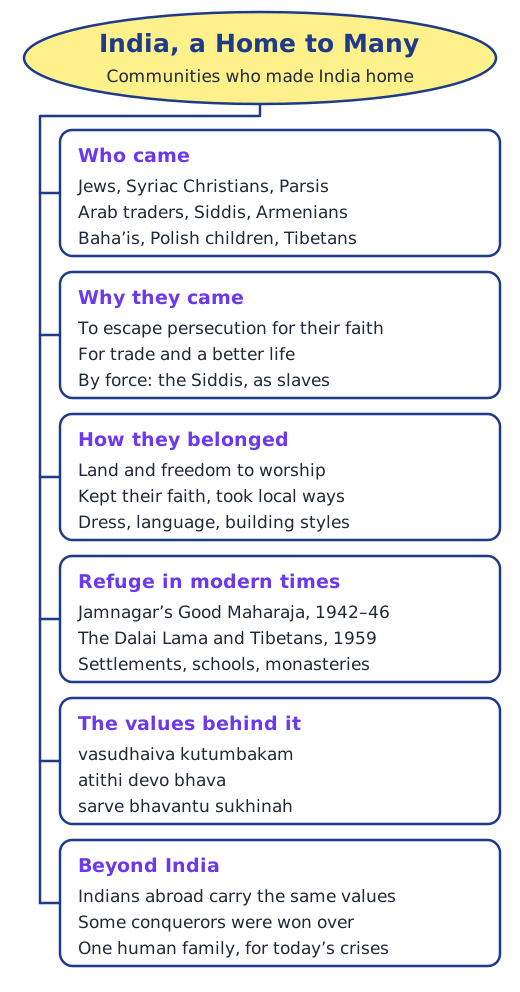
India, a Home to Many tells the stories of communities who came from other lands and made India their home: Jews, Syriac Christians, Parsis, Arab merchants, Siddis, Armenians, Baha’is, Polish orphans of the Second World War and Tibetans. Most fled persecution or came to trade. They kept their own faiths while becoming part of Indian society, helped by values like vasudhaiva kutumbakam.
What is this chapter about?
In Class 6 you read that many Indians are migrants in a simple sense: they live away from their birthplace. This chapter looks at another kind of migrant: people from other parts of the world who moved to India, made their homes here and added to its diversity. It opens with a verse from the Hitopadesha. Narrow minds, it says, sort people into “mine” and “not mine”, while for the noble-hearted the whole world is family. The chapter picks a few communities as examples and asks three big questions: what made India a home for people from far away, why the persecuted sought refuge here, and what in Indian society lets newcomers belong.
Fleeing persecution: Jews, Syriac Christians and Parsis
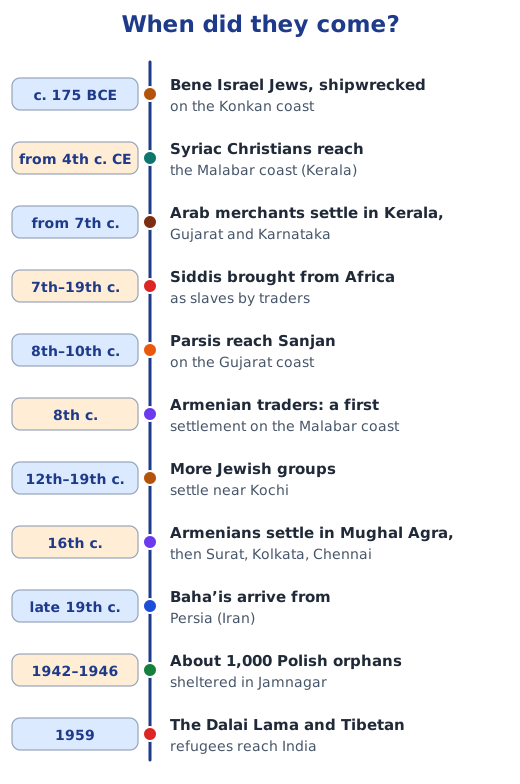
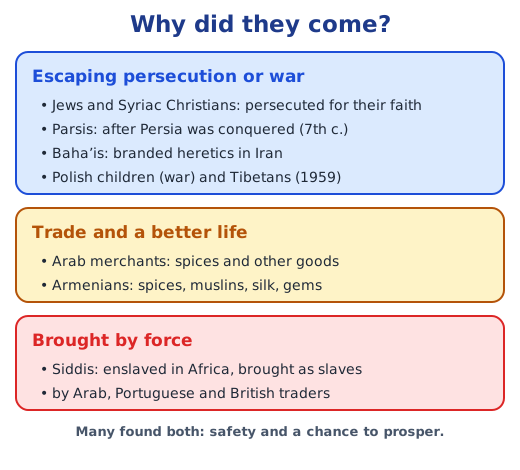
Jews came to India in several waves, escaping persecution elsewhere. Some scholars say the Bene Israel reached the Konkan coast about 175 BCE, after a shipwreck; they grew into India’s largest Jewish community. Later groups settled near Kochi, where the Raja gave them land, and they built a synagogue. Syriac Christians, treated as heretics in the Roman Empire and suspected as Roman allies in Persia, sailed along trade routes to the Malabar coast from the 4th century CE. The Parsis, followers of Zoroastrianism, left Persia after its conquest by Arab armies in the 7th century and reached Gujarat between the 8th and 10th centuries. A legend says their wise man answered a full jug of milk by stirring in sugar without spilling a drop. Read more in communities who made India home.
Traders, the Siddis, Armenians and Baha’is
From the 7th century, Arab merchants made homes on the west coast, married local women and, in Kerala, joined the Mappila Muslims. The Siddis have a harder story: enslaved in Africa, they were brought to India by Arab, Portuguese and British traders, yet they built a culture blending African and Indian traditions. Armenian merchants dealt in spices, silk and gems; Akbar let them build a church in Agra, and they later settled in Surat, Kolkata and Chennai. Baha’is, branded heretics in Iran, began arriving in the late 19th century.
Refuge in the 20th century
During the Second World War, Maharaja Digvijaysinhji of Nawanagar (Jamnagar) sheltered about a thousand Polish orphans from 1942 to 1946, and a square in Warsaw now honours him as the Good Maharaja. In 1959, after an uprising in Lhasa against the Chinese presence there, the 14th Dalai Lama took refuge in India. Tibetans have since built settlements, schools and monasteries here, and their government-in-exile works from Dharamshala. See Polish children and Tibetan refugees.
The whole world is family
The chapter ends by asking how India earned a name for compassion. Its answer lies in old ideas: vasudhaiva kutumbakam (the whole world is one family), atithi devo bhava (a guest is like God) and sarve bhavantu sukhinah (may all be happy). Communities could keep their faiths here while becoming Indian. The book adds that Indians living abroad carry the same values, and that this idea of one human family can help the world face wars, climate change and inequality. Read vasudhaiva kutumbakam. Answers to every question are in the NCERT solutions for Part 2 Chapter 5.
Key terms
| Term | Meaning |
|---|---|
| Migrant | A person who lives away from their birthplace or original community. This chapter is about migrants from other parts of the world who made their homes in India. |
| Refugee | A person forced to leave their home country to escape danger, such as war or persecution, and who seeks safety in another country. |
| Persecution | Hostile and unfair treatment of people because of their religion, ethnic group or political views, often with harassment or violence. |
| Heretic | Someone said to hold beliefs, especially religious ones, that go against the main or official view. Syriac Christians and Baha’is were branded heretics. |
| Synagogue | A Jewish place of worship, where prayers are held along with ceremonies such as weddings. Kochi has a famous one. |
| Zoroastrianism | One of the oldest religions in the world, founded by the prophet Zarathushtra. Its followers worship one God, Ahura Mazda, and choose good over evil. The Parsis follow it. |
| Avesta | The ancient sacred text of the Parsis, written in Old Avestan, a language that shares many word roots with Vedic Sanskrit. |
| Siddis | A community of African origin, brought to India as slaves between the 7th and 19th centuries. Today the Siddis are a scheduled tribe. |
| Government-in-exile | A government that works from outside its own country. The Central Tibetan Administration works from Dharamshala in Himachal Pradesh. |
| Vasudhaiva kutumbakam | “The whole world is one family”, a line from the Hitopadesha. The chapter sees it as the root of India’s welcome to people from other lands. |
Topics in this chapter
Practice
-
According to the legend, where did the Parsis ask a king for a place to settle?
Show answer
Answer: (b) Sanjan
-
Which community helped build the Cheraman Juma Masjid in Kerala?
Show answer
Answer: (b) Arab merchants
-
Who sheltered about 1,000 Polish orphans during the Second World War?
Show answer
Answer: (b) The Maharaja of Nawanagar (Jamnagar)
-
Which traditional system of medicine did Tibetans bring to India?
Show answer
Answer: (c) Sowa Rigpa
-
What does vasudhaiva kutumbakam mean?
Show answer
Answer: (b) The whole world is one family
-
On which coast did the Bene Israel Jews settle?
Show answer
Answer: (a) The Konkan coast
Questions students ask
What are the main topics of Class 7 Social Science Part 2 Chapter 5?
Communities who came to India from abroad and settled here: Jews, Syriac Christians, Parsis, Arab merchants, Siddis, Armenians and Baha’is; refuge in the 20th century for Polish orphans and Tibetans; and the Indian values, such as vasudhaiva kutumbakam, that made India a home to many.
Is India, a Home to Many in the new NCERT Social Science book?
Yes. It is Chapter 5 of Exploring Society: India and Beyond, the Class 7 Social Science textbook Part 2 (2026-27), on pages 125 to 142, in the theme Our Cultural Heritage and Knowledge Traditions.
Why did persecuted people seek refuge in India?
Because India had a name as a safe place where people could practise their faith without fear. Rulers gave newcomers land and freedom of worship, and a society already used to many faiths and languages let them keep their ways while becoming part of it.
Stuck on a question?
Take a photo and Lagnever AI explains it step by step. Try it for 7 days for ₹2.
Get it on Google Play Open in browser
For parents: after the trial, the plan renews monthly by UPI or card autopay. You can cancel anytime in the app.