
Vasudhaiva kutumbakam: the whole world is family
Answer in short
Vasudhaiva kutumbakam, from a verse in the Hitopadesha, means “the whole world is one family”. The chapter sees it, along with atithi devo bhava (a guest is like God) and sarve bhavantu sukhinah (may all be happy), as the reason India welcomed people from other lands and let them keep their faiths for centuries.
Stuck on a question? Take a photo and Lagnever AI explains it step by step. Try it for 7 days for ₹2. Get it on Google Play
A verse about narrow and noble minds
The chapter opens with two lines from the Hitopadesha, a collection of fables. They draw a contrast. Small-minded people divide the world into “mine” and “not mine”; for the large-hearted, vasudhaiva kutumbakam, the whole earth is one family. Beside the verse stands the last message of Sri Sarada Devi, spiritual companion of Sri Ramakrishna, who told her listeners to treat the whole world as their own, since no one is a stranger. Both say the same thing in different words: the circle of “my people” can be as wide as the world.
A stranger at the door
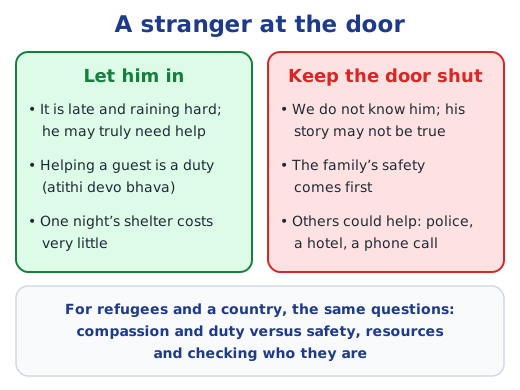
The book asks you to imagine a stranger knocking at midnight in heavy rain, saying his car has broken down. Should your family let him in? One side says he may truly need help, and helping a guest is a duty. The other side says you do not know him, and the family’s safety comes first. A country faces the same questions when refugees ask for shelter: compassion and duty on one side, safety, resources and checking who people are on the other. The chapter’s stories show how India has often answered.
Values that opened doors
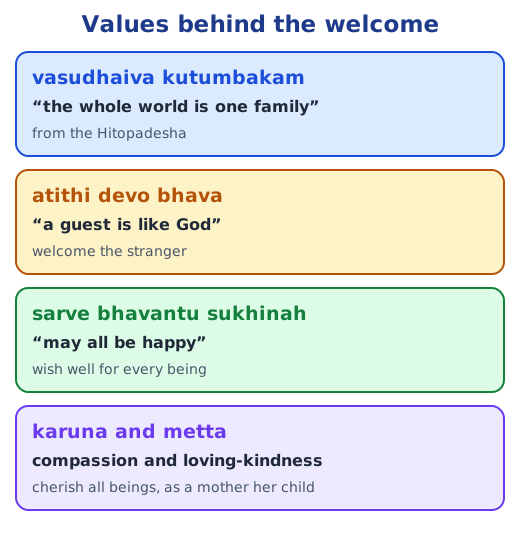
How did India come to be known as a land that welcomed people? The chapter points to teachings found across India’s many schools of thought:
- vasudhaiva kutumbakam: the whole world is one family;
- atithi devo bhava: a guest is like God, to be treated with honour;
- sarve bhavantu sukhinah: may all beings be happy;
- compassion (karuna): in the Buddha’s Karaniya Metta Sutta, one should cherish all living beings with a boundless heart, the way a mother guards her only child.
Values in practice
The chapter calls vasudhaiva kutumbakam a practice of millennia, not a slogan, and its stories show why. The Raja of Kochi granted Jewish settlers land for as long as the sun and moon endure. Raja Jadi Rana gave the Parsis a home at Sanjan. Akbar allowed Armenians to build a church. A Maharaja of Jamnagar sheltered Polish orphans during the Second World War, and India gave the Dalai Lama asylum in 1959. In each case newcomers could keep their own faith and customs. That is the meaning of the Parsi legend: sugar dissolves in milk and sweetens it without making it overflow.
Beyond India
The book makes three further points. First, Indians who live abroad have carried the same values, and are generally seen as peaceful, law-abiding communities that work hard and fit well into their new countries. Second, some who came to conquer India were won over by its culture, ideas, geography and wealth, as the Indo-Greeks and the Kushanas were. Third, the idea that all humankind is one is a value the world needs now, when it faces wars, climate change, growing inequality and discrimination.
Why it matters
Every class, town and country meets newcomers. These values ask us to see them first as family, and to let them stay themselves while they belong. See how communities actually settled in communities who made India home and Polish children and Tibetan refugees. Answers to the textbook questions are in the NCERT solutions for Part 2 Chapter 5; see all of Part 2 Chapter 5 notes.
Practice
-
What does atithi devo bhava mean?
Show answer
Answer: (b) A guest is like God
-
The verse with the words vasudhaiva kutumbakam comes from:
Show answer
Answer: (b) The Hitopadesha
-
Which text asks us to cherish all beings as a mother protects her only child?
Show answer
Answer: (b) The Karaniya Metta Sutta
-
How can the idea of one human family help the world today?
Show answer
Answer: If people see all humans as one family, they are more likely to settle quarrels peacefully, share the work of fighting climate change, and treat others fairly instead of with discrimination. The chapter names wars, climate change, inequality and discrimination as crises this value can help with.
-
Name two cases from the chapter where Indian rulers put these values into practice.
Show answer
Answer: The Raja of Kochi gave Jewish settlers land, and Raja Jadi Rana let the Parsis settle at Sanjan. In the 20th century, the Maharaja of Nawanagar sheltered about 1,000 Polish orphans, and India gave the Dalai Lama and Tibetan refugees a home.
Questions students ask
What does vasudhaiva kutumbakam mean?
It means “the whole world is one family”. Vasudha is the earth and kutumbakam a family. The full verse says that thinking “this is mine, that is not mine” belongs to narrow minds, while for the noble-hearted the whole world is family.
Where does the phrase vasudhaiva kutumbakam come from?
The chapter quotes it from the Hitopadesha, a collection of fables with lessons on wise conduct. (Extra) The same verse is also found in the Maha Upanishad.
How did Indian values help people from other lands settle in India?
Ideas like vasudhaiva kutumbakam, atithi devo bhava and sarve bhavantu sukhinah encouraged rulers and ordinary people to welcome newcomers. Communities were given land and the right to follow their faith, so they could keep their traditions while becoming part of Indian society.
Stuck on a question?
Take a photo and Lagnever AI explains it step by step. Try it for 7 days for ₹2.
Get it on Google Play Open in browser
For parents: after the trial, the plan renews monthly by UPI or card autopay. You can cancel anytime in the app.