
Communities who made India home
Answer in short
Over two thousand years, many communities from abroad made India their home. Jews, Syriac Christians, Parsis and Baha’is fled persecution for their faith; Arab merchants and Armenians came to trade; the Siddis were brought from Africa as slaves. Each kept its own faith while taking up Indian dress, languages and customs, and became part of Indian society.
Stuck on a question? Take a photo and Lagnever AI explains it step by step. Try it for 7 days for ₹2. Get it on Google Play
Many journeys, one home
India’s diversity is not only about the many peoples who were always here. Across two thousand years, communities from other lands also arrived, some fleeing danger, some looking for trade, and one, the Siddis, brought against their will. The chapter picks a few as examples. What they share is that they settled, kept their own faith and became part of Indian life.
The Jews of India
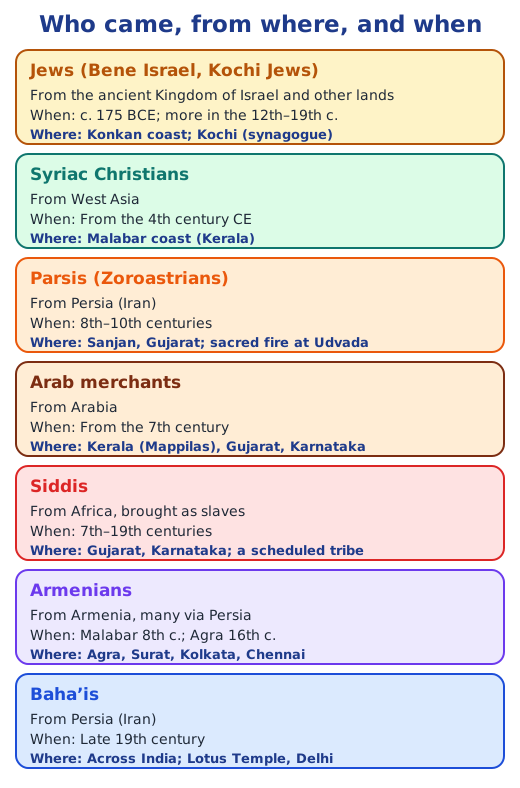
Jews came in several waves, escaping persecution in various countries, and found in India a place to follow their faith without fear. The Bene Israel, some scholars say, sailed from the ancient Kingdom of Israel around 175 BCE and were shipwrecked near the Konkan coast, south of present-day Mumbai. The survivors lost their holy books but kept their prayer about one God. By the time India became independent they numbered over 25,000, the country’s largest Jewish community. Other groups came between the 12th and 19th centuries and settled near Kochi, where the Raja granted them land “as long as the world, sun, and moon endure”. There they built a synagogue. In 1805, a plaque records, the Maharaja of Travancore presented a gold crown for its Torah.
Syriac Christians
From the 4th century CE, some Christian groups who worshipped in the ancient Syriac language had trouble in West Asia. The Roman Empire sometimes called them heretics, because a few of their beliefs about Christ differed from the teaching of the official Church, while Persia’s rulers suspected them of siding with Rome. Some sailed east along trade routes to the Malabar coast, in present-day Kerala, where they could worship as they wished. In India they are also called Syrian Christians.
The Parsis
The Parsis follow Zoroastrianism, the state religion of Persia’s Sassanid Empire. After Arab armies conquered Persia in the middle of the 7th century, the book says, Zoroastrians faced forced conversion, a religious tax called jizya, the destruction of their fire temples and loss of rights. Groups of them crossed the Arabian Sea and reached the Gujarat coast between the 8th and 10th centuries, carrying their sacred fire.
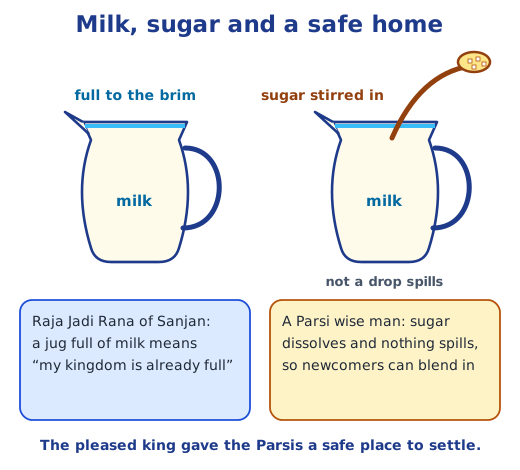
At Sanjan, a legend says, Raja Jadi Rana showed them a jug brimming with milk: his kingdom was full. A Parsi wise man stirred in a spoon of sugar without spilling a drop, and the Raja gave them a home. Their sacred fire still burns at nearby Udvada, and India has more Zoroastrians than any other country. Their faith is also an old cousin of Vedic thought: both value a cosmic order and fire worship, and words like soma and haoma, or yajna and yasna, share roots.
Arab merchants and the Siddis
From the 7th century, Arab merchants made homes along the west coast, in Kerala, Gujarat and Karnataka. They dealt in spices and other goods and married local women, and new communities grew up; in Kerala they joined the Mappila Muslims and helped build the Cheraman Juma Masjid, said to be India’s oldest mosque. They came as peaceful traders, not as conquerors. The Siddis came differently: enslaved in Africa, they were brought as slaves by Arab, Portuguese and British traders. Some later rose in rulers’ armies, and today their dance and drumming, regional languages and faiths blend Africa and India.
Armenians and Baha’is
Armenian merchants dealt in India’s spices and fine muslin cloth, with signs of a settlement on the Malabar coast as early as the 8th century. In the 16th century Akbar let them build a church in Agra, and Armenians served in Mughal courts and armies. They later settled in Surat, Kolkata and Chennai, where Armenian Street still bears their name. The Baha’is began arriving from Iran in the late 19th century, after being branded heretics there; most Baha’is in India today are Indians who joined the faith.
Why it matters
These stories show that India’s mix of faiths and customs grew richer with every community that settled. Read about refuge in the 20th century in Polish children and Tibetan refugees, and about the values behind the welcome in vasudhaiva kutumbakam. Answers to the textbook questions are in the NCERT solutions for Part 2 Chapter 5; see all of Part 2 Chapter 5 notes.
Practice
-
Whose ancient sacred fire still burns at Udvada in Gujarat?
Show answer
Answer: (b) The Parsis’
-
Which Mughal emperor let the Armenians build a church in Agra?
Show answer
Answer: (b) Akbar
-
What did the Maharaja of Travancore present to the Kochi synagogue in 1805?
Show answer
Answer: (b) A gold crown for the Torah
-
Why did the Syriac Christians leave West Asia?
Show answer
Answer: In the Roman Empire some of them were treated as heretics, because a few of their beliefs about Christ differed from the teaching of the official Church. Persia’s rulers suspected them of siding with Rome, Persia’s enemy, and persecuted them. So some travelled east along trade routes to the Malabar coast.
-
How do the Siddis show a blend of African and Indian culture?
Show answer
Answer: They keep a distinctive dance with African-style drumming, but they speak the regional languages and follow Hinduism, Islam or Christianity, mixed with African religious practices. Their dress and ornaments, such as saris and nose rings, are Indian.
Questions students ask
Which communities came to India to escape persecution?
In this chapter: Jews, who came in several waves; Syriac Christians from West Asia; Parsis from Persia after its 7th-century conquest; and Baha’is from Iran in the late 19th century. In the 20th century, Polish orphans of the Second World War and Tibetans also found refuge in India.
Who are the Siddis?
A community of African origin. Enslaved in Africa, they were brought to India by Arab, Portuguese and British traders over many centuries, from the 7th to the 19th. Today they live mainly in Gujarat and Karnataka and are a scheduled tribe. Hirabai Lobi, a Siddi woman from Gujarat, received the Padma Shri in 2023.
What is the story of the Parsis, the milk and the sugar?
When the Parsis reached Sanjan in Gujarat, Raja Jadi Rana showed them a jug full of milk to say his kingdom was full. A Parsi wise man stirred a spoon of sugar into it without spilling any, showing they would blend in and sweeten the land. The pleased Raja let them settle.
Stuck on a question?
Take a photo and Lagnever AI explains it step by step. Try it for 7 days for ₹2.
Get it on Google Play Open in browser
For parents: after the trial, the plan renews monthly by UPI or card autopay. You can cancel anytime in the app.