
Polish children and Tibetan refugees in India
Answer in short
During the Second World War, Maharaja Digvijaysinhji of Nawanagar (Jamnagar) sheltered about 1,000 Polish orphans from 1942 to 1946, and Warsaw now honours him as the Good Maharaja. In 1959 the 14th Dalai Lama took refuge in India; Tibetans have since built settlements, schools and monasteries here and kept their culture alive.
Stuck on a question? Take a photo and Lagnever AI explains it step by step. Try it for 7 days for ₹2. Get it on Google Play
Shelter in a world at war
In Warsaw, the capital of Poland, there is a square named after an Indian ruler, the Good Maharaja Square. Its story goes back to the Second World War (1939–1945). Poland was invaded, families were torn apart and many children lost their parents. Digvijaysinhji Ranjitsinhji Jadeja, the Maharaja of Nawanagar, today’s Jamnagar in Gujarat, was moved by their plight. He worked with the Red Cross and other organisations to rescue Polish children and bring them to Jamnagar, where they were given a safe home, food and care. He is credited with saving about a thousand Polish orphans from 1942 to 1946, and several thousand other Polish refugees were also welcomed in his state.
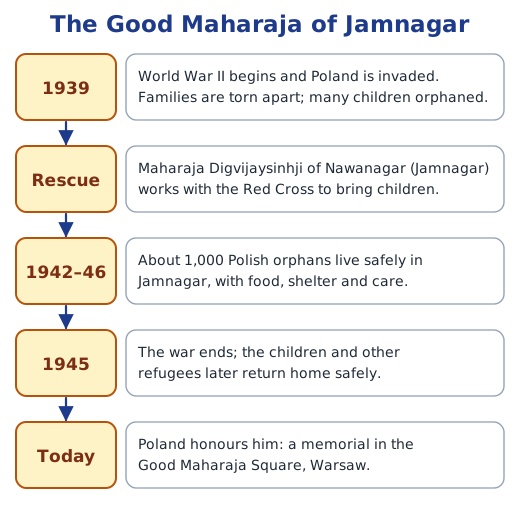
After the war ended, the children and the other refugees went home safely. In the early 21st century, the President of Poland recognised his service and a memorial was built in his honour. For a few years, India had been a home away from home for children who had lost everything.
Tibet and India, an old link
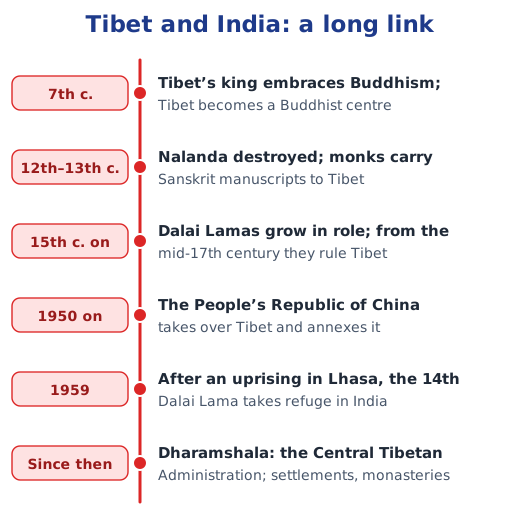
Tibet, the “Land of Snows” beyond the Himalaya, lies just north of India. In the 7th century its king embraced the Buddha’s teachings, and Buddhism slowly spread there. When Turko-Afghan invasions in eastern India destroyed Nalanda and other Buddhist centres of learning in the 12th and 13th centuries, many monks fled to Tibet with precious Sanskrit manuscripts. From the 15th century the Dalai Lamas, each said to be the rebirth of the one before, gained a larger role, and from the mid-17th century they ruled Tibet.
1959: the Dalai Lama takes refuge
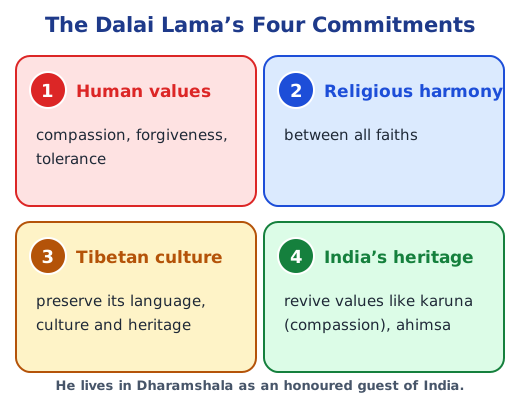
From 1950 the People’s Republic of China took over Tibet in several waves and finally annexed it. In 1959 the people of Lhasa rose up against the Chinese presence there. Advised to escape, the 14th Dalai Lama crossed the Himalaya into India, which granted him asylum. Since then he has lived in Dharamshala, Himachal Pradesh, as an honoured guest, and the Central Tibetan Administration works from there as a government-in-exile. He is known for his Four Commitments: human values, harmony between religions, Tibetan culture and the revival of India’s heritage.
Making a second home
The Indian government rehabilitated the Tibetan refugees, educated their children and helped create Tibetan settlements, so that the community could make India a second home while keeping its own language, culture and heritage. Monasteries modelled on those in Tibet were built, especially in Karnataka, for example at Bylakuppe, so monks could follow their way of life without fear. Non-government organisations helped people find work, and Tibetan markets are now familiar sights, even in Goa. Over time Tibetans have become part of Indian society.
The art of healing
Soon after 1959, Tibetans began to spread their system of medicine, Sowa Rigpa, the art of healing. Its rules were set down in the 8th century CE near Lhasa, and it blends Ayurveda with ideas from China, Central Asia, Persia and Greece. Men-Tsee-Khang in Dharamshala uses it to treat long-lasting diseases, and it is now part of the government’s AYUSH programme alongside Ayurveda, Yoga and Naturopathy, Unani, Siddha and Homoeopathy.
Why it matters
Both stories show refuge given in hard times, by a single ruler and by a whole country. Compare them with older arrivals in communities who made India home, and read about the values behind them in vasudhaiva kutumbakam. Answers to the textbook questions are in the NCERT solutions for Part 2 Chapter 5; see all of Part 2 Chapter 5 notes.
Practice
-
Which ruler sheltered Polish orphans during the Second World War?
Show answer
Answer: (b) The Maharaja of Nawanagar (Jamnagar)
-
In which year did the 14th Dalai Lama take refuge in India?
Show answer
Answer: (c) 1959
-
From where does the Central Tibetan Administration work?
Show answer
Answer: (b) Dharamshala
-
What are the Dalai Lama’s Four Commitments?
Show answer
Answer: Promoting human values such as compassion, forgiveness and tolerance; promoting harmony between religions; preserving Tibetan culture; and reviving India’s ancient heritage, especially values like karuna (compassion) and ahimsa (non-violence).
-
How did India help Tibetan refugees rebuild their lives?
Show answer
Answer: The government rehabilitated them, gave their children education and helped set up Tibetan settlements, so they could keep their language, culture and heritage. Monasteries modelled on those in Tibet were built, especially in Karnataka, and non-government organisations helped with ways to earn a living.
Questions students ask
Who was the Good Maharaja?
Digvijaysinhji Ranjitsinhji Jadeja, the Maharaja of Nawanagar (present-day Jamnagar in Gujarat). During the Second World War he worked with the Red Cross to rescue Polish children, and he is credited with saving about 1,000 Polish orphans between 1942 and 1946. Poland honoured him, and a square in Warsaw is named after him.
Why did the Dalai Lama come to India?
From 1950 the People’s Republic of China took over Tibet in stages and annexed it. In 1959, after a popular uprising in Lhasa against the Chinese presence there, the 14th Dalai Lama was advised to escape over the Himalaya. India granted him asylum, and he has lived in Dharamshala since then as an honoured guest.
What is Sowa Rigpa?
The traditional Tibetan system of medicine, whose name means the art of healing. A medical council near Lhasa set down its rules in the 8th century CE, and it blends Ayurveda with ideas from China, Central Asia, Persia and Greece. It is now one of the systems supported by India’s AYUSH programme.
Stuck on a question?
Take a photo and Lagnever AI explains it step by step. Try it for 7 days for ₹2.
Get it on Google Play Open in browser
For parents: after the trial, the plan renews monthly by UPI or card autopay. You can cancel anytime in the app.