
NCERT Solutions Class 8 Maths Chapter 2: Power Play
Answers to the questions inside the chapter, both Figure it Out sets and the Tremendous in Ten! game in Chapter 2, Power Play, of Ganita Prakash, Grade 8 Part 1. Page numbers follow the book (pages 19–47). Where a question asks for an estimate, the assumptions are stated, and other sensible assumptions give other answers. Short notes: Chapter 2 notes.
Experiencing the power play (pages 19–21)
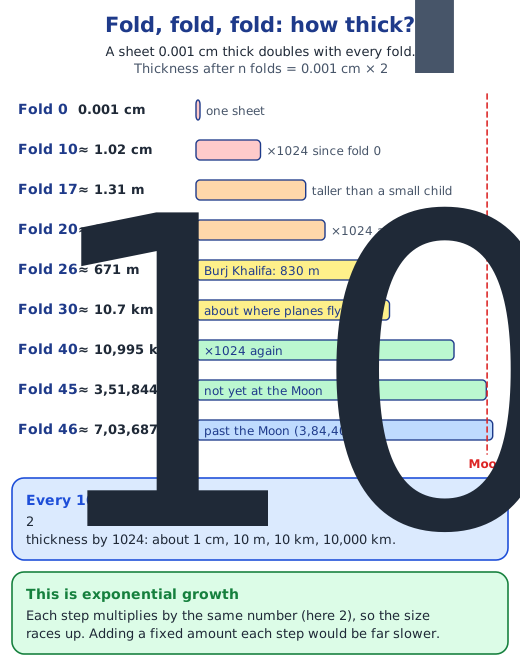
How many times can you fold a sheet? Try it with a few kinds of paper. You will probably manage only a handful of folds, around 7, even with a big or thin sheet, because the stack doubles in thickness each time and soon becomes too thick and stiff to bend.
Your guess for 30 folds (and 45, Math Talk). Write your guess first. Then check: 0.001 cm × 2³⁰ ≈ 10.7 km after 30 folds, and 0.001 cm × 2⁴⁵ ≈ 3,51,844 km after 45 folds, almost as far as the Moon.
The table from fold 18 to fold 45. Each entry is double the one before (rounded):
- Folds 18–26: ≈ 2.62 m, 5.24 m, 10.5 m, 21 m, 41.9 m, 83.9 m, 168 m, 336 m, 671 m.
- Folds 27–30: ≈ 1.34 km, 2.68 km, 5.37 km, 10.7 km.
- Folds 31–35: ≈ 21.5 km, 42.9 km, 85.9 km, 172 km, 344 km.
- Folds 36–40: ≈ 687 km, 1374 km, 2749 km, 5498 km, 10,995 km.
- Folds 41–45: ≈ 21,990 km, 43,980 km, 87,961 km, 1,75,922 km, 3,51,844 km.
So fold 46 gives about 7,03,687 km, more than the distance to the Moon.
The change over two folds, and over any three folds. Two folds multiply the thickness by 2 × 2 = 4 (0.016 cm becomes 0.064 cm). Three folds multiply it by 2 × 2 × 2 = 8: for example 0.016 cm at fold 4 becomes 0.128 cm at fold 7, and 0.128 × 8 = 1.024 cm at fold 10.
Exponential notation (pages 21–22)
Thickness after 10 folds, starting from v. Each fold multiplies by 2, so after 10 folds the thickness is v × 2¹⁰, option (v) 2¹⁰v. Options (i)–(iii) add or multiply by 10 instead of doubling 10 times, (iv) forgets v, and (vi) 10²v = 100v is too small.
Is (−1)⁵ positive or negative? And (−1)⁵⁶? (−1)⁵ = −1, negative, because an odd number of minus signs is left with one unpaired. (−1)⁵⁶ = 1, positive, because 56 minus signs pair up completely.
Is (−2)⁴ = 16? Yes: (−2) × (−2) = 4, and 4 × 4 = 16.
What are 0², 0⁵ and 0ⁿ? 0 × 0 = 0, so 0² = 0 and 0⁵ = 0. In general 0ⁿ = 0 for every counting number n.
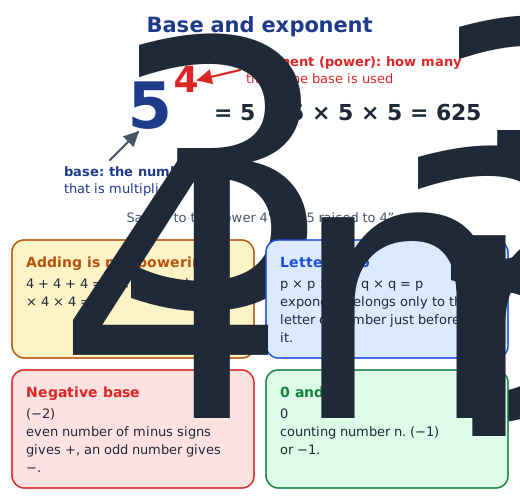
Figure it Out (pages 22–23)
1. (i) 6⁴ (ii) y² (iii) b⁴ (iv) 5² × 7³ (v) 2² × a², which is also (2a)² (vi) a³c⁴d.
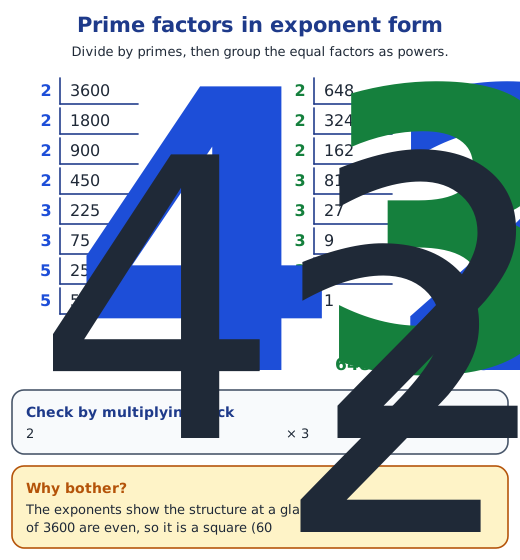
2. (i) 648 = 2 × 2 × 2 × 3 × 3 × 3 × 3 = 2³ × 3⁴. (ii) 405 = 3 × 3 × 3 × 3 × 5 = 3⁴ × 5. (iii) 540 = 2 × 2 × 3 × 3 × 3 × 5 = 2² × 3³ × 5. (iv) 3600 = 2⁴ × 3² × 5². Check (iii): 4 × 27 × 5 = 540.
3. (i) 2 × 1000 = 2000. (ii) 49 × 8 = 392. (iii) 3 × 256 = 768. (iv) 9 × 25 = 225. (v) 9 × 10,000 = 90,000. (vi) (−32) × 10,00,000 = −3,20,00,000; the first factor is negative (odd power) and the second positive (even power).
The Stones that Shine (pages 23–24)
How many rooms? Each of the 3 daughters has 3 baskets (9), each basket 3 keys (27), each key opens 3 rooms: 3⁴ = 81 rooms.
How many diamonds, with one multiplication? Each room has 3 tables, each table 3 necklaces and each necklace 3 diamonds, so there are 3⁷ diamonds. Using the products already found, 3⁷ = 3⁴ × 3³ = 81 × 27 = 2187.
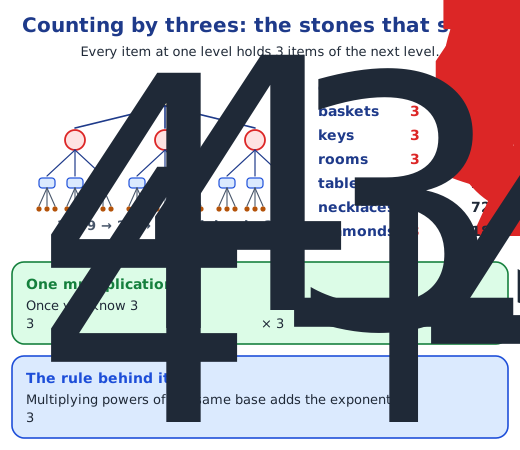
Why is 3⁷ also 3² × 3⁵? 3⁷ is seven 3s multiplied. Group the first two and the last five: (3 × 3) × (3 × 3 × 3 × 3 × 3) = 3² × 3⁵. Any split of 7 into two parts works.
Computing with nᵃ × nᵇ = nᵃ⁺ᵇ. (i) 2⁹ = 2⁴ × 2⁵ = 16 × 32 = 512. (ii) 5⁷ = 5³ × 5⁴ = 125 × 625 = 78,125. (iii) 4⁶ = 4³ × 4³ = 64 × 64 = 4096.
Each as a power of a power, in two ways. (i) 8⁶ = (8²)³ = (8³)², and also (2³)⁶ = 2¹⁸. (ii) 7¹⁵ = (7³)⁵ = (7⁵)³. (iii) 9¹⁴ = (9²)⁷ = (9⁷)², and also (3²)¹⁴ = 3²⁸. (iv) 5⁸ = (5²)⁴ = (5⁴)², and also ((5²)²)².
Magical Pond (page 25)
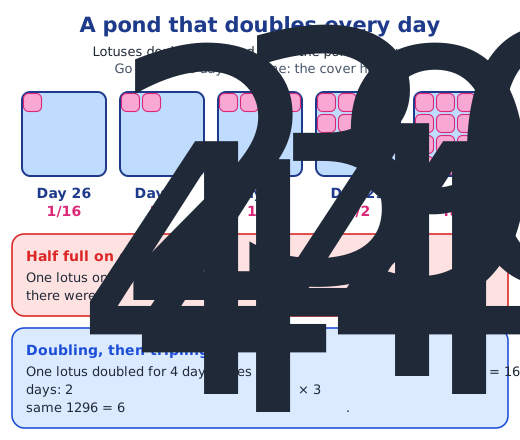
When was the pond half covered? On day 29. The lotuses double every day, so the cover on day 29 is half of the full cover on day 30.
The number of lotuses in exponential form. Starting with one lotus that doubles each day for 30 days: (i) fully covered: 2³⁰ lotuses; (ii) half covered: 2²⁹.
Doubling pond, then tripling pond. After 4 days of doubling there are 2⁴ = 16 lotuses; 4 days of tripling make 2⁴ × 3⁴ = 16 × 81 = 1296.
If the order were changed? 1 × 3⁴ × 2⁴ = 81 × 16 = 1296, the same, because multiplication can be done in any order.
As one power mⁿ. Pair each 3 with a 2: (3 × 2) × (3 × 2) × (3 × 2) × (3 × 2) = 6⁴ = 1296.
2⁵ × 5⁵. Same exponent, so multiply the bases: (2 × 5)⁵ = 10⁵ = 1,00,000.
10⁴ ÷ 5⁴ in exponential form. (10 ÷ 5)⁴ = 2⁴ = 16. Check: 10,000 ÷ 625 = 16.
How Many Combinations (pages 26–27)
Roxie’s outfits. Each of 7 dresses goes with each of 2 hats (14 pairs), and each pair with each of 3 pairs of shoes: 7 × 2 × 3 = 42 ways.
Passwords for a 5-digit lock. 10 choices in each of 5 places: 10 × 10 × 10 × 10 × 10 = 10⁵ = 1,00,000 passwords, from 00000 to 99999.
A lock with 6 letters A to Z. 26 choices in each of 6 places: 26⁶ = 30,89,15,776 passwords, far more than the 10⁶ = 10,00,000 of a 6-digit lock. So Estu is right that it is safer.
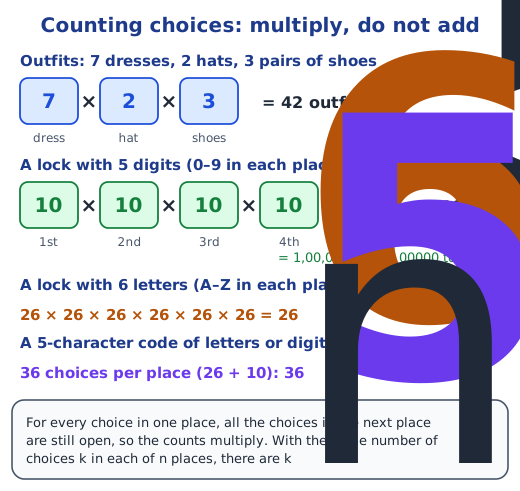
Try This: pincodes, mobile numbers and vehicle numbers. A pincode has 6 digits, so at most 10⁶ = 10,00,000 pincodes are possible. A mobile number has 10 digits, so at most 10¹⁰. Extra: in practice not every code is used. The first digit of a pincode stands for a postal region of India, and Indian mobile numbers begin with 6, 7, 8 or 9. A vehicle number such as MH 12 AB 1234 has a state code, a district office number, a letter series and a 4-digit number; with two-letter series, one district office can issue up to 26 × 26 × 10⁴ = 67,60,000 numbers.
The other side of powers (pages 27–30)
2¹⁰⁰ ÷ 2²⁵ as a power of 2. Subtract the exponents: 2¹⁰⁰⁻²⁵ = 2⁷⁵.
Why can n not be 0 in nᵃ ÷ nᵇ? 0ᵃ and 0ᵇ are both 0, and 0 ÷ 0 has no meaning. Division by 0 is not defined, so the base must not be 0.
Can a and b be any integers? Yes. Once n⁰ = 1 and n⁻ᵃ = 1/nᵃ, the laws hold for all integers (with n ≠ 0). Checks: 2⁻³ × 2⁵ = (1/8) × 32 = 4 = 2², and −3 + 5 = 2; (2⁻²)³ = (1/4)³ = 1/64 = 2⁻⁶, and (−2) × 3 = −6; 2² ÷ 2⁻¹ = 4 × 2 = 8 = 2³, and 2 − (−1) = 3.
Equivalent forms. (i) 2⁻⁴ = 1/2⁴ = 1/16. (ii) 10⁻⁵ = 1/10⁵ = 1/1,00,000 = 0.00001. (iii) (−7)⁻² = 1/(−7)² = 1/49. (iv) (−5)⁻³ = 1/(−5)³ = −1/125. (v) 10⁻¹⁰⁰ = 1/10¹⁰⁰.
Simplify in exponential form. (i) 2⁻⁴⁺⁷ = 2³. (ii) 3²⁻⁵⁺⁶ = 3³. (iii) p³⁻¹⁰ = p⁻⁷, that is 1/p⁷. (iv) (−4)² = 16 = 2⁴, so 2⁴ × (−4)⁻² = 2⁴ ÷ 2⁴ = 2⁰ = 1. (v) Same base 8, so add the exponents: 8 to the power p times 8 to the power q is 8 to the power (p + q).
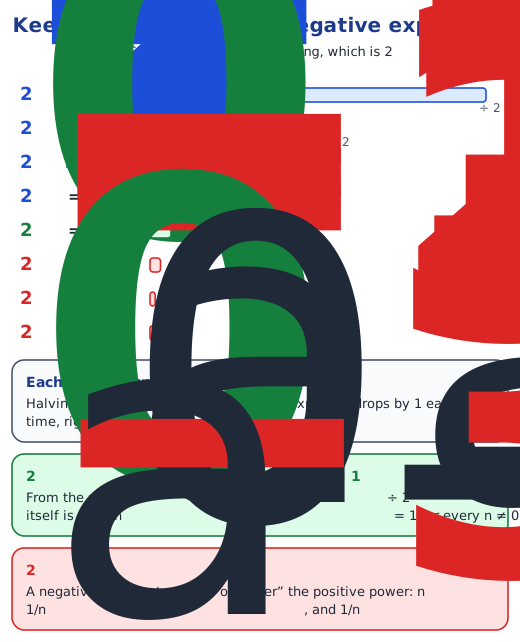
4² compared with 4⁻²: how many times as big? 4² ÷ 4⁻² = 4²⁺² = 4⁴ = 256 times. Check: 16 ÷ (1/16) = 256.
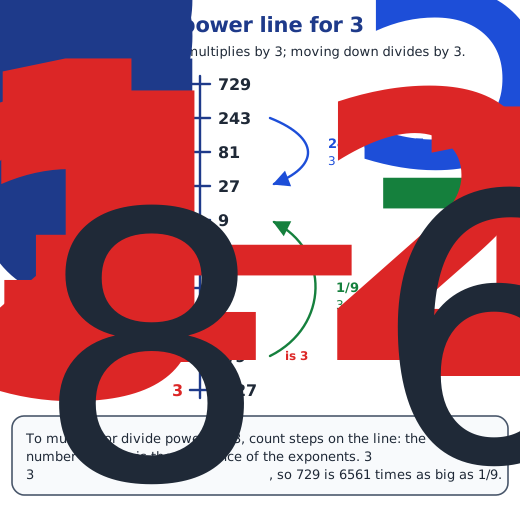
Using the power line for 7.
- 2401 × 49 = 7⁴ × 7² = 7⁶ = 1,17,649.
- 49³ = (7²)³ = 7⁶ = 1,17,649.
- 343 × 2401 = 7³ × 7⁴ = 7⁷ = 8,23,543.
- 16,807 ÷ 49 = 7⁵ ÷ 7² = 7³ = 343.
- 7 ÷ 343 = 7¹ ÷ 7³ = 7⁻² = 1/49.
- 16,807 ÷ 8,23,543 = 7⁵ ÷ 7⁷ = 7⁻² = 1/49.
- 1,17,649 × 1/343 = 7⁶ × 7⁻³ = 7³ = 343.
- 1/343 × 1/343 = 7⁻³ × 7⁻³ = 7⁻⁶ = 1/1,17,649.
Powers of 10 (pages 30–32)
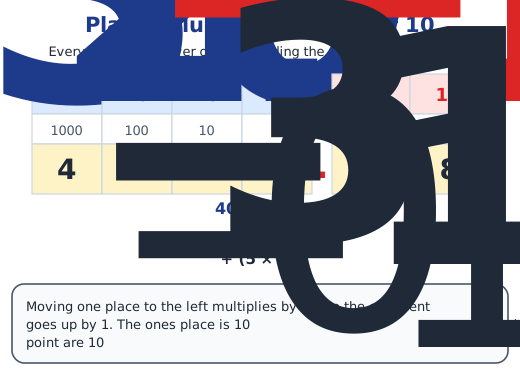
172, 5642 and 6374 with powers of 10. (i) 172 = (1 × 10²) + (7 × 10¹) + (2 × 10⁰). (ii) 5642 = (5 × 10³) + (6 × 10²) + (4 × 10¹) + (2 × 10⁰). (iii) 6374 = (6 × 10³) + (3 × 10²) + (7 × 10¹) + (4 × 10⁰).
The three large-number facts in standard form. Count the digits: (i) the distance of the Sun from the centre of the galaxy has 21 digits, so it is 3 × 10²⁰ m; (ii) the count of stars in the Milky Way has 12 digits, so it is 1 × 10¹¹; (iii) the mass of the Earth has 25 digits, so it is 5.976 × 10²⁴ kg.
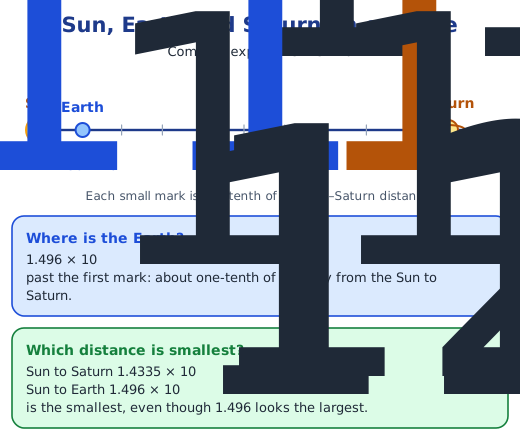
The shortest of the three distances. Sun to Earth, 1.496 × 10¹¹ m. The other two have exponent 12, so they are about ten times as large.
Marking the Earth on the Sun–Saturn line. 1.496 × 10¹¹ ÷ (1.4335 × 10¹²) ≈ 0.104. Split the line into ten equal parts: the Earth goes just past the first mark from the Sun.
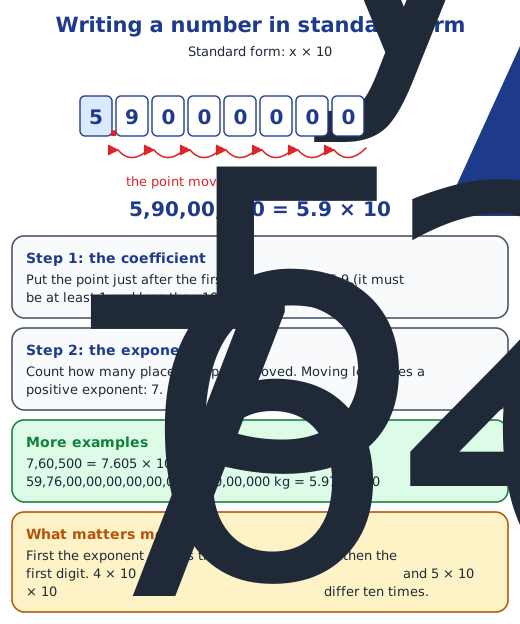
Standard form. (i) 59,853 = 5.9853 × 10⁴. (ii) 65,950 = 6.595 × 10⁴. (iii) 34,30,000 = 3.43 × 10⁶. (iv) 70,04,00,00,000 = 7.004 × 10¹⁰.
Did You Ever Wonder? (pages 33–42)
The answers below use our own assumptions. Yours may differ, and then so will the numbers.
Worth of the jaggery and the wheat. Use your own guesses for the weights and prices. With the book’s sample values (Roxie 45 kg, jaggery ₹70 per kg; Estu 50 kg, wheat ₹50 per kg) the jaggery is worth 45 × 70 = ₹3150 and the wheat 50 × 50 = ₹2500.
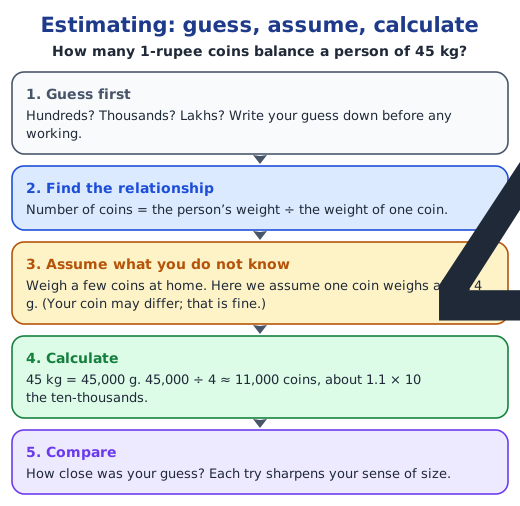
1-rupee coins to balance Roxie. Guess first. Weigh a few coins; suppose one weighs about 4 g. Then 45 kg = 45,000 g gives 45,000 ÷ 4 ≈ 11,000 coins, about 1.1 × 10⁴: in the ten-thousands.
5-rupee coins or 10-rupee notes. Suppose a 5-rupee coin weighs about 6 g: 45,000 ÷ 6 = 7500 coins, worth 7500 × 5 = ₹37,500. Suppose a 10-rupee note weighs about 1 g: 45,000 notes, worth ₹4,50,000. Light notes add up to far more money.
Notebooks and annadāna every year. Suppose a notebook weighs 200 g. Estu’s 50 kg buys 50,000 ÷ 200 = 250 notebooks; at 5 notebooks per child, that helps 50 children a year. If one meal uses about 150 g of grain, Roxie’s 45 kg gives 45,000 ÷ 150 = 300 meals, enough to feed 300 people once.
When did the pādayātra start? Suppose the walkers covered about 4 km an hour for 8 hours a day, that is 32 km a day. Then 400 ÷ 32 ≈ 12.5, so they started about 12 to 13 days ago.
Walking round the Earth in a lifetime. Walking non-stop at 5 km an hour gives 5 × 24 × 365 = 43,800 km a year, a little more than one trip of 40,000 km. Over 70 years that is about 43,800 × 70 ÷ 40,000 ≈ 77 trips. Real walkers rest, so the true number would be far smaller.
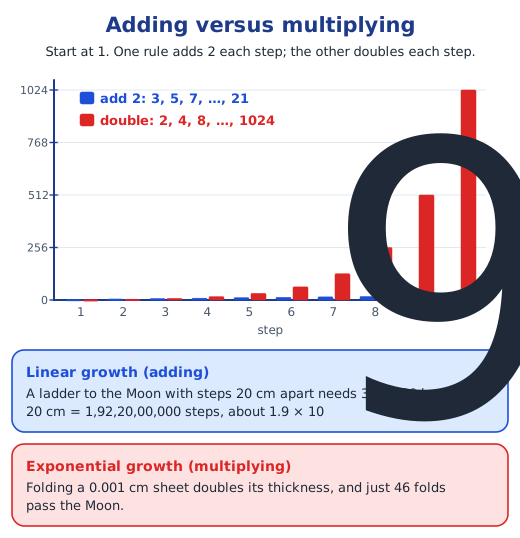
Steps on a ladder to the Moon. 3,84,400 km = 3,84,40,00,000 cm, and ÷ 20 cm gives 1,92,20,00,000 steps, about 1.9 × 10⁹, which is in the hundreds of crores.
Examples of linear and exponential growth. Linear: saving ₹20 every day, a candle burning down 1 cm each hour, the steps of a staircase. Exponential: a chain message where everyone forwards to 3 people, bacteria that double every hour, the folded paper, the lotus pond.
The blanks. Starlings: 1.3 arab = 1.3 × 10⁹. Mosquitoes: 110 trillion = 1.1 × 10¹⁴.
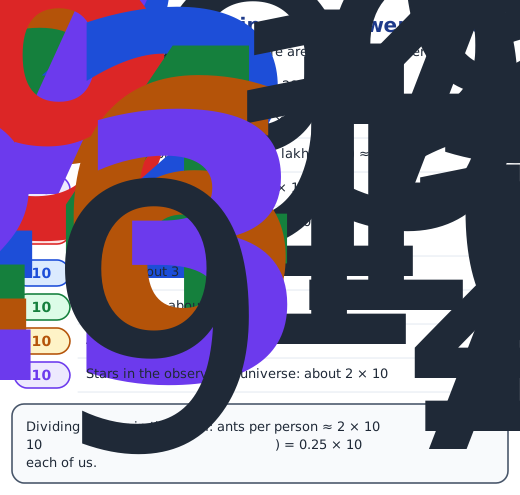
About 20,000 people per African elephant: is that right? Yes: (8 × 10⁹) ÷ (4 × 10⁵) = 2 × 10⁴ = 20,000.
Calculate in scientific notation (page 38). (i) Ants per person: (2 × 10¹⁶) ÷ (8 × 10⁹) = 2.5 × 10⁶ (with 8.2 × 10⁹ people, about 2.4 × 10⁶). (ii) Flocks of 10,000 starlings: (1.3 × 10⁹) ÷ 10⁴ = 1.3 × 10⁵ flocks. (iii) Leaves: (3 × 10¹²) × 10⁴ = 3 × 10¹⁶ leaves. (iv) Sheets of 0.001 cm to the Moon: 3,84,400 km = 3.844 × 10¹⁰ cm, and 3.844 × 10¹⁰ ÷ 10⁻³ = 3.844 × 10¹³ sheets.
Roxie’s age in hours. 4840 days × 24 = 1,16,160 hours.
What could 69,70,710 mean? Her age in minutes. 4840 days × 24 × 60 = 69,69,600 minutes, and the extra 1110 minutes (18½ hours) are the part of today that has passed.
Estu’s date of birth. Count 4070 days back from today. 4070 days is 11 years (with 3 leap days, 4018 days) and 52 more days. For example, if today is 16 November 2026, Estu was born on 25 September 2015.
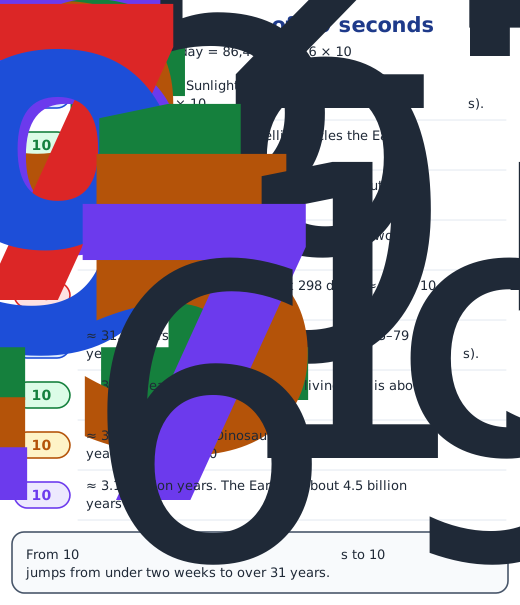
A million seconds old. 10⁶ ÷ 86,400 ≈ 11.6 days: not even two weeks.
Events of the order of 10⁵ and 10⁶ seconds. 10⁵ s: a weekend of 2 days (≈ 1.7 × 10⁵ s), a 30-hour train journey (≈ 1.1 × 10⁵ s). 10⁶ s: a 10-day Diwali holiday (≈ 8.6 × 10⁵ s), two weeks (≈ 1.2 × 10⁶ s).
The two fossil blanks. Using 1 year ≈ 3.15 × 10⁷ s: the terror bird, 15 million years ago, is about 1.5 × 10⁷ × 3.15 × 10⁷ ≈ 4.7 × 10¹⁴ seconds ago. Plants on land, 470 million years ago: 4.7 × 10⁸ × 3.15 × 10⁷ ≈ 1.5 × 10¹⁶ seconds.
Calculate in scientific notation (page 42). (i) One star a second for 2 × 10²³ stars takes 2 × 10²³ seconds, about 6 × 10¹⁵ years. (ii) 2 × 10²⁵ drops at 16 drops per ml is 1.25 × 10²⁴ ml. In glasses of 200 ml that is 6.25 × 10²¹ glasses, and at 10 seconds a glass it takes 6.25 × 10²² seconds.
A pinch of history (pages 42–43)
What the start of each name means. From billion on, it is a Latin number word: bi = 2, tri = 3, quadr = 4, quint = 5, sext = 6, sept = 7, oct = 8, non = 9, dec = 10. It counts how many more groups of three zeros follow the first thousand: a billion is 1000 followed by 2 more groups (10⁹), a trillion by 3 (10¹²), and in general the name for k is 10 raised to 3k + 3. Million fits the pattern with k = 1.
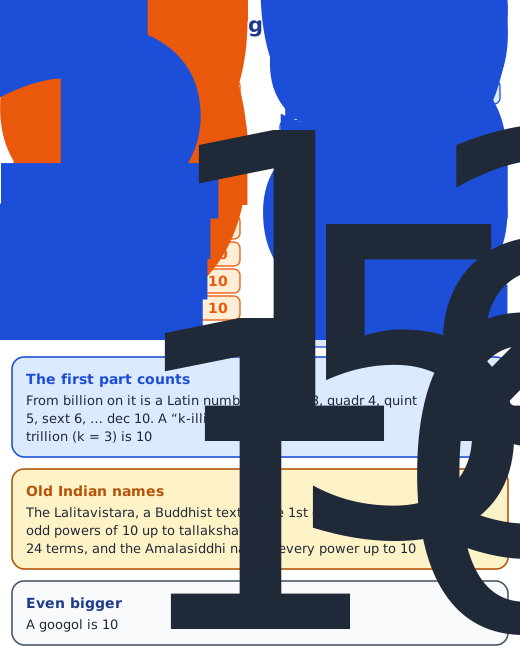
Figure it Out (pages 44–45)
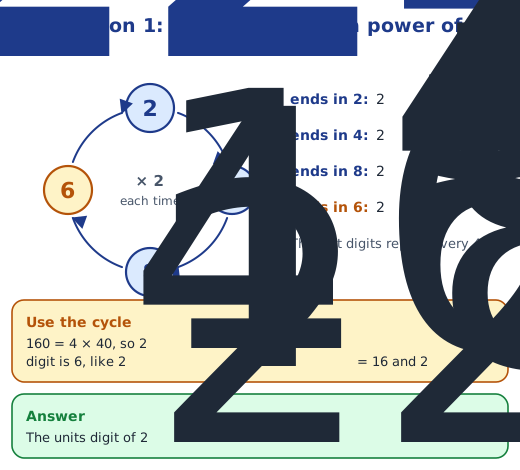
1. Since 4 = 2², 4³² = 2⁶⁴, so 2²²⁴ ÷ 4³² = 2¹⁶⁰. The last digits of 2, 2², 2³, 2⁴, … repeat 2, 4, 8, 6. As 160 is a multiple of 4, 2¹⁶⁰ ends like 2⁴ = 16: the units digit is 6.
2. Each new container adds the same 5 bottles, so this is linear growth, not doubling: after 40 days there are 40 × 5 = 200 = 2 × 10² bottles. (If one container was already there at the start, it would be 205.)
3. Many answers are possible; three for each: (i) 64³ = (2⁶)³ = 2¹⁸ = 2¹⁰ × 2⁸ = 4⁵ × 4⁴ = 8³ × 8³ (or 2²⁰ × 2⁻²). (ii) 192 = 2⁶ × 3, so 192⁸ = 2⁴⁸ × 3⁸ = 2⁴⁸ × 3⁸ = 64⁸ × 3⁸ = 2⁴⁰ × 6⁸. (iii) 32⁻⁵ = (2⁵)⁻⁵ = 2⁻²⁵ = 2⁻¹⁰ × 2⁻¹⁵ = 2⁻³⁰ × 2⁵ = 4⁻¹² × 2⁻¹.
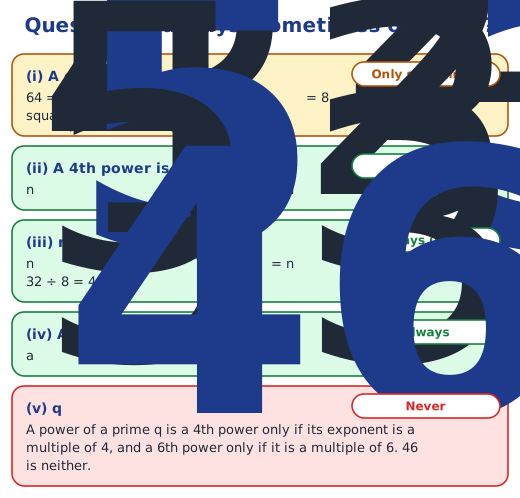
4. (i) Only sometimes true. 64 = 4³ = 8² is both, but 8 = 2³ is not a square. The cubes that are squares are the 6th powers. (ii) Always true. n⁴ = (n²)², the square of n². (iii) Always true (for n ≠ 0). n⁵ = n³ × n², so n⁵ ÷ n³ = n², a whole number. (iv) Always true. a³ × b³ = (ab)³, for example 8 × 27 = 216 = 6³. (v) Never true. For a prime q, qᵏ is a 4th power only when k is a multiple of 4, and a 6th power only when k is a multiple of 6. 46 is neither (q⁴⁶ is only a square, (q²³)²).
5. (i) Add the exponents: −2 + (−5) = −7, so 10⁻⁷. (ii) Subtract: 7 − 4 = 3, so 5³. (iii) Subtract: −7 − 4 = −11, so 9⁻¹¹. (iv) Multiply: (−2) × (−3) = 6, so 13⁶. (v) (mn)⁹ = m⁹n⁹, so m⁵n¹² × m⁹n⁹ = m¹⁴n²¹.
6. 1.2 = 12 ÷ 10, so (1.2)² = 144 ÷ 10² = 1.44; each decimal place in the number gives two in its square. (i) (1.2)² = 1.44. (ii) (0.12)² = 0.0144. (iii) (0.012)² = 0.000144. (iv) 120² = 14,400.
7. Write each in primes: 2⁴ × 3⁶; 6⁴ × 3² = 2⁴ × 3⁴ × 3² = 2⁴ × 3⁶; 6¹⁰ = 2¹⁰ × 3¹⁰; 18² × 6² = (2 × 3²)² × (2 × 3)² = 2⁴ × 3⁶; 6²⁴ = 2²⁴ × 3²⁴. So 2⁴ × 3⁶, 6⁴ × 3² and 18² × 6² are the same number, 11,664.
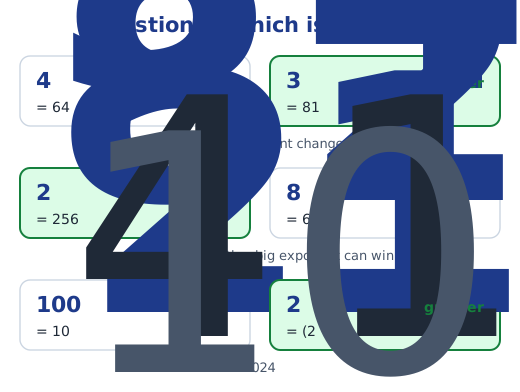
8. (i) 4³ = 64 and 3⁴ = 81, so 3⁴ is greater. (ii) 2⁸ = 256 and 8² = 64, so 2⁸ is greater. (iii) 100² = 10⁴, while 2¹⁰⁰ = (2¹⁰)¹⁰ = 1024¹⁰, which is more than 1000¹⁰ = 10³⁰. So 2¹⁰⁰ is far greater.
9. A code of n digits gives 10ⁿ different codes. 8.5 billion = 8.5 × 10⁹. Since 10⁹ is less than that but 10¹⁰ is more, the code needs at least 10 digits.
10. Yes, infinitely many: the 6th powers, 1⁶ = 1, 2⁶ = 64, 3⁶ = 729, 4⁶ = 4096, 5⁶ = 15,625, … Each is n⁶ = (n³)² = (n²)³. In general, a number is both a square and a cube exactly when every exponent in its prime factorisation is a multiple of both 2 and 3, that is of 6.
11. Each of the 5 places can hold one of 10 digits or 26 letters, 36 choices. So there are 36⁵ = 6,04,66,176 codes (which happens to equal 6¹⁰).
12. 10⁹ + 10⁹ = 2 × 10⁹, so both (v) 2 × 10⁹ and (vi) 10⁹ + 10⁹ are correct; they are the same number, 2 billion. The others are far too big: 10¹⁰ is 10 billion, and 20⁹ is about 5 × 10¹¹.
13. (i) 30 × 8.2 × 10⁹ = 246 × 10⁹ = 2.46 × 10¹¹ pieces of clothing. (ii) 100 million = 10⁸, so 10⁸ × 5 × 10⁴ = 5 × 10¹² honeybees. (iii) 38 trillion = 3.8 × 10¹³, so 3.8 × 10¹³ × 8.2 × 10⁹ ≈ 31.2 × 10²² = 3.1 × 10²³ bacterial cells. (iv) Assume about 1 hour of eating a day for 70 years: 3600 × 365 × 70 = 9,19,80,000 ≈ 9.2 × 10⁷ seconds, of the order of 10⁸.
14. 1 billion seconds = 10⁹ ÷ 86,400 ≈ 11,574 days, about 31 years 8 months. Counting back from your own today gives the date. For example, from noon on 16 November 2026, 10⁹ seconds earlier was the morning of 10 March 1995.
Puzzle Time: Tremendous in Ten! (page 47)
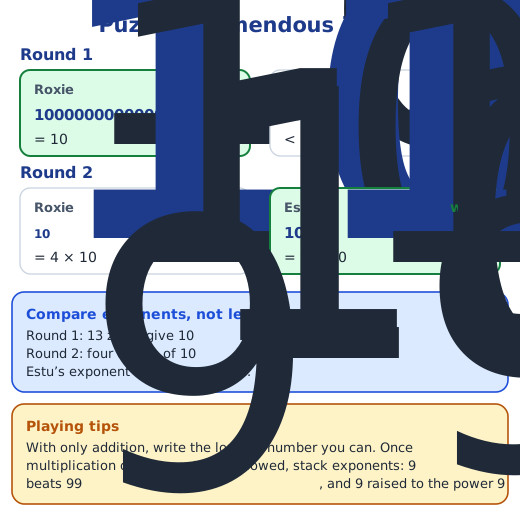
Round 1. Roxie’s number has 13 zeros after the 1, so it is 10¹³. Each of Estu’s factors is less than 10⁶, so the product is less than 10⁶ × 10⁶ = 10¹². Roxie wins.
Round 2. Roxie’s sum is 4 × 10¹⁰⁰⁰, which is less than 10¹⁰⁰¹. Estu’s number is 10 raised to 10,00,000, times 9000, that is 9 × 10¹⁰⁰⁰⁰⁰³. Estu’s is far greater.
Playing the rounds. With only addition, write the longest number you can in 10 seconds. With multiplication, multiply big numbers. Once exponents are allowed, put the exponent on top of an exponent; each extra level wins easily.
Practice
-
Simplify 3⁴ × 3⁻⁶ × 3⁵.
Show answer
Answer: (a) 3³
-
What is (−1)¹⁰¹ + (−1)¹⁰⁰?
Show answer
Answer: (b) 0
-
How many 4-character codes can be made using only the letters A, B and C?
Show answer
Answer: (c) 81
-
Write 0.000356 in standard form.
Show answer
Answer: Move the point 4 places to the right to get 3.56, so 0.000356 = 3.56 × 10⁻⁴.
-
Which is greater, 5³ or 3⁵? By how much?
Show answer
Answer: 5³ = 125 and 3⁵ = 243, so 3⁵ is greater, by 243 − 125 = 118.
Stuck on a question?
Take a photo and Lagnever AI explains it step by step. Try it for 7 days for ₹2.
Get it on Google Play Open in browser
For parents: after the trial, the plan renews monthly by UPI or card autopay. You can cancel anytime in the app.