
Class 8 Maths Chapter 2: Power Play Notes
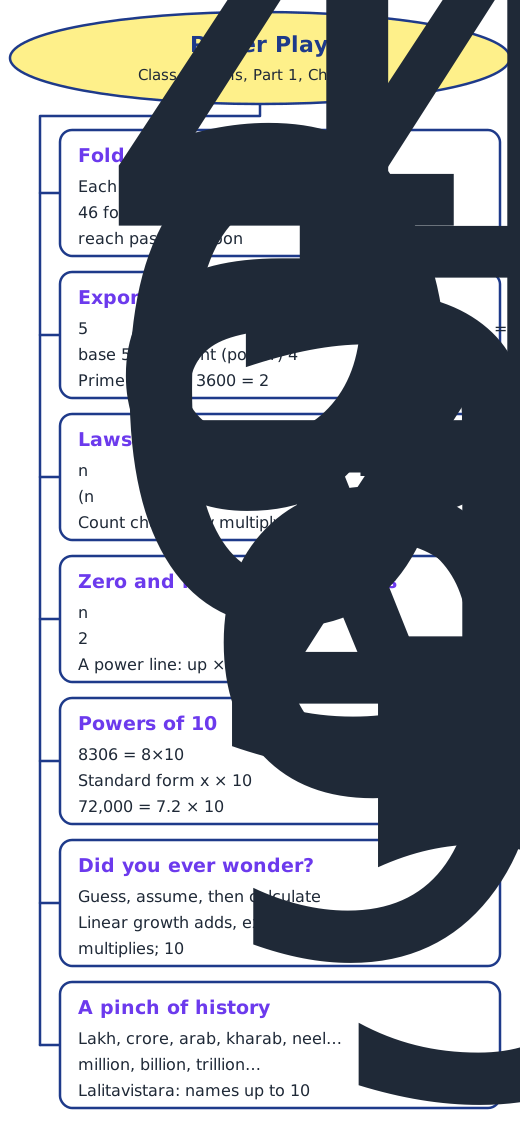
This chapter in five lines
An exponent tells how many times a base is multiplied by itself: 2⁵ = 2 × 2 × 2 × 2 × 2 = 32. Powers of the same base follow simple laws, and zero and negative exponents extend them. Powers of 10 give scientific notation for huge numbers. Repeated multiplication, called exponential growth, beats repeated addition very quickly.
What is this chapter about?
This is the second chapter of Ganita Prakash, Grade 8 Part 1. It asks what happens when you multiply by the same number again and again. That idea gives a short way to write such products (exponents), a set of rules for working with them, a neat way to write very large and very small numbers, and a feel for how fast repeated multiplication grows.
Folding paper: a surprising start
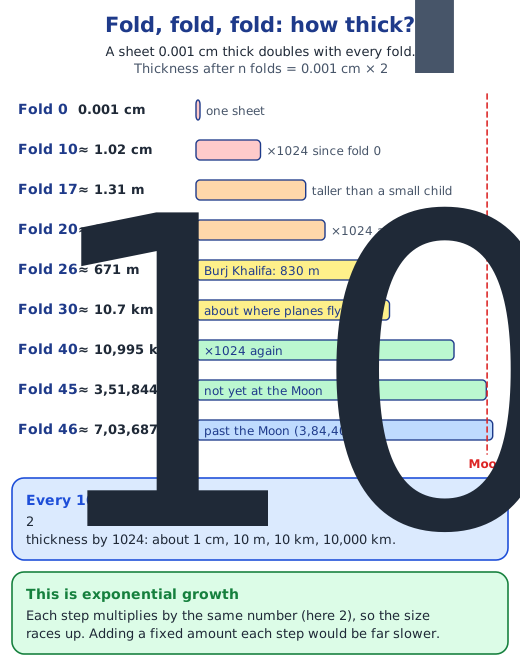
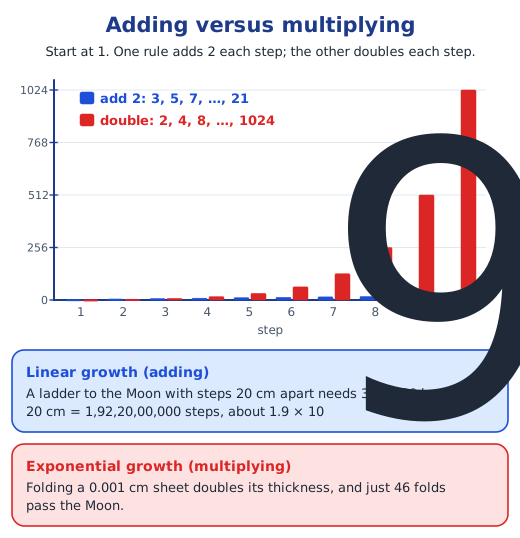
Fold a sheet of paper in half and its thickness doubles. Fold again and it doubles again. A sheet 0.001 cm thick is about 1 cm thick after 10 folds, about 10.7 km after 30 folds, and more than 7 lakh km after 46 folds, farther than the Moon. In real life you cannot fold paper that many times, but the arithmetic shows the power of doubling. Read exponential growth.
Exponents: writing repeated multiplication short
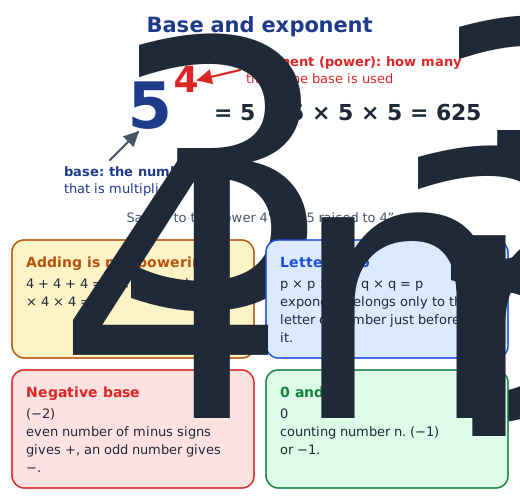
Instead of 2 × 2 × 2 × 2 × 2 we write 2⁵, read “2 raised to the power 5”. Here 2 is the base and 5 is the exponent or power. Squares (n²) and cubes (n³) from Chapter 1 are just powers 2 and 3. Prime factorisations become short too: 200 = 2 × 2 × 2 × 5 × 5 = 2³ × 5². Be careful with signs: (−3)² = 9 but (−3)³ = −27. Read exponents and powers.
The laws of exponents
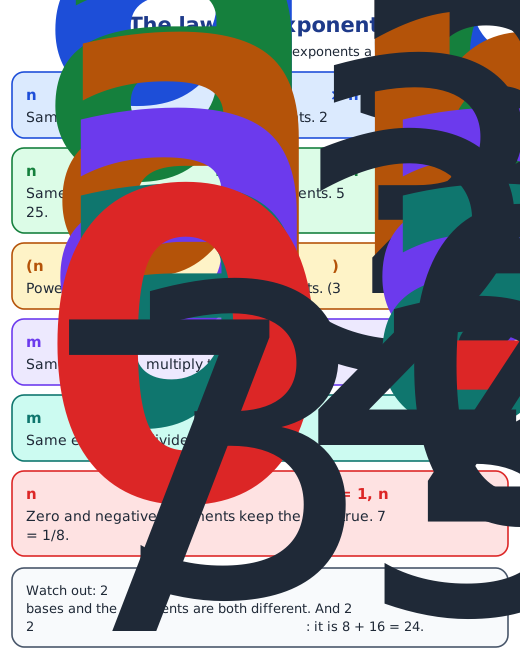
When the base is the same, multiplying powers adds the exponents: 3² × 3⁴ = 3⁶, because there are 2 + 4 threes in all. Dividing subtracts them, and a power of a power multiplies them: (2³)² = 2⁶. When the exponent is the same, the bases can be multiplied: 2⁵ × 5⁵ = 10⁵. These laws also explain counting problems: with 10 choices for each of 4 digits, a lock has 10⁴ codes.
Zero and negative exponents
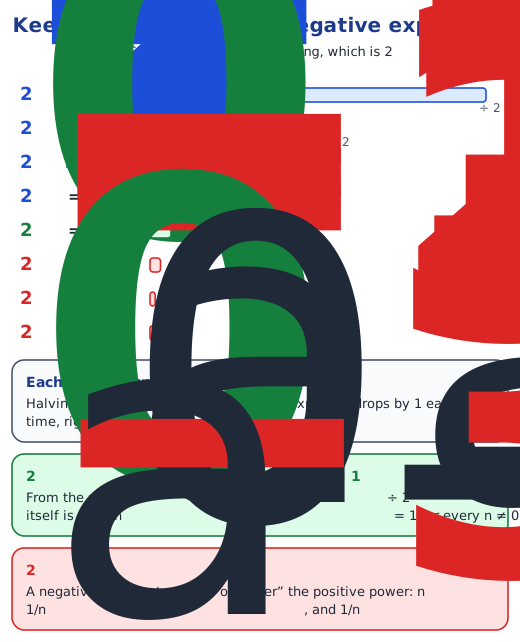
Halve 2⁴ = 16 again and again: 8, 4, 2, 1, ½, ¼. Each halving lowers the exponent by 1, so 1 = 2⁰ and ½ = 2⁻¹. In general n⁰ = 1 and n⁻ᵃ = 1/nᵃ for any n that is not 0. With these meanings, all the laws work for every integer exponent, and a power line shows them as steps up and down.
Powers of 10 and scientific notation
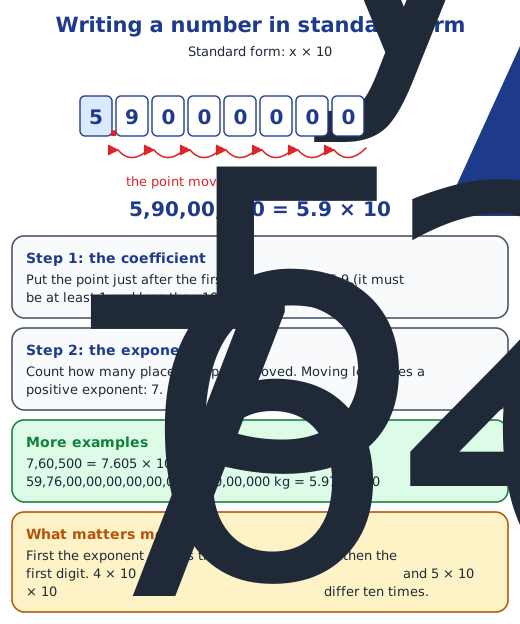
Our place values are powers of 10, so 4072.58 = 4 × 10³ + 7 × 10¹ + 2 × 10⁰ + 5 × 10⁻¹ + 8 × 10⁻². Very large numbers are easier to read and compare in standard form, x × 10ʸ with x from 1 up to (but not including) 10: the mass of the Earth, a 25-digit number of kilograms, is 5.976 × 10²⁴ kg. The exponent tells the size at a glance. Read powers of 10 and large numbers.
Estimating and comparing growth
The chapter also trains you to estimate: guess first, write the relationship, assume sensible values for what you do not know, then calculate. How many coins would balance your weight? How many steps would a ladder to the Moon need? With steps 20 cm apart, it needs about 1.9 × 10⁹ steps, while 46 paper folds get there. Adding the same amount is linear growth; multiplying by the same number is exponential growth.
Names for very large numbers
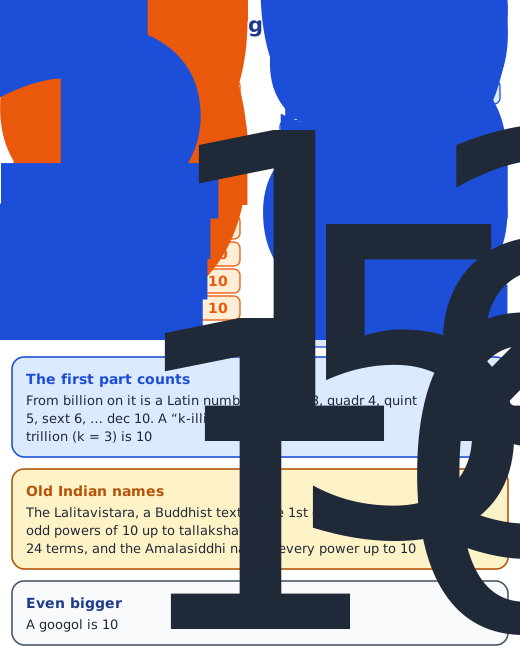
Counts of living things and spans of time are compared using powers of 10, from 2 northern white rhinos to about 2 × 10¹⁶ ants, and from seconds to the age of the Earth. Indian names go up in steps of 100 (lakh, crore, arab, kharab, neel, padma, shankh), while international names go up in steps of 1000 (million, billion, trillion). The Buddhist text Lalitavistara, from the 1st century BCE, already named powers of 10 up to 10⁵³.
Before we move on
Squares and cubes came first in Chapter 1, A Square and A Cube, and lakhs and crores in Class 7 (lakhs and crores). Repeated multiplication returns in Part 2 with compound interest. Answers to every question in this chapter, both Figure it Out sets and the Tremendous in Ten! game are in the NCERT solutions for Chapter 2.
Key terms
| Term | Meaning |
|---|---|
| Exponent (power) | The small raised number that says how many times the base is used in a product. In 3⁴ the exponent is 4. |
| Base | The number that is multiplied by itself. In 3⁴ = 3 × 3 × 3 × 3 = 81 the base is 3. |
| Exponential form | A product of equal factors written short, such as 7 × 7 × 7 = 7³, or 200 = 2³ × 5². |
| Laws of exponents | Rules for the same base or the same exponent: nᵃ × nᵇ = nᵃ⁺ᵇ, nᵃ ÷ nᵇ = nᵃ⁻ᵇ, (nᵃ)ᵇ = nᵃᵇ and mᵃ × nᵃ = (mn)ᵃ. |
| Zero exponent | Any number except 0 raised to the power 0 is 1, so that the laws stay true: 5³ ÷ 5³ = 5⁰ = 1. |
| Negative exponent | “One over” the positive power: n⁻ᵃ = 1/nᵃ for n ≠ 0. So 10⁻² = 1/100. |
| Power line | A number line of the powers of one base. Each step up multiplies by the base and each step down divides by it. |
| Expanded form with powers of 10 | Writing a number by its places: 305.7 = (3 × 10²) + (0 × 10¹) + (5 × 10⁰) + (7 × 10⁻¹). |
| Scientific notation (standard form) | A number written as x × 10ʸ, where x is at least 1 and less than 10 and y is an integer: 6,30,000 = 6.3 × 10⁵. |
| Exponential growth | Growth by multiplying by the same number at each step, such as doubling. It is also called multiplicative growth. |
| Linear growth | Growth by adding the same amount at each step, such as climbing one 20 cm step at a time. |
| Estimate | A sensible approximate answer found by guessing, making assumptions and calculating roughly. |
| Lakh, crore, arab | Indian names for 10⁵, 10⁷ and 10⁹. Each next name (kharab, neel, padma, …) is 100 times the one before. |
| Million, billion, trillion | International names for 10⁶, 10⁹ and 10¹². Each next name is 1000 times the one before. |
Topics in this chapter
Practice
-
What is the value of 2⁶?
Show answer
Answer: (c) 64
-
Simplify 7⁸ ÷ 7⁵.
Show answer
Answer: (a) 7³
-
(5²)³ is equal to:
Show answer
Answer: (b) 5⁶
-
10⁻³ is equal to:
Show answer
Answer: (c) 0.001
-
What is 4,05,000 in standard form?
Show answer
Answer: (c) 4.05 × 10⁵
-
Which grows fastest after 20 steps, starting from 1?
Show answer
Answer: (c) Double each step
Questions students ask
What are the main topics of Class 8 Maths Chapter 2?
Paper folding and exponential growth, exponents and prime factors, the laws of exponents, counting combinations, zero and negative exponents, powers of 10 and scientific notation, estimation, and Indian and international names for large numbers. It ends with the Tremendous in Ten! game.
Is Power Play in the new NCERT Class 8 Maths book?
Yes. It is Chapter 2 of Ganita Prakash, Grade 8 Part 1, on pages 19 to 47 of the book marked Reprint 2026-27. The older Class 8 book had a chapter called Exponents and Powers.
Why is any number to the power 0 equal to 1?
Because of the division law. 5³ ÷ 5³ = 5³⁻³ = 5⁰, and any non-zero number divided by itself is 1. Defining 5⁰ = 1 keeps the laws of exponents true.
What is the difference between linear and exponential growth?
Linear growth adds the same amount each step: 2, 4, 6, 8, … Exponential growth multiplies by the same number each step: 2, 4, 8, 16, … After a few steps the multiplying pattern is far ahead.
Stuck on a question?
Take a photo and Lagnever AI explains it step by step. Try it for 7 days for ₹2.
Get it on Google Play Open in browser
For parents: after the trial, the plan renews monthly by UPI or card autopay. You can cancel anytime in the app.