
Powers of 10, scientific notation and large numbers
Answer in short
Every place value is a power of 10: hundreds are 10², ones 10⁰ and tenths 10⁻¹. Scientific notation writes a number as x × 10ʸ, with x at least 1 and less than 10: 3,84,400 = 3.844 × 10⁵. The exponent shows the size at a glance, which makes huge numbers easy to read and compare.
Stuck on a question? Take a photo and Lagnever AI explains it step by step. Try it for 7 days for ₹2. Get it on Google Play
How are place values powers of 10?
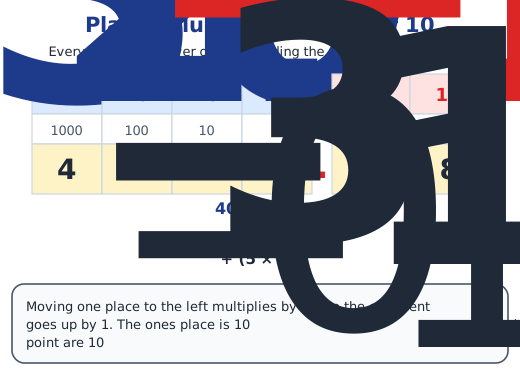
In our number system each place is worth 10 times the place to its right. So the places are powers of 10: ones are 10⁰ = 1, tens 10¹, hundreds 10², thousands 10³ and so on. After the decimal point the powers carry on below zero: tenths are 10⁻¹ = 1/10, hundredths 10⁻² and thousandths 10⁻³.
That gives the expanded form of any number. For example, 8306 = (8 × 10³) + (3 × 10²) + (0 × 10¹) + (6 × 10⁰), and 0.47 = (4 × 10⁻¹) + (7 × 10⁻²).
What is scientific notation?
Long numbers are easy to misread. Is 30,00,00,00,000 three thousand crore or three hundred crore? Counting zeros is slow and risky. Scientific notation, also called standard form, writes a number as x × 10ʸ, where the coefficient x is at least 1 and less than 10, and the exponent y is an integer.
To change a number into standard form:
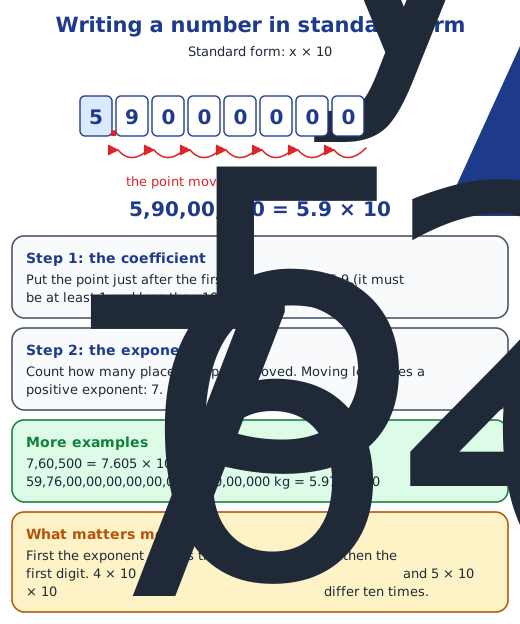
- Place the decimal point just after the first non-zero digit. That gives x.
- Count how many places the point moved to the left. That count is y.
So 5,90,00,000 = 5.9 × 10⁷, because the point moves 7 places. The same number can be written as 59 × 10⁶ or 590 × 10⁵, but only 5.9 × 10⁷ has x between 1 and 10.
How do you compare numbers in standard form?
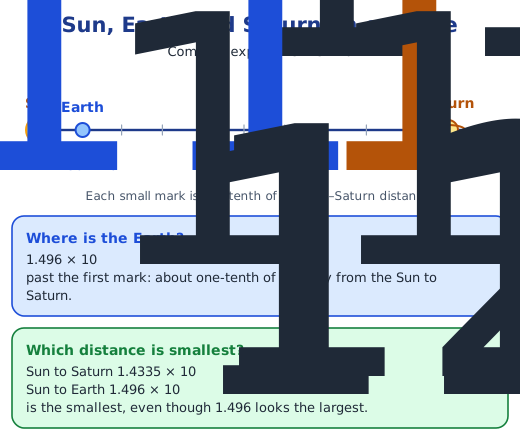
Look at the exponents first. The number with the bigger exponent is bigger, whatever the coefficients are. Only when the exponents are equal do you compare the coefficients. For example, the distance from the Sun to the Earth is 1.496 × 10¹¹ m and from the Sun to Saturn is 1.4335 × 10¹² m. The exponent 11 is smaller than 12, so the Earth is much closer: about one-tenth of the way to Saturn.
Why do we round large numbers?
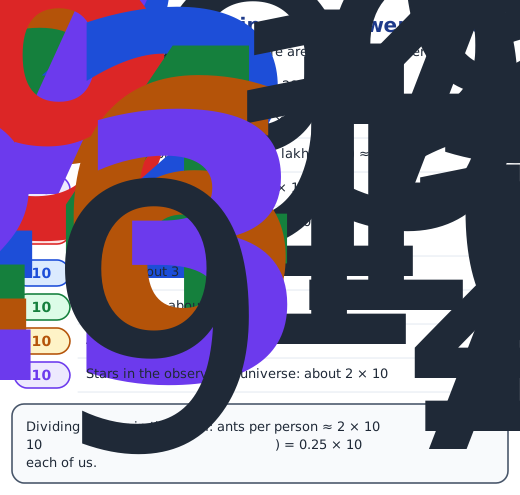
Big counts are rarely exact. If a town has about 1 lakh 40 thousand people, writing 1.4 × 10⁵ is more honest than a number given to the last digit. The number of digits in the coefficient shows how well we know the value. Multiplying and dividing also become easy, because the laws of exponents handle the powers of 10: (3 × 10⁴) × (2 × 10³) = 6 × 10⁷.
How long is a million seconds?
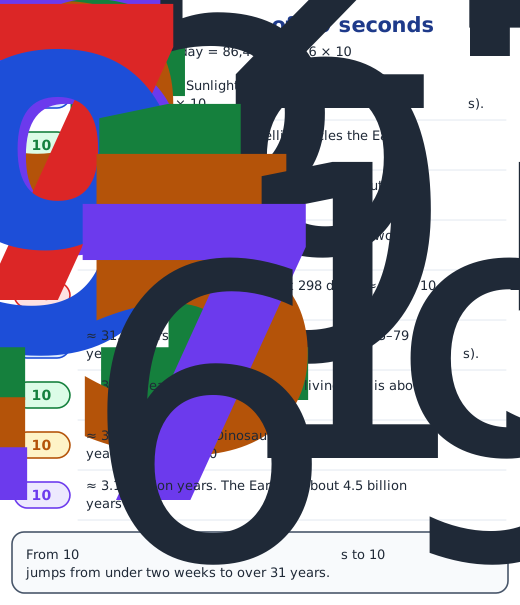
Powers of 10 help with time as well. A day has 86,400 seconds, about 8.6 × 10⁴, and a year about 3.15 × 10⁷. So 10⁶ seconds is under 12 days, but 10⁹ seconds is nearly 32 years. Adding just three to the exponent turned days into decades.
What are lakh, crore, billion and trillion as powers of 10?
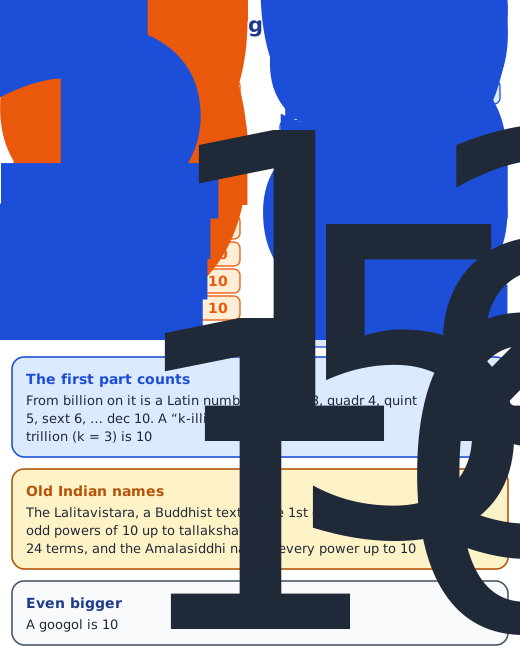
The Indian system names every second power of 10 from a lakh onwards: lakh 10⁵, crore 10⁷, arab 10⁹, kharab 10¹¹, neel 10¹³, padma 10¹⁵, shankh 10¹⁷. Each name is 100 times the one before, so 10² × 10⁵ = 10⁷ shows that a hundred lakh is a crore.
The international system steps by 1000: million 10⁶, billion 10⁹, trillion 10¹², quadrillion 10¹⁵. From billion on, the start of each name is a Latin number word (bi = 2, tri = 3, quadr = 4), and the name means 10 raised to 3 × (that number) + 3. Ancient Indian texts went much further: the Lalitavistara named powers up to 10⁵³, and a googol is 10¹⁰⁰.
Read next: exponential growth, exponents and powers, the chapter notes and NCERT solutions.
Practice
-
What is 7,20,000 in standard form?
Show answer
Answer: (b) 7.2 × 10⁵
-
Which is the largest?
Show answer
Answer: (b) 1.1 × 10⁹
-
One crore written as a power of 10 is:
Show answer
Answer: (c) 10⁷
-
Write 6050.4 using powers of 10.
Show answer
Answer: 6050.4 = (6 × 10³) + (0 × 10²) + (5 × 10¹) + (0 × 10⁰) + (4 × 10⁻¹).
-
A city has about 2.4 × 10⁶ people and a town about 6 × 10⁴. About how many times bigger is the city?
Show answer
Answer: 2.4 × 10⁶ ÷ (6 × 10⁴) = (2.4 ÷ 6) × 10² = 0.4 × 100 = 40 times.
Questions students ask
What is scientific notation in Class 8?
It is a way to write a number as x × 10ʸ, where x is at least 1 and less than 10 and y is an integer. For example 5,00,000 = 5 × 10⁵. It is also called standard form.
Why is the exponent the most important part?
The exponent tells how many digits the number has, so it sets the size. Changing 3 × 10⁶ to 4 × 10⁶ adds a third, but changing it to 3 × 10⁷ makes it ten times bigger.
How many zeros are in a crore and in a billion?
A crore is 1,00,00,000, which has 7 zeros (10⁷). A billion is 1,000,000,000, which has 9 zeros (10⁹), the same as an arab.
Why write 1.4 × 10⁵ instead of 1,42,395?
When a number is only known roughly, the shorter form says so honestly. 1.4 × 10⁵ means “about 1 lakh 40 thousand”, while 1,42,395 claims we know it to the last person.
Stuck on a question?
Take a photo and Lagnever AI explains it step by step. Try it for 7 days for ₹2.
Get it on Google Play Open in browser
For parents: after the trial, the plan renews monthly by UPI or card autopay. You can cancel anytime in the app.