
Exponential growth: when things multiply
Answer in short
Exponential growth means multiplying by the same number at every step, as when a quantity doubles. After n doublings, 1 becomes 2ⁿ, so 10 doublings give 1024 and 20 give over 10 lakh. Linear growth adds the same amount each step instead, and it falls far behind exponential growth after only a few steps.
Stuck on a question? Take a photo and Lagnever AI explains it step by step. Try it for 7 days for ₹2. Get it on Google Play
What happens when you keep doubling?
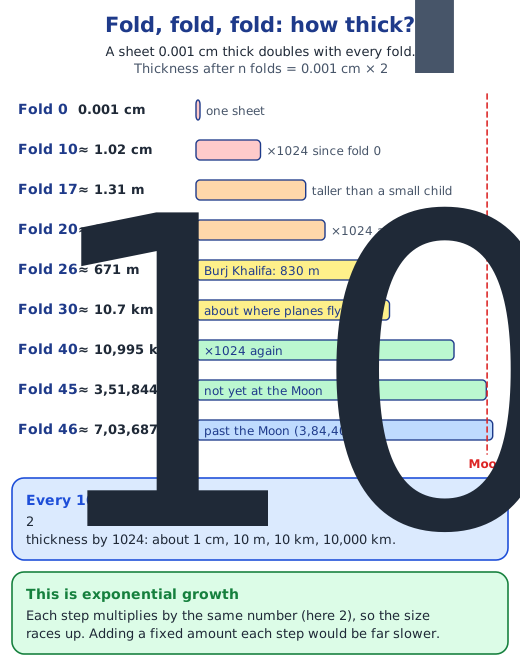
Take a sheet of paper 0.001 cm thick and imagine folding it in half again and again. Each fold doubles the thickness, so after n folds it is 0.001 cm × 2ⁿ. The first folds change little: after 7 folds the stack is just 0.128 cm. But 2¹⁰ = 1024, so every 10 folds multiply the thickness by about a thousand. After 10 folds it is about 1 cm, after 20 about 10 m, after 30 about 10.7 km, after 40 about 11,000 km, and after 46 folds it would be over 7 lakh km, past the Moon.
Real paper cannot be folded that often, but the numbers show what multiplying does. This is exponential growth, also called multiplicative growth.
Why is a doubling pond half full only one day before it is full?
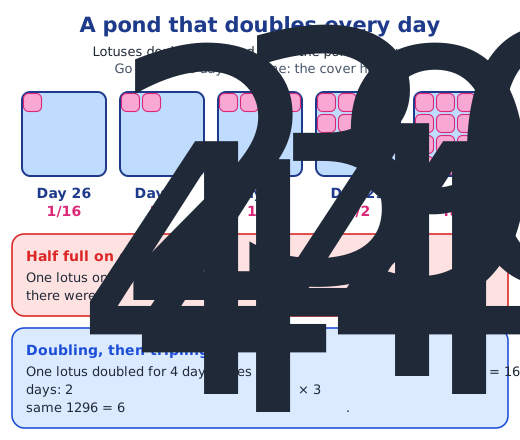
Suppose lotuses in a pond double every day and cover it completely on day 30. Going back one day halves the cover, so the pond was half covered on day 29, a quarter covered on day 28 and only one-sixteenth covered on day 26. For most of the month the pond looks nearly empty; then it fills in a rush. Starting from one lotus, there are 2³⁰ lotuses on day 30 and 2²⁹ on day 29.
If the flowers double for 4 days and then triple for 4 days, one lotus becomes 2⁴ × 3⁴ = 16 × 81 = 1296. Swapping the order gives 3⁴ × 2⁴, the same number, and regrouping shows it is (2 × 3)⁴ = 6⁴.
How do powers count combinations?
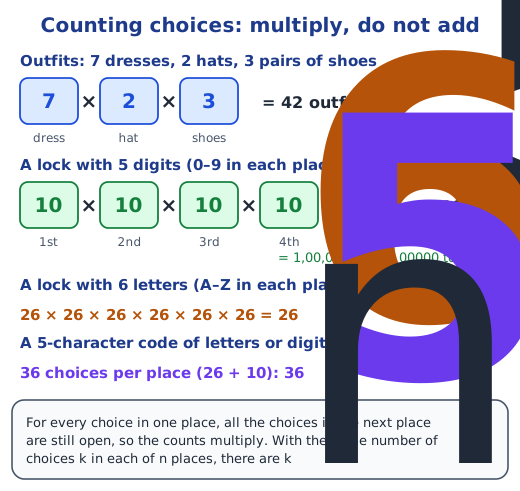
Choices that are made one after another multiply. With 5 shirts and 3 caps there are 5 × 3 = 15 outfits, because each shirt can go with every cap. Add 2 pairs of shoes and there are 15 × 2 = 30.
A code lock works the same way. With the digits 0 to 9 in each of 3 places, there are 10 × 10 × 10 = 10³ = 1000 codes, from 000 to 999. A lock of 6 letters A to Z has 26⁶ = 30,89,15,776 codes. When every place has k choices and there are n places, the count is kⁿ, a power that grows fast with each extra place.
What is the difference between linear and exponential growth?
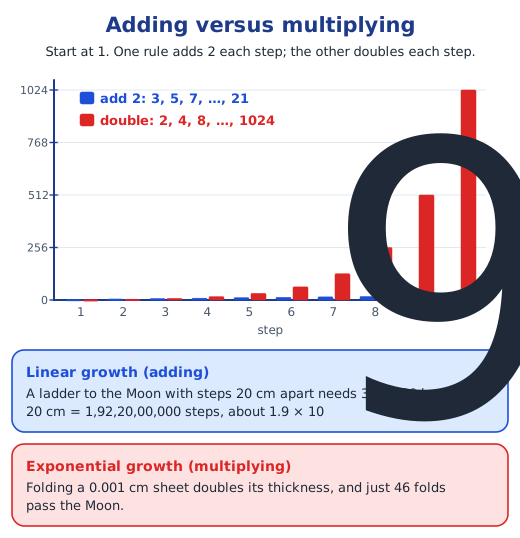
Linear growth adds the same amount at every step. Climbing a ladder whose rungs are 20 cm apart raises you 20 cm per step. To reach the Moon, 3,84,400 km away, such a ladder would need 3,84,400 km ÷ 20 cm = 1,92,20,00,000 steps, about 1.9 × 10⁹.
Exponential growth multiplies by the same number at every step. The folded paper covers the same distance in only 46 steps. Starting from 1, adding 2 ten times reaches 21, while doubling ten times reaches 1024.
Other examples: saving ₹100 every month is linear growth, while a rumour where every person tells 2 new people each day grows exponentially.
How do we estimate large quantities?
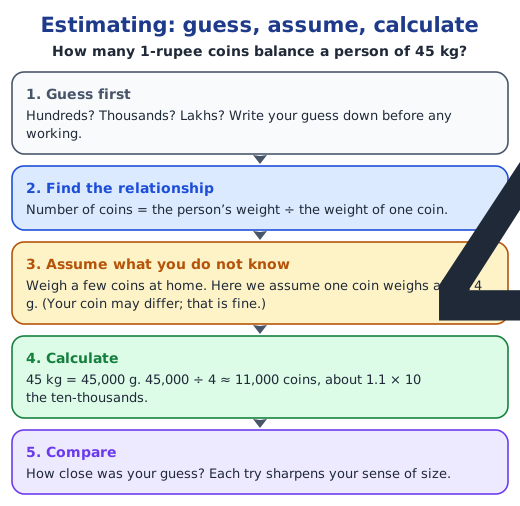
Many questions in this chapter have no exact answer, such as “How many 1-rupee coins would balance my weight?”. A good method is:
- Guess quickly, without working. Hundreds? Lakhs?
- Describe the relationship: number of coins = your weight ÷ weight of one coin.
- Assume sensible values for what you do not know, and weigh or measure when you can.
- Calculate, then compare the answer with your guess.
For a person of 45 kg and a coin assumed to weigh about 4 g, the answer is about 45,000 ÷ 4 ≈ 11,000 coins, roughly 10⁴. Different assumptions give different answers, and that is fine; what matters is a sensible model. Writing the answer as a power of 10 shows its size clearly.
Read next: the chapter notes, exponents and powers, powers of 10 and large numbers and NCERT solutions.
Practice
-
A number doubles every day, starting at 1. What is it after 8 days?
Show answer
Answer: (c) 256
-
How many 3-digit codes can be made from the digits 0–9?
Show answer
Answer: (d) 1000
-
Which is an example of linear growth?
Show answer
Answer: (b) Saving ₹50 every week
-
A pond’s weeds triple every day and cover it on day 12. What part is covered on day 11?
Show answer
Answer: One-third. Tripling means day 12 has 3 times the cover of day 11, so day 11 has 1/3 of the full cover.
-
A sheet is 0.01 cm thick. How thick is it after 10 folds?
Show answer
Answer: Each fold doubles it, so 0.01 cm × 2¹⁰ = 0.01 × 1024 = 10.24 cm.
Questions students ask
What is exponential growth in simple words?
It is growth where the amount is multiplied by the same number at each step, like doubling. Because each step builds on a bigger amount, it starts slowly and then shoots up.
Can a paper really be folded 46 times?
No. Real paper becomes too thick and stiff after a few folds. The chapter uses 46 folds as a thought experiment to show how quickly doubling grows: 0.001 cm × 2⁴⁶ is more than 7 lakh km.
How is counting passwords related to exponents?
Each place in a code can be filled independently, so the choices multiply. With 10 digits for each of 6 places there are 10 × 10 × 10 × 10 × 10 × 10 = 10⁶ codes.
Why does the chapter ask us to guess before calculating?
Guessing first and then checking trains your sense of size. Over time your guesses for large quantities, like coins, steps or seconds, get much closer to the real answers.
Stuck on a question?
Take a photo and Lagnever AI explains it step by step. Try it for 7 days for ₹2.
Get it on Google Play Open in browser
For parents: after the trial, the plan renews monthly by UPI or card autopay. You can cancel anytime in the app.