
Exponents and powers: the laws of exponents
Answer in short
An exponent tells how many times the base is multiplied by itself: in 3⁴ = 3 × 3 × 3 × 3 = 81, the base is 3 and the exponent is 4. For the same base, multiplying adds exponents, dividing subtracts them and a power of a power multiplies them. And n⁰ = 1, n⁻ᵃ = 1/nᵃ.
Stuck on a question? Take a photo and Lagnever AI explains it step by step. Try it for 7 days for ₹2. Get it on Google Play
What does an exponent mean?
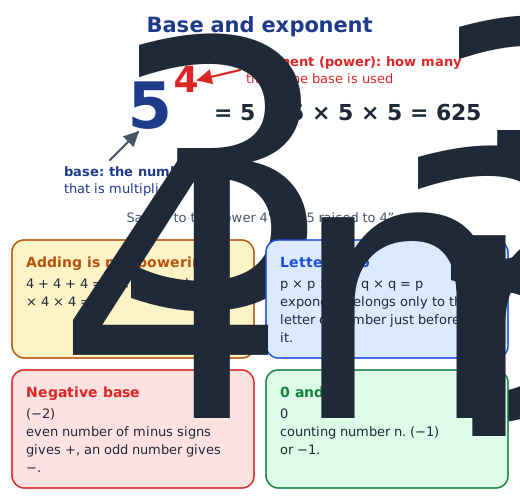
When the same number is multiplied again and again, we write it short. 6 × 6 × 6 × 6 is written 6⁴, said “6 to the power 4” (or “6 raised to 4”). The number being multiplied, 6, is the base. The small raised number, 4, is the exponent or power: it counts how many 6s are multiplied.
Squares and cubes are powers you already know: 7² = 49 and 7³ = 343. Letters work the same way: x × x × x × y × y = x³y².
What about negative numbers, 0 and 1?
A negative base needs care with signs. (−5)² = (−5) × (−5) = 25, but (−5)³ = −125. Each pair of minus signs makes a plus, so an even exponent gives a positive answer and an odd exponent a negative one. Also 1 to any power is 1, and 0 to any counting-number power is 0.
How do prime factors look in exponent form?
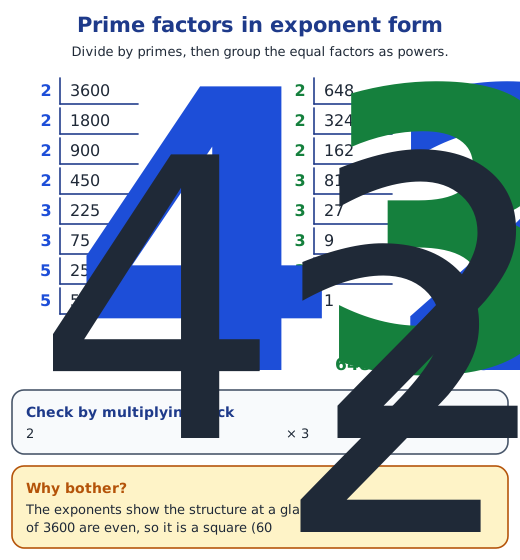
Break a number into primes, then group the equal ones. 3600 = 2 × 2 × 2 × 2 × 3 × 3 × 5 × 5 = 2⁴ × 3² × 5². The short form shows the structure at once: all the exponents of 3600 are even, so it is a perfect square.
Why do we add exponents when we multiply?
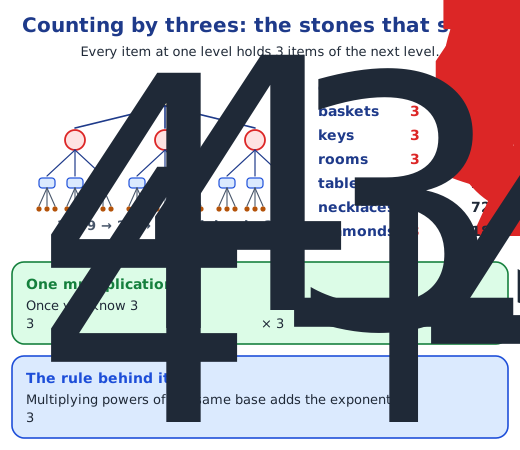
Count the factors. 3⁴ × 3³ = (3 × 3 × 3 × 3) × (3 × 3 × 3), which is seven 3s, so it is 3⁷. In general nᵃ × nᵇ = nᵃ⁺ᵇ. This saves work: if you know 3⁴ = 81 and 3³ = 27, then 3⁷ = 81 × 27 = 2187 with one multiplication.
What are the other laws?
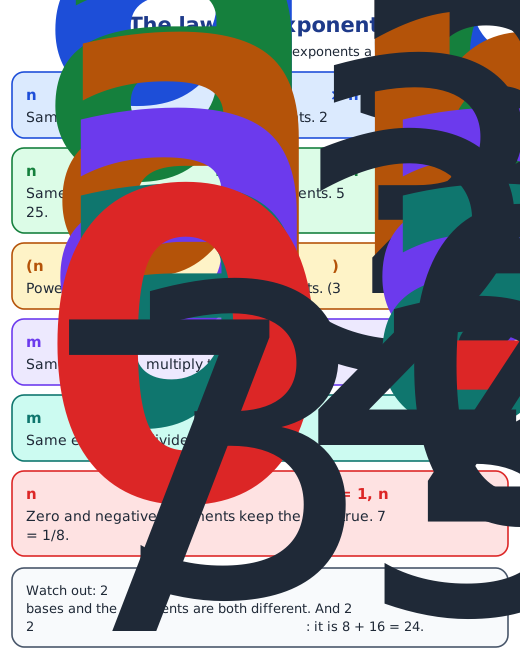
- Power of a power: (2³)⁴ means four groups of 2³, that is 3 × 4 = 12 twos, so (2³)⁴ = 2¹². In general (nᵃ)ᵇ = (nᵇ)ᵃ = nᵃᵇ.
- Dividing: 5⁶ ÷ 5⁴ cancels four 5s from top and bottom and leaves 5². So nᵃ ÷ nᵇ = nᵃ⁻ᵇ.
- Same exponent: 4³ × 5³ = (4 × 5) × (4 × 5) × (4 × 5) = 20³, because the factors can be regrouped in pairs. So mᵃ × nᵃ = (mn)ᵃ, and similarly mᵃ ÷ nᵃ = (m ÷ n)ᵃ. A handy case: 2⁶ × 5⁶ = 10⁶ = 10,00,000.
If both the bases and the exponents differ, as in 2³ × 3⁴, nothing combines; just work out 8 × 81 = 648.
What is n⁰, and what does a negative exponent mean?
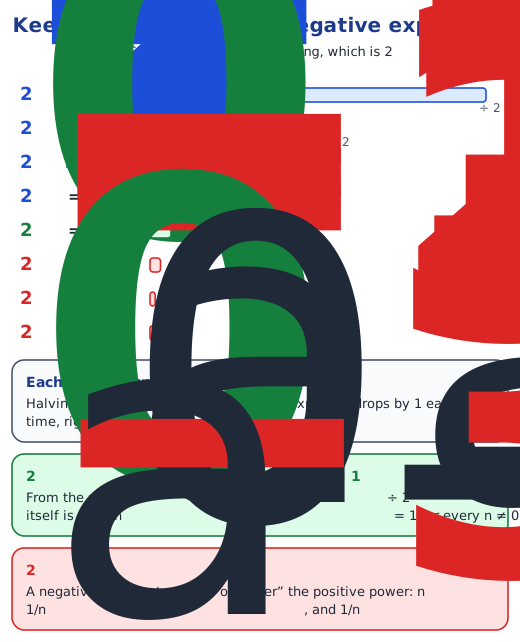
Use the division law on equal powers: 2⁴ ÷ 2⁴ = 2⁴⁻⁴ = 2⁰. But any non-zero number divided by itself is 1, so 2⁰ = 1. In the same way n⁰ = 1 for every n except 0.
Now divide by a bigger power: 2³ ÷ 2⁵ = (2 × 2 × 2)/(2 × 2 × 2 × 2 × 2) = 1/2². The law says 2³⁻⁵ = 2⁻², so 2⁻² must mean 1/2² = 1/4. In general n⁻ᵃ = 1/nᵃ, and turned around, 1/n⁻ᵃ = nᵃ. With these meanings, every law above works for all integers a and b: 2⁻³ × 2⁵ = 2² = 4.
How does a power line help?
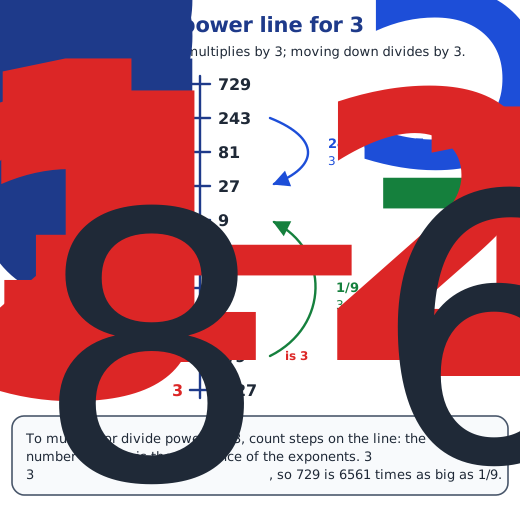
Write the powers of one base on a vertical line: 3⁰ = 1 in the middle, 3, 9, 27, … above and 1/3, 1/9, … below. One step up multiplies by 3 and one step down divides by 3. Multiplying by 3ᵇ means moving b steps, so 3⁵ ÷ 3² is two steps down from 3⁵, landing on 3³ = 27. The gap between two powers on the line tells how many times bigger one is: 3² is 3⁴ = 81 times as big as 3⁻².
Read next: powers of 10 and large numbers, exponential growth, the chapter notes and NCERT solutions.
Practice
-
What is 3⁵?
Show answer
Answer: (c) 243
-
Write 2⁷ × 2⁻³ as a single power of 2.
Show answer
Answer: (a) 2⁴
-
Which of these equals 1?
Show answer
Answer: (b) 9⁰
-
Write 1800 as a product of powers of primes.
Show answer
Answer: 1800 = 2 × 2 × 2 × 3 × 3 × 5 × 5 = 2³ × 3² × 5². Check: 8 × 9 × 25 = 1800.
-
Simplify (4²)³ ÷ 4⁵ and give its value.
Show answer
Answer: (4²)³ = 4⁶, and 4⁶ ÷ 4⁵ = 4¹ = 4.
Questions students ask
What is the difference between an exponent and a power?
In 5³ = 125, the exponent is 3 and the whole expression 5³, or its value 125, is called a power of 5. In everyday maths talk, “raised to the power 3” and “exponent 3” mean the same thing.
What are the laws of exponents in Class 8?
For the same base n: nᵃ × nᵇ = nᵃ⁺ᵇ, nᵃ ÷ nᵇ = nᵃ⁻ᵇ and (nᵃ)ᵇ = nᵃᵇ. For the same exponent: mᵃ × nᵃ = (mn)ᵃ and mᵃ ÷ nᵃ = (m ÷ n)ᵃ. Also n⁰ = 1 and n⁻ᵃ = 1/nᵃ when n is not 0.
Why can the base not be 0 in nᵃ ÷ nᵇ?
Because 0ᵇ is 0, and dividing by 0 has no meaning. The same reason rules out 0⁰ and negative powers of 0.
Is (−1) to an even power always 1?
Yes. Every pair of (−1) × (−1) makes +1, so an even number of them gives 1. With an odd number, one (−1) is left over and the answer is −1.
Stuck on a question?
Take a photo and Lagnever AI explains it step by step. Try it for 7 days for ₹2.
Get it on Google Play Open in browser
For parents: after the trial, the plan renews monthly by UPI or card autopay. You can cancel anytime in the app.