
Simple and compound interest
Answer in short
Interest is extra money paid on a deposit or a loan, given as a rate per annum (p.a.). Without compounding, a principal p at rate r earns the same interest every year and becomes p(1 + rt) after t years. With yearly compounding, each year’s interest is added back, so the amount becomes p(1 + r)ᵗ.
Stuck on a question? Take a photo and Lagnever AI explains it step by step. Try it for 7 days for ₹2. Get it on Google Play
Interest, principal and rate
Banks and post offices pay interest, extra money, on money kept with them, and people pay interest when they borrow. A notice such as ‘FD @ 10% p.a.’ gives the rate of interest; p.a. stands for per annum, every year. The money deposited is the principal. If you keep ₹6000 in a fixed deposit at 10% p.a., after one year you have 6000 + 0.10 × 6000 = ₹6600. In other words the deposit becomes 110% of itself: 6000 × 1.1 = 6600. In a fixed deposit (FD) the money stays locked for the chosen period, and taking it out early usually means paying a penalty.
Without compounding
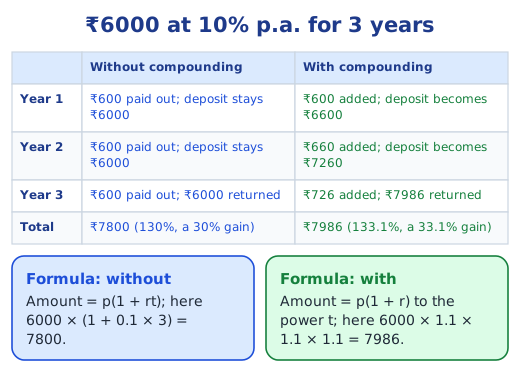
Suppose the bank pays the interest out at the end of every year and returns the principal at the end. Then ₹6000 at 10% p.a. earns ₹600 each year. Over 3 years that is ₹1800 of interest, so ₹7800 is received in all, 130% of the deposit, a gain of 30%. In general, with principal p and yearly rate r (as a decimal), the interest each year is p × r, the interest over t years is prt, and the total is p + prt = p(1 + rt). This is often called simple interest.
With compounding
Now suppose each year’s interest is added back into the deposit. The first year still earns ₹600, making ₹6600. The second year earns 10% of ₹6600, which is ₹660, making ₹7260. The third earns ₹726, making ₹7986. This is compounding: every year’s interest also earns interest. Each year the amount is multiplied by 1.1, so after 3 years it is 6000 × 1.1 × 1.1 × 1.1 = 6000 × 1.331, a gain of 33.1%. After t years the amount is p(1 + r)ᵗ, and the compound interest is p(1 + r)ᵗ − p.
Why compounding wins in the long run
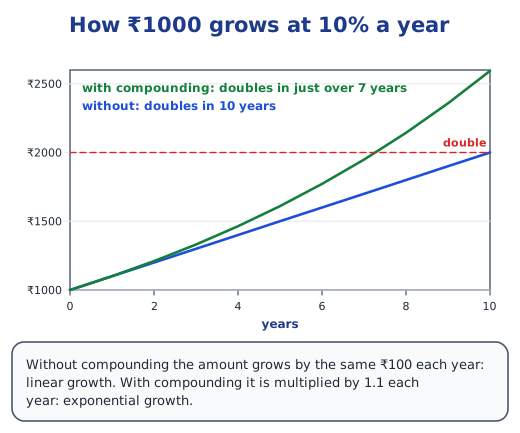
At first the two methods are close. ₹20,000 at 10% p.a. for 2 years gives ₹24,000 without compounding and ₹24,200 with it, a difference of only ₹200. But the gap widens with time and with more periods. Without compounding, ₹1000 at 10% grows by the same ₹100 every year, a straight line, and doubles in 10 years. With compounding, it is multiplied by 1.1 every year, a curve that bends upwards, and doubles in just over 7 years. The first is linear growth; the second is exponential growth. The same rule describes a city growing 3% a year or bacteria multiplying 2.5% an hour.
Comparing loans
Interest on loans works the same way. Giridhar borrows ₹12,500 at 12% p.a. for 3 years without compounding, and pays 12,500 × 0.12 × 3 = ₹4500 in interest. Raghava borrows the same amount at 10% p.a. compounded yearly, and pays 12,500 × (1.1³ − 1) = ₹4137.50. Even though compounding grows faster, the lower rate keeps Raghava’s interest ₹362.50 smaller over these 3 years.
Decline and depreciation
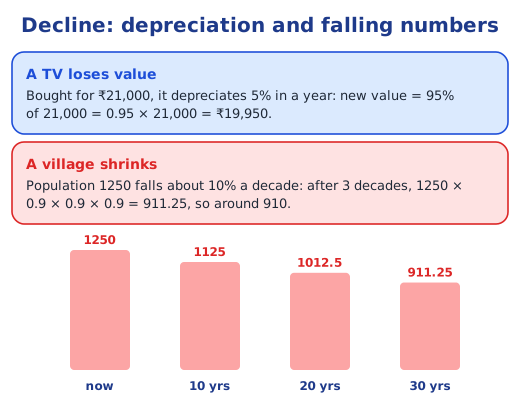
Compounding can also run downwards. Many things lose value with age and use; this is depreciation. A TV bought for ₹21,000 that loses 5% of its value in a year is worth 0.95 × 21,000 = ₹19,950. A village of 1250 people that shrinks by about 10% every decade has 1250 × 0.9 × 0.9 × 0.9 ≈ 911 people after three decades, or around 910. Each decade multiplies by 0.9 instead of 1.1. For the rest of the chapter, see the Chapter 1 notes, percentage increase and decrease, and the NCERT solutions.
Practice
-
₹20,000 is deposited at 10% p.a. for 2 years without compounding. The amount received is:
Show answer
Answer: (b) ₹24,000
-
The same ₹20,000 at 10% p.a. compounded yearly for 2 years becomes:
Show answer
Answer: (b) ₹24,200
-
A bike bought for ₹1,00,000 loses 10% of its value in a year. Its value after the year is:
Show answer
Answer: (b) ₹90,000
-
₹50,000 is invested at 7% p.a. for 3 years. How much more interest does compounding give than no compounding?
Show answer
Answer: Without compounding: 50,000 × 0.07 × 3 = ₹10,500. With compounding: 50,000 × 1.07³ ≈ ₹61,252.15, so the interest is ₹11,252.15. Compounding gives about ₹752.15 more.
-
How long does ₹1000 take to double at 10% p.a. with and without compounding?
Show answer
Answer: Without compounding it gains ₹100 a year, so it doubles in 10 years. With compounding, 1.1⁷ ≈ 1.95 and 1.1⁸ ≈ 2.14, so it doubles in a little over 7 years.
Questions students ask
What is the difference between simple and compound interest?
With simple interest, the interest is calculated on the original principal every year, so it is the same each year. With compound interest, each year’s interest is added to the principal, and the next year’s interest is calculated on this bigger amount, so the interest grows every year. The book calls these interest without and with compounding.
What is the formula for compound interest in Class 8?
The amount after t years is p(1 + r)ᵗ, where p is the principal and r is the yearly rate written as a decimal. The compound interest is this amount minus the principal: p(1 + r)ᵗ − p. Without compounding the amount is p(1 + rt) and the interest is prt.
What is depreciation?
Depreciation is the fall in the value of an item, such as a TV, a phone or a bike, as it gets older and is used. A 5% depreciation in a year means the item is worth 95% of its earlier value, so a ₹21,000 TV is worth 0.95 × 21,000 = ₹19,950 after a year.
Stuck on a question?
Take a photo and Lagnever AI explains it step by step. Try it for 7 days for ₹2.
Get it on Google Play Open in browser
For parents: after the trial, the plan renews monthly by UPI or card autopay. You can cancel anytime in the app.