
Percentage increase and decrease
Answer in short
Percentage increase or decrease = amount of change ÷ original amount × 100. If tomatoes go from ₹30 to ₹42 a kg, the increase of ₹12 is 12/30 × 100 = 40%. Profit and loss work the same way, with the cost price as the original amount, and a discount is a percentage decrease in the marked price.
Stuck on a question? Take a photo and Lagnever AI explains it step by step. Try it for 7 days for ₹2. Get it on Google Play
Measuring a change in per cent
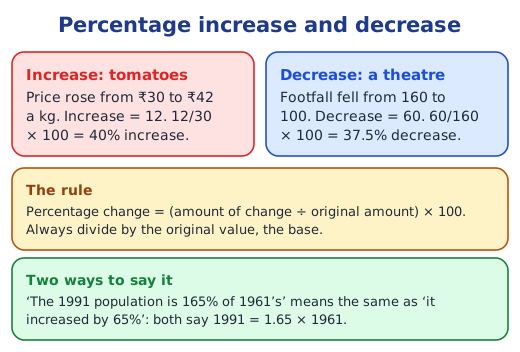
Prices, populations and visitor numbers change all the time, and percentages tell us how big a change is compared with where it started. The price of 1 kg of tomatoes went from ₹30 three years ago to ₹42 now. The increase is ₹12, and 12/30 × 100 = 40%, so the price rose by 40%. A theatre had an average of 160 visitors a show before COVID and has 100 now. The decrease is 60, and 60/160 × 100 = 37.5%. In both cases:
Percentage change = amount of change ÷ original amount × 100.
The original amount is called the base. Dividing by the new amount instead is the most common slip.
Two ways to say the same thing
‘The population in 1991 is 165% of the 1961 population’ and ‘the population increased by 65% from 1961 to 1991’ say the same thing. If p was the earlier population, the later one is p + 0.65p = 1.65p either way. So an increase of x% means multiplying by 1 + x/100, and a decrease of x% means multiplying by 1 − x/100. A 5% rise multiplies by 1.05; a fall of 85% leaves only 15% of the earlier value.
Profit and loss
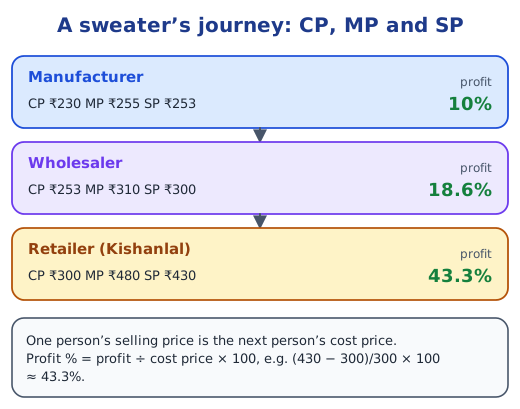
A shopkeeper pays the cost price (CP), quotes a marked price (MP) and finally receives the selling price (SP). When SP is more than CP there is a profit; when it is less, a loss. Kishanlal buys a sweater for ₹300, marks it at ₹480 and sells it for ₹430 after bargaining. His profit is ₹130, and 130/300 × 100 ≈ 43.3%. Profit and loss percentages are worked out on the cost price, since they answer the question ‘how much did I gain compared with what I spent?’. Running backwards works too: Shyamala sells a ₹2650 vase at an 18% loss, so she gets 82% of 2650, which is ₹2173.
Sometimes profit is measured against the sales instead. Manisha buys fertiliser at ₹500 a bag and sells it at ₹750: her profit is 50% of the cost but only 33.33% of the sale price. Businesses often quote net profit, after expenses, as a percentage of revenue.
Discounts and GST
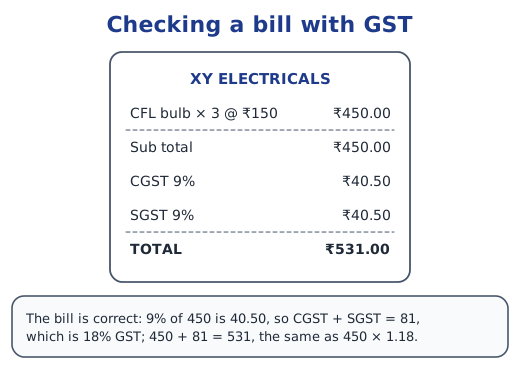
A discount is a percentage decrease in the marked price. A cooker marked ₹1800 with 35% off sells for 65% of 1800, which is ₹1170; if the shop bought it for ₹900, its profit is ₹270, or 30%. GST is a percentage increase: a mobile phone priced at ₹8250 with 18% GST costs 8250 × 1.18 = ₹9735. On a bill, the 18% may appear as 9% CGST plus 9% SGST.
Changes on changes
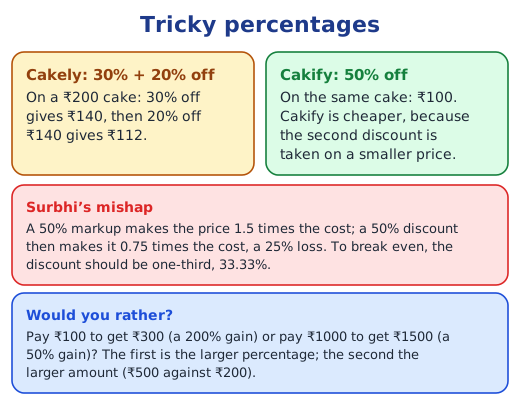
When one percentage change follows another, the second is worked out on the new amount, so the changes multiply rather than add. A bakery offering ‘30% + 20%’ off a ₹200 cake charges ₹140 after the first discount and ₹112 after the second, while a straight 50% discount gives ₹100. A 3% fare rise followed by a 4% rise is a 7.12% rise overall. See the Chapter 1 notes for the whole chapter, what percentages are for the basics, and the NCERT solutions for every exercise.
Practice
-
Petrol went from ₹60 to ₹100 a litre. The percentage increase is about:
Show answer
Answer: (c) 66.67%
-
A ₹300 shirt has a 25% discount. What is the selling price?
Show answer
Answer: (b) ₹225
-
A number increased by 20% becomes 90. The number is:
Show answer
Answer: (c) 75
-
A geometry box bought for ₹75 is sold for ₹110. Find the profit percentage on the cost.
Show answer
Answer: Profit = 110 − 75 = ₹35. Profit % = 35/75 × 100 ≈ 46.67%, taken on the cost price of ₹75.
-
A price is first raised by 35% and then cut by 30%. Is the final price more or less than the original?
Show answer
Answer: Less. The price becomes 1.35 × 0.70 = 0.945 times the original, which is 5.5% lower, because the 30% cut is taken on the bigger, raised price.
Questions students ask
How do you calculate percentage increase?
Subtract the original value from the new value to get the increase, divide it by the original value, and multiply by 100. For rice going from ₹38 to ₹42 a kg, the increase is 4, and 4/38 × 100 ≈ 10.53%. This is also called the rate of inflation for that item.
How are profit and loss percentages calculated?
Profit % = (selling price − cost price) ÷ cost price × 100, and loss % = (cost price − selling price) ÷ cost price × 100. Raghu buys rice at ₹35 a kg and sells 10 kg for ₹300, losing ₹50 on ₹350, which is about 14.29%.
What is the difference between a markup and a discount?
A markup is a percentage added to the cost price to set the selling or marked price. A discount is a percentage taken off the marked price. Because they are taken on different amounts, a 50% markup followed by a 50% discount does not bring the price back to the cost; it gives a 25% loss.
Stuck on a question?
Take a photo and Lagnever AI explains it step by step. Try it for 7 days for ₹2.
Get it on Google Play Open in browser
For parents: after the trial, the plan renews monthly by UPI or card autopay. You can cancel anytime in the app.