
Class 8 Maths Part 2 Chapter 1: Fractions in Disguise Notes
This chapter in five lines
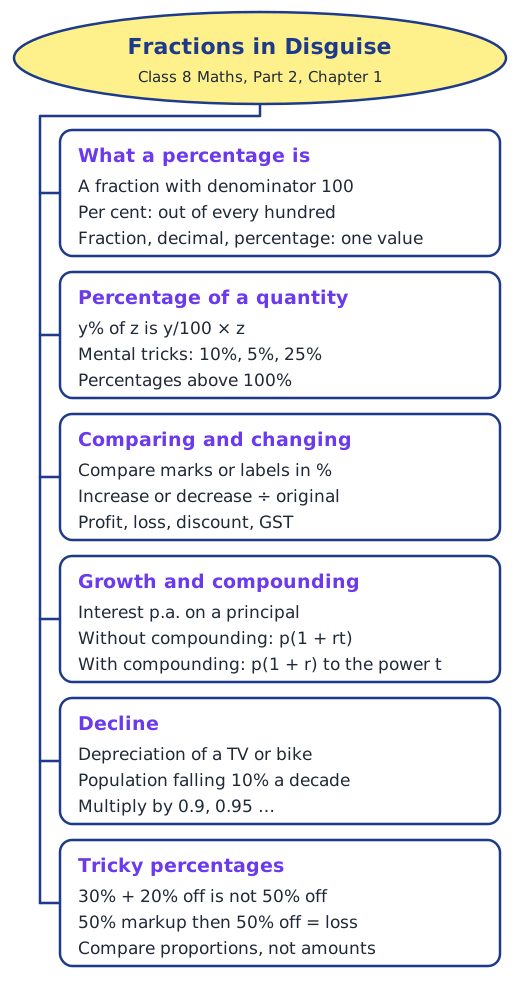
Fractions in Disguise is about percentages, which are fractions with denominator 100. The chapter moves between fractions, decimals and percentages, finds a percentage of a quantity and the whole from a part, and uses percentages to compare proportions, describe increase and decrease, and work out profit, loss, discounts and GST. It ends with interest with and without compounding, depreciation, and some tricky percentages.
What is this chapter about?
Sale banners promise 50% off, report cards show 83%, and a bank board lists 6% p.a. on fixed deposits. All of these use the sign %, read as ‘per cent’. The chapter shows that a percentage is simply a fraction in disguise: a fraction whose denominator has been fixed at 100. With that idea it builds tools for shopping, marks, recipes, prices, profit and loss, taxes and savings.
Percentages are fractions
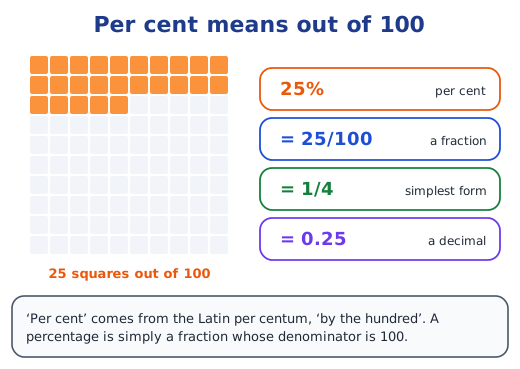
‘Per cent’ comes from the Latin per centum, ‘by the hundred’, so 20% = 20/100 = 1/5, and 50% of a quantity s is 50/100 × s, half of s. To turn a fraction into a percentage, find an equivalent fraction with denominator 100 (3/4 = 75/100 = 75%) or multiply by 100 (3/5 × 100 = 60, so 3/5 = 60%). Why 100? Our number system is base ten, so percentages change easily into decimals (31% = 0.31), and two percentages are much easier to compare than two fractions with different denominators. The idea is old: Kautilya’s Arthashastra already spoke of interest ‘per cent’. Read what percentages are.
Percentage of a quantity
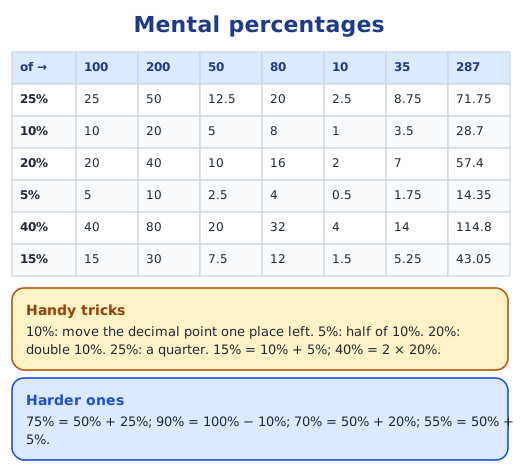
Madhu ate biscuits with 25% sugar and Madhav ate biscuits with 35% sugar, but the percentages alone do not say who ate more sugar: we also need the amounts. Madhu’s 120 g contained 25/100 × 120 = 30 g of sugar, and Madhav’s 95 g contained 35/100 × 95 = 33.25 g. In general, y% of z is y/100 × z. Many percentages can be found mentally: 10% means dividing by 10, 5% is half of that, 20% is double it, and 25% is a quarter; 15% is 10% plus 5%, and 75% is 50% plus 25%. A fraction, a decimal and a percentage of the same value form an FDP trio, so 80% of 75 is 4/5 × 75 or 0.8 × 75, both 60.
Finding the whole, and percentages above 100
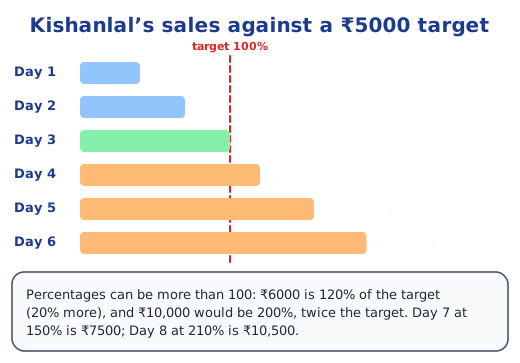
A cyclist has covered 92 km, which is 40% of the way from Delhi to Agra. Then 20% is 46 km and the remaining 60% is 138 km; or the whole trip is 92 × 100/40 = 230 km. A ratio can become a percentage too: millet and water mixed 2 : 7 means millet is 2/9 of the porridge, about 22.22%. Percentages can also go beyond 100. Kishanlal’s daily sales target is ₹5000, so a day’s sale of ₹6000 is 120% of the target, 20% more than it, and ₹9550 is 191%.
Comparing and changing
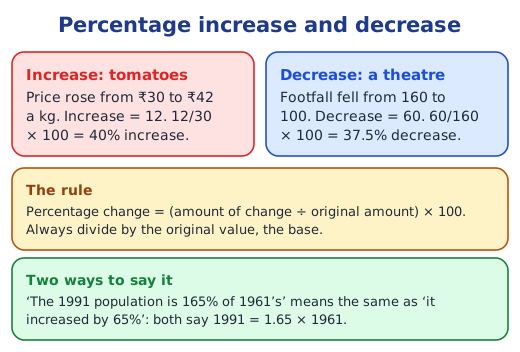
Eesha scored 42/50 in English and 70/80 in Science. Out of 100, those are 84% and 87.5%, so Science went better even though more marks were lost there. Labels work the same way: turning the grams on two badam drink mixes into percentages shows which has more badam. Percentages also describe change. Tomatoes going from ₹30 to ₹42 a kg is an increase of 12/30 × 100 = 40%; a theatre’s footfall falling from 160 to 100 is a decrease of 37.5%. The change is always divided by the original amount. Read percentage increase and decrease.
Profit, loss, discount and GST
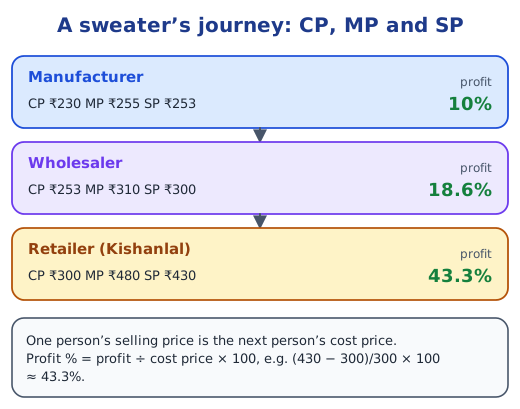
The cost price is what a seller paid, the marked price is what is quoted, and the selling price is what the customer finally pays. A sweater passes from a manufacturer to a wholesaler to Kishanlal’s shop, and one person’s selling price becomes the next person’s cost price. Kishanlal buys it for ₹300 and sells it for ₹430, a profit of ₹130, which is 130/300 × 100 ≈ 43.3% of the cost. A loss is worked out in the same way. A 35% discount on a ₹1800 cooker leaves 65% of the price, ₹1170. Taxes such as GST are percentages too: 9% CGST plus 9% SGST on ₹450 adds ₹81.
Growth and compounding
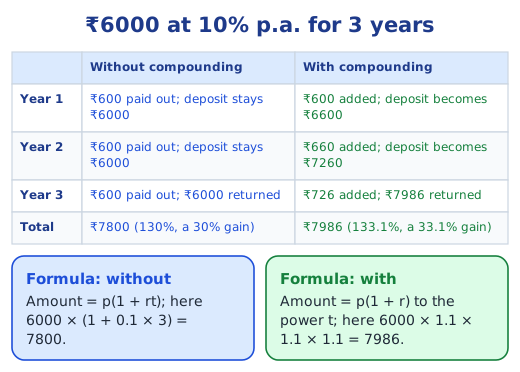
A bank paying 10% p.a. on ₹6000 gives ₹600 interest a year. If the interest is paid out each year, the deposit stays ₹6000 and the total received after 3 years is ₹7800. If each year’s interest is added back, the deposit grows to ₹6600, then ₹7260, then ₹7986: this is compounding. In general a principal p at rate r for t years becomes p(1 + rt) without compounding and p(1 + r)ᵗ with it. Read simple and compound interest.
Decline and tricky percentages
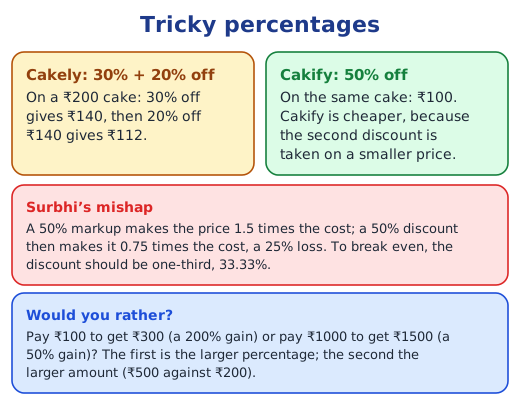
Things can also lose value. A TV bought for ₹21,000 that depreciates by 5% is worth 0.95 × 21,000 = ₹19,950 a year later, and a village of 1250 people that shrinks by about 10% a decade has around 910 people after three decades. Percentages can mislead if we are careless: 30% off followed by 20% off a ₹200 cake leaves ₹112, more than the ₹100 that 50% off gives, and Surbhi’s 50% markup followed by a 50% discount ends in a 25% loss.
In a nutshell
A percentage is a fraction out of 100. Change it into a fraction or a decimal to calculate, always ask what the whole or base is, estimate before you calculate, and draw a rough bar model when a problem feels confusing. The chapter ends with a chess puzzle about eight knights that must not attack one another. Answers to every question are in the NCERT solutions for Part 2 Chapter 1.
Key terms
| Term | Meaning |
|---|---|
| Percentage | A fraction whose denominator is 100, written with the sign %; x% means x/100. |
| Per cent | From the Latin per centum, ‘by the hundred’: 25 per cent means 25 out of every 100. |
| FDP trio | A fraction, a decimal and a percentage that name the same value, such as 1/4 = 0.25 = 25%. |
| Base | The original amount a change is compared with; percentage change = change ÷ base × 100. |
| Cost price (CP) | The price at which a seller buys an item. |
| Marked price (MP) | The price a shopkeeper quotes or prints on an item, sometimes the MRP, before any discount. |
| Selling price (SP) | The price the customer actually pays, after any bargaining or discount. |
| Profit or loss percentage | The profit or loss as a percentage of the cost price, unless a question says it is taken on the revenue. |
| Discount | A cut in the marked price, usually given as a percentage of it: 30% off lowers the price by 30% of the marked price. |
| GST | Goods and Services Tax, charged as a percentage of the price; a bill may split it into equal CGST and SGST. |
| Principal | The money deposited or borrowed, on which interest is calculated. |
| Per annum (p.a.) | For every year: 10% p.a. means the interest for one year is 10% of the principal. |
| Compounding | Adding each period’s interest back to the deposit, so that the next interest is worked out on a bigger amount. |
| Depreciation | The fall in the value of an item, such as a TV or a bike, because of use and age. |
Topics in this chapter
Practice
-
What is 3/5 as a percentage?
Show answer
Answer: (c) 60%
-
What is 15% of 80?
Show answer
Answer: (b) 12
-
A price rises from ₹30 to ₹42. The percentage increase is:
Show answer
Answer: (c) 40%
-
An item bought for ₹300 is sold for ₹345. The profit percentage is:
Show answer
Answer: (a) 15%
-
₹10,000 is deposited at 10% p.a., compounded yearly. After 2 years the amount is:
Show answer
Answer: (b) ₹12,100
-
Which is the same as a 65% increase?
Show answer
Answer: (b) Multiplying by 1.65
Questions students ask
What are the main topics of Class 8 Maths Part 2 Chapter 1?
Percentages as fractions with denominator 100; converting between fractions, decimals and percentages; finding a percentage of a quantity and the whole from a part; percentages above 100; comparing proportions and reading labels; percentage increase and decrease; cost, marked and selling price, profit, loss, discounts and GST; interest with and without compounding; depreciation; and tricky percentages.
Is Fractions in Disguise in the new NCERT Class 8 Maths book?
Yes. It is the first chapter of Ganita Prakash, the Class 8 Maths textbook Part 2 (first edition December 2025, used in 2026-27), on pages 1 to 32. Part 2 numbers its chapters from 1 again, after the 7 chapters of Part 1.
Why is the chapter called Fractions in Disguise?
Because a percentage is really a fraction dressed up differently. 25% is just 25/100, or 1/4; the % sign only says the denominator is 100. Fixing the denominator at 100 makes quantities easy to compare and to change into decimals.
What is the difference between compounding and no compounding?
Without compounding, the interest is paid out every year and the principal stays the same, so ₹6000 at 10% p.a. earns ₹600 each year, ₹7800 in all after 3 years. With compounding, each year’s interest is added to the deposit and earns interest too, so the same deposit grows to ₹7986.
Stuck on a question?
Take a photo and Lagnever AI explains it step by step. Try it for 7 days for ₹2.
Get it on Google Play Open in browser
For parents: after the trial, the plan renews monthly by UPI or card autopay. You can cancel anytime in the app.