
NCERT Solutions Class 8 Maths Part 2 Chapter 1: Fractions in Disguise
Answers to every question in Part 2 Chapter 1, Fractions in Disguise, of Ganita Prakash Grade 8 (first edition, December 2025, used in 2026-27): each Figure it Out, the questions in the text, Math Talk and Try This, and the Peaceful Knights puzzle. Page numbers follow the book (pages 1–32). Percentages are rounded to two decimal places where they do not come out exactly. Short notes: Part 2 Chapter 1 notes.
Fractions as percentages (pages 1–5)
Express 24% as a fraction. 24% = 24/100, which equals 12/50, 6/25 or 48/200.
Which biscuit is more sugary? Variety 2: 13/45 ≈ 28.89% is more than 9/34 ≈ 26.47%.
Why choose 100 as the denominator? Any number would work, but 100 fits our base-ten system, so percentages turn straight into decimals (31% = 0.31). It is also a round number that is easy to picture, while 10 is too coarse and 1000 too fine for most uses.
Figure it Out (pages 3–4)
1. (i) 3/5 = 60% (ii) 7/14 = 1/2 = 50% (iii) 9/20 = 45% (iv) 72/150 = 48% (v) 1/3 = 33⅓% ≈ 33.33% (vi) 5/11 = 45 5/11% ≈ 45.45%.
2. 15/25 × 100 = 60%, option (iv).
3. 15/80 × 100 = 18.75% of the students walk to school.
4. Measuring each runner’s distance from Start along the line: A ≈ 38%, B ≈ 55%, C ≈ 72% and D ≈ 93%. The options 20% and 84% are not used.
5. (i) > , since 50% is ten times 5%. (ii) =, since 5/10 is one half. (iii) <, since 3/11 is under one half while 61% is over it. (iv) <, since 1/3 is 33⅓%.
Percentage of some quantity (pages 6–9)
Who ate more sugar? Madhu: 25% of 120 g = 30 g. Madhav: 35% of 95 g = 33.25 g. Madhav ate more.
The mental-maths table. For 100, 200, 50, 80, 10, 35 and 287: 25% gives 25, 50, 12.5, 20, 2.5, 8.75, 71.75; 10% gives 10, 20, 5, 8, 1, 3.5, 28.7; 20% gives 20, 40, 10, 16, 2, 7, 57.4; 5% gives 5, 10, 2.5, 4, 0.5, 1.75, 14.35. 40% is double 20%: 40, 80, 20, 32, 4, 14, 114.8. 15% = 10% + 5%: 15, 30, 7.5, 12, 1.5, 5.25, 43.05. Each 20% entry is double the 10% entry, and 20% + 5% = 25%.
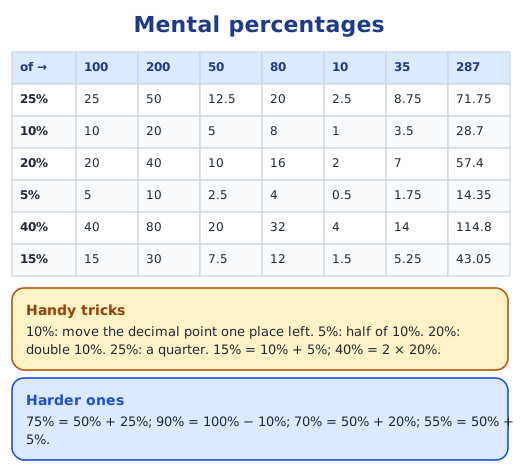
75%, 90%, 70%, 55% mentally. 75% = 50% + 25% (or three quarters); 90% = 100% − 10%; 70% = 50% + 20% (or 7 × 10%); 55% = 50% + 5%.
The FDP table. 50% = 50/100 = 1/2 = 0.5; 100% = 1 = 1.0; 25% = 1/4 = 0.25; 75% = 3/4 = 0.75; 10% = 1/10 = 0.1; 1% = 1/100 = 0.01; 5% = 1/20 = 0.05; 43% = 43/100 = 0.43. To find 10% of a quantity, multiply by 0.1.
Example 3 (Zubin). 80% of 75 = 0.8 × 75 = 60 marks at least.
Example 4 (millet kanji). Millet is 2/9 of the mixture, about 22.22%; water is about 77.78%. In 500 ml, millet is 2/9 × 500 ≈ 111.1 ml.
Finding the whole and percentages above 100 (pages 10–12)
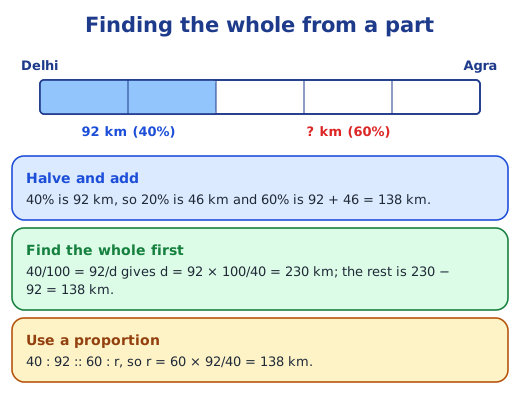
Cyclist. 40% is 92 km, so 20% is 46 km and the remaining 60% is 138 km; the whole trip is 230 km.
Kishanlal’s sales. Day 5: 7800/5000 × 100 = 156%. Day 6: 9550/5000 × 100 = 191%. Day 7 at 150% is 1.5 × 5000 = ₹7500, and Day 8 at 210% is 2.1 × 5000 = ₹10,500.
The table. 90% = 9/10 = 0.9; 110% = 11/10 = 1.1; 200% = 2/1 = 2; 250% = 5/2 = 2.5; 15% = 3/20 = 0.15; 173% = 173/100 = 1.73; 358% = 179/50 = 3.58; 28.9% = 289/1000 = 0.289; 305% = 61/20 = 3.05. On the line from 0 to 4, each point sits at its decimal value: 0.15 and 0.289 near the start, 0.9 just before 1, 1.1 just after it, 1.73 short of 2, 2 and 2.5, 3.05 just past 3, and 3.58 a little more than halfway from 3 to 4.
Example 7 (wheat). 650/260 × 100 = 250%, so this year’s harvest is 2.5 times last year’s.
Figure it Out (pages 12–14)
1. (ii) The bar has 10 equal parts, so one part is 10%; six of the ten parts of 90 make 60% of 90 = 54. (iii) The bar has 4 parts, so one part is 25%; three of the four parts of 140 make 75% of 140 = 105.
2. (i) 25% of 160 = 40 (ii) 16% of 250 = 40 (iii) 62% of 360 = 223.2 (iv) 140% of 40 = 56 (v) 1% of 1 hour = 0.6 minute = 36 seconds (vi) 7% of 10 kg = 0.7 kg = 700 g. For each bar model, draw the whole as 100% and shade the part; for 140%, draw one full bar and 40% of a second.
3. Red paint = 3/4 of 60 ml = 45 ml.
4. (i) < (ii) < (iii) < (iv) < (12 against 20) (v) > (90 against 49) (vi) > (24 against 15.36).
5. (i) 140, 210, 280. (ii) 21.5, 2.15, 12.9. (iii) 27, 54, 300. (iv) For example: 25% of q is 40, so 50% of q is 80 and 100% of q is 160; and 20% of w is 9, so 10% of w is 4.5 and 60% of w is 27.
6. (i) 3/300 = 1/100, so the blank is 1. (ii) 40% of 4 = 1.6. (iii) If 80% of a number is 40, 10% is 5 and the number is 50.
7. Yes. 10% of a day is 2.4 hours = 144 minutes; 1% of a week is 1.68 hours = 100.8 minutes. Another one to try: is 1% of a year longer than 25% of a day? (Yes: 87.6 hours against 6 hours.)
8. Day 1: 1/2 = 50%; Day 2: 2/3 ≈ 66.67%; Day 3: 3/4 = 75%; Day 4: 4/5 = 80%; Day 9: 9/10 = 90%; Day 99: 99/100 = 99%. The percentage eaten keeps rising, by smaller and smaller steps, getting closer and closer to 100% without ever reaching it.
9. 20% takes 18 days, so 100% takes 5 × 18 = 90 days. The assumption matters because if the number of workers, the weather or the ripeness of the berries changes, the work is no longer proportional to the time.
10. Warm-up 10% of 90 = 9 minutes, play 80% = 72 minutes, cool-down 9 minutes.
11. With the world population at about 8.2 billion in 2025, 90% is about 7.4 billion people.
12. (i) The proportions stay the same, 40% rava, 40% sugar and 20% ghee; only the amounts double. (ii) Rava 800 g, sugar 800 g and ghee 400 g.
Using percentages (pages 14–19)
Eesha’s marks. English 42/50 = 84%; Science 70/80 = 87.5%. She did better in Science. Vishu is right that raw marks with different maximums cannot be compared, but changing them into percentages settles it.
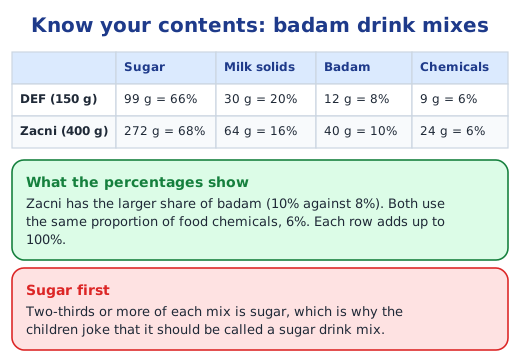
Know your contents. DEF (150 g): sugar 66%, milk solids 20%, badam 8%, food chemicals 6%. Zacni (400 g): sugar 68%, milk solids 16%, badam 10%, food chemicals 6%. Zacni has the larger share of badam; both have the same share of food chemicals. Each row adds up to 100%.
Wholesaler and manufacturer. Wholesaler: CP ₹253, SP ₹300, profit 47/253 × 100 ≈ 18.58%. Manufacturer: CP ₹230, SP ₹253, profit 23/230 × 100 = 10%.
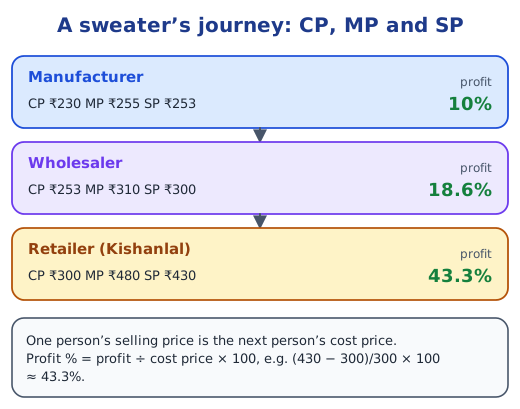
Shambhavi. Notebook SP = 120% of ₹36 = ₹43.20. Crayons: 125% of the cost is ₹50, so the cost is 50/1.25 = ₹40.
Raghu, per kg. CP ₹35, SP ₹30, loss ₹5 a kg: 5/35 × 100 ≈ 14.29%, the same as for 10 kg.
Example 6 (Shyamala). An estimate first: 18% is a little under a fifth, so she gets a little over ₹2100. Exactly, 82% of 2650 = ₹2173.
Snehal’s strawberries. ₹80 is 88% of the cost price, so CP = 80/0.88 ≈ ₹90.91 a kg.
The cooker. SP = 65% of 1800 = ₹1170. Profit = 1170 − 900 = ₹270, which is 30% of the cost.
The bill. It is correct: 3 × 150 = 450; 9% of 450 = 40.50 each for CGST and SGST; 450 + 81 = 531.
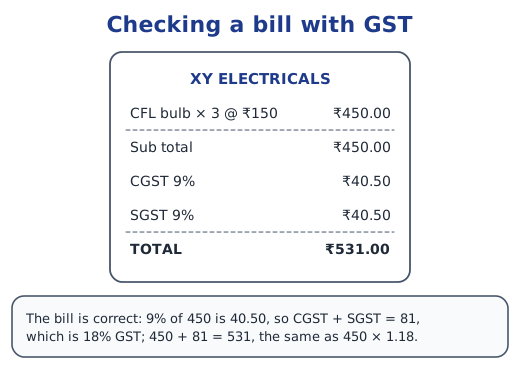
Figure it Out (pages 19–20)
The second half of this exercise, on page 20, is numbered again from 3; here it continues as 6 to 12.
1. Profit = 110 − 75 = ₹35; 35/75 × 100 ≈ 46.67% on the cost.
2. 150% of 475 = ₹712.50.
3. If the 25% margin is on revenue, as is usual for a company, profit = 25% of ₹2.5 crore = ₹0.625 crore and costs = ₹1.875 crore. (If the margin were on cost, costs × 1.25 = 2.5 crore would give ₹2 crore.)
4. 75% of 300 = ₹225.
5. Increase = 40 on 60, which is 66.67%, option (iv).
6 (printed 3). ₹4,40,000 is 85% of the price, so the price was 4,40,000/0.85 ≈ ₹5,17,647.
7 (printed 4). 500/1600 × 100 = 31.25%. The other candidates share 1100 votes, each with fewer than 500, so there must be at least 3 others: at least 4 candidates in all.
8 (printed 5). Inflation = 4/38 × 100 ≈ 10.53%.
9 (printed 6). 120% of the number is 90, so the number is 90/1.2 = 75.
10 (printed 7). First buffalo: CP = 80,000/1.05 ≈ ₹76,190.48. Second: CP = 80,000/0.90 ≈ ₹88,888.89. Total CP ≈ ₹1,65,079.37 against SP ₹1,60,000: an overall loss of about ₹5,079.37, roughly 3.08%.
11 (printed 8). (iv) p × 1.05.
12 (printed 9). Only (iii): a fall of 85% leaves today’s demand at 15% of what it was ten years ago.
Growth and compounding (pages 20–24)
Example 7. Without compounding: ₹600 a year paid out, ₹7800 received in all. With compounding: ₹6600, ₹7260, then ₹7986. Example 8: 7800/6000 = 130%, a 30% gain; 7986/6000 = 133.1%, a 33.1% gain.
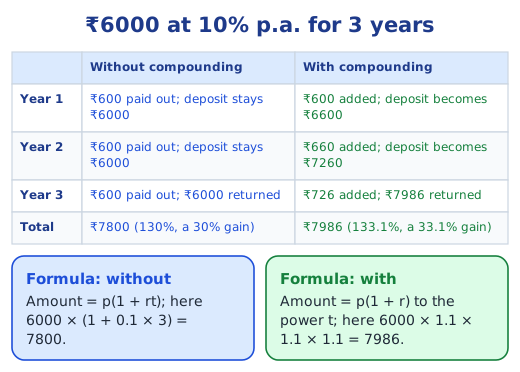
Figure it Out (pages 22–24)
1. Without compounding: 20,000 + 2 × 2000 = ₹24,000. With compounding: 20,000 × 1.1² = ₹24,200, which is ₹200 more.
2. Without compounding: 20,000 + 4 × 1000 = ₹24,000. With compounding: 20,000 × 1.05⁴ ≈ ₹24,310.13, which is ₹310.13 more.
3. Both give the same ₹24,000 without compounding, since 10% for 2 years and 5% for 4 years both add 20%. With compounding, the 4-year deposit earns more, because interest is added back more times.
Formulas for the total interest. Without compounding: prt. With compounding: p(1 + r)ᵗ − p.
4. (vii) p + (p × 0.06 × 4).
5. Without compounding: 50,000 × 0.07 × 3 = ₹10,500. With compounding: 50,000 × 1.07³ ≈ ₹61,252.15, so the interest is ₹11,252.15, about ₹752.15 more.
6. Giridhar: 12,500 × 0.12 × 3 = ₹4500. Raghava: 12,500 × 1.1³ − 12,500 = ₹4137.50. Giridhar pays ₹362.50 more.
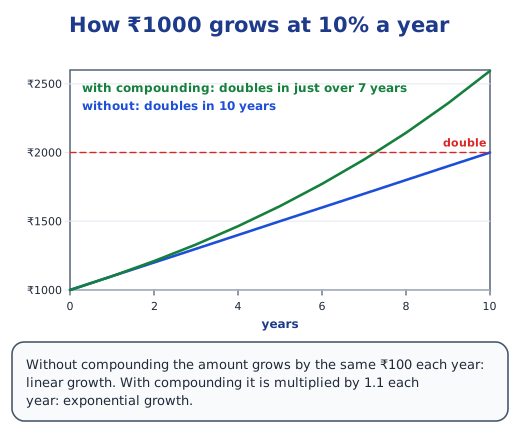
7. Without compounding, ₹1000 gains ₹100 a year and doubles in 10 years. With compounding, 1.1⁷ ≈ 1.95 and 1.1⁸ ≈ 2.14, so it doubles after a little over 7 years (by the end of the 8th year). Yes: compounding multiplies by the same factor every year (exponential growth), while no compounding adds the same amount (linear growth).
8. 1.5 crore × 1.03³ ≈ 1.639 crore, about 1.64 crore people.
9. 5,06,000 × 1.025² ≈ 5,31,616 bacteria.
Decline and tricky percentages (pages 24–27)
Example 10 (TV). 95% of 21,000 = ₹19,950. Example 11 (village). 1250 × 0.9³ ≈ 911; rounding at each step as the book does gives 912, so about 910.
Would you rather? Option A gains ₹200 on ₹100, a 200% gain. Option B gains ₹500 on ₹1000, a 50% gain. A has the bigger percentage but B gives more money, so B is the better choice if you can take only one.
The stock clearance sale. (i) ₹180: 20% is ₹36, so take ₹50 off. (ii) ₹225: 20% is ₹45, so again take ₹50 off. (iii) ₹300: 20% is ₹60, so take the 20% discount. The two are equal at ₹250.
Example 12 (cakes). Cakely: ₹200 → ₹140 → ₹112. Cakify: ₹100. Choose Cakify.
Example 13 (Surbhi). (i) She made a loss: the final price is 1.5 × 0.5 = 0.75 of the cost, a 25% loss. (ii) 0.75x = 12,000 gives x = 16,000, so she lost ₹4000, which is 25%. (iii) A discount of one-third, 33.33%, brings 1.5x back to x.
Ariba and Arun. Arun has 100/120 = 5/6 of Ariba’s marbles, so he can say, ‘I have about 83.33% of the marbles Ariba has’, or ‘I have 16.67% fewer than Ariba’.
Figure it Out (pages 28–30)
1. 250% of 50 lakh = 125 lakh = 1.25 crore.
2. Germany: 83 million ÷ 8.2 billion ≈ 1%. India: 1.46 billion ÷ 8.2 billion ≈ 18%. Bangladesh: 175 million ≈ 2%. USA: 347 million ≈ 4.2%, a share that matches none of the printed options.
3. (v) and (vi): 8250 × 1.18 = 8250 + 8250 × 0.18 = ₹9735.
4. (ii) and (vi): 1.05 × 0.98 × 0.97 ≈ 0.998, so the population ends slightly below p.
5. A loss: 1.35 × 0.70 = 0.945, so he sells at 94.5% of his cost, a 5.5% loss.
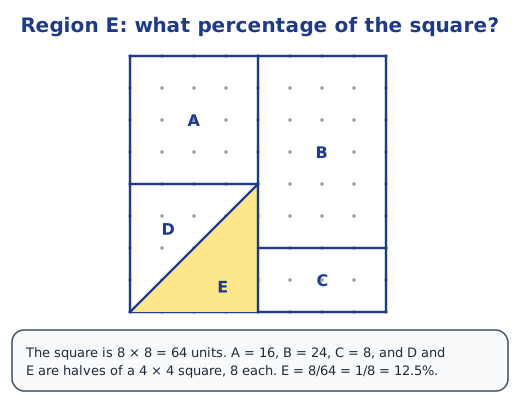
6. The square is 8 × 8 = 64 small squares. A = 16, B = 24, C = 8, and D and E are the two halves of a 4 × 4 square, 8 each. E = 8/64 = 12.5%.
7. 5% of 40 = 2 = 40% of 5; 25% of 12 = 3 = 12% of 25; 15% of 60 = 9 = 60% of 15. In general, x% of y = xy/100 = y% of x.
8. (i) 60% of 40% = 0.6 × 0.4 = 24% of the students are Grade 8 girls. (ii) 24% of 160 = 38.4, so about 38 girls; the percentages given do not divide 160 students into whole numbers exactly.
9. Let one pencil cost c. Three pencils sell for 5c, so one sells for 5c/3. Profit = 2c/3 on c, a profit of 66.67%.
10. 1.03 × 1.04 = 1.0712: an overall rise of 7.12%.
11. The new breadth is 1/1.1 = 10/11 of the old, so it decreases by 1/11 = 9 1/11% ≈ 9.09%.
12. Potato 70% of 65 g = 45.5 g; vegetable oil 24% = 15.6 g; salt 3% = 1.95 g; spices 3% = 1.95 g.
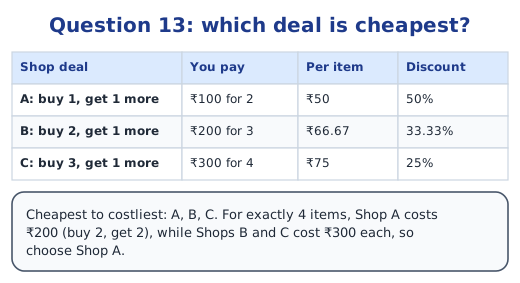
13. (i) A: ₹100 for 2 items, ₹50 each. B: ₹200 for 3, ₹66.67 each. C: ₹300 for 4, ₹75 each. Cheapest to costliest: A, B, C. (ii) A: 1 of 2 items costs nothing, 50% off; B: 1 of 3, 33.33%; C: 1 of 4, 25%. (iii) Shop A: paying for 2 items there gives 4 items for ₹200, while B and C both cost ₹300 for 4.
14. Only 1 person is right-handed. For that 1 person to be 2%, the room must have 50 people, so 50 left-handed people must leave.
15. Valid: (i), (ii) and (v). (iii) is not valid: the graph shows percentages, not numbers of people. (iv) is not valid: only 14% of women and 25% of men in their thirties can use computers, so less than a quarter overall. (vi) is not valid: the figures are 26% and 37%, not half.
Peaceful Knights (page 32)
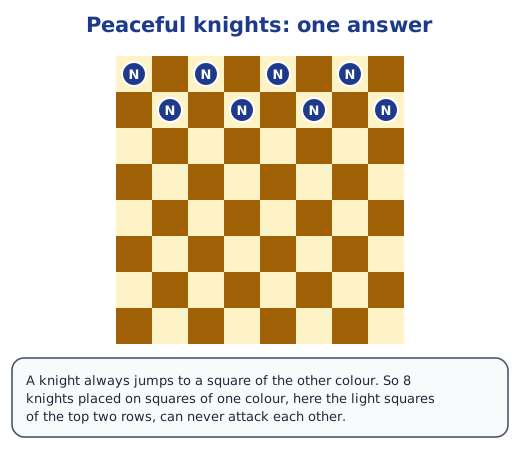
A knight always moves one or two rows up or down, and it always lands on a square of the other colour. So eight knights placed in a single row can never attack each other; neither can eight knights all on squares of the same colour, such as the light squares of the top two rows.
Short notes and more practice are on the topic pages: what percentages are, percentage increase and decrease and simple and compound interest.
Practice
-
What is 72/150 as a percentage?
Show answer
Answer: (b) 48%
-
A car costs ₹4,40,000 after a 15% discount. The original price was about:
Show answer
Answer: (b) ₹5,17,647
-
Fares rise by 3% one year and 4% the next. The overall rise is:
Show answer
Answer: (b) 7.12%
-
A room holds 100 people and 99 of them are left-handed. How many left-handers must walk out so that they make up 98%?
Show answer
Answer: There is 1 right-handed person. For that person to be 2% of the room, the room must hold 50 people, so 49 left-handed people stay and 50 must leave.
-
Is x% of y always equal to y% of x?
Show answer
Answer: Yes. x% of y = x/100 × y = xy/100, and y% of x = y/100 × x = xy/100. For example, 5% of 40 and 40% of 5 are both 2.
Stuck on a question?
Take a photo and Lagnever AI explains it step by step. Try it for 7 days for ₹2.
Get it on Google Play Open in browser
For parents: after the trial, the plan renews monthly by UPI or card autopay. You can cancel anytime in the app.