
NCERT Solutions Class 8 Maths Chapter 4: Quadrilaterals
Answers to the questions inside the chapter, all three Figure it Out sets and the puzzle in Chapter 4, Quadrilaterals, of Ganita Prakash, Grade 8 Part 1. Page numbers follow the book (pages 82–111). Construction answers give the steps; your own drawing may be turned a different way. Short notes: Chapter 4 notes.
Which figures are quadrilaterals? (page 82)
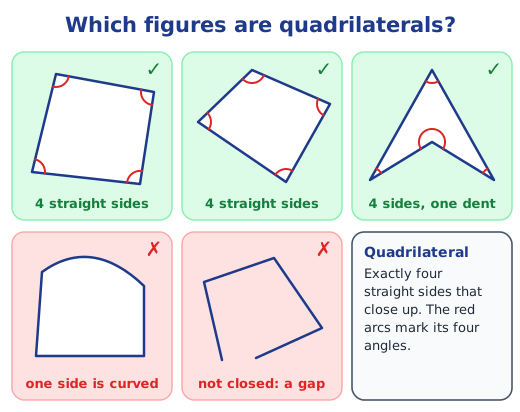
Why are figures (i), (ii) and (iii) quadrilaterals, but (iv) and (v) not? Figures (i), (ii) and (iii) are closed and made of exactly four straight sides. Figure (iii) is dented inwards, so one of its angles is more than 180°, but its sides are still straight, so it counts. Figures (iv) and (v) have curved sides, and the sides of a quadrilateral must be line segments, so they are not quadrilaterals.
Rectangles: the carpenter’s problem (pages 83–88)
Can a rectangle be defined in other ways? Yes. Besides “all angles 90° and opposite sides equal”, the chapter finds two more: “the diagonals are equal and bisect each other” (page 89), and simply “all angles are 90°” (page 90). All three describe exactly the same shapes.
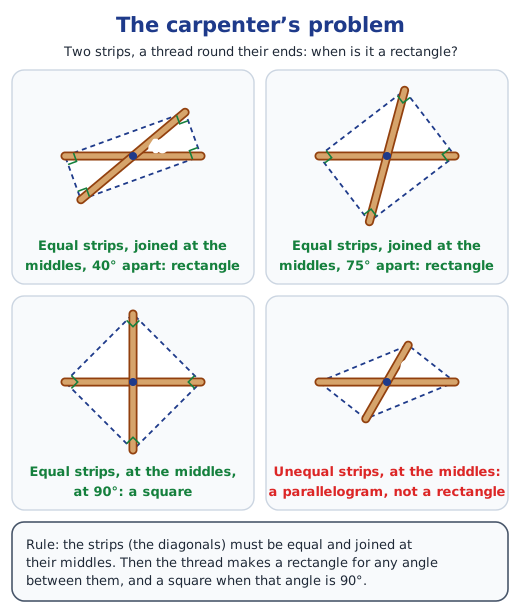
The carpenter’s three questions (page 83).
- The other strip, the second diagonal, must also be 8 cm long.
- The strips must be joined at their midpoints, 4 cm from each end.
- Any angle between them works. At 90° the rectangle is a square.
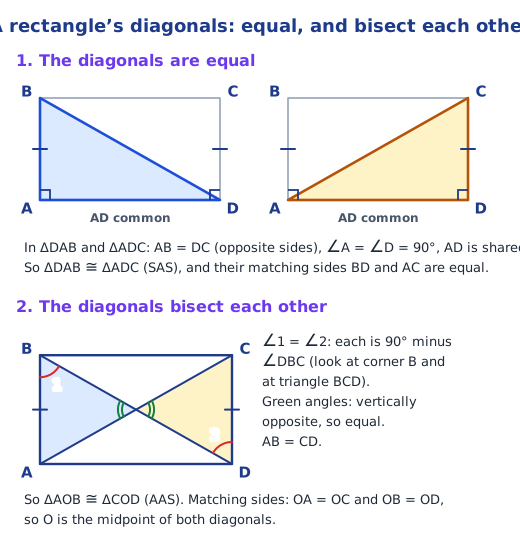
Deductions 1 and 2 (pages 84–85). In rectangle ABCD, triangles DAB and ADC have AB = DC, right angles at A and D, and the shared side AD, so they are congruent by SAS and BD = AC. With O where the diagonals cross, ∠ABD = ∠CDB (each is 90° − ∠DBC), the angles at O are vertically opposite and AB = CD, so ΔAOB ≅ ΔCOD by AAS. Hence OA = OC and OB = OD.
Math Talk (page 85): do AO = CO, ∠AOB = ∠COD and AD = CB prove ΔAOD ≅ ΔCOB? No. ∠AOB and ∠COD are not angles of triangles AOD and COB at all. Even the right pair, ∠AOD = ∠COB, is not the angle between the two given sides AO and AD, and two sides with an angle that is not between them is not a congruence condition. A correct proof: AO = CO and OD = OB (both from Deduction 2) and ∠AOD = ∠COB (vertically opposite), so ΔAOD ≅ ΔCOB by SAS. SSS also works, with AD = CB.
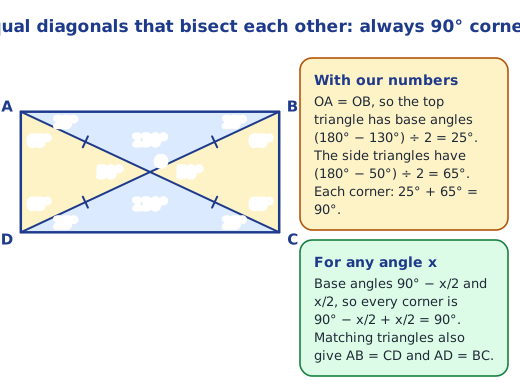
Deduction 3 with 60° between the diagonals (pages 85–86). The angles at O are 60°, 120°, 60° and 120° (linear pairs and vertically opposite angles). In ΔAOB, OA = OB, so a + a + 60° = 180° and a = 60°. In ΔAOD the angle at O is 120°, so its base angles are (180° − 120°) ÷ 2 = 30°. Every corner is 60° + 30° = 90°.
What type of quadrilateral is ABCD, and what about its sides? It has four right angles, so it is a rectangle. Also ΔAOB ≅ ΔCOD and ΔAOD ≅ ΔCOB (SAS), so AB = CD and AD = CB.
Will it stay a rectangle if the angle between the diagonals changes? (pages 86–87) Yes. If the angle is x, the four angles at O are x, 180° − x, x and 180° − x. In ΔAOB the base angles are a = (180° − x) ÷ 2 = 90° − x/2. In ΔAOD they are b = x/2. Each corner is a + b = 90° − x/2 + x/2 = 90°, and the matching triangles give AB = CD and AD = BC.
Defining a rectangle by its angles alone (pages 89–90)
Is “all angles 90°” enough to define a rectangle? Yes. You cannot construct a quadrilateral with four right angles and unequal opposite sides. Deduction 4 shows why: join BD in ABCD. At B, ∠ABD = 90° − ∠DBC, and in ΔBCD, ∠CDB = 90° − ∠DBC, so ∠ABD = ∠CDB. With the right angles at A and C and the shared side BD, ΔBAD ≅ ΔDCB by AAS, so AD = CB and DC = BA.
Can we write ΔBAD ≅ ΔCDB instead? Why not? Yes. The order of the letters tells which corners match. In ΔBAD ≅ ΔDCB, B matches D, A matches C and D matches B. Writing ΔCDB would match A with D, claiming that ∠BAD (90°) equals ∠CDB (less than 90°) and that the side AD equals the diagonal DB. Both are false.
Is each pair of opposite sides of a rectangle parallel? Show that AB ∥ DC. Yes. BC crosses AB and DC, and ∠B + ∠C = 90° + 90° = 180°. Two lines are parallel when the angles on the same side of a crossing line add up to 180°, so AB ∥ DC (just as AD ∥ BC).
A special rectangle (page 90): are any of the four figures not rectangles? None. All four have four right angles. Figure (iv), with all sides 4 cm, is also a square.
Squares (pages 91–93)
The cartoon (page 91): how can someone be both Indian and Malayali? Every Malayali is an Indian: the smaller group lies inside the bigger one. In the same way every square is a rectangle, which a Venn diagram shows as one region inside another.
The carpenter’s problem for a square (page 92). Use equal strips, joined at their midpoints, at right angles.
Deduction 5: can ΔBOA ≅ ΔBOC give the angles ∠BOA and ∠BOC? Yes. BA = BC (sides of the square), OA = OC (half-diagonals) and BO is shared, so the triangles are congruent by SSS. Then ∠BOA = ∠BOC, and as they make a straight angle together, each is 90°.
Construct a square with a diagonal of 8 cm (page 93).
- Draw AC = 8 cm.
- With the compass open to more than 4 cm, draw arcs from A and from C above and below AC. Join the two crossing points: this line is the perpendicular bisector of AC, meeting it at O.
- Mark B and D on this line, 4 cm from O on each side.
- Join A, B, C and D. Each side measures about 5.7 cm.
Do Deductions 1 and 2 also work for a square? Yes. They used only the right angles and AB = CD, and a square has both, so its diagonals are equal and bisect each other.
∠1, ∠2, ∠3 and ∠4 (page 93). In ΔADC, AD = DC and ∠D = 90°, so ∠1 = ∠3 = (180° − 90°) ÷ 2 = 45°. In the same way, ΔABC gives ∠2 = ∠4 = 45°.
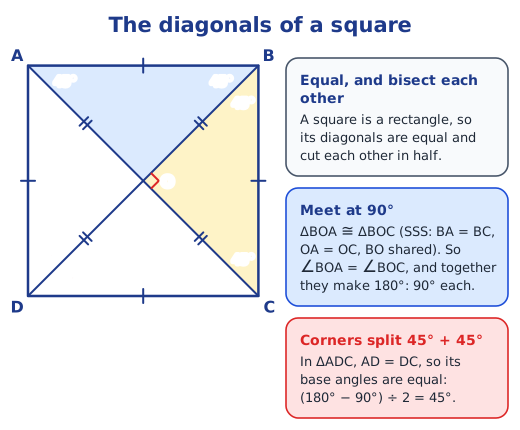
Figure it Out (page 94)
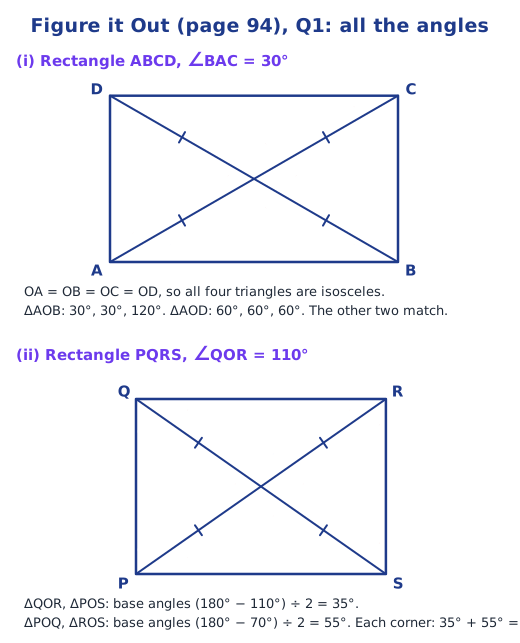
1. The diagonals of a rectangle are equal and bisect each other, so OA = OB = OC = OD and all four triangles round O are isosceles.
(i) ∠BAC = 30°, so ∠CAD = 90° − 30° = 60°. In ΔAOB, ∠ABO = ∠BAO = 30° and ∠AOB = 180° − 60° = 120°. Then ∠DBC = 60°, ∠COD = 120° and ∠AOD = ∠BOC = 60°. ΔAOD and ΔBOC are equilateral: ∠ADB = 60° and ∠BCA = 60°. Finally ∠BDC = ∠ACD = 30°.
(ii) ∠QOR = 110°, so ∠POS = 110° and ∠QOP = ∠ROS = 70°. In ΔQOR and ΔPOS the base angles are (180° − 110°) ÷ 2 = 35°: ∠OQR = ∠ORQ = ∠OSP = ∠OPS = 35°. In ΔPOQ and ΔROS they are (180° − 70°) ÷ 2 = 55°: ∠OPQ = ∠OQP = ∠ORS = ∠OSR = 55°. Check: 35° + 55° = 90° at every corner.
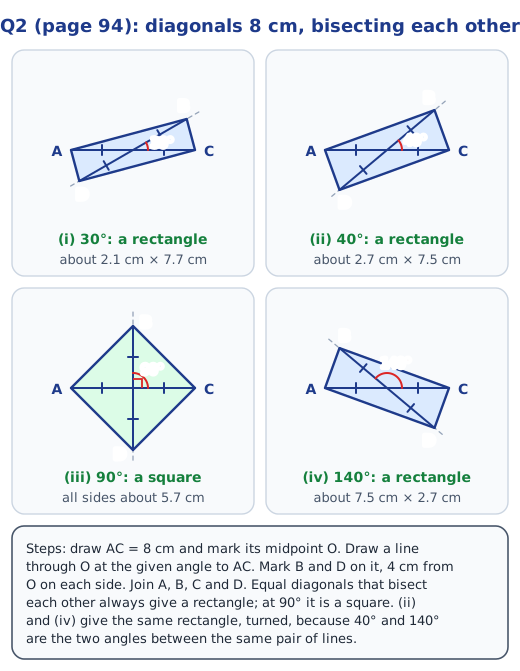
2. For each angle: draw AC = 8 cm and mark its midpoint O. Draw a line through O making the given angle with AC. Mark B and D on it, 4 cm from O on each side, and join A, B, C and D. All four are rectangles, because each has equal diagonals that bisect each other. (iii), at 90°, is a square. When measured, the sides come to about 2.1 cm × 7.7 cm for 30°, about 2.7 cm × 7.5 cm for 40° and 140°, and about 5.7 cm for the square. (ii) and (iv) give the same rectangle, turned, since 40° and 140° are the two angles between the same pair of lines.
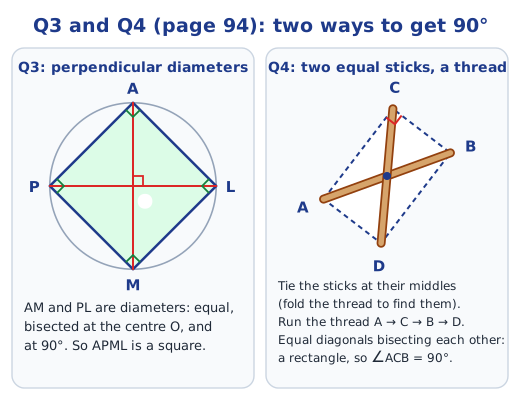
3. APML is a square. Its diagonals are AM and PL. Both are diameters, so they are equal; both pass through the centre O, which is the midpoint of each, so they bisect each other; and they are perpendicular. Equal diagonals bisecting each other at 90° make a square.
4. Find the middle of each stick by folding the thread to the stick’s length and then in half. Tie the sticks together at their middles, at any angle. Run the thread round the four ends, A to C to B to D and back to A. The sticks are equal diagonals that bisect each other, so the thread forms a rectangle, and the angle at each corner, such as ∠ACB, is exactly 90°.
5. No. A quadrilateral with opposite sides parallel and equal is a parallelogram, and it need not have right angles. For example, parallelogram ABCD with AB = 4 cm, AD = 5 cm and ∠A = 30° (page 96) has opposite sides parallel and equal, but it is not a rectangle.
Angles in a quadrilateral (pages 94–95)
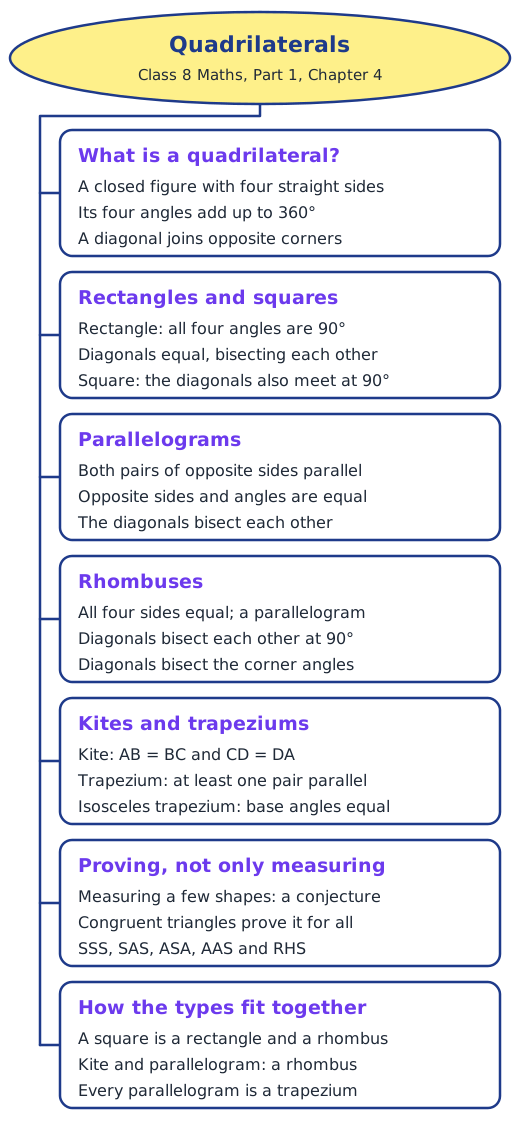
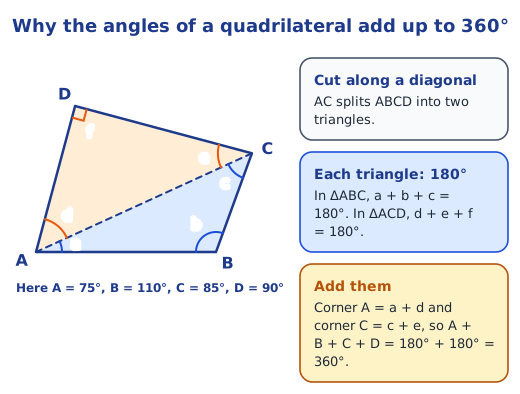
Can a quadrilateral have three angles of 90° and a fourth that is not 90°? No. Why not? The four angles of every quadrilateral add up to 360°. Three right angles use up 270°, so the fourth must be 360° − 270° = 90°.
Why the sum is 360° (quadrilateral SOME). The diagonal SM splits SOME into ΔSEM and ΔSOM. Their six angles add up to 180° + 180° = 360°, and together they make exactly the four corners of SOME.
Parallelograms (pages 95–99)
Are there quadrilaterals with parallel opposite sides that are not rectangles? Construct one. Yes. Draw a line, and with a ruler and set square draw a second line parallel to it. Then draw another pair of parallel lines that cross the first pair at a slant, not at 90°. The four crossing points make a quadrilateral with both pairs of opposite sides parallel but no right angles: a parallelogram.
Is a rectangle a parallelogram? Yes. Its opposite sides are parallel, so it meets the definition. It is a parallelogram whose angles are all 90°.
Parallelogram ABCD with AB = 4 cm, AD = 5 cm and ∠A = 30° (pages 96–98). Draw AB = 4 cm, then AD = 5 cm at 30° to AB. Through D draw a line parallel to AB, and through B a line parallel to AD; they meet at C. Since AB ∥ DC, ∠A + ∠D = 180°, so ∠D = 150°; in the same way ∠B = 150° and ∠C = 30°. Opposite sides are equal: DC = 4 cm and BC = 5 cm.
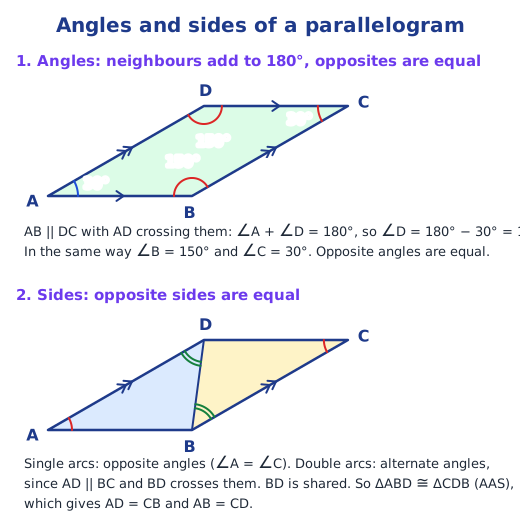
Are opposite angles equal in every parallelogram? How can we be sure? Yes. In parallelogram PEAR, let ∠P = x. ∠P + ∠R = 180°, so ∠R = 180° − x. ∠A + ∠R = 180°, so ∠A = 180° − (180° − x) = x. Likewise ∠E = ∠R = 180° − x. This works for any x, so for every parallelogram.
Deduction 7: which two triangles show that opposite sides are equal? The two made by a diagonal, ΔABD and ΔCDB. ∠A = ∠C (opposite angles), ∠ADB = ∠CBD (alternate angles, as AD ∥ BC) and BD is shared, so ΔABD ≅ ΔCDB by AAS. Hence AD = CB and AB = CD.
Can we write ΔABD ≅ ΔCBD instead? Why not? Yes. The matching is A with C, B with D and D with B. Writing ΔCBD matches B with B, which would claim AB = CB, that neighbouring sides are equal, and that BD splits ∠B in half. That is false in general: here AB = 4 cm but CB = 5 cm.
Must a parallelogram’s diagonals be equal? No. In the 4 cm, 5 cm, 30° parallelogram they measure about 8.7 cm and 2.5 cm.
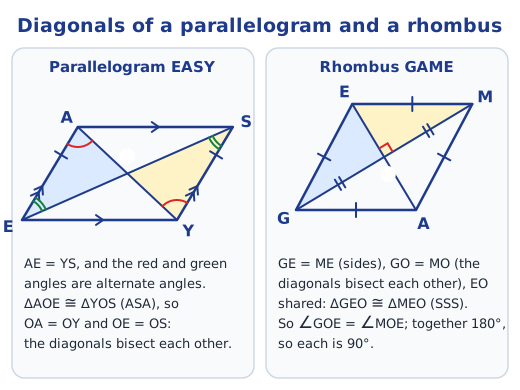
Do they bisect each other? (Deduction 8) Yes. In parallelogram EASY, AE = YS, ∠OAE = ∠OYS and ∠OEA = ∠OSY (alternate angles, as AE ∥ SY), so ΔAOE ≅ ΔYOS by ASA. Hence OA = OY and OE = OS.
Can we write ΔAOE ≅ ΔSOY instead? Why not? Yes. The correct matching is A with Y, O with O and E with S. ΔSOY would match A with S, claiming AO = SO, that half of one diagonal equals half of the other, which is not true in general.
Do the diagonals of a parallelogram meet at a particular angle? No. The angle depends on the parallelogram; in the 4 cm, 5 cm, 30° one it is about 66° (and 114°). Only in a rhombus is it always 90°.
Rhombuses (pages 99–102)
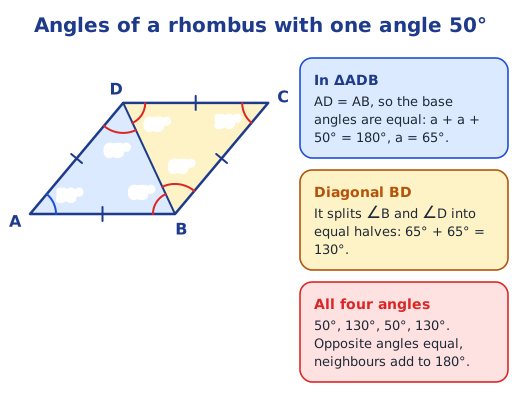
Are squares the only quadrilaterals with equal sides? No. With AB = AD at 50°, we can still make all four sides equal.
Can we complete the quadrilateral so that all its sides are equal? Yes. Open the compass to AB, and draw arcs from B and from D; they meet at C. Then AB = BC = CD = DA: a rhombus with one angle of 50°.
What are the other angles of rhombus ABCD? The diagonal BD makes the isosceles triangle ADB, so a + a + 50° = 180° and a = 65°. The four angles made by the diagonal are all 65°, so ∠B = ∠D = 130° and ∠C = 50°.
How is ΔGAE ≅ ΔMAE? By SSS: GA = MA and GE = ME (sides of the rhombus), and AE is shared.
A Venn diagram for rhombuses, rectangles and parallelograms. Where do the squares go? Draw the rectangles and the rhombuses as two overlapping regions inside the parallelograms. Squares are both rectangles and rhombuses, so they fill the overlap.
Are the diagonals of a rhombus equal? Not in general. If they were equal, then, as they also bisect each other, the rhombus would be a rectangle, and a rhombus that is a rectangle is a square. So only a square has equal diagonals.
Do the diagonals of a rhombus meet at a particular angle? Why is ΔGEO ≅ ΔMEO? Yes, at 90°. GE = ME (sides), GO = MO (a parallelogram’s diagonals bisect each other) and EO is shared, so the triangles are congruent by SSS. Then ∠GOE = ∠MOE, and as they add up to 180°, each is 90°.
Figure it Out (page 102)
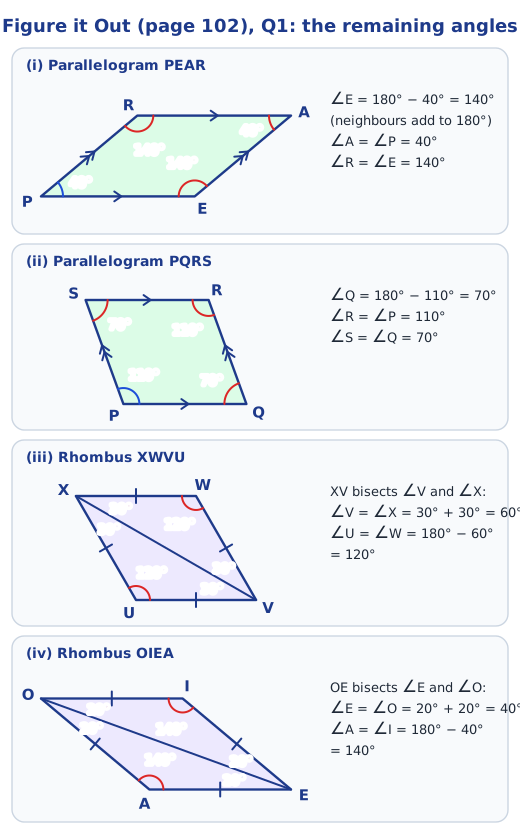
1. (i) PEAR is a parallelogram with ∠P = 40°. Neighbouring angles add up to 180°, so ∠E = 140°, ∠A = 40° and ∠R = 140°.
(ii) PQRS is a parallelogram with ∠P = 110°, so ∠Q = 70°, ∠R = 110° and ∠S = 70°.
(iii) All sides are equal, so it is a rhombus, and the diagonal XV bisects the angles at X and V. ∠XVU = 30°, so ∠XVW = 30° and ∠V = 60°. ∠X = ∠V = 60°, with ∠UXV = ∠WXV = 30°. Then ∠U = ∠W = 180° − 60° = 120°.
(iv) OIEA is a rhombus with ∠OEA = 20°. The diagonal OE bisects the angles at O and E, so ∠OEI = ∠AOE = ∠EOI = 20° and ∠E = ∠O = 40°. Then ∠A = ∠I = 180° − 40° = 140°.
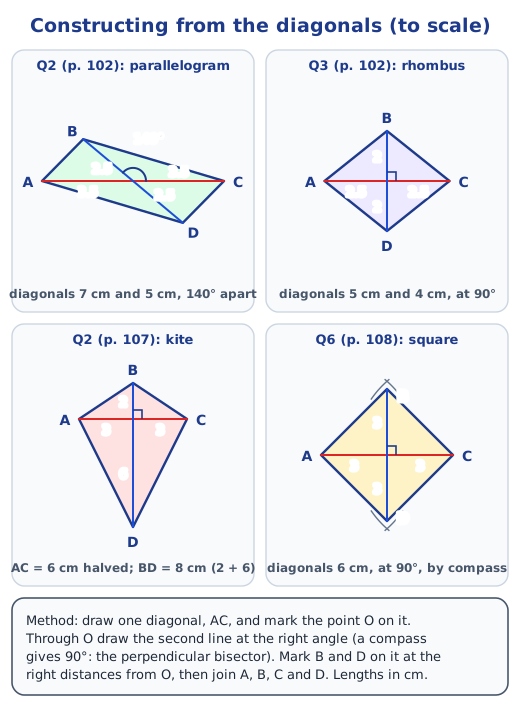
2. A parallelogram’s diagonals bisect each other. Draw AC = 7 cm and mark its midpoint O (3.5 cm from each end). Draw a line through O at 140° to OC. Mark B and D on it, 2.5 cm from O on each side. Join A, B, C and D: a parallelogram, since its diagonals bisect each other.
3. A rhombus has diagonals that bisect each other at 90°. Draw AC = 5 cm and construct its perpendicular bisector, meeting AC at its midpoint O. Mark B and D on it, 2 cm from O on each side. Join A, B, C and D. The four right triangles round O are congruent (SAS), so all four sides are equal, about 3.2 cm when measured: a rhombus.
Playing with quadrilaterals (pages 103–105)
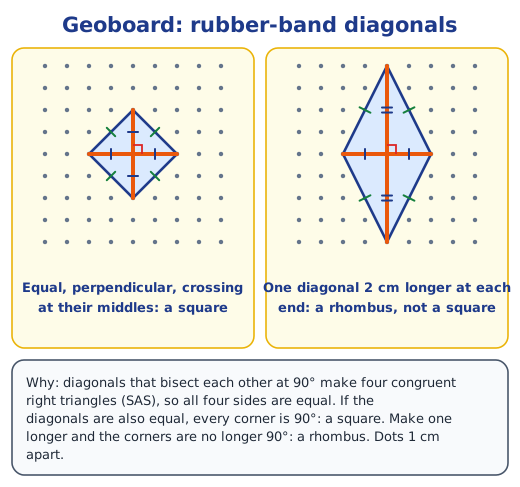
Geoboard: equal, perpendicular rubber bands crossing at their middles (as in the picture). What do you get? A square. The diagonals are equal and bisect each other, so it is a rectangle, and the four right triangles round the centre are congruent (SAS), so all sides are equal.
One diagonal extended by 2 cm at each end. What now? A rhombus that is not a square. The diagonals still bisect each other at 90°, so the four triangles are still congruent and the sides are equal, but the diagonals are no longer equal, so the corners are no longer 90°.
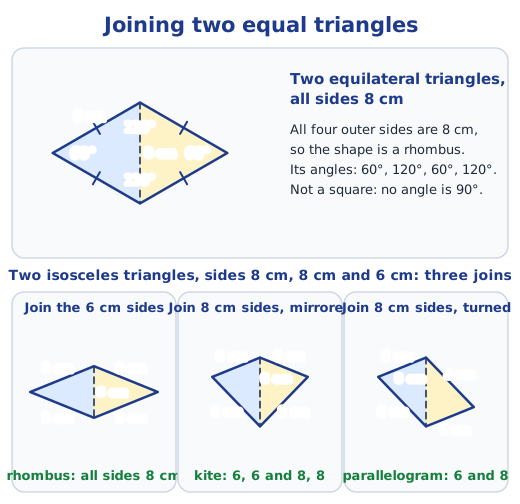
Joining triangles 1: two equilateral triangles of side 8 cm. Join them along a side. All four outer sides are 8 cm, so the shape is a rhombus. Its angles are 60°, 120°, 60° and 120° (each 120° corner is made of two 60° angles), so it is not a square.
Joining triangles 2: two isosceles triangles with sides 8 cm, 8 cm and 6 cm. There are three different results.
- Join the 6 cm sides: all four outer sides are 8 cm, a rhombus.
- Join 8 cm sides, the second triangle a mirror image: the sides go 6, 6, 8, 8, with equal sides meeting, a kite.
- Join 8 cm sides, the second triangle turned round: opposite sides are 6 cm and 8 cm, a parallelogram (opposite sides equal).
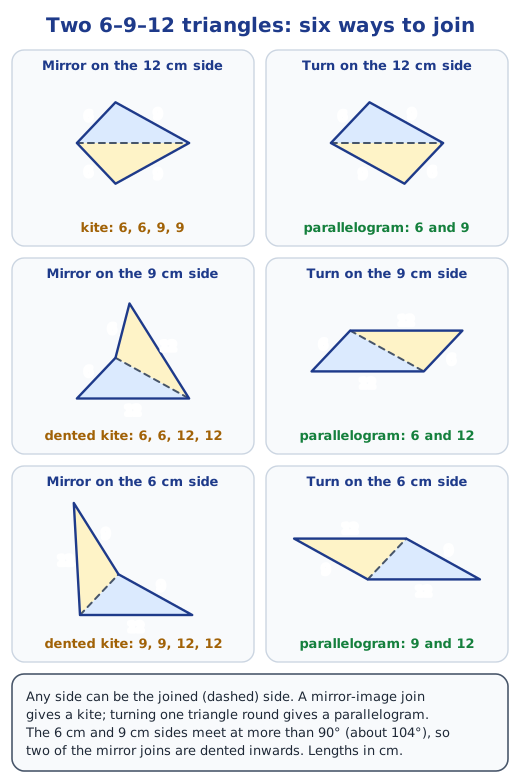
Joining triangles 3: two triangles whose sides are 6 cm, 9 cm and 12 cm. Any of the three sides can be joined, and the second triangle can be a mirror image or turned round, so there are six ways.
- Mirror images give kites: joined on the 12 cm side, sides 6, 6, 9 and 9; on the 9 cm side, sides 6, 6, 12 and 12; on the 6 cm side, sides 9, 9, 12 and 12. The last two are dented inwards, because the angle between the 6 cm and 9 cm sides is more than 90° (about 104° when measured), so doubling it gives more than 180°.
- Turned round, opposite sides are equal, so they are parallelograms: with sides 6 and 9, 6 and 12, or 9 and 12.
Kites and trapeziums (pages 105–107)
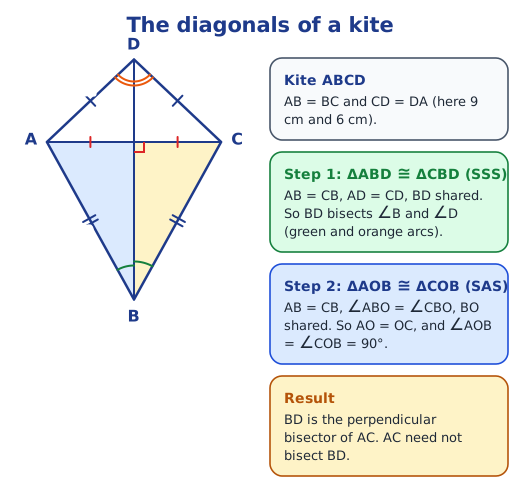
Kite, Property 1: show that BD bisects ∠ABC and ∠ADC, bisects AC and is perpendicular to it. In ΔABD and ΔCBD, AB = CB, AD = CD and BD is shared, so they are congruent by SSS. Hence ∠ABD = ∠CBD and ∠ADB = ∠CDB: BD bisects ∠ABC and ∠ADC. Now in ΔAOB and ΔCOB, AB = CB, ∠ABO = ∠CBO and BO is shared, so they are congruent by SAS. Hence AO = OC, and ∠AOB = ∠COB; together they make 180°, so each is 90°.
Construct a trapezium, measure its base angles and find the other two without measuring. Draw SR, then a line through P parallel to SR, and mark Q on it. Since PQ ∥ SR, ∠S + ∠P = 180° and ∠R + ∠Q = 180°. For example, if ∠S = 70° and ∠R = 50°, then ∠P = 110° and ∠Q = 130°; measuring confirms it.
How do we draw an isosceles trapezium UVWX in which UV ∥ XW? Draw UV and a line parallel to it. With the compass at the same opening, cut that line from U and from V to get X and W, so that UX = VW. Take X near U and W near V, so that the sides lean towards each other; otherwise you get a parallelogram.
Can the remaining angles be found without measuring? Are ∠U and ∠V equal? Yes. Measure ∠U; then ∠V = ∠U, and ∠X = ∠W = 180° − ∠U.
What type of quadrilateral is XWZY? A rectangle: the angles at Y and Z are 90°, and since XW ∥ UV, the angles at X and W are 180° − 90° = 90°.
How is ΔUXY ≅ ΔVWZ? By RHS: both have a right angle (at Y and Z), the hypotenuses UX and VW are equal, and XY = WZ (opposite sides of the rectangle XWZY). So ∠U = ∠V.
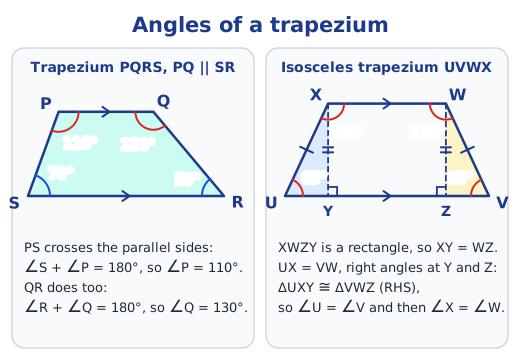
Figure it Out (pages 107–109)
1. Joining two equilateral triangles of side 4 cm along a side gives a rhombus with all sides 4 cm. Its angles are 60°, 120°, 60° and 120°: each 120° corner is two 60° angles together.
2. In a kite, one diagonal is the perpendicular bisector of the other. Draw AC = 6 cm and its perpendicular bisector, meeting AC at O. Mark B on the bisector 2 cm from O, and D on the other side 6 cm from O, so that BD = 8 cm. Join A, B, C and D: AB = CB and AD = CD, a kite. (Any split of the 8 cm other than 4 + 4 works; 4 + 4 gives a rhombus. You can also let the 8 cm diagonal be the one that is halved.)
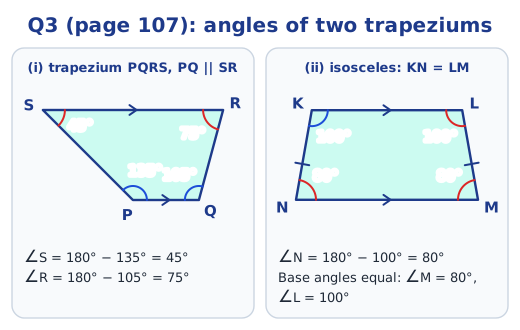
3. (i) The parallel sides are the top and bottom. Each slanting side’s two angles add up to 180°, so the angle above 135° is 180° − 135° = 45°, and the angle above 105° is 180° − 105° = 75°.
(ii) The tick marks show that the two slanting sides are equal: an isosceles trapezium. Along the slanting side that starts at the 100° angle, the other angle is 180° − 100° = 80°. In an isosceles trapezium the two angles on the same parallel side are equal, so the corner beside the 100° angle, on the same parallel side, is also 100°, and the fourth corner is 80°. Check: 100° + 100° + 80° + 80° = 360°.
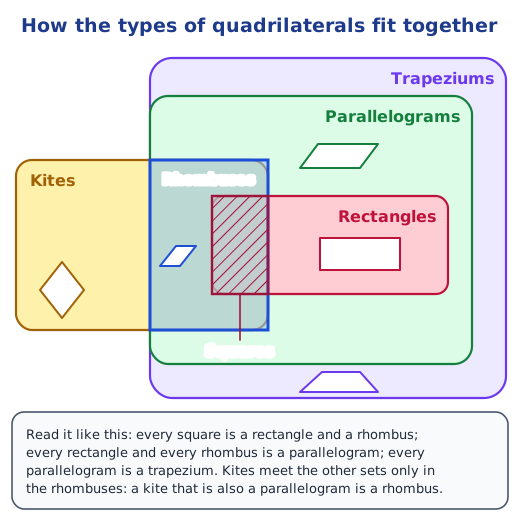
4. In the Venn diagram, rectangles and rhombuses are two overlapping regions inside the parallelograms, and squares fill their overlap. Kites form another region that overlaps the parallelograms exactly in the rhombuses.
(i) If a quadrilateral is a kite and also a parallelogram, it is a rhombus (squares included). A kite has AB = BC and CD = DA, and a parallelogram has AB = CD and BC = DA, so all four sides are equal.
(ii) Yes, a square, and only a square. A rectangle has AB = CD and BC = DA, so a kite that is a rectangle has four equal sides and four right angles.
(iii) No. A kite needs only two pairs of equal neighbouring sides, such as 6, 6, 9 and 9. But every rhombus is a kite: the rhombuses are a part of the kites.
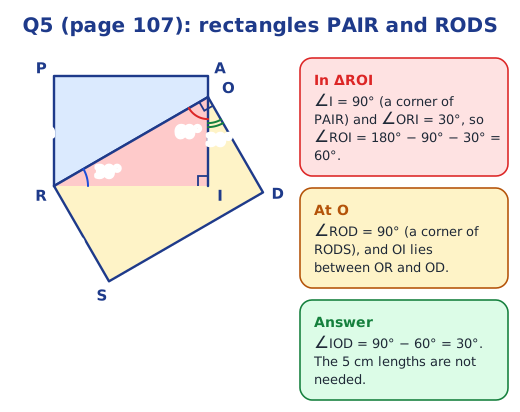
5. In ΔROI, ∠RIO = 90° (a corner of rectangle PAIR) and ∠ORI = 30°, so ∠ROI = 180° − 90° − 30° = 60°. ∠ROD = 90° (a corner of rectangle RODS), and OI lies between OR and OD. So ∠IOD = 90° − 60° = 30°. The 5 cm lengths are not needed.
6. Draw AC = 6 cm. Open the compass to more than 3 cm and draw arcs from A and from C on both sides of AC; join the two crossing points. This perpendicular bisector meets AC at O. With the compass at 3 cm, mark B and D on it on each side of O. Join A, B, C and D. The diagonals are equal (6 cm), bisect each other and are at 90°, so ABCD is a square. No protractor is needed.
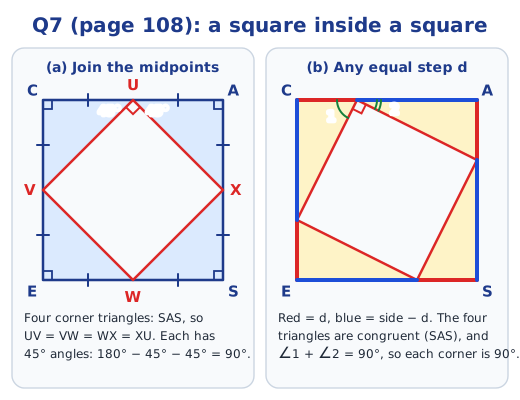
7. UVWX is a square. Each corner triangle, such as CUV, has two sides equal to half the side of CASE with a right angle between them, so the four corner triangles are congruent (SAS) and UV = VW = WX = XU. Each corner triangle is also isosceles with a right angle, so its other two angles are 45°. At U, ∠VUX = 180° − 45° − 45° = 90°, and the same holds at every corner. Measuring confirms four equal sides and four right angles.
Other squares: mark a point the same distance d from each corner of the outer square, always moving the same way round. The four corner triangles are again congruent (SAS: sides d and side − d with a right angle between), so the inner sides are equal. At each inner corner the two triangle angles, ∠1 and ∠2, are the two acute angles of one right triangle, so ∠1 + ∠2 = 90° and the inner angle is 180° − 90° = 90°. Every choice of d gives a square.
8. Yes. Four equal sides make it a rhombus, which is a parallelogram. Neighbouring angles of a parallelogram add up to 180°, so the angles next to the 90° angle are 90°, and the opposite angle equals it, 90°. Four equal sides and four right angles: a square. Construct one with sides 5 cm and a 90° angle to check that all angles measure 90°.
9. It is a parallelogram. In ABCD let AB = CD and BC = DA, and draw the diagonal AC. ΔABC and ΔCDA have AB = CD, BC = DA and the shared side AC, so they are congruent by SSS. Hence ∠BAC = ∠DCA; these are alternate angles for AB and DC with AC crossing them, so AB ∥ DC. Also ∠BCA = ∠DAC, so BC ∥ AD. Both pairs of opposite sides are parallel.
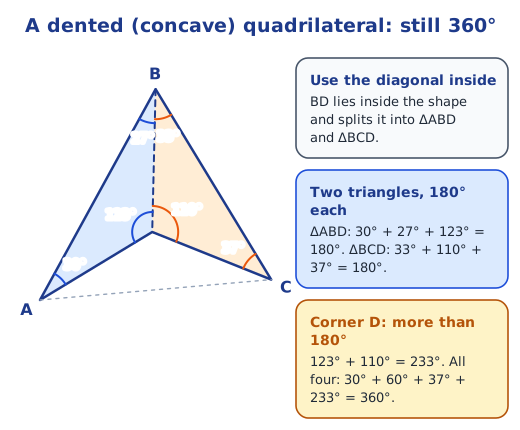
10. Yes, the sum is still 360°. In the dented quadrilateral ABCD, the diagonal AC lies outside, but BD lies inside and splits the shape into ΔABD and ΔCBD. The angles of each add up to 180°. ∠B is made of one angle from each triangle, and the angle at D inside the shape (more than 180°) is made of the other two, so ∠A + ∠B + ∠C + ∠D = 180° + 180° = 360°. A drawing measured with a protractor gives, for example, about 30°, 60°, 37° and 233°, which add up to 360°.
11. (i) False. Such diagonals give a rectangle, which need not be a square; a 6 cm × 3 cm rectangle has equal diagonals that bisect each other.
(ii) True. The fourth angle is 360° − 3 × 90° = 90°, so all four angles are 90°.
(iii) True. If AC and BD bisect each other at O, then ΔAOB ≅ ΔCOD (SAS: OA = OC, OB = OD, vertically opposite angles), so ∠OAB = ∠OCD and AB ∥ CD (alternate angles). In the same way ΔAOD ≅ ΔCOB gives AD ∥ BC.
(iv) False. A kite such as the 6, 6, 9, 9 one has perpendicular diagonals but unequal sides. For a rhombus the diagonals must also bisect each other.
(v) True. If ∠A = ∠C = x and ∠B = ∠D = y, then 2x + 2y = 360°, so x + y = 180°. ∠A + ∠B = 180° gives AD ∥ BC, and ∠A + ∠D = 180° gives AB ∥ DC.
(vi) True. Four equal angles adding up to 360° are 90° each.
(vii) False. An isosceles trapezium has only one pair of parallel sides; its equal sides lean towards each other, as in UVWX, so it is not a parallelogram.
Puzzle Time: Which Quad? (page 111)
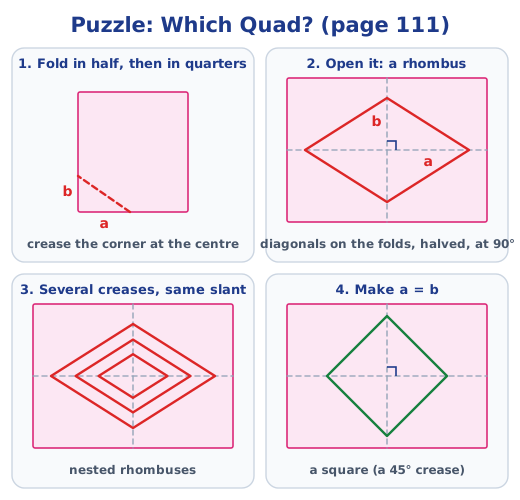
4. What shape do the creases make? A rhombus. The two folds of the sheet are perpendicular lines through its centre. The crease cuts them at the same distances from the centre in all four layers, so it opens into a quadrilateral whose diagonals lie on the folds: they bisect each other at 90°.
5. Many rhombuses one inside another. Fold the quarter sheet as before, but make several creases across the middle corner, all with the same slant and at different distances from the corner. Each opens into a rhombus, one inside the next.
6. A square. Make the crease cut off equal lengths along the two folded edges (a crease at 45°). Then the diagonals are equal as well as perpendicular, and the shape is a square.
Practice
-
The diagonals of a quadrilateral bisect each other at right angles but are not equal. The quadrilateral is a:
Show answer
Answer: (b) rhombus that is not a square
-
In a parallelogram, one angle is 4 times its neighbouring angle. The smaller angle is:
Show answer
Answer: (a) 36°
-
In isosceles trapezium KLMN, KL ∥ NM, KN = LM and ∠N = 70°. What is ∠L?
Show answer
Answer: (b) 110°
-
The diagonals of rectangle ABCD meet at O, and ∠AOB = 100°. Find ∠OAB.
Show answer
Answer: OA = OB, because the diagonals are equal and bisect each other. So ∠OAB = (180° − 100°) ÷ 2 = 40°.
-
Two angles of a quadrilateral are 70° and 110°, and the other two are equal. Find them.
Show answer
Answer: The four angles add up to 360°, so the other two add up to 360° − 70° − 110° = 180°. Each is 180° ÷ 2 = 90°.
Stuck on a question?
Take a photo and Lagnever AI explains it step by step. Try it for 7 days for ₹2.
Get it on Google Play Open in browser
For parents: after the trial, the plan renews monthly by UPI or card autopay. You can cancel anytime in the app.