
Class 8 Maths Chapter 4: Quadrilaterals Notes
This chapter in five lines
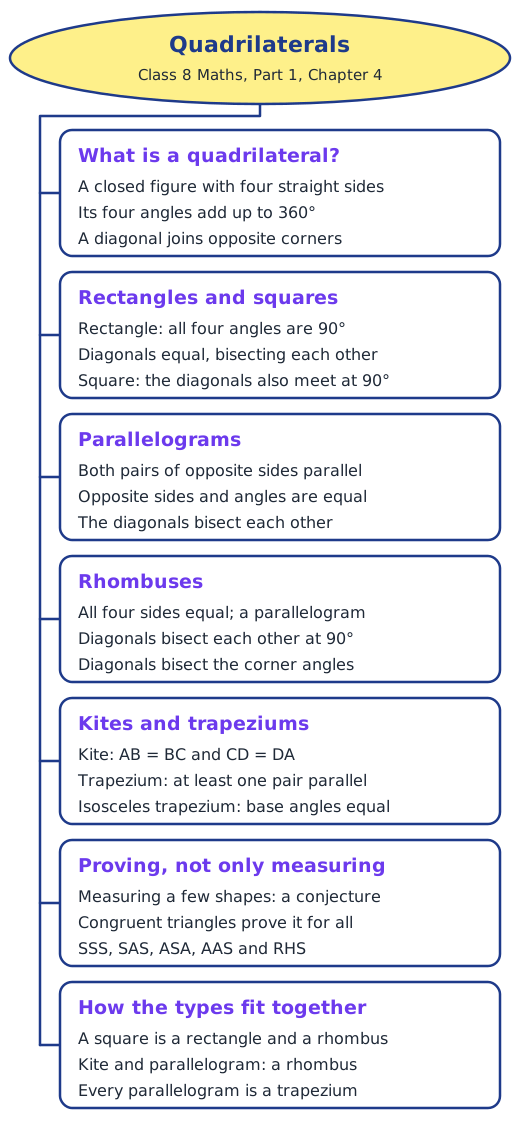
A quadrilateral is a closed figure with four straight sides, and its four angles always add up to 360°. The chapter defines rectangles, squares, parallelograms, rhombuses, kites and trapeziums, and proves their properties with congruent triangles instead of only measuring. Many proofs are about the diagonals: when they are equal, when they bisect each other and when they meet at 90°.
What is this chapter about?
This is the fourth chapter of Ganita Prakash, Grade 8 Part 1. It takes a close look at four-sided figures: rectangles, squares, parallelograms, rhombuses, kites and trapeziums. The aim is not just to list their properties but to prove them, mostly with congruent triangles, and then to use those properties to build shapes. The name comes from Latin: quadri means four and latus means side.
What is a quadrilateral?
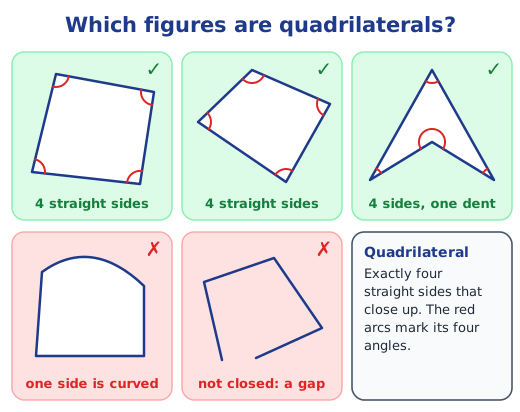
A quadrilateral is a closed figure made of exactly four straight sides. Its angles are the angles between neighbouring sides, one at each corner. A figure with a curved side, or with a gap, is not a quadrilateral. A quadrilateral can even be dented inwards, so that one of its angles is more than 180°. Read types of quadrilaterals.
Rectangles: the carpenter’s problem
A carpenter wants to cross two thin strips of wood so that a thread passed round their four ends makes a rectangle. The strips are the diagonals of that rectangle. Using congruent triangles, the chapter proves that a rectangle’s diagonals are equal and bisect each other, that is, they cross at their midpoints. It also proves the reverse: equal diagonals that bisect each other give a rectangle whatever the angle between them. So the strips must be equally long and joined at their middles. The chapter adds that carpenters in Europe and farmers in Mozambique, in Africa, use this very trick. Read diagonals of quadrilaterals.
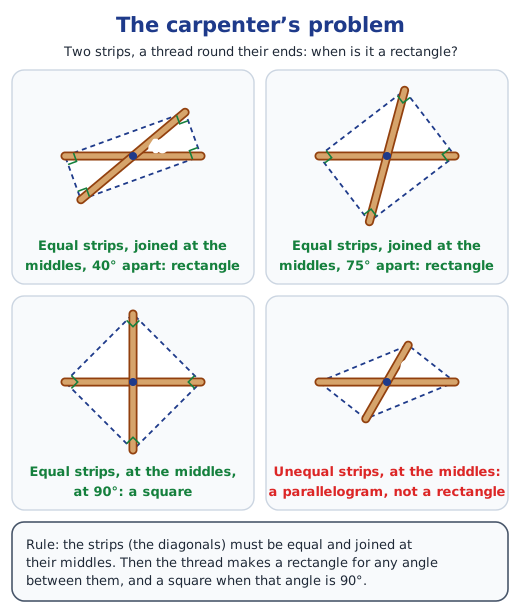
A rectangle needs only one condition: all four angles are 90°. A short proof shows that its opposite sides are then equal and parallel. A square is a rectangle whose four sides are also equal. Its diagonals meet at 90° and cut every corner into 45° + 45°.
Why prove, if we can measure?
Measuring a few rectangles can make us fairly sure that their diagonals bisect each other. But that is only a conjecture, because no one can measure every rectangle that could ever be drawn. A proof with congruent triangles settles the question for all of them at once. Measuring is still useful: it checks a proof, and it gives ideas when a proof is hard to find.
Why do the angles add up to 360°?
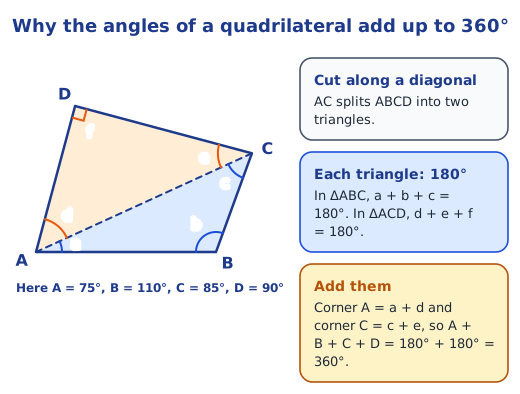
Draw a diagonal and the quadrilateral splits into two triangles. The angles of each add up to 180°, and together they fill the four corners, so the angles of every quadrilateral add up to 360°. This explains why a quadrilateral cannot have exactly three right angles. Read angles in a quadrilateral.
Parallelograms and rhombuses
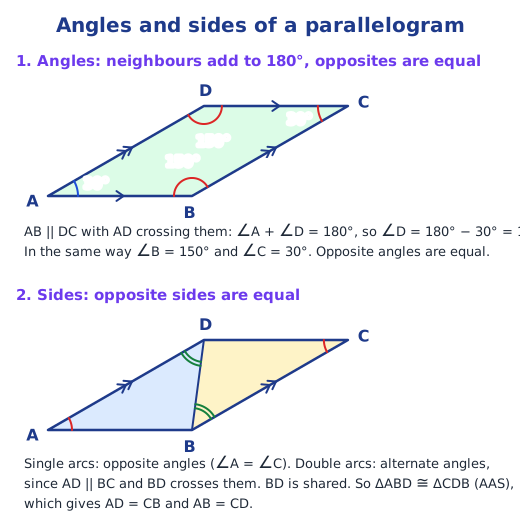
A parallelogram has both pairs of opposite sides parallel. Its opposite sides are equal, its opposite angles are equal, its neighbouring angles add up to 180°, and its diagonals bisect each other (but need not be equal). A rectangle is a special parallelogram. A rhombus has four equal sides. It turns out to be a parallelogram as well, and its diagonals bisect each other at 90° and split its angles into equal halves.
Kites and trapeziums
A kite ABCD has AB = BC and CD = DA. Its diagonal BD splits the angles at B and D into equal halves and is the perpendicular bisector of the other diagonal, AC. A trapezium needs only one pair of parallel sides, so the two angles along each slanting side add up to 180°. When its two non-parallel sides are equal, it is an isosceles trapezium, and its base angles are equal.
How do the types fit together?
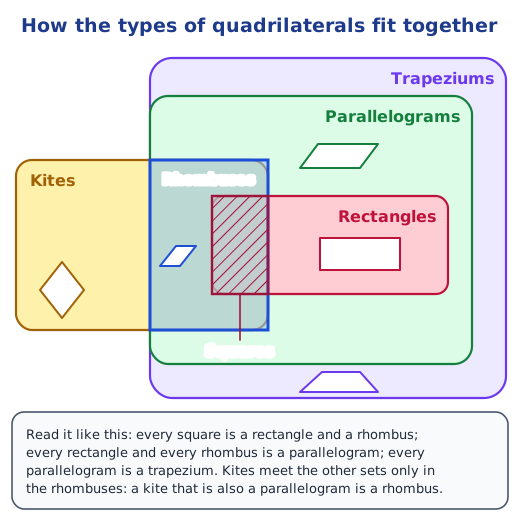
A Venn diagram shows the whole family. Every square is both a rectangle and a rhombus. Every rectangle and every rhombus is a parallelogram, and every parallelogram is a trapezium. Kites meet the parallelograms only in the rhombuses. The chapter also joins two equal triangles in different ways and gets rhombuses, kites and parallelograms.
Before we move on
The proofs use the congruence conditions from Class 7 (congruent triangles), the angles made by a transversal (transversal angles) and the angle sum of a triangle (triangle angle sum). Areas of these shapes come later, in Part 2, Chapter 7: Area. Answers to every question in this chapter, all three Figure it Out sets and the puzzle are in the NCERT solutions for Chapter 4.
Key terms
| Term | Meaning |
|---|---|
| Quadrilateral | A closed figure made of exactly four straight sides. It has four corners (vertices) and four angles. |
| Diagonal | A line segment joining two opposite corners of a quadrilateral. Every quadrilateral has two. |
| Bisect | To cut into two equal parts. Two diagonals bisect each other when they cross at their midpoints. |
| Rectangle | A quadrilateral whose four angles are all 90°. Its opposite sides then turn out to be equal and parallel. |
| Square | A quadrilateral with all four angles 90° and all four sides equal. Every square is a rectangle. |
| Parallelogram | A quadrilateral in which both pairs of opposite sides are parallel. |
| Rhombus | A quadrilateral whose four sides are all equal. Every rhombus is also a parallelogram. |
| Kite | A quadrilateral ABCD with AB = BC and CD = DA: two pairs of equal sides, each pair meeting at a corner. |
| Trapezium | A quadrilateral in which at least one pair of opposite sides is parallel. |
| Isosceles trapezium | A trapezium whose two non-parallel sides are equal. Its two base angles are equal. |
| Congruent triangles | Triangles of exactly the same shape and size. They can be shown congruent by SSS, SAS, ASA, AAS or RHS. |
| Conjecture | A statement we strongly believe from examples or measurements, but have not yet proved for every case. |
| Venn diagram | A picture that shows sets as closed regions, drawn inside or overlapping one another to show how they are related. |
Topics in this chapter
Practice
-
Three angles of a quadrilateral are 80°, 95° and 105°. What is the fourth angle?
Show answer
Answer: (b) 80°
-
Which quadrilateral always has diagonals that are equal and bisect each other?
Show answer
Answer: (c) Rectangle
-
One angle of a parallelogram is 65°. Going round, the other three angles are:
Show answer
Answer: (a) 115°, 65°, 115°
-
Which of these is NOT always true for a rhombus?
Show answer
Answer: (b) The diagonals are equal
-
A kite that is also a parallelogram must be a:
Show answer
Answer: (c) rhombus
-
In a square, what angle does a diagonal make with a side?
Show answer
Answer: (b) 45°
Questions students ask
What are the main topics of Class 8 Maths Chapter 4?
Rectangles and squares through the carpenter’s problem, the angle sum of a quadrilateral, parallelograms, rhombuses, kites and trapeziums, how these types fit together in a Venn diagram, and joining two triangles to make quadrilaterals. Most properties are proved with congruent triangles.
Is Quadrilaterals in the new NCERT Class 8 Maths book?
Yes. It is Chapter 4 of Ganita Prakash, Grade 8 Part 1, on pages 82 to 111 of the book marked Reprint 2026-27.
Is a square a rectangle?
Yes. A rectangle only needs four right angles, and a square has them, so every square is a rectangle. It is also a rhombus, because its four sides are equal. But most rectangles are not squares.
Why do the angles of a quadrilateral add up to 360°?
A diagonal cuts any quadrilateral into two triangles. The angles of each triangle add up to 180°, and together they make up the four corners, so the total is 180° + 180° = 360°.
Stuck on a question?
Take a photo and Lagnever AI explains it step by step. Try it for 7 days for ₹2.
Get it on Google Play Open in browser
For parents: after the trial, the plan renews monthly by UPI or card autopay. You can cancel anytime in the app.