
Angles in a quadrilateral: the 360° rule and the special shapes
Answer in short
The four angles of any quadrilateral add up to 360°, because a diagonal splits it into two triangles of 180° each; this works even for a dented shape. In a parallelogram, neighbouring angles add up to 180° and opposite angles are equal. In a trapezium, the two angles along each slanting side add up to 180°.
Stuck on a question? Take a photo and Lagnever AI explains it step by step. Try it for 7 days for ₹2. Get it on Google Play
Why do the angles of a quadrilateral add up to 360°?
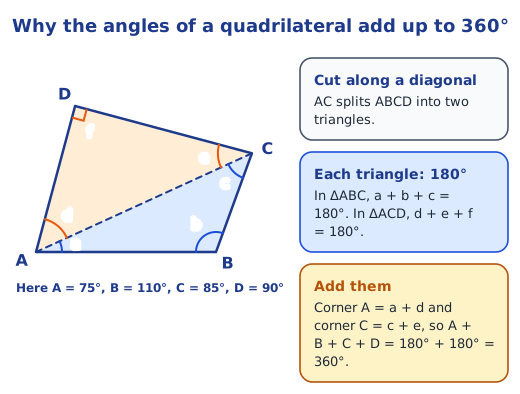
Take any quadrilateral ABCD and draw the diagonal AC. It cuts the shape into two triangles, ABC and ACD. In each triangle the three angles add up to 180°. Now look at the corners: the angle at B belongs to one triangle and the angle at D to the other, while the corners at A and C are each split into two parts, one in each triangle. So the six triangle angles together make exactly the four corners:
∠A + ∠B + ∠C + ∠D = 180° + 180° = 360°.
Does it work for a dented quadrilateral?
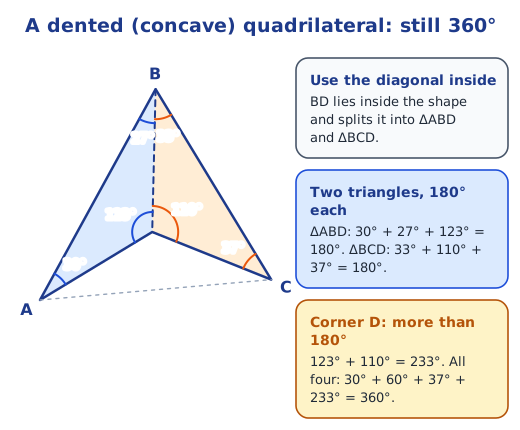
Yes. In a dented (concave) quadrilateral one diagonal falls outside the shape, so use the other one, which lies inside. It still splits the shape into two triangles. The corner at the dent is made of two triangle angles and is more than 180°, and the total is again 360°.
Why can a quadrilateral not have exactly three right angles?
If three angles are 90° each, they use up 270°. The fourth must be 360° − 270° = 90°. So a quadrilateral with three right angles has four, and is a rectangle.
What are the angles of a parallelogram?
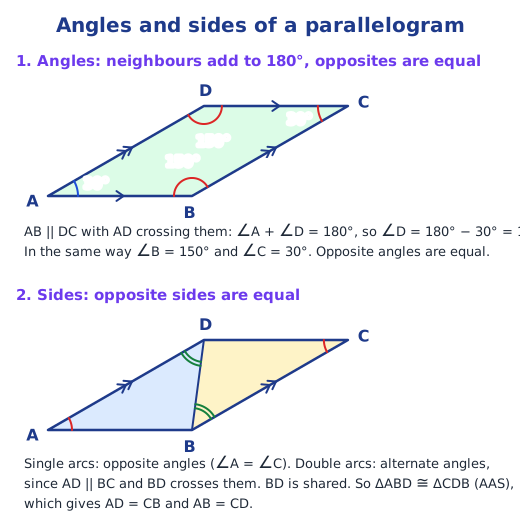
In parallelogram ABCD, AB ∥ DC and AD crosses both of them. The two angles on the same side of a crossing line between parallel lines add up to 180°, so ∠A + ∠D = 180°. The same holds for every pair of neighbouring angles.
Now let ∠A = x. Then ∠B = 180° − x, and ∠C = 180° − ∠B = 180° − (180° − x) = x. So opposite angles are equal and neighbouring angles add up to 180°. For example, if ∠A = 30°, the angles going round are 30°, 150°, 30° and 150°.
What about a rhombus and a square?
A rhombus is a parallelogram, so its angles follow the same rules. It also has one more: each diagonal cuts the two corners it joins into equal halves. Say ∠A = 50° in rhombus ABCD and draw the diagonal BD. Triangle ADB has AD = AB, so its base angles are equal: a + a + 50° = 180°, giving a = 65°. So ∠B = ∠D = 65° + 65° = 130°, and ∠C = 50°.
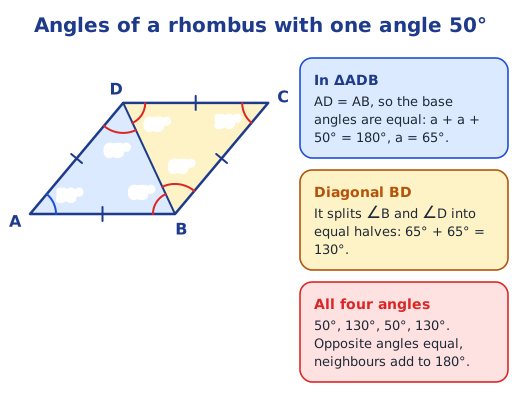
A square is a rhombus with right angles, so each diagonal cuts every 90° corner into 45° + 45°.
What about a trapezium?
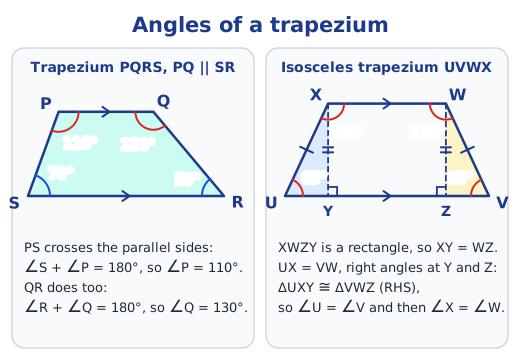
In trapezium PQRS with PQ ∥ SR, each slanting side crosses the two parallel sides, so ∠S + ∠P = 180° and ∠R + ∠Q = 180°. Measure the two angles at one parallel side and you can work out the other two.
In an isosceles trapezium UVWX (UV ∥ XW, UX = VW), draw XY and WZ perpendicular to UV. Then XWZY is a rectangle, so XY = WZ. The right-angled triangles UXY and VWZ have equal slanting sides and equal heights, so they are congruent by RHS, and ∠U = ∠V. The angles at the other parallel side are then equal too.
Read next: the chapter notes, types of quadrilaterals, diagonals of quadrilaterals and NCERT solutions.
Practice
-
Three angles of a quadrilateral are 90°, 90° and 90°. The fourth angle is:
Show answer
Answer: (b) 90°
-
In parallelogram ABCD, ∠A = 72°. What is ∠B?
Show answer
Answer: (b) 108°
-
One angle of a rhombus is 80°. What angle does the diagonal from that corner make with each side there?
Show answer
Answer: (c) 40°
-
In trapezium PQRS with PQ ∥ SR, ∠S = 62° and ∠R = 75°. Find ∠P and ∠Q.
Show answer
Answer: ∠P = 180° − 62° = 118° and ∠Q = 180° − 75° = 105°. Check: 62° + 75° + 118° + 105° = 360°.
-
Can a quadrilateral have angles of 100°, 100°, 100° and 70°? Why?
Show answer
Answer: No. They add up to 370°, but the angles of every quadrilateral add up to exactly 360°.
Questions students ask
What is the angle sum property of a quadrilateral?
The four angles of any quadrilateral add up to 360°. A diagonal splits it into two triangles, and the angles of the two triangles together make up the four corners: 180° + 180° = 360°.
Are opposite angles of a parallelogram equal?
Yes. If one angle is x, each neighbour is 180° − x, and the angle opposite is 180° − (180° − x) = x. So opposite angles are always equal.
Why are the base angles of an isosceles trapezium equal?
Draw perpendiculars from the two top corners to the bottom side. They make two right-angled triangles with equal slanting sides and equal heights, so the triangles are congruent by RHS, and the base angles match.
Does the 360° rule work for a dented (concave) quadrilateral?
Yes. Use the diagonal that lies inside the shape; it still splits it into two triangles. The angle at the dent is more than 180°, and the four angles still add up to 360°.
Stuck on a question?
Take a photo and Lagnever AI explains it step by step. Try it for 7 days for ₹2.
Get it on Google Play Open in browser
For parents: after the trial, the plan renews monthly by UPI or card autopay. You can cancel anytime in the app.