
Types of quadrilaterals: rectangle, square, parallelogram, rhombus, kite and trapezium
Answer in short
A quadrilateral is a closed figure with four straight sides. A rectangle has four right angles; a square also has four equal sides. A parallelogram has both pairs of opposite sides parallel, and a rhombus has four equal sides. A kite has two pairs of equal sides that meet, and a trapezium has at least one parallel pair.
Stuck on a question? Take a photo and Lagnever AI explains it step by step. Try it for 7 days for ₹2. Get it on Google Play
What is a quadrilateral?
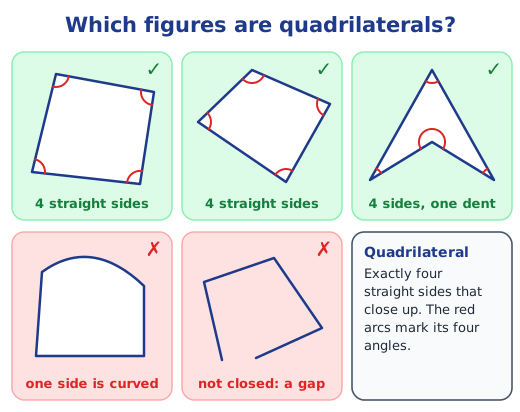
A quadrilateral is a closed figure made of exactly four straight sides (line segments). It has four corners, called vertices, and four angles: the angles between neighbouring sides. We name it by its corners in order, going round, as in ABCD. A figure with a curved side is not a quadrilateral, and neither is one with a gap. A quadrilateral may even be dented inwards; then the angle inside the dent is more than 180°.
What are the special quadrilaterals?
Each special type is defined by one simple condition:
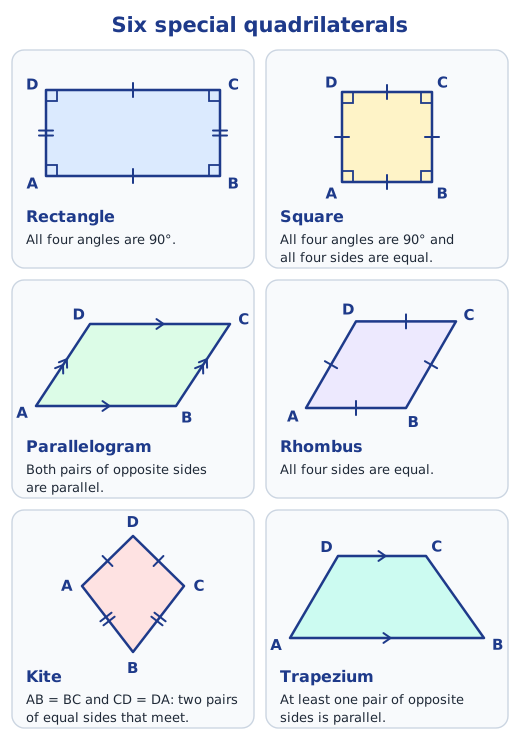
- Rectangle: all four angles are 90°. (Its opposite sides then come out equal and parallel; this can be proved.)
- Square: all four angles are 90° and all four sides are equal.
- Parallelogram: both pairs of opposite sides are parallel.
- Rhombus: all four sides are equal.
- Kite: it can be labelled ABCD so that AB = BC and CD = DA, two pairs of equal sides that meet.
- Trapezium: at least one pair of opposite sides is parallel. If its two non-parallel sides are equal, it is an isosceles trapezium.
In diagrams, small tick marks show equal sides, a small square shows a right angle, and arrowheads show parallel sides.
Why is a square also a rectangle?
A definition lists only what must be true. A rectangle must have four right angles, and nothing else. A square has four right angles, so it passes the test: it is a rectangle, a special one whose sides also happen to be equal. Think of fruit: every mango is a fruit, but not every fruit is a mango. In the same way, every square is a rectangle, but most rectangles are not squares.
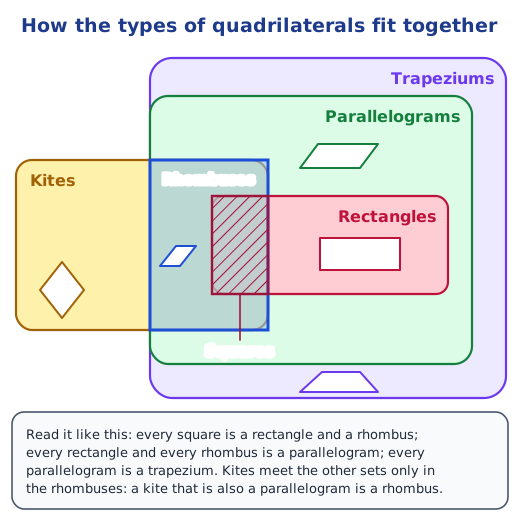
A Venn diagram shows this neatly. Each type of quadrilateral is a region, and a region drawn inside another means “every one of these is also one of those”.
How are rectangles and rhombuses related to parallelograms?
In a rectangle ABCD, the side AB crosses AD and BC, and ∠A + ∠B = 90° + 90° = 180°. When the two angles on the same side of a crossing line add up to 180°, the lines are parallel, so AD ∥ BC; in the same way AB ∥ DC. So every rectangle is a parallelogram.
In a rhombus, draw one diagonal. It makes two triangles that match side for side, and each of them is isosceles, so the four angles the diagonal makes with the sides are all equal. Those equal angles are alternate angles, which means the opposite sides are parallel. So every rhombus is a parallelogram too. A square is both a rectangle and a rhombus, so it sits where those two regions overlap.
Where do kites and trapeziums fit?
A rhombus has all four sides equal, so it certainly has AB = BC and CD = DA: every rhombus is a kite. If a kite is also a parallelogram, its opposite sides are equal as well, which makes all four sides equal: it is a rhombus. A kite that is also a rectangle must be a square.
A trapezium only needs one parallel pair. A parallelogram has two, so every parallelogram is a trapezium, but a trapezium with exactly one parallel pair is not a parallelogram. An isosceles trapezium, for example, has its equal sides leaning towards each other.
What do you get by joining two equal triangles?
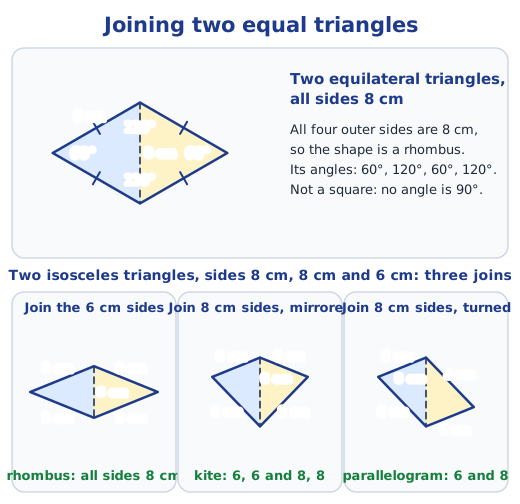
Join two equal triangles edge to edge, with matching sides together. Two equilateral triangles always give a rhombus with angles 60° and 120°. Two isosceles triangles with sides 8 cm, 8 cm and 6 cm can give a rhombus, a kite or a parallelogram, depending on which sides you join and whether the second triangle is flipped over or turned round.
Read next: the chapter notes, angles in a quadrilateral, diagonals of quadrilaterals and NCERT solutions.
Practice
-
Which of these is always a parallelogram?
Show answer
Answer: (c) A rhombus
-
A quadrilateral has all four sides equal and a 90° angle. It is a:
Show answer
Answer: (b) square
-
Which statement is true?
Show answer
Answer: (c) Every parallelogram is a trapezium
-
Two equilateral triangles of side 5 cm are joined along a side. Name the quadrilateral and give its angles.
Show answer
Answer: It is a rhombus with all sides 5 cm. Its angles are 60°, 120°, 60° and 120°, so it is not a square.
-
Can a kite be a rectangle? Explain.
Show answer
Answer: Only if it is a square. A rectangle has AB = CD and BC = DA, and a kite has AB = BC and CD = DA. Together these make all four sides equal, and with four right angles that is a square.
Questions students ask
What are the types of quadrilaterals in Class 8?
The chapter studies rectangles, squares, parallelograms, rhombuses, kites and trapeziums, including isosceles trapeziums. Each type is defined by a condition on its sides or angles, and one shape can belong to several types at once.
Is a rhombus a square?
Not always. A rhombus only needs four equal sides. It is a square only when its angles are also 90°. But every square is a rhombus.
What is the difference between a parallelogram and a trapezium?
A parallelogram has both pairs of opposite sides parallel. A trapezium needs only one parallel pair, so every parallelogram counts as a trapezium, but most trapeziums are not parallelograms.
What is a kite in maths?
A quadrilateral ABCD with AB = BC and CD = DA: two pairs of equal sides, each pair meeting at a corner. A rhombus is a special kite, with all four sides equal.
Stuck on a question?
Take a photo and Lagnever AI explains it step by step. Try it for 7 days for ₹2.
Get it on Google Play Open in browser
For parents: after the trial, the plan renews monthly by UPI or card autopay. You can cancel anytime in the app.